Last week, a new client and I were going through her wardrobe. She proudly pulled out three shiny blouses: "Look, Olena, I snagged 100% silk on sale for only $150 each!" I picked up the fabric, closed my eyes, gave it a gentle squeeze—and realized we'd been cleverly tricked. What we saw was gorgeous, incredibly high-quality, but still polyester. And the client was shocked: visually, the items looked flawless.

We discussed the basic differences between fabrics in more detail in our a complete guide to identifying natural silk But today I want to give you some hard, practical tools. In my 14 years as a stylist, I've seen hundreds of counterfeits. The modern textile industry has advanced so far that visual inspection is no longer enough. Today we'll look at how to test fabrics right in the boutique without damaging your items, why grandma's ring test no longer works, and, of course, we'll discuss in detail how to test silk with a lighter at home to ensure 100% authenticity.
The illusion of luxury: why are we so easily deceived?
According to McKinsey's State of the Fashion Industry (2024) report, the share of high-tech synthetic fibers in the premium apparel market has grown by 42% over the past five years. Factories have learned to create polyester and viscose that are visually indistinguishable from natural silk. They flow just as smoothly, shimmer in the light just as brightly, and even cost almost as much as the original.
Mass-market and even mid-market brands actively use misleading terms. You've probably seen price tags labeled "Armani silk," "rayon," "silky touch," or "eco-silk." Remember: these terms have nothing to do with real silk. The infamous "Armani silk" is a trade name for a fabric made of 97% polyester and 3% spandex. It sounds luxurious, but in reality, you're buying a petroleum product.
The problem with synthetics isn't just the price. Natural silk is a protein fiber (fibroin). It can absorb up to 30% of its own weight in moisture while remaining completely dry to the touch. Wearing a polyester blouse on a hot day will make you feel like you're in a personal sauna within 15 minutes. That's why it's important to be able to distinguish the real thing.
The Ultimate Crash Test: How to Test Silk with a Lighter at Home
If you've already purchased the item or are ordering vintage items online and have the opportunity to test it at home, fire remains the only 100% reliable method. You can't fool chemistry: protein burns completely differently than plastic or cellulose.
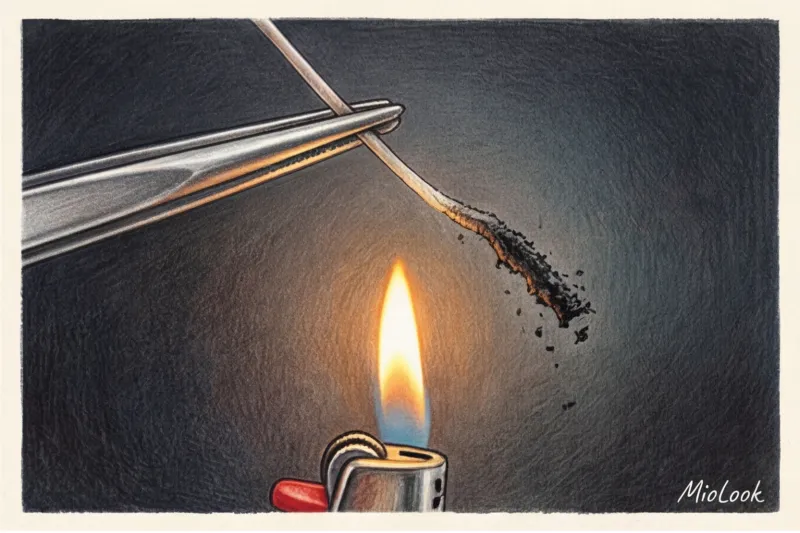
Here's my personal step-by-step guide on how to test silk with a lighter without damaging the item. I often use this method when buying expensive vintage items:
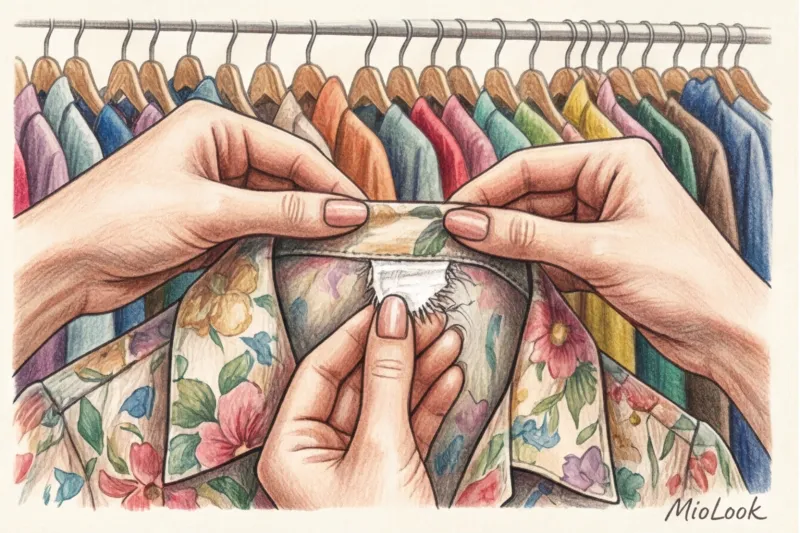
- Find a safe place: Turn the garment inside out. Find the inside seam (preferably at the hem or armhole) where there is a small fabric allowance (overlock).
- Obtain a sample: Take tweezers and carefully pull 2-3 threads from the very edge of the seam allowance. This will be more than enough.
- Set fire to: Take the threads with tweezers and hold a lighter flame to them. Carefully observe, smell, and touch the result.
Stylist's note: Natural silk burns only while it's in the flame. As soon as you remove the lighter, the thread will instantly go out. The smell will be sharp and distinctive—natural silk smells like burnt hair or singed feathers. What remains on the tweezers will be a fragile black ball that can easily be crushed into a fine dust by your fingers.
Now about how counterfeits burn:
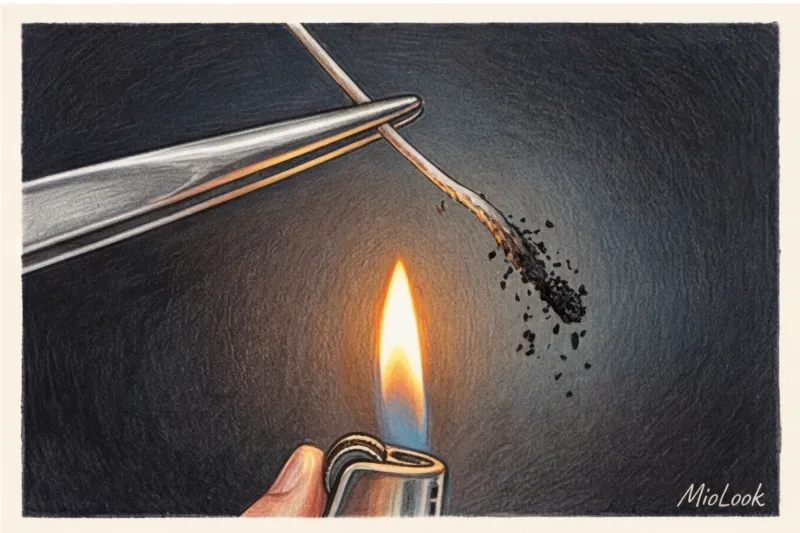
- Polyester: It melts, produces black smoke, and continues to burn even when not in contact with a flame. It smells like burnt plastic or a sweetish chemical. It leaves behind a hard plastic lump that's impossible to rub off (it'll just scratch your fingers).
- Viscose and cotton: They ignite instantly, burning brightly and quickly. They smell like burnt paper or autumn leaves, leaving a light gray ash.
Fair warning: This test fails only in one case: if you're using a blended fabric (for example, 70% silk and 30% polyester). In this case, the thread will smell like burnt hair but will leave behind a hard plastic residue. Be careful with the residue!
Your perfect wardrobe without mistakes
Stop wasting money on things that don't flatter you. Add your purchases to your virtual wardrobe and create iconic looks in just a few clicks.
Get access — €0.99 onceStylist's Secrets: How to Spot Real Silk in the Store (Without the Fire)
Obviously, no one will allow you to set fire to clothes in a boutique. How can you test fabric in the field, standing in front of a mirror in a fitting room? During shopping tours, I always teach clients to trust their tactile and auditory senses, not their eyes.
Temperature and touch test
Silk has exceptional thermal conductivity. Place the fabric on your cheek or the inside of your wrist (the skin is most sensitive there). Natural silk will instantly—in 1-2 seconds—accept your body temperature. It will no longer feel like a foreign object. Synthetics, on the other hand, will always remain slightly cool, but after a couple of minutes, it will create an unpleasant "greenhouse" effect.

My second favorite technique is the “crunch” test (in the textile industry it’s called scroop ). Take the fabric in both hands and rub the layers together, or simply squeeze them in a fist near your ear. Natural silk makes a distinctive, barely perceptible sound, similar to the crunch of freshly fallen snow on a frosty day. Polyester glides absolutely silently, while viscose produces a dull rustle.
Wrinkle and drape test
Squeeze the hem of your blouse in your fist for 5-7 seconds, then release. Look at the creases:
- Natural silk: It will leave soft, smooth folds that will gradually begin to come apart under the weight of the fabric.
- Viscose (especially budget): It will become covered with sharp, hard creases, like chewed paper, and they will not go away.
- Polyester: It will instantly straighten out like a spring, leaving no traces at all.
Pay attention to how the thing behaves dynamically. If you want look expensive , you need the right drape. Silk flows and has a pleasant weight, hugging the figure. Synthetics often become staticky (stick to tights) and become stiff where they should be soft.
Popular myths: which home remedies no longer work
If you open articles online written 10 years ago, you'll find a ton of "proven" life hacks. Speaking as a practicing stylist, I say: forget them. Today, they'll only harm you and force you to buy a fake for an exorbitant price.
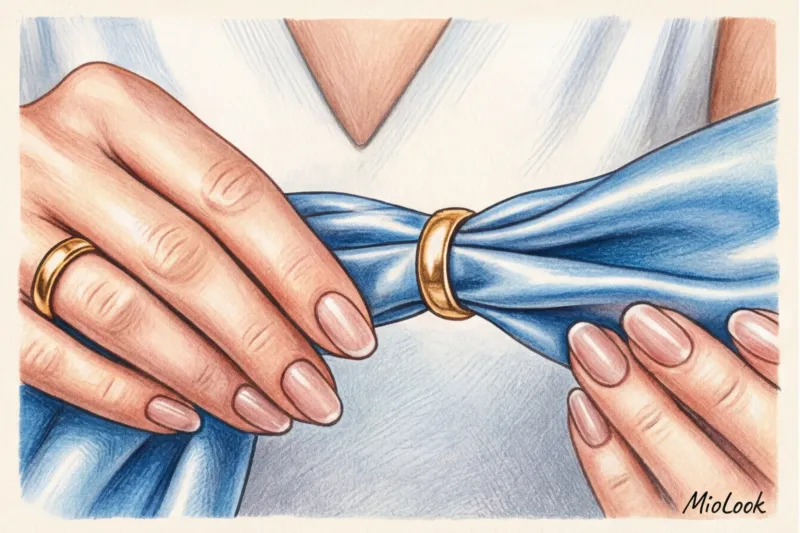
The main myth is wedding ring test It was believed that only natural silk could slip smoothly and snaglessly through a narrow metal ring. Guess what? Modern cupro (premium viscose) and thin micropolyester pass through the ring as easily as water through your fingers. This test is completely useless for modern fabrics.
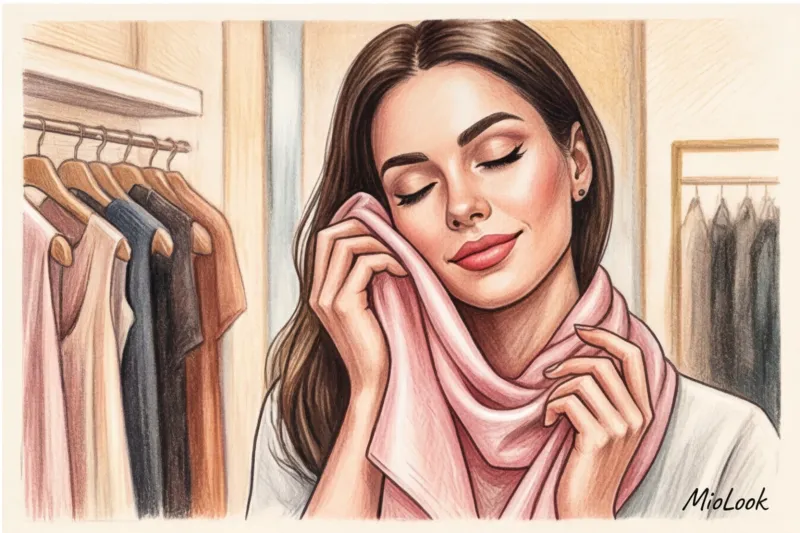
The second myth is silky shine It's generally accepted that natural silk has a unique sheen. Indeed, historically, silk reflected light in a multifaceted, pearly way, while synthetics had a cheap, glassy sheen. But today, technologies exist for matting synthetic fibers. Moreover, natural silk itself can be matte (for example, silk crêpe de chine, crepe de chine, or washed silk). Judging a fabric solely by its sheen is a recipe for disappointment.
Build the perfect capsule
Upload photos of your silk blouses and skirts into the app. Artificial intelligence will suggest dozens of new combinations using your own items.
Get access — €0.99 onceReading the Label Like an Expert: What is Momme and Why It Matters
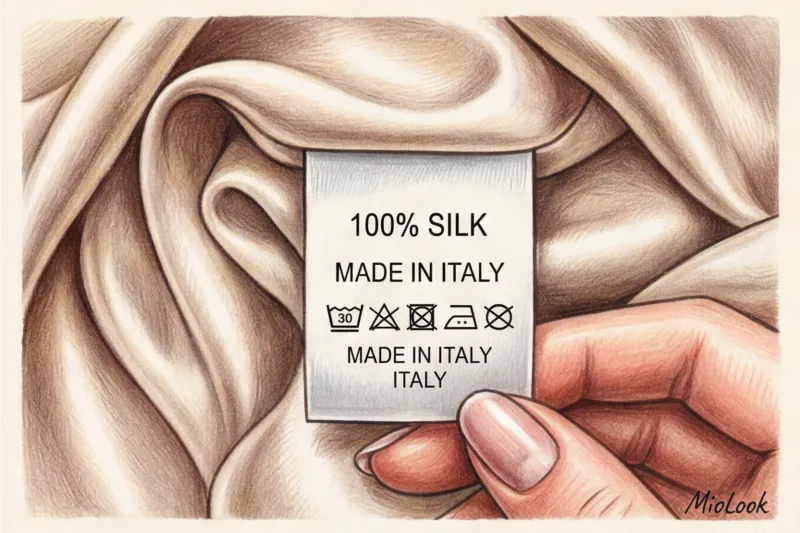
Even if the label honestly says "100% Silk," that doesn't mean the item is worth buying. Have you ever noticed how some silk tops literally fall apart at the seams after wearing them twice? The problem lies in the density of the fabric.
Unlike cotton, whose density is measured in grams per square meter, silk density is measured in mommy (abbreviated mm) One momme is equal to approximately 4.34 grams per square meter. This is the international quality standard you should use as a guide.
How to read this indicator:
- 8–12 mm: A very thin, translucent silk (chiffon, georgette). Suitable only for lightweight scarves. If you use it for a tight-fitting blouse, the seams will come undone at the first awkward movement. Don't buy this as a wardrobe staple.
- 14–19 mm: An ideal standard for clothing. This silk is used to make high-quality blouses, shirts, and lightweight slip skirts. The fabric is opaque, durable, and has a beautiful drape.
- 22–30 mm: A heavy, luxurious fabric. Used for suits, evening gowns, and fine bedding. Items made from this silk last for decades.
A separate trick of the manufacturers is the inscription Silk Blend (silk blend). If the brand conceals the exact percentages on the main tag, rest assured: it's 5% silk and 95% viscose. Always look for the inner sewn-in label in the side seam—only there, by law, is the exact fiber composition stated.
Checklist: 5 steps to buying a prestigious silk item
Buying natural silk is always an investment. To avoid disappointment, here's my short shopping checklist:
- Check the side label: look for 100% silk (or soie, seta) and a density rating of at least 14 mm.
- Place the cloth on your cheek in the fitting room. It should feel warm within a few seconds.
- Lightly rub the fabric near your ear – look for that “snowy crunch.”
- Squeeze the hem in your fist to make sure the fabric doesn't spring back like a spring (a sign of polyester) or become covered in papery creases (a sign of viscose).
- If you're buying vintage or unsure about the composition of your home, pull the thread out of your overlocker and set it on fire. The smell of scorched hair and crumbly ash will confirm its authenticity.
As a stylist, I always tell my clients one thing: it's better to buy one perfect 100% silk shirt with a 19mm density than three polyester versions from Zara that will be covered in snags within a season. The quality of the fabric is perceived by others on a subconscious level. Natural silk conveys status, confidence, and self-respect.
To make your investment work for you every day, you need to style your pieces correctly. Add your best finds to your wardrobe. MioLook — and our smart AI stylist will help you fit your new silk garment into dozens of casual and business looks, calculating the cost-per-wear ratio for you. Choose quality, wear it with pleasure, and don't be fooled!
Ready to get started?
Try a free plan—no commitments required. Organize your wardrobe and get ready-made looks for every day.
Get access — €0.99 once