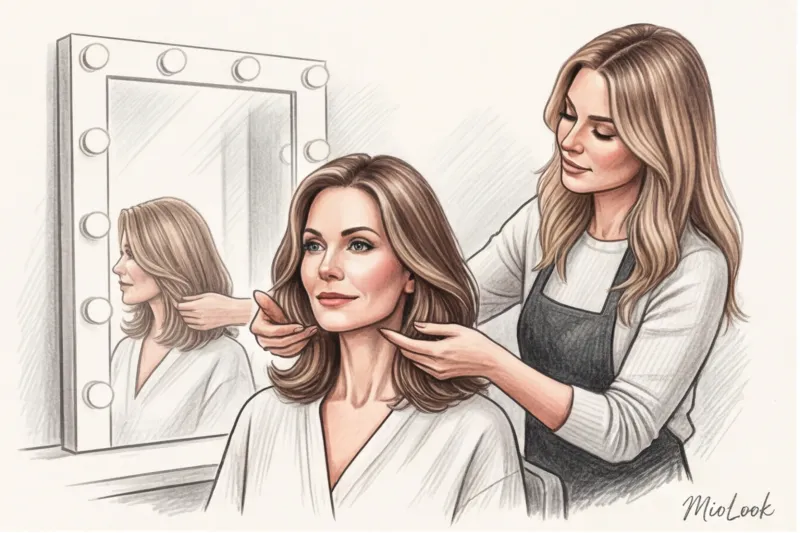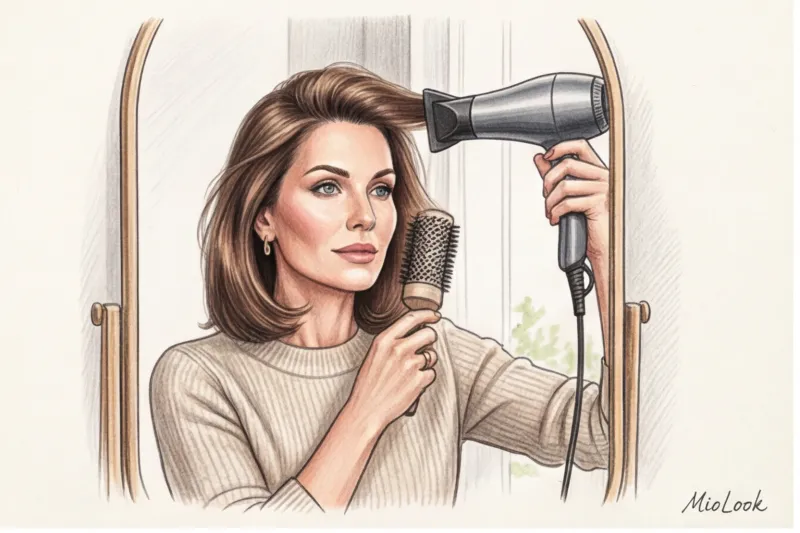
"Isabella, do something to freshen up my face. Just don't touch the length and be sure to curl the ends inward, I'm used to it that way." That was the beginning of my acquaintance with Anna, a 42-year-old client who came to my salon for a makeover. Unbeknownst to her, she was asking me to do exactly what would visually add at least ten years to her age. Round, tight ends, styled tightly at the chin, created the perfect frame for her budding jowls and accentuated her sagging face.
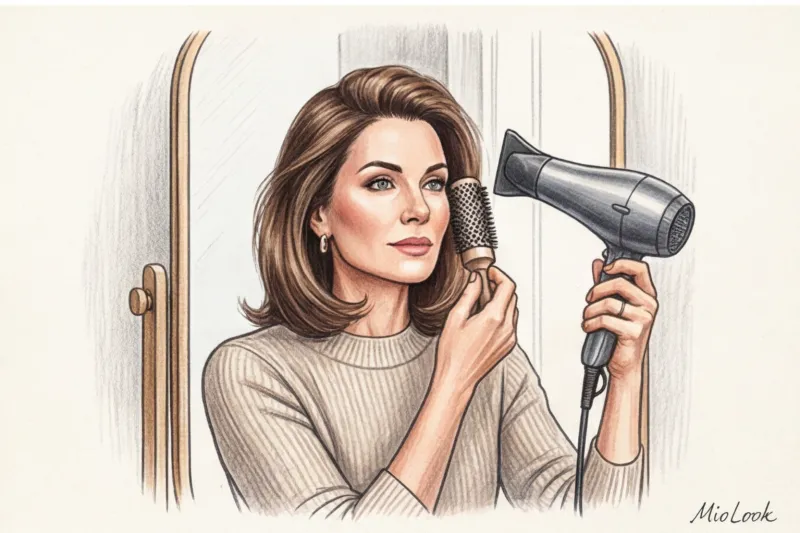
Many women search for an answer to the question every day, How to style your hair to look younger , but we continue to use styling patterns from our youth. We change our face creams, switch to a lighter foundation, but for some reason we continue to create that same "reinforced concrete" volume at the roots.
This article isn't a list of trivial "just do a bob" tips. We've already discussed the basics and geometry in more detail in our The complete guide to anti-aging haircuts for women 35+ Today we'll talk about something else. We'll look into architectural laying — the use of vectors, strand direction, and dynamics for optical correction of age-related changes. This is a true visual lift without a single injection.
The Architecture of Youth: How to Style Your Hair to Look Younger
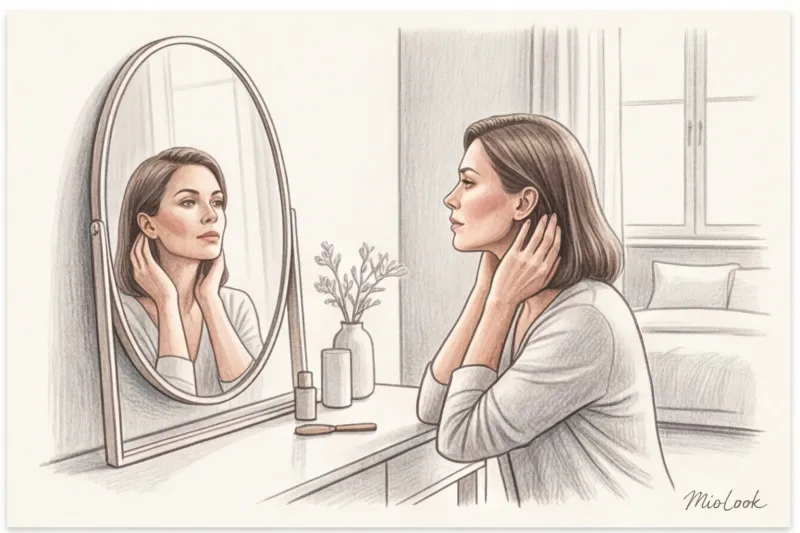
As we age, our faces inevitably change due to gravitational ptosis. In cosmetology, there's a concept called the "triangle of youth": in young women, its base is at the cheekbones and its apex is at the chin. After 35-40, this triangle inverts: volume shifts away from the cheekbones and toward the lower third of the face.
This biological fact dictates entirely new rules for working with hair. The great Vidal Sassoon always said that a haircut should have a bone structure. Styling works the same way. The direction of your strands is the equivalent of contouring in makeup.
If you're hiding behind thick, straight bangs or thick strands at the cheekbones in hopes of concealing wrinkles, you're making a strategic mistake. Hair falling vertically creates downward lines. Our eyes read these and automatically draw our facial features downward. To achieve a lifting effect, we need to redirect these vectors upward and diagonally, opening the face to the light.
Your perfect look starts here
Join thousands of users who look flawless every day with the smart AI stylist MioLook.
Get access — €0.99 onceThe Biggest Volume Myth: Why Backcombing Adds 10 Years
"Give me more volume at the top!"—I hear this request almost every day. There's a persistent, yet completely outdated, pattern: the more volume at the roots, the younger and more elegant a woman looks. This is a dangerous illusion.
A stiff, teased, and hairsprayed volume creates the effect of a static "helmet" on the head. And static is a key marker of age. Youth is associated with movement, casualness, and lightness. When your hair doesn't move even in a gust of wind, your look instantly becomes heavy and conservative.
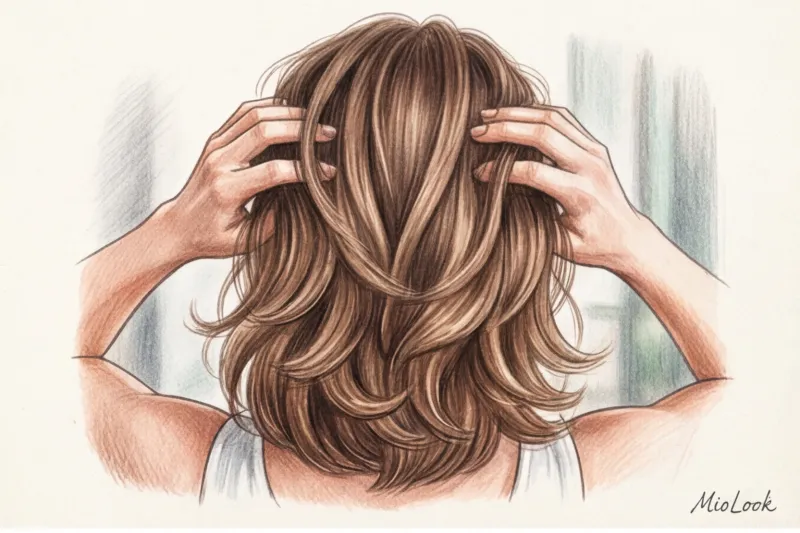
"Air length is valued far more today than a solid crown. Modern luxury is effortless elegance."
To avoid the "I tried too hard" effect, avoid backcombing. Use modern texturizers that lift the roots with microparticles of powder, leaving the hair itself lively and flexible. You should be able to run your fingers through your hair and flip it to the other side at any time.
Lifting Vectors: 3 Styling Formulas for a Facelift
Over 12 years of salon practice, I've developed clear algorithms that work like an optical illusion. It's not just about "looking good," it's about targeted work with proportions.
Formula 1: Diagonals at the Cheekbones
If you have curtain bangs or short layers around your face, your job is to always style them on behalf of Never curl them inward like an arch.
Take a brush, curl a strand, and angle it upward and back at a 45-degree angle. When the strand cools and unravels, it will create an upward diagonal line pointing directly toward your cheekbones and the outer corners of your eyes. This optical illusion visually "lifts" your cheekbones by 1-2 centimeters.
Formula 2: Asymmetry and open neck
Symmetry soothes the eye, but with age, it begins to highlight the slightest imperfections and age-related asymmetries of the face itself. Break this perfection.
Create a deep side parting. Tuck the side with the thinner hair behind your ear. Leave the other side loosely framing your face. This technique highlights your jawline on one side, creating a delicate yet delicate effect.
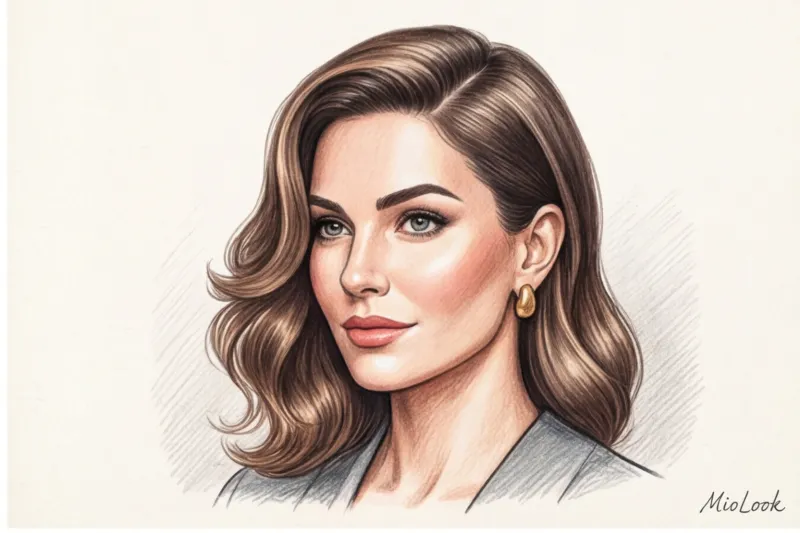
Fair Limit: This technique won't work if you have a pronounced slouch (called a "dowager's hump") or a lot of tension in your neck. In this case, sleekly tucked hair behind your ear will completely expose the side of your neck and only emphasize the static nature of your body. In this situation, it's better to leave soft, textured strands on both sides.
Formula 3: Ends out, not in
Let's return to my client Anna. Curling the ends inward toward the chin (a classic 2010s bob cut) creates a massive visual anchor in the lower third of the face. This makes the jaw appear heavier.
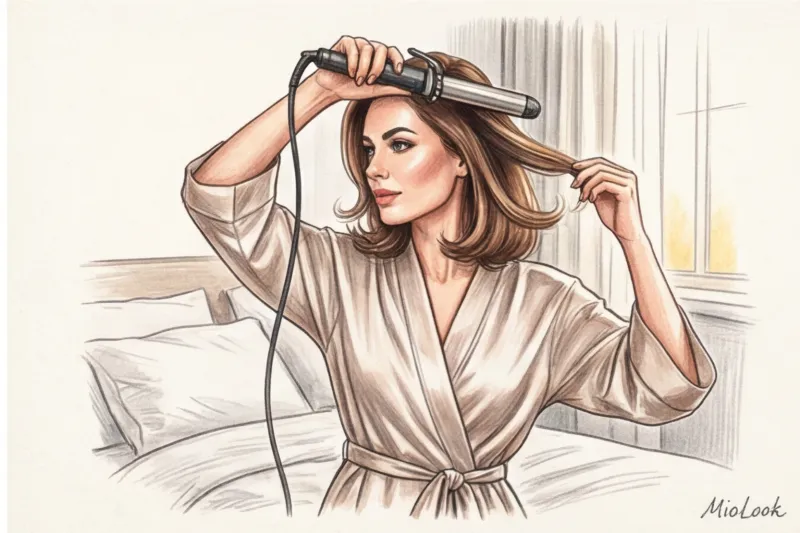
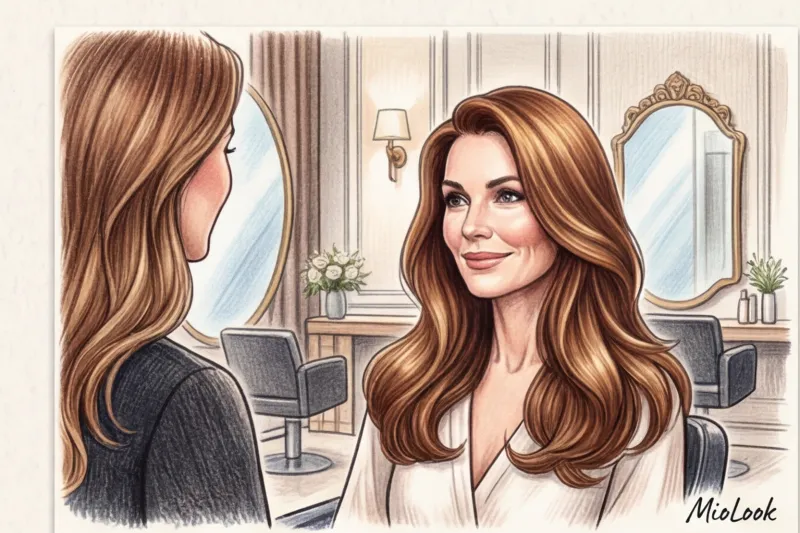
Try the subtle flip technique. Using a flat iron or brush, gently pull the ends outward, away from the neck. This creates a floating, light effect, draws attention away from the chin, and adds a playful, almost youthful vibrancy to the look.
Ready to get started?
Try a free plan—no commitments required. Find the perfect hairstyle for your facial features at MioLook.
Get access — €0.99 onceTexture Matters: Why Hair Quality Reveals Age
According to modern trichological research, after age 40, hair diameter thins by an average of 10-15%. Furthermore, the sebaceous glands function differently: hair becomes drier, more porous, and coarser.
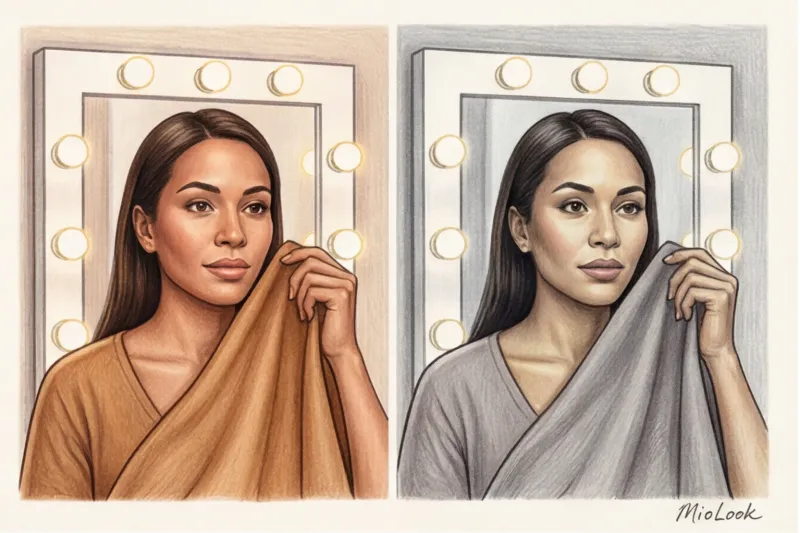
Matte, dry hair literally absorbs light. It dulls the complexion and highlights shadows (and therefore wrinkles). Healthy, glossy hair acts as a reflector, illuminating the surrounding skin.
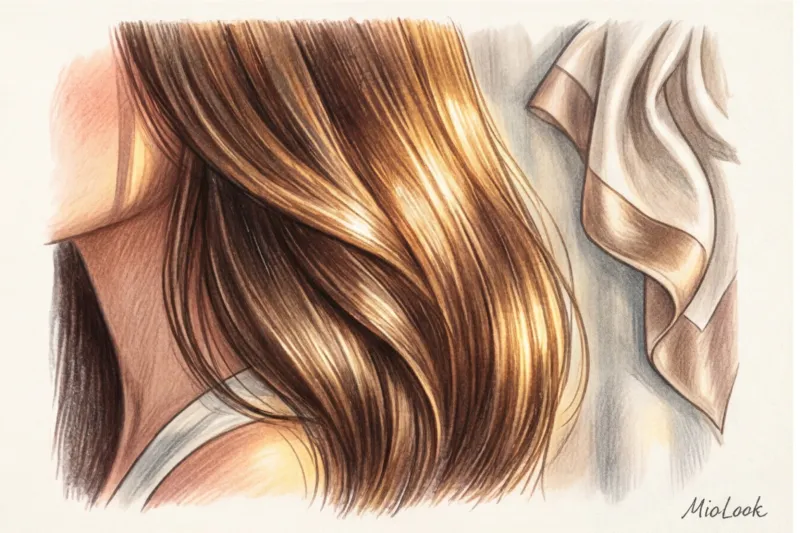
I adore the Mediterranean approach to texture. Spanish and Italian women rarely use harsh foams and mousses. Their secret is leave-in conditioners before blow-drying and a drop of lightweight oil-serum on the ends afterward. This gives that "expensive" shine without the effect of dirty, over-styled hair.
Anti-aging arsenal: the right tools and styling
What you style your hair with is just as important as the technique itself. In my experience, 8 out of 10 women burn their thinning hair simply because they haven't changed their tools for years.
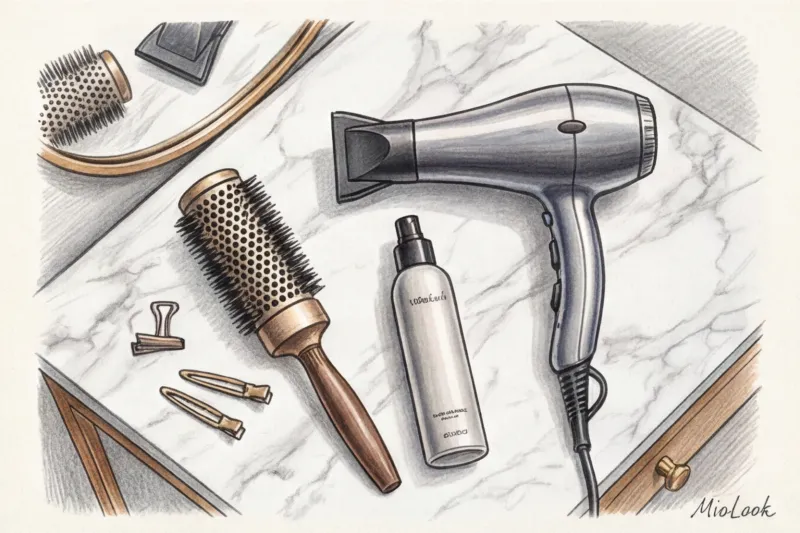
- Throw away the strong hold hairspray (Hold 4-5). Replace it with a dry texturizing spray. It provides the necessary body and structure without leaving your hair frizz-free.
- Ceramics vs. stubble. For aging hair that has lost its elasticity, I strongly recommend using ceramic or tourmaline brushes with nylon pins. Natural boar bristles are too aggressive in pulling and can damage the fragile cuticle.
- Temperature conditions. Your rule: 160-180 degrees. No 210°C! To ensure your style lasts, it's not the extreme temperature that's important, but the right temperature. cooling down strands on the brush.
- Heat protection primers. Look for products labeled "plumping/thickening," which contain polymers that expand when heated, visually thickening each hair strand.
Checklist: Daily Lifting Hairstyle in 10 Minutes
Especially for those who don't have the time to spend half an hour getting ready, I've put together a step-by-step action plan. This is the routine that guarantees a fresh and modern look.
- Preparing the foundation. Apply a root-volumizing spray (without a sticky alcohol base) to damp roots. Apply a heat-protective cream to the lengths.
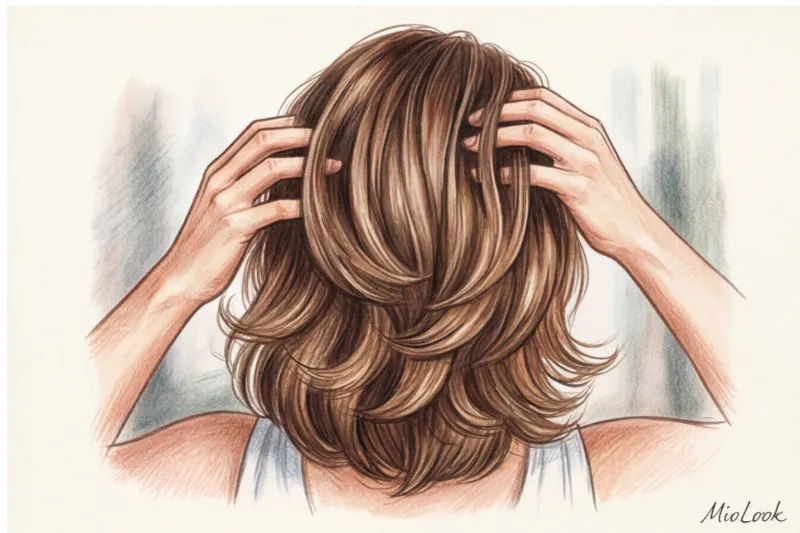
- Drying upside down. Turn your head upside down and blow-dry your hair, running your fingers through it until it's 80% dry. This will create that natural volume without the "helmet" effect.
- Working on facial strands. Lift your head. Take a brush and dry only the top zone and the strands near your face. Remember the vector: from the face and up The rest of the hair can simply be dried by hand.
- Fixing the texture. Spray a salt or dry texturizing spray through the lengths, using your hands to gently lift the strands.
- Mediterranean finish. Rub a pea-sized amount of texturizing paste or wax between your palms and literally "warm up" the strands by scrunching them up. This will break up any frizz and add a touch of chic.
Instead of a conclusion: focus on dynamics, not statics
It's not wrinkles that betray our age. It's a frozen, immobile, overly studious look. Don't be afraid to experiment: flip your parting, tuck your hair behind your ear, or let the wind tousle your hairstyle.
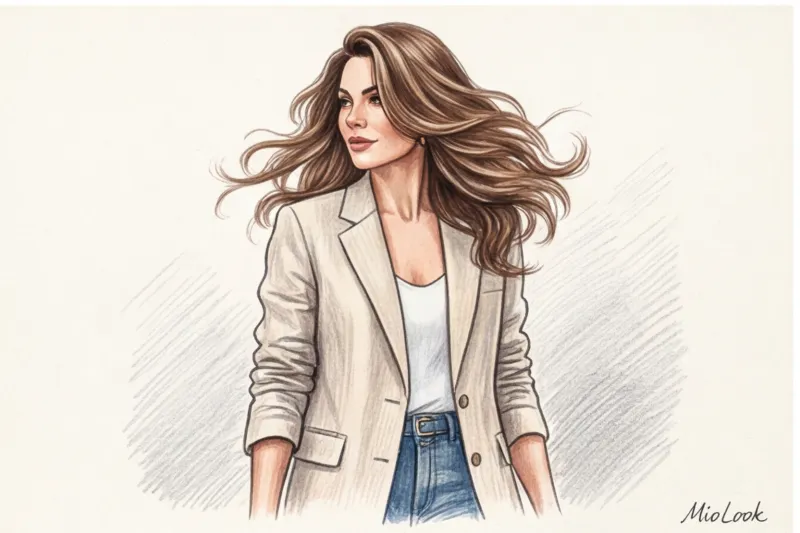
But remember one important thing: hair doesn't exist separately from your body and clothing. A gorgeous, dynamic, modern hairstyle will be lost if you wear an outdated, tight-fitting jacket. A look only works as a complete ensemble.
That's why I recommend using smart wardrobe feature in the MioLook app You can create trendy capsule hairstyles that will perfectly complement your new, light, and flowing hairstyle. Change the direction, add air to your hair, open up your face—and you'll see how your look will be filled with completely new energy.