Five minutes before going on stage at a major IT conference, my client dropped a drop of liquid foundation right on her emerald silk blouse. Her first reaction? Grab an antibacterial wet wipe from her purse and start frantically scrubbing the fabric. I managed to intercept her hand just a centimeter away from the silk. If she had touched the material, her prestigious look, worth several hundred dollars, would have been irreparably ruined by a whitish stain that would be impossible to paint over.
This case from my practice perfectly illustrates the main problem with caring for delicate fabrics. We're used to acting intuitively, using harsh folk remedies with baking soda or alcohol wipes. But when we're faced with a task, How to remove a stain from silk , intuition is our main enemy. I've already covered the properties and physics of this amazing material in more detail in our complete guide. How to distinguish natural silk: tips from a stylist Today, we'll explore a scientifically proven approach to cleansing protein fibers: no panic, no vinegar compresses, and no loss of pearly shine.
The Anatomy of Delicacy: Why Silk Is So Vulnerable to Staining
To understand how to save an item, you need to understand what we're working with. Forget about cotton or polyester care guidelines. Natural silk is a material of animal origin, composed primarily of protein. fibroin , fastened with silk glue - sericin.
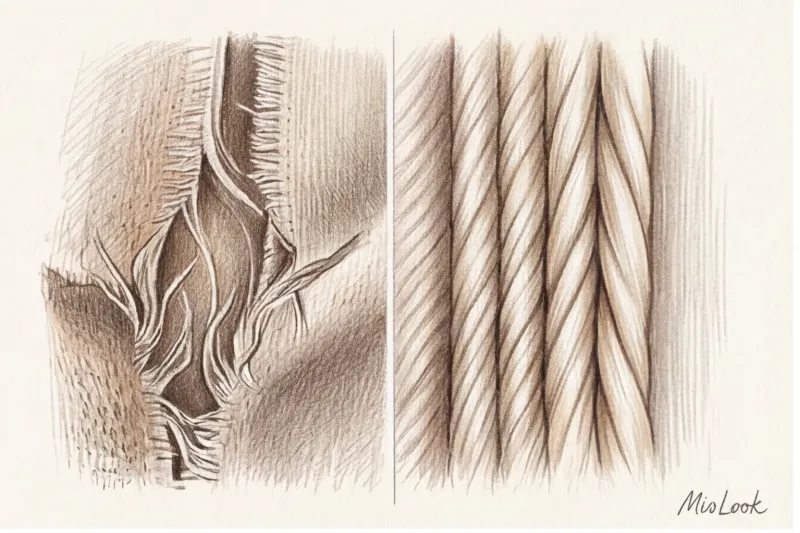
Did you know that silk loses up to 20% of its strength when wet? This is a scientifically proven fact of textile physics. Under a microscope, a silk thread looks like a smooth, triangular prism. These facets refract light, creating that signature pearlescent shine that makes COS blouses and Massimo Dutti silk slips so beloved.
"Any mechanical friction on wet silk breaks these microscopic prisms. The fabric at the point of friction becomes permanently matte and whitish. This isn't a result of the dye being washed out; it's a physically damaged fiber structure that cannot be restored," warn experts at the International Textile Analysis Laboratory.
Moreover, silk is incredibly hygroscopic—it absorbs liquids like a sponge, instantly allowing pigment or oil to penetrate into the very core of the thread. Therefore, every minute counts.
The First 5-Minute Rule: Emergency Care (and Key Do's and Don'ts)
Statistically, 8 out of 10 of my new clients admit that their first instinct when they see a stain on silk is to wash it under cold water or wipe it with a damp cloth. Both actions are fatal.
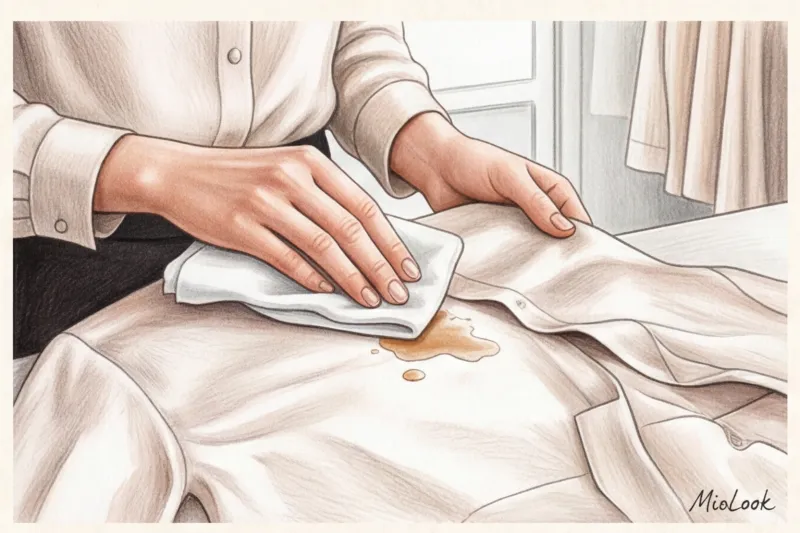
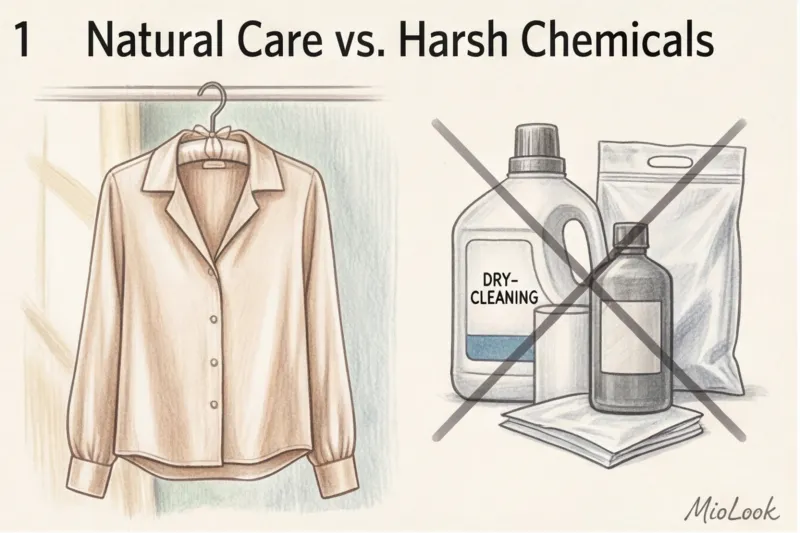
Why are wet wipes such a death sentence for silk? They almost always contain alcohol, propylene glycol, and harsh surfactants. These chemical bombs instantly react with the delicate fabric dye, corroding it.
Your correct algorithm of actions (Blotting method):
- Take a completely dry, clean paper napkin (without fragrances or lotions) or a white cotton handkerchief.
- Apply to the stain without the slightest pressure.
- Allow the paper's capillary action to absorb excess moisture.
- Change the napkin until it stops staining.
And most importantly: absolutely never pour water on the stain. Silk is coated with a special impregnation (sizing) during production to maintain its shape. Localized water displaces this sizing toward the edges of the wet stain, creating a hard, dark "halo" that will remain on the fabric even after the stain itself has disappeared.
Organize your wardrobe wisely
Upload photos of your silk items to MioLook. Our AI stylist will suggest pairings and help you create looks for any occasion.
Get access — €0.99 onceHow to remove sweat and deodorant stains from silk
The chemicals of sweat are merciless to protein fibers. Sweat itself is acidic, but most antiperspirants are alkaline (due to aluminum salts). When these salts meet the fibroin fibers, a chemical reaction occurs, causing the fabric to yellow and become stiff.
The ideal pH for cleaning silk is between 5.5 and 7 (slightly acidic or neutral). The popular internet advice of dousing the stain with hydrogen peroxide or sprinkling baking soda (which is a strong alkali) will literally "cook" the silk protein.
How to act safely:
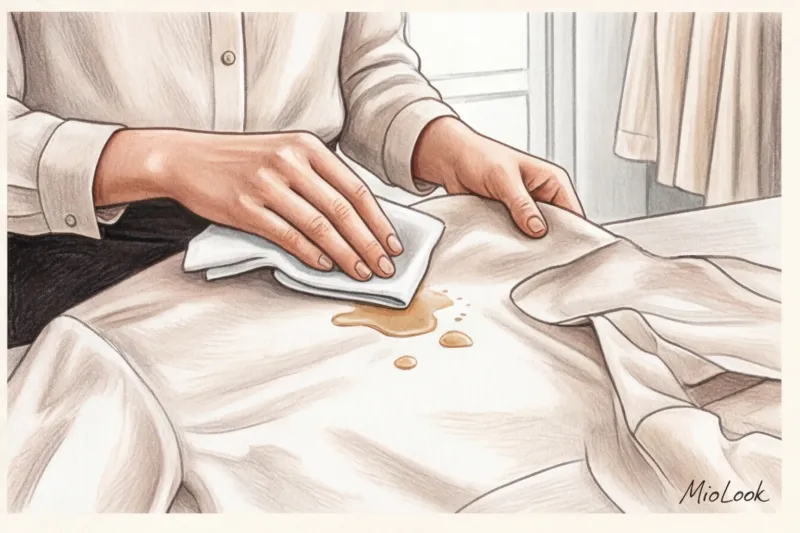
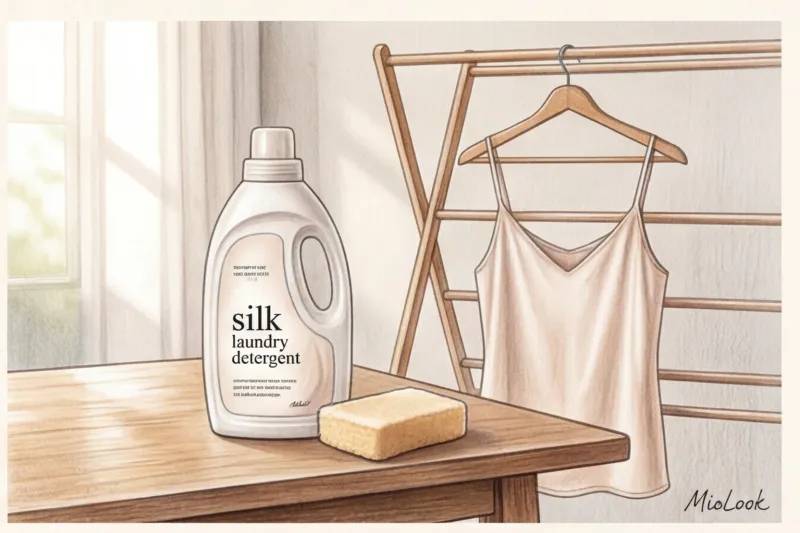
- Use a weak solution of white vinegar (1 tablespoon per glass of cool water). Vinegar has the right pH to restore protein fibers and neutralize the alkaline deodorant.
- Apply the solution to the underarm area using a sponge (using only blotting movements).
- Leave for 5-10 minutes, after which the entire item must be washed in cool water with a special shampoo for silk.
Stylist's advice: If you're preparing for an important performance under the spotlight, it's best to protect your fabric preemptively. I've covered how to choose the right textures for such occasions in detail in this article. Fabrics that don't show sweat stains: A guide for speakers.
Makeup and sebum stains: remove oil without leaving a trace
Foundation, lipstick, a drop of olive oil from a salad—these are all grease stains. The tricky thing about them is that water is completely useless (grease repels water). Washing away such a stain only drives the lipids deeper into the fiber structure.
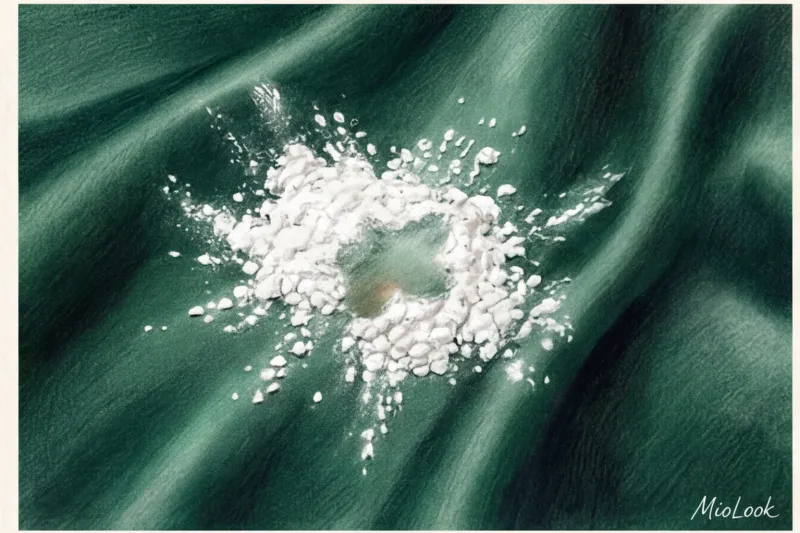
Here, the laws of physics come to our aid—specifically, dry sorbents. This is the only case where a folk remedy works flawlessly.
Dry method (step by step):
- Immediately after contact with grease, blot it with a dry cloth.
- Generously sprinkle the stain with baby powder (talc) or regular cornstarch. The powder should form a mound.
- A secret that is often missed: Leave the item alone for 12–24 hours. The sorbent needs time to physically draw the fat molecules out of the fibers.
- Brush off the powder with a soft brush (such as a clean powder brush). Don't rub with your hands!
- If the stain remains lightly, apply a drop of neutral silk shampoo, gently pat it in with your finger, and wash the entire item.
Don't know what to wear with your favorite blouse?
Try the "smart wardrobe" feature in MioLook. Artificial intelligence will analyze your items and suggest dozens of fresh combinations.
Create an image in MioLookCaution: pigmented stains (wine, coffee, berries)
Coffee, tea, and wine contain tannins—plant-based tannins. The problem is that tannins love to bond with animal proteins (which is why wine pairs so well with steak on a gastronomic level). When tannins come into contact with silk, they form a strong chemical bond with fibroin.
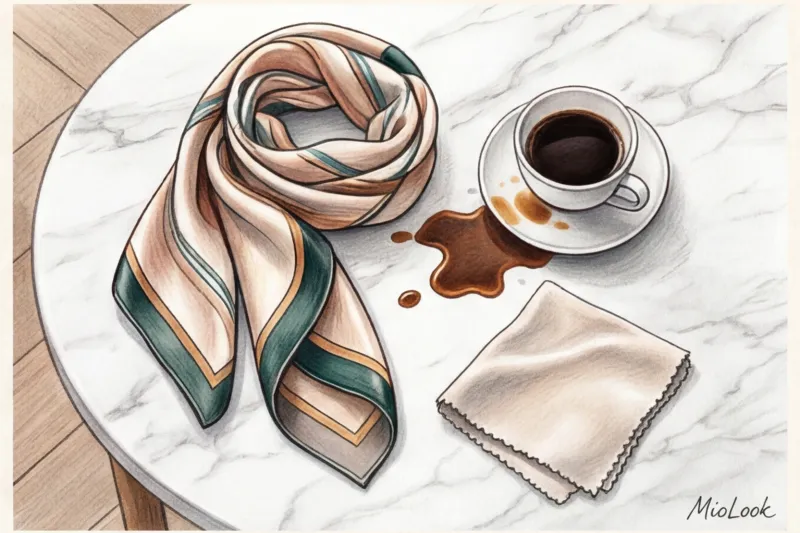
A strict temperature regime applies here. The water for rinsing (if you decide to risk it before dry cleaning) must be ice-cold. Even water at 40 degrees Celsius will act like custard—it will permanently "cook" the protein and pigment.
My fair warning: if you spill red wine or blueberry juice on light-colored silk, don't touch the stain at all. Blot it with a napkin and run to the dry cleaner. This is the kind of situation where home experiments 99% of the time lead to buying a new item.
The Halo Effect: How to Remove Water Stains If You've Already Made a Mistake
Let's say you did wash the stain out with water, and now the dried fabric has a distinct dark outline. As I mentioned above, this is due to the sericin and factory finishing agent displacing the stain. The fibers in this area have become compressed, changing the angle of light reflection.
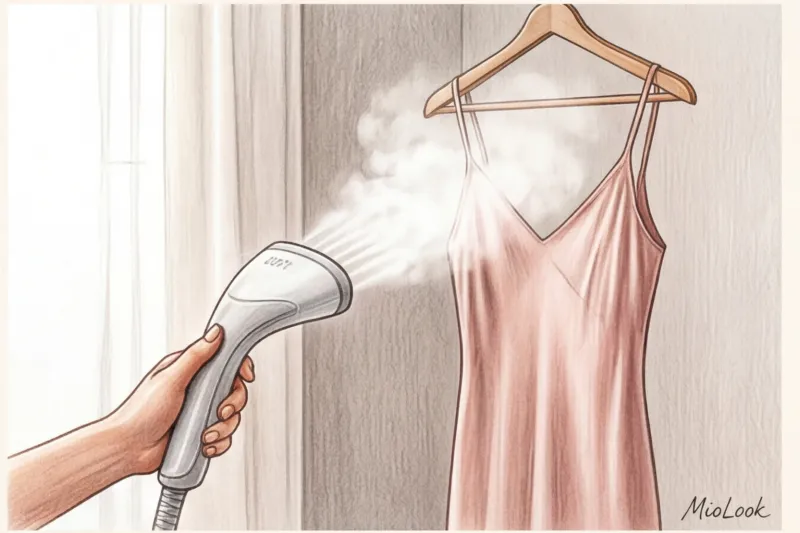
In my practice as a stylist I often use steam therapy To save things like this on set:
- Hang the item on a soft hanger.
- Turn on the hand steamer to the delicate setting.
- Hold the nozzle 15-20 cm from the fabric. Never touch wet silk with hot metal or plastic!
- Apply dense steam to the areola area. The steam will gently warm and relax the fibers, allowing the dressing to distribute more evenly.
- After this, the item requires a full immersion technique: hand washing the entire item in a large basin of cool water to even out the color.
Checklist: When to Stop Experimenting at Home
I truly believe that basic clothing care saves time and money, but as a professional, I have a responsibility to point out the red flags. Don't attempt to remove stains yourself if an item meets any of these risk markers:
- Complex cut and lining. This is especially true if the lining is a contrasting color (for example, a black jacket on red silk). Water will cause the dye to migrate, and red streaks will appear on the outer surface.
- Crepe de Chine and chiffon. Highly twisted fabrics shrink up to 10% when in contact with water.
- Bright, unstable dyes. If the silk is fuchsia or electric blue, spot cleaning will leave a white stain - the dye will come off along with the stain.
- Vintage silk. Fibers older than 15-20 years are overdried by time. They will simply fall apart with any friction.

How to properly dry clean silk:
Never hand over an item and say, "It's just a spot." The receiver needs to know the chemistry behind the process. Say: "This is an oil-based foundation (or deodorant). The fabric is 100% silk. Please do not use perchloroethylene; I require a gentle dry cleaning with a hydrocarbon solvent." Hydrocarbon is the most gentle premium solvent that does not wash out the natural oils from silk, preserving its elasticity.
Silk isn't as fragile as commonly believed. This fabric can last for decades if treated with proper chemistry and physics. The key lesson to remember is that when working with silk, it's not friction or harsh chemicals that matter, but rather the time it takes to apply sorbents and control pH levels.