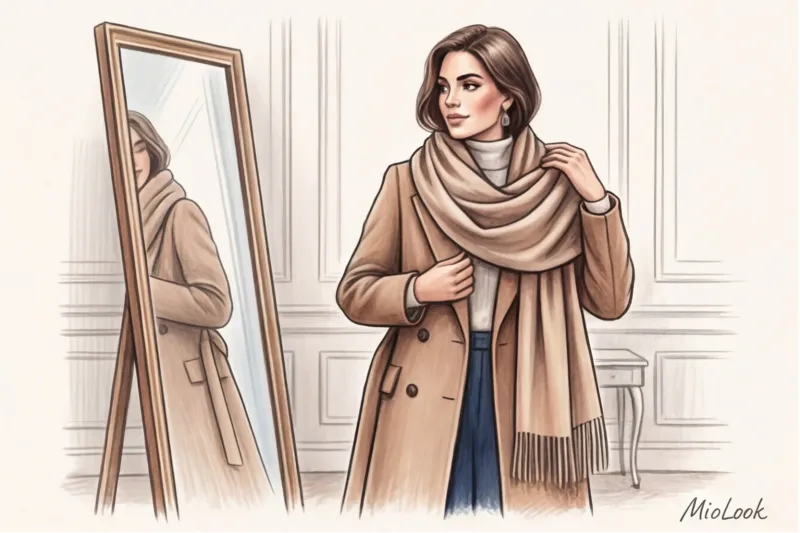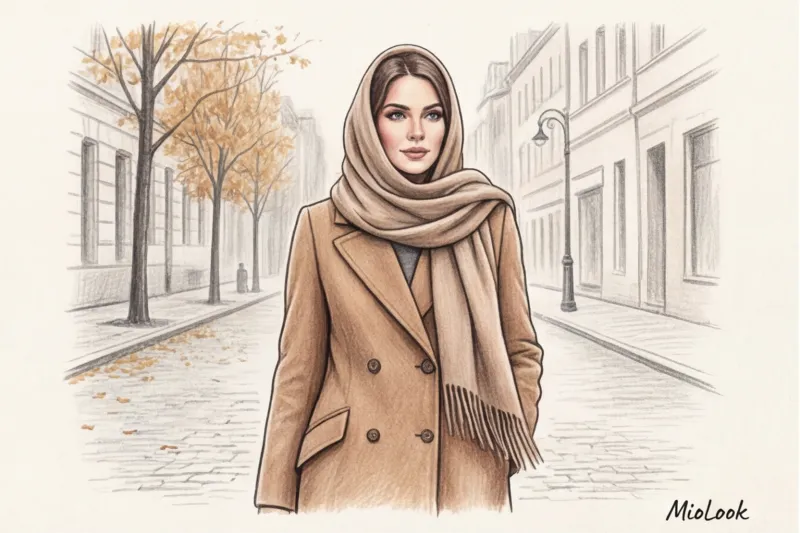
Paris, Rue Saint-Honoré, a chilly November day. A show guest emerges from a black car wearing the iconic double-breasted camel coat (which, by the way, costs around 2,500 euros)—the Max Mara 101801. The look could have become a street style icon, if not for one detail: a stiff, creaky, chunky-knit acrylic scarf cinched tightly around her neck. It stood upright, interrupting the graceful line of the shoulders and instantly cheapening the coat's luxurious cashmere fabric.
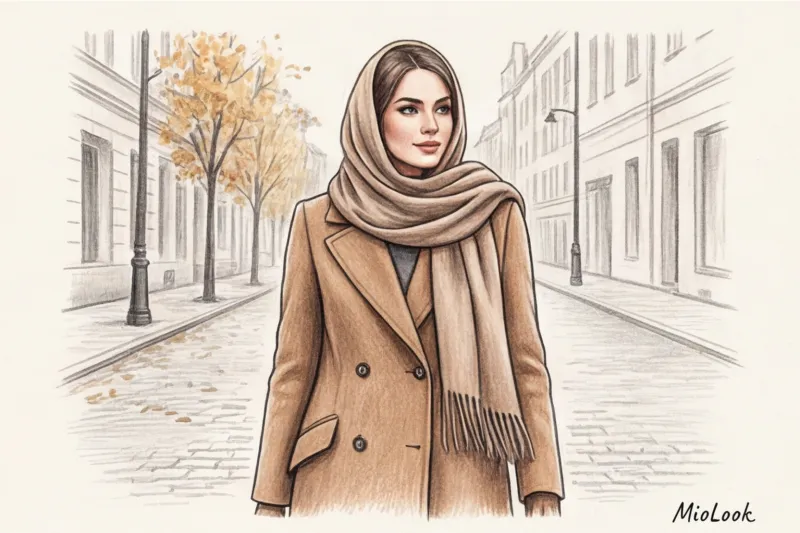
I often remember this incident from Fashion Week when clients ask, How to choose a scarf to match a coat Most women treat this accessory purely utilitarian—like a piece of fabric to keep a cold out of their throat. But when styled correctly, a scarf acts as an architectural bridge between the rigid form of outerwear and your face.
We talked in more detail about how the quality of accessories shapes the status of the entire image in our A complete guide to essential bags and wardrobe investment tips The same law applies to scarves: cheap raw materials in the portrait area devalue the most expensive base.
The Architecture of the Image: Why a Scarf Is More Than Just a Warmth Detail
Imagine a classic wool coat. It has a clear structure, lapels, and a shoulder band. Your face is the focal point. If there's no proper transition between them, the look looks unfinished. A scarf softens this contrast, creating the desired dynamic.
"In the fitting room, I always show my clients a trick: the right scarf works like a professional reflector during a photo shoot. It can erase tiredness from your face, while the wrong one will highlight every wrinkle." This is a rule I've learned over the years as a personal stylist.
That's why choosing a scarf shouldn't be left to the last minute. It's an investment in your face and silhouette, requiring the same thoughtful approach as buying good shoes.
Access to MioLook for €0.99 — one-time payment
A smart AI stylist will select the perfect look based on your outerwear.
Get access — €0.99 onceMaterials Science: Textures That Don't Clash with Outerwear
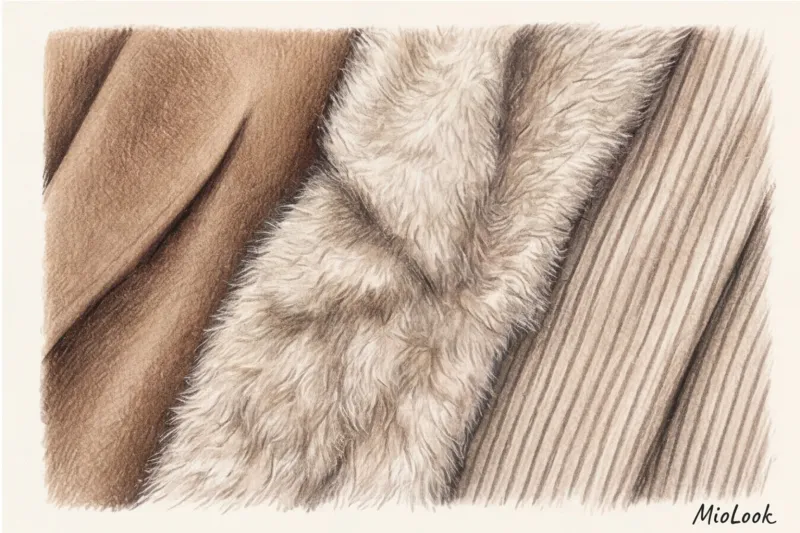
Let's turn to the technical side of the issue. Why does one scarf flow like water over your shoulders, while another makes you look like a snowman? The answer lies in the micron size of the fiber.
The technical standards of manufacturers like Loro Piana or Johnston of Elgin are strict for a reason. Premium cashmere fiber has a thickness of 14 to 19 microns. By comparison, standard sheep's wool starts at 25 microns and above. This difference of just a few microns determines the fabric's drape. Cashmere will lay down softly, while thick wool will form a stiff collar around the neck.
The rule of proportionality of textures
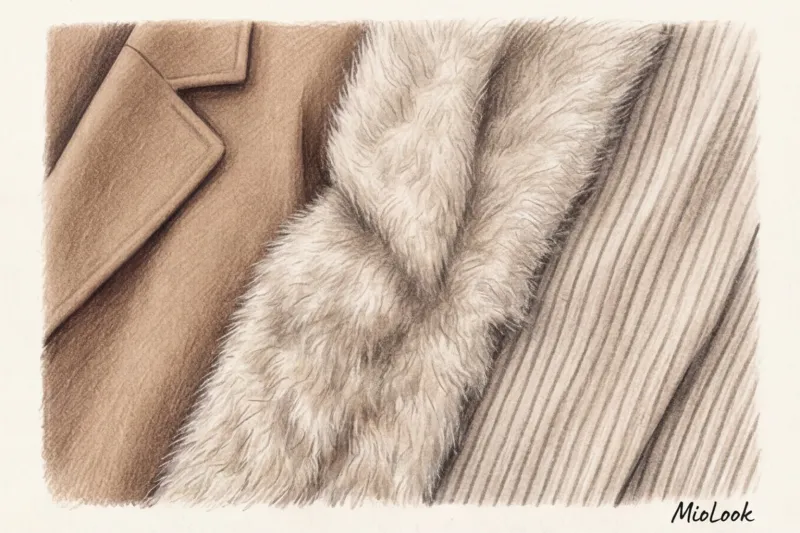
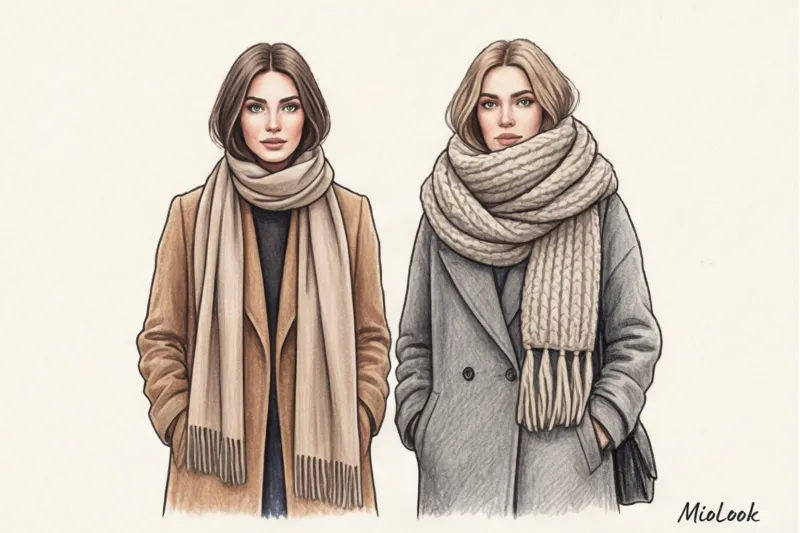
The golden rule of styling: the textures of the coat and scarf should interact, rather than merge into a single spot.
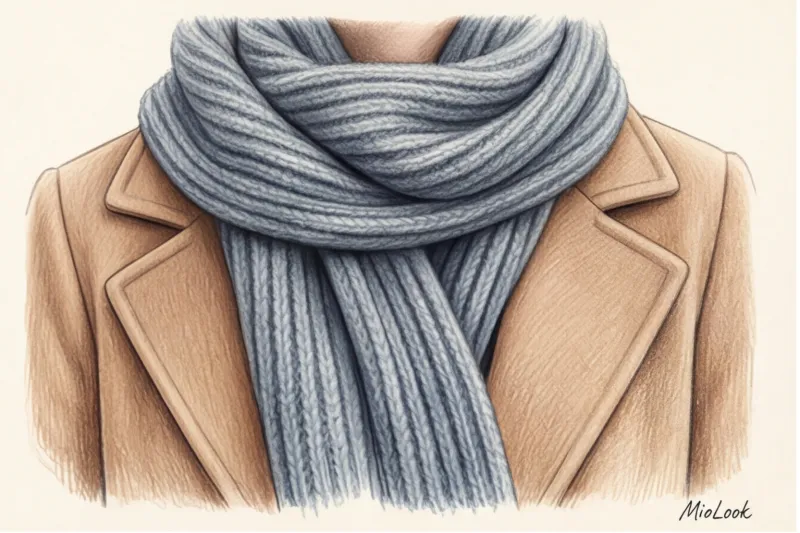
- If your coat is made of smooth, dense wool (melton, gabardine), you need a scarf with a pronounced texture - mohair, boucle, cashmere with long pile.
- If you wear textured coat (teddy fabric, large herringbone, boucle), choose the smoothest and thinnest accessory - silk with wool or the finest merino.
When this rule does NOT work: The only exceptions are avant-garde monochrome looks in the style of The Row, which deliberately exaggerate a single texture. But for everyday smart casual, contrast is essential.
The Myth of 100% Wool and the Magic of Blended Compositions
We're used to looking for the coveted "100% wool" label, believing it to be a guarantee of quality. In reality, thick, 100% sheep's wool scarves are a poor choice for a basic wardrobe. They create a "neck corset" effect, making it difficult to turn your head and visually shortening your neck.
Blends are an ideal investment. A combination of 70% cashmere and 30% silk produces a stunning result: the silk adds a delicate sheen and durability, while the cashmere provides warmth without adding bulk. A budget-friendly yet excellent alternative is a blend of fine merino and viscose (at least 40% pure wool).
Coloristics for Advanced Learners: How to Match a Scarf to Your Coat
Forget the "tone-on-tone" rule. In 1839, French chemist Michel-Eugène Chevreul formulated the law of simultaneous contrast: colors placed next to each other influence how we perceive each other. In styling, we use this law to draw the desired pigment from your eye or skin tone.
Working with a dark base: black, navy, graphite
The most common mistake I see on the street is a black coat paired with a black scarf. After 30, black close to the face acts as a merciless highlighter: it accentuates nasolabial folds, under-eye shadows, and even the slightest redness.
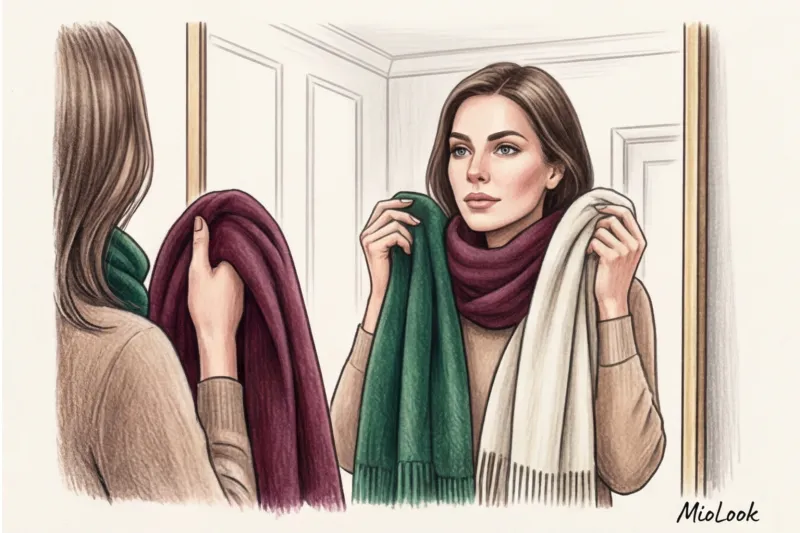
Complex, dusty shades like sage, muted burgundy, taupe, or dusty rose complement a dark base perfectly. They create a soft contrast and illuminate the face. If you're unsure which shade to choose, consider your eye color and find a scarf in a complementary shade (opposite on the color wheel).
Light and camel coats: secrets to an aristocratic look
Camel coat is a classic winter office wear for women To look classy in it, create a monochrome vertical, playing with saturation.
The key is to pay attention to color temperature. Don't mix a cool ash beige scarf with a warm golden camel coat, otherwise the latter will look dirty. A great trick is to use a scarf two shades lighter or two shades darker than the coat, but strictly within the same color temperature (warm for warm, cool for cool).
Your perfect look starts here
Join thousands of users who look flawless every day with MioLook, collecting capsules in a couple of clicks.
Get access — €0.99 onceGeometry and Proportion: How Scarf Length Affects Your Silhouette
Fashion is the mathematics of proportion. Even the most expensive cashmere will ruin your figure if it's the wrong size.
There is a clear formula we use when putting together a wardrobe: The ideal length of a basic scarf should be your height minus 10-15 centimeters That is, if you are 170 cm tall, look for an accessory that is about 155-160 cm long.
Why is this important?
- Scarves that are too short and tied in a knot at the chest cut the silhouette in half and visually add volume to the waist area.
- Stoles that are too long and hang below the knees make you look squat.
- Width also matters. Narrow striped scarves are a 2010s staple, while oversized throws and stoles look sloppy today. The optimal width for a basic scarf is 40-50 cm.
The correct draping is to drape one end of the scarf over your shoulder, leaving the other end in front. This creates a vertical line that slims and elongates the figure.
The "Set" Misconception: Why You Shouldn't Buy a Hat and Scarf as a Set
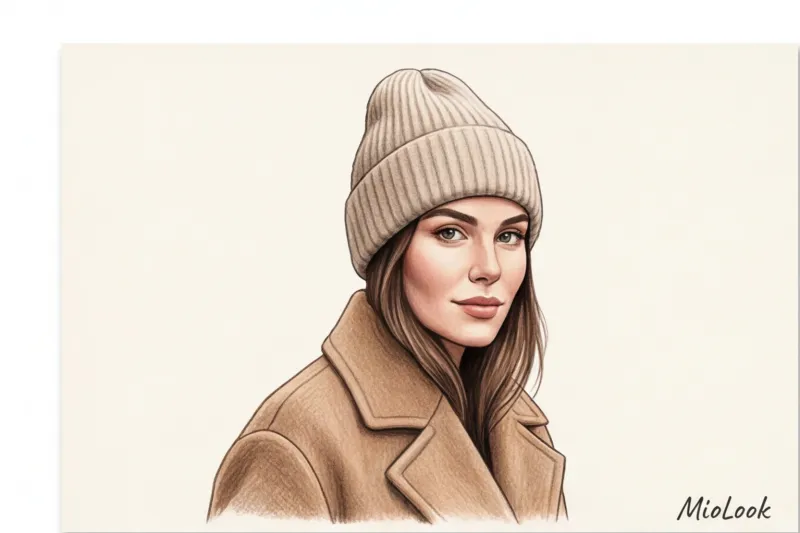
If I were asked to name one key marker of outdated style, I would answer without hesitation: identical machine knits and colors in hats, scarves, and gloves. Such "sets" instantly evoke a preschool-like approach to clothing and betray a lack of confidence in one's own taste.
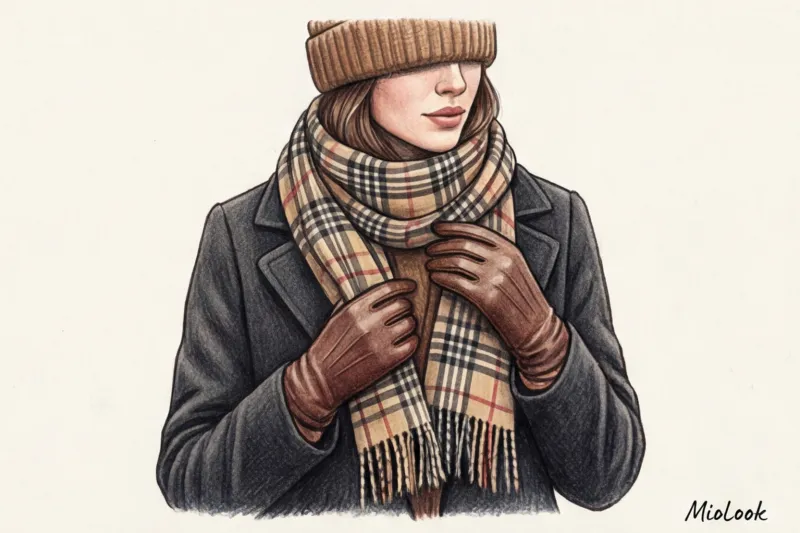
Modern styling is based on the principle Texture Blocking (blocking textures). The idea is to intentionally push different materials together in the same area.
What it looks like in practice: smooth wine-colored leather gloves + a voluminous, chunky graphite-colored beanie + a smooth, woven tartan scarf with a fine burgundy thread. The secret to combining different accessories lies precisely in this: they shouldn't be the same fabric, but rather intersect through a subtle undertone or overall color.
To learn how to see such combinations, you can upload your status accessories V MioLook wardrobe and virtually mix them with different coats, checking the compatibility before leaving the house.
Stylist checklist: test drive a basic scarf in the fitting room
When you go shopping, don't just try a scarf on your hand. Give it a full test drive using my process.
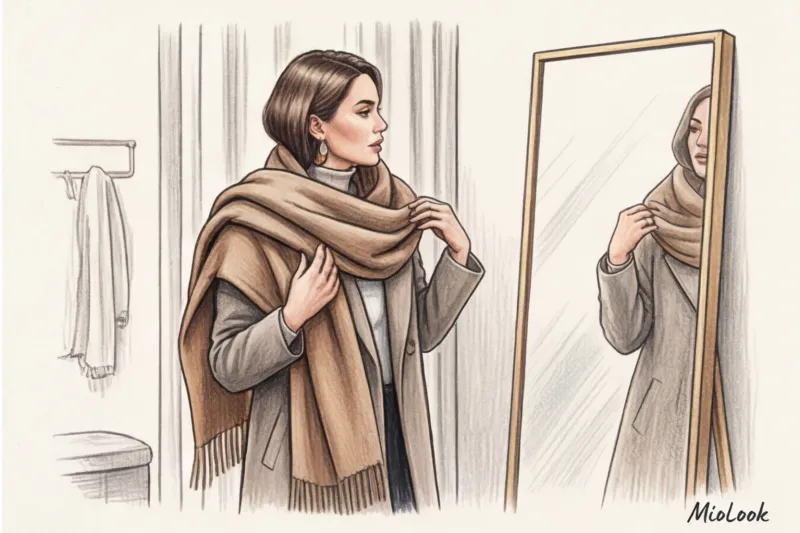
1. Drapery test. Fold the scarf in half and tie a classic Parisian knot. Look in the mirror: does it form a soft, heavy loop that rests gracefully on your collarbones? Or does the fabric bulge, creating a voluminous ruff around your face, like a lizard's? If the latter, leave it at the store.
2. Static test. Run a scarf over the lining of your coat or lapels. Cheap acrylic and polyester will instantly crackle, cling to your hair, and collect dust. High-quality wool or silk glide silently.
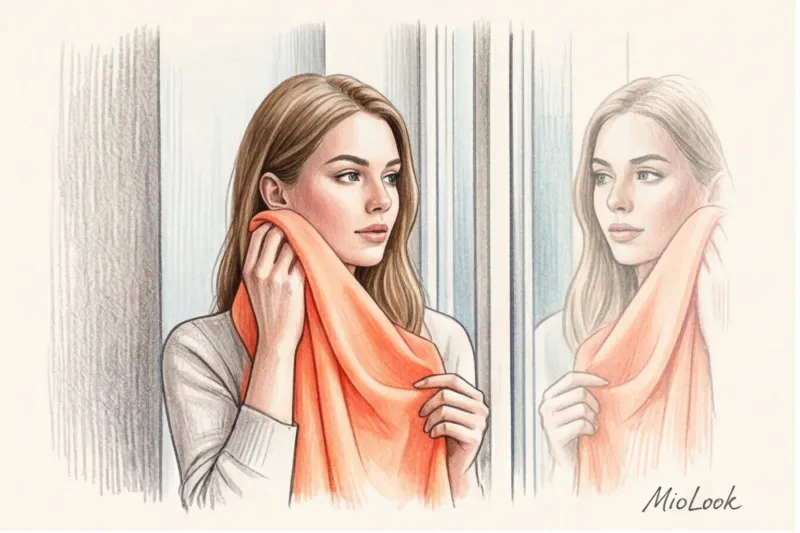
3. The "no makeup" test. Stand by the fitting room window (in daylight) and hold the straightened scarf to your chin. It's best to do this with minimal makeup. If your eyes become brighter and your skin tone more even, you've found your shade. If dark circles appear under your eyes, keep looking.
Smart Investments: Putting the Finishing Touch on Your Winter Capsule
To summarize, I want to emphasize: a scarf isn't the kind of wardrobe item where you should chase quantity. You don't need ten different, acid-colored polyester scarves from the mass market.
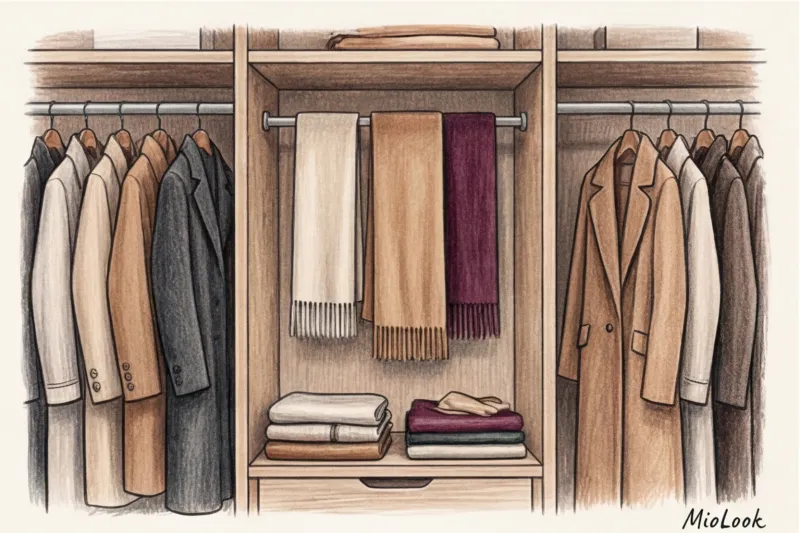
For a fully functional winter wardrobe, you only need two basic scarves:
- One smooth, thin, light shade (cashmere/silk) for elegant outings and textured coats.
- One voluminous, dense, deep dark or rich accent color (mohair/wool blend) for cold protection and working with smooth wool outerwear.
A well-chosen scarf is the finishing touch to your look. It speaks of attention to detail, a sense of proportion, and self-love. Invest in quality fabrics right at your face, and even a mid-priced coat will look like it just stepped off the Milan runway.