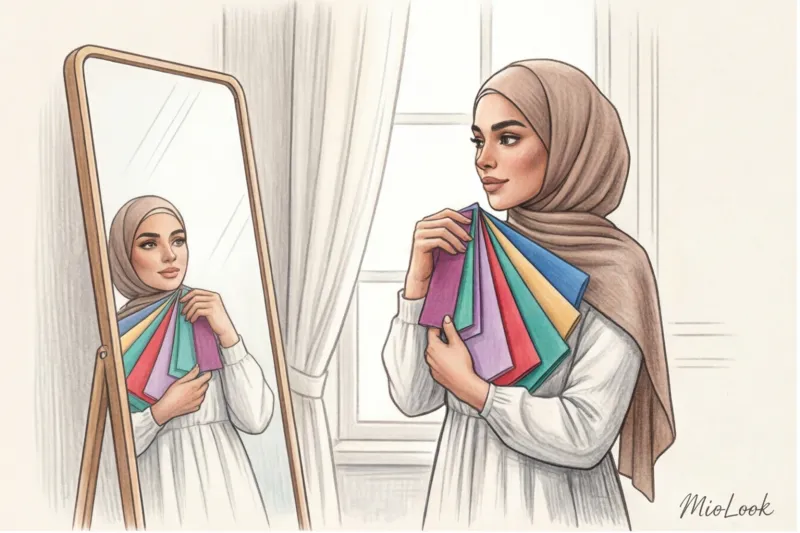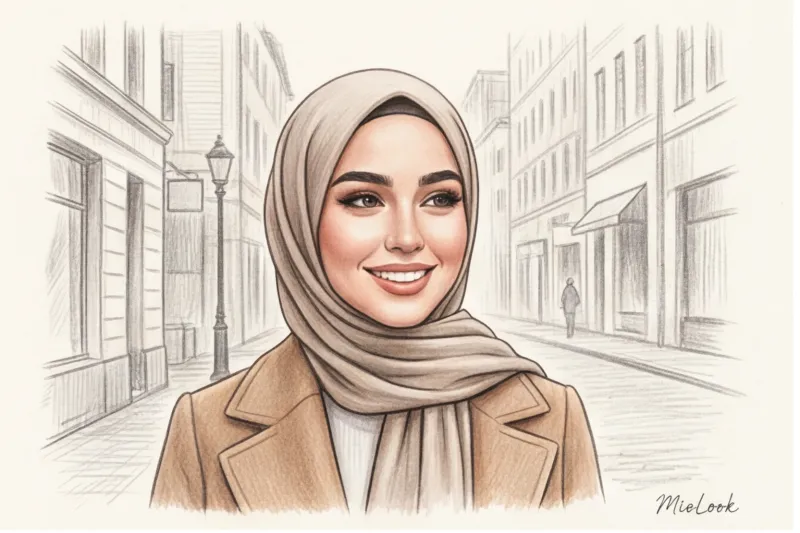
One of my clients once proudly opened her closet to me: about forty hijabs in every imaginable shade crowded the hangers. "I buy a new scarf to match every dress so the color matches perfectly," she said. But when we started putting together looks, an unpleasant detail emerged. Despite the perfect tonal match, the outfits looked flat, and the cheap, shiny synthetics cheapened even premium wool coats. It was then that we completely rethought her approach to How to match the color of your hijab with your clothes.
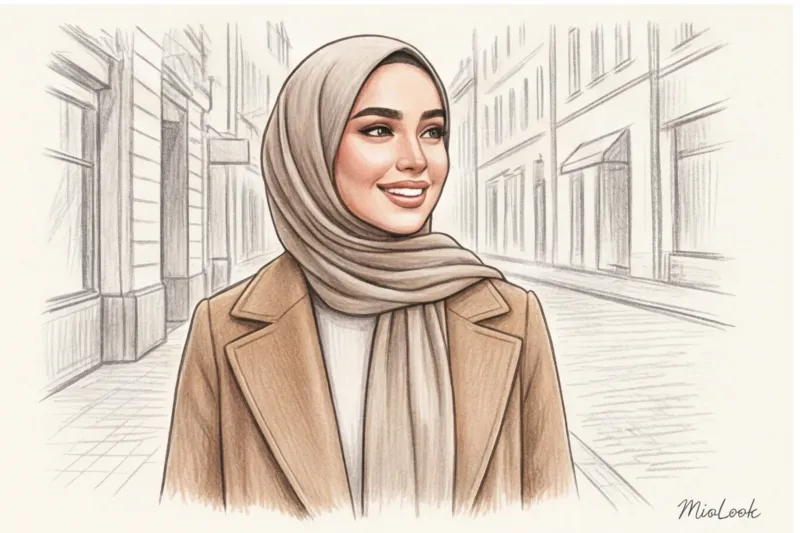
We threw out 40 squeaky polyester stoles and replaced them with seven scarves made of modal and high-quality silk. The result? Getting ready decreased from 20 minutes to three, and our looks began to look like they had been created by a stylist. We've already discussed basic coloring and the influence of skin undertone in our The complete guide to choosing a hijab color But today we'll go further and explore the physics of fabric, visual weight, and rules of proportion that will forever change your approach to closet wardrobe.
The Architecture of the Image: Why the Hijab is More Important than the Outfit Itself
When we talk about modest fashion, we work with large areas of fabric. Unlike standard styling, where the neck and décolleté serve as natural "air" in the look, the hijab creates a dense block of color right at the face. It becomes the architectural center of the silhouette.
According to Nielsen Norman Group research on visual perception (and actively used by fashion psychologists), about 70% of a person's attention is focused on the portrait. If the color or texture of a scarf is chosen incorrectly, it can visually overwhelm the face, make your skin tone appear dull, or disrupt the proportions of your figure, even if you're wearing a perfectly tailored suit.
Over 12 years of working with textiles and style, I've learned the most important rule: a hijab isn't an accessory added on as an afterthought. It's the focal point around which the rest of an outfit is often built.
Three golden rules: harmony of color and texture
Back in 1961, Swiss artist and color theorist Johannes Itten described the laws of color contrast in his book "The Art of Color." But when we apply his theory to closed-cell clothing, the rules change slightly due to the area covered.
Monochrome and texture: the secret to a luxurious look
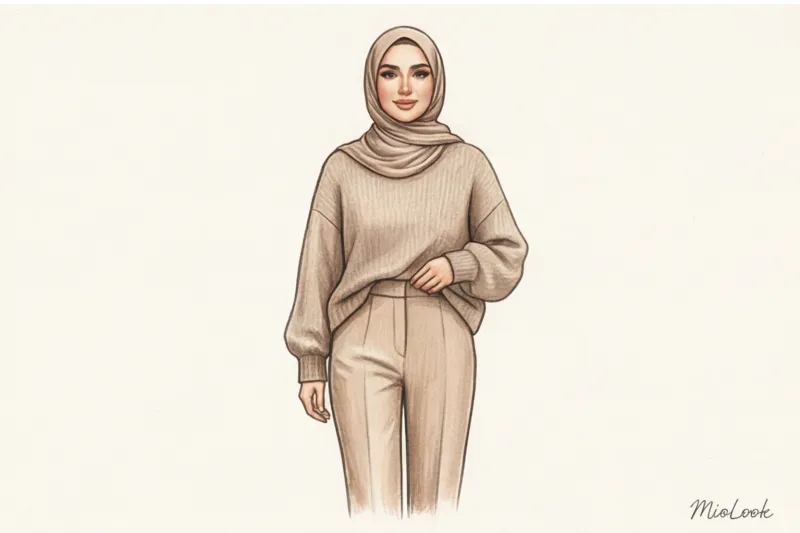
Many people think monochrome means wearing a single color from head to toe. But if you wear a matte burgundy cotton dress and a matte burgundy cotton hijab, you'll look like a statue. There's nothing to catch the eye.
The secret to a perfect monochrome look lies in the stark contrast of textures. If the colors of your clothing and hijab match, their textures should contrast. For example, pair a smooth, slightly shimmery silk hijab with a chunky, matte knit sweater. Or vice versa: pair a flowing satin dress with a thick, matte modal scarf. The difference in light refraction will create that depth that distinguishes an "expensive" look from a dull one.
The 60-30-10 Rule of Proportions in Modest Fashion
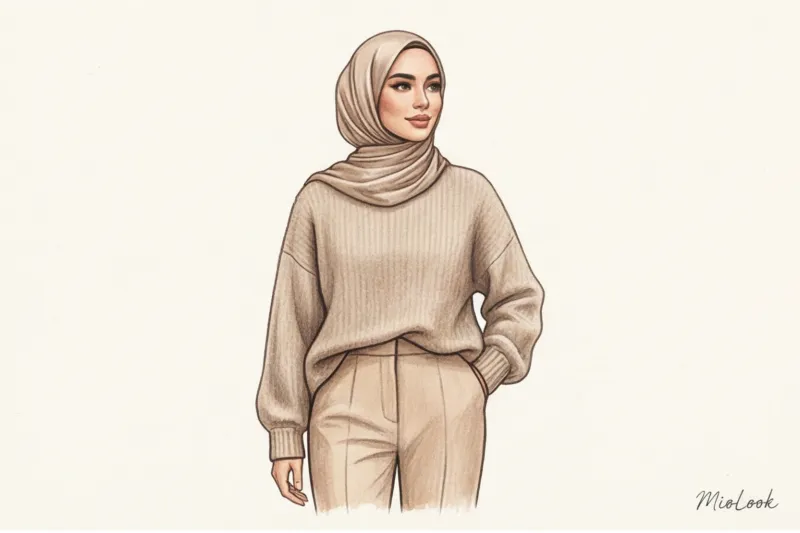
In interior design and styling, there's a foolproof rule for color distribution: 60-30-10. For a closed wardrobe, it's adapted as follows:
- 60% (Primary color) - your basic outfit (maxi dress or pantsuit).
- 30% (Secondary color) - second layer (long cardigan, trench coat, jacket).
- 10% (Accent) - your hijab, shoes or bag.
An important nuance: The hijab can act as a connecting link (falling into the 30% and merging with the top layer), or be a bright flash (those same 10%) if the rest of the image is kept in strict basic tones.
Your perfect look starts here
Join thousands of users who look flawless every day with the MioLook smart wardrobe.
Get access — €0.99 onceThe echo principle and temperature contrast
Instead of matching your headscarf to your dress, use the "color echo" principle. Instead of the main color of your outfit, let your hijab mimic the hue of a subtle detail: stitching on a denim jacket, buttons on a coat, or a print accent on a skirt. This demonstrates a high level of attention to detail.
Playing with temperature contrasts also works great. I love pairing a warm olive trench coat with a cool pearl gray hijab. They're on the same level of muted, but the different temperatures create a stylish tension.
Outdated myths: what you can no longer wear with the hijab
The fashion of the 2010s left us with a legacy of several strict rules that today's stylists are scratching their heads.
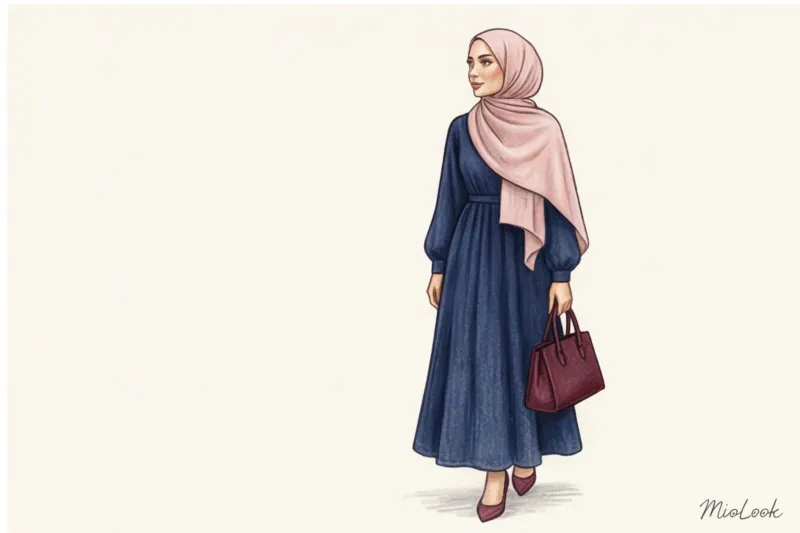
Myth 1: “The hijab should be the same color as your shoes or bag.”
This is the most common misconception. When you wear black shoes, a black bag, and a black scarf (with a light-colored dress), you visually "cut" your height into several horizontal blocks. This looks too deliberate, as if you're trying too hard. Modern styling is built on a subtle casualness and tonal harmony, not on a mathematically coordinated ensemble.
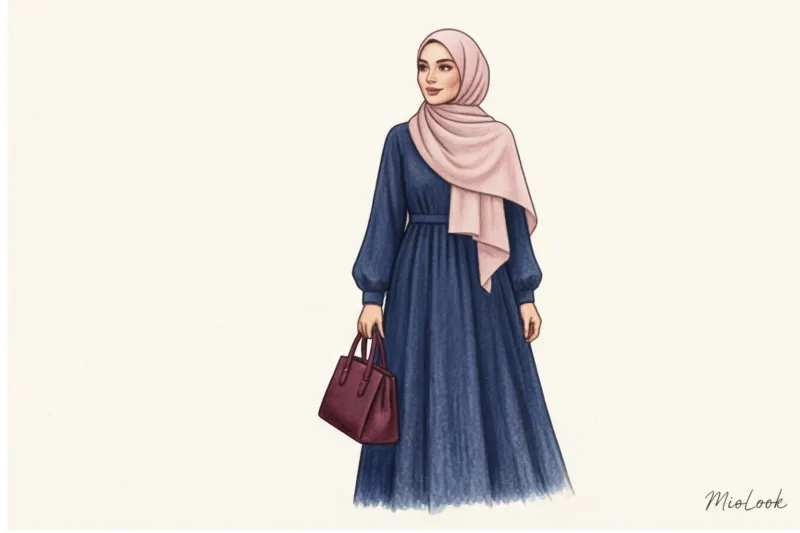
Myth 2: “A printed dress requires a hijab that is exactly the same color as the background of the dress.”
This often overwhelms the look. The alternative? Use sophisticated neutrals like taupe, ivory, and greige. They act as a visual eraser, calming even the most vibrant leopard or floral print.
"Honestly, the 'bag, shoes, and scarf in the same color' rule only works in one case: if it's a completely black monochrome. In any other situation, it looks like a flight attendant's uniform, not a personal style," the stylist notes.
Color Illusion: How Fabric Composition Changes the Shade of a Hijab
This is where the most interesting part begins—the physics of textiles. Why does the same color look so different?
There's a metric called LRV (Light Reflectance Value). According to WGSN Textile Reports (2024), matte surfaces absorb up to 40% more light than glossy ones. What does this mean for you in practice?
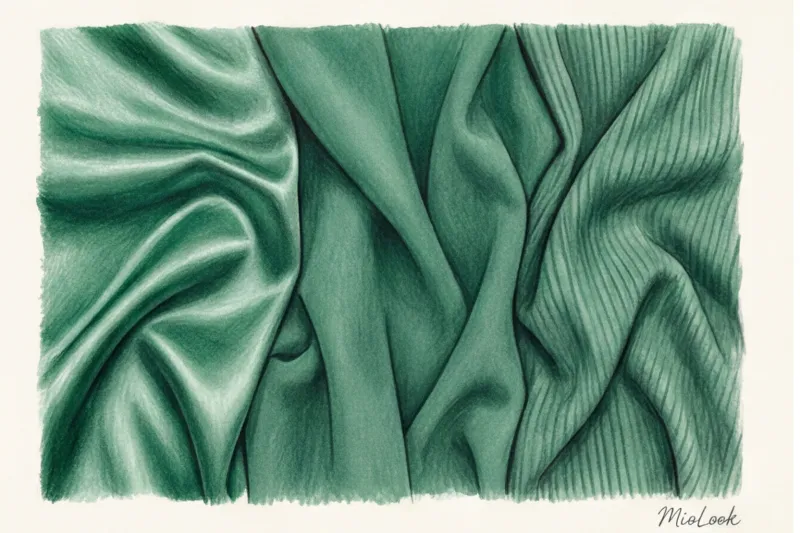
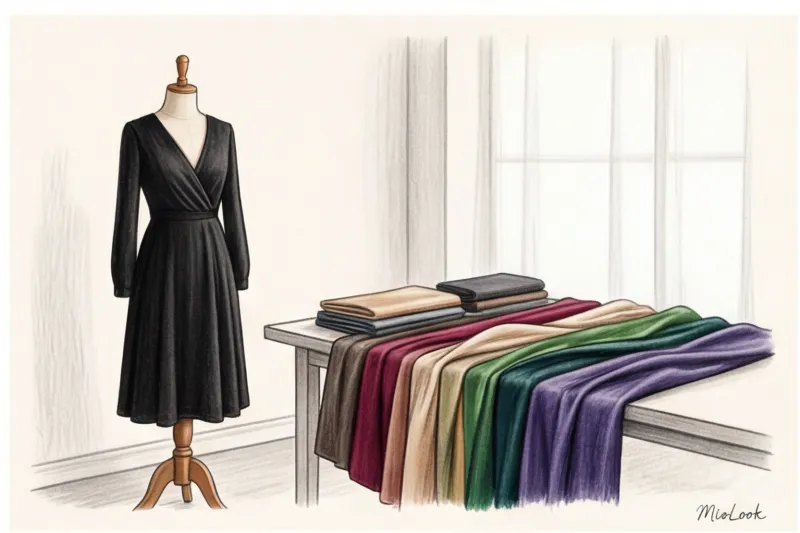
If you use a deep emerald dye (such as PANTONE 17-5641) on matte chiffon and silk satin, you'll get two visually different hijabs. The chiffon will appear two shades darker, denser, and more formal. The satin will shimmer, appear lighter, and more elegant. Therefore, when evaluating how to pair the hijab color with your clothing, you Always must take into account the fabric.
And here I must mention ecology and quality. Cheap polyester not only doesn't breathe, but also holds complex pigments poorly. After three washes, it fades, becomes covered in tiny pills (pilling), and instantly cheapens your entire look. A $300 dress with a $5 polyester scarf will look like a $15 outfit. Invest in modal, tencel, viscose (with 5% elastane added for drape), and high-quality cotton with a minimum weight of 180 g/m².
Access to MioLook for €0.99 — one-time payment
A smart AI stylist will select the perfect look from your items and suggest the best color combinations.
Get access — €0.99 onceInvesting Wisely: A Hijab Capsule Wardrobe
Let's get back to my client Aliya and her forty scarves. The problem was that she bought colors haphazardly, reacting to her emotions ("Oh, what a beautiful mint!"). As a result, the mint scarf sat around for years because it didn't match her warm autumn wardrobe.
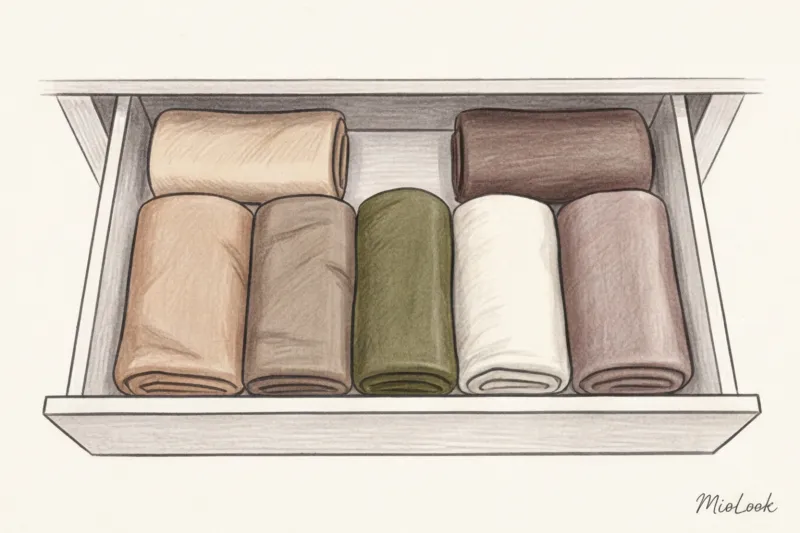
You don't need dozens of headscarves. You need a smart matrix of 7-10 high-quality hijabs that will cover 95% of life situations. Here's the formula for the perfect base:
- Three neutral scarves (to match your skin tone): one a tone lighter than your skin (refreshes), one in the same tone (for a “naked” color effect), one slightly darker (creates facial contouring).
- Two dark bases: Forget about harsh black, unless you're a fiery brunette with high contrast. For most women, deep navy and rich chocolate are the perfect dark base. They look much softer and more luxurious.
- Two accents: Here you can give free rein to your favorite colors (emerald, dusty rose, wine), based on the overall palette of your closet.
MioLook Checklist: How to Choose a Hijab to Match Your Look in 3 Minutes
It's easy to get overwhelmed in the morning when you stand in front of the mirror. To automate the process, I recommend running your image through this short filter. (By the way, you can upload your items to MioLook app , and the algorithm itself will suggest successful combinations).
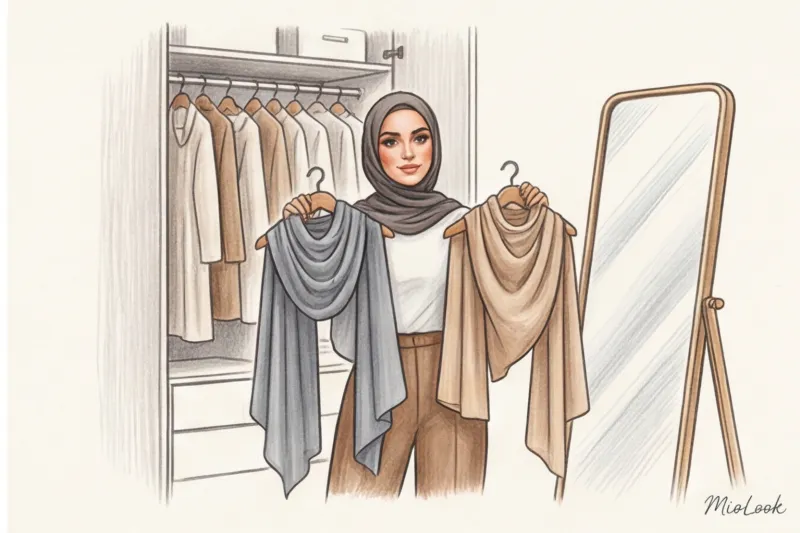
- Step 1: Assess the “temperature” of the outfit. Is your outfit warm (with yellow/orange undertones) or cool (with blue/gray undertones)? The hijab should either match the color temperature or deliberately clash with it for contrast (in which case you'll need a unifying element, like a bag in a matching shade).
- Step 2: Check the contrast level. Can your face handle a bright neon scarf against a pastel trench coat? Fair Limit: If you have soft features and a low-contrast appearance, the abrupt transition from a white coat to a black scarf will wash you out. Opt for soft gradients.
- Step 3: Contrast textures. Is your outfit shiny (silk, satin, sequins)? Choose a matte scarf. Is your outfit matte (wool, heavy cotton, linen)? Choose a scarf with a light satin finish or a pronounced weave.
- Step 4: Take a selfie in daylight. Our brains often play tricks on us when we look in the mirror under the yellow light of hallway bulbs. A phone camera by the window will instantly show us if the color of a scarf makes our face look tired or cuts off our silhouette.
A well-chosen hijab isn't about restrictions; it's about the architecture of your style. Stop trying to mathematically match your headscarf to the color of your shoes or the print on your dress. Focus on the quality of the fabric, the contrast in textures, and the harmony of shades within the silhouette. When you begin to perceive the hijab as a standalone, luxurious element of your silhouette, your wardrobe will take on a whole new, prestigious quality.