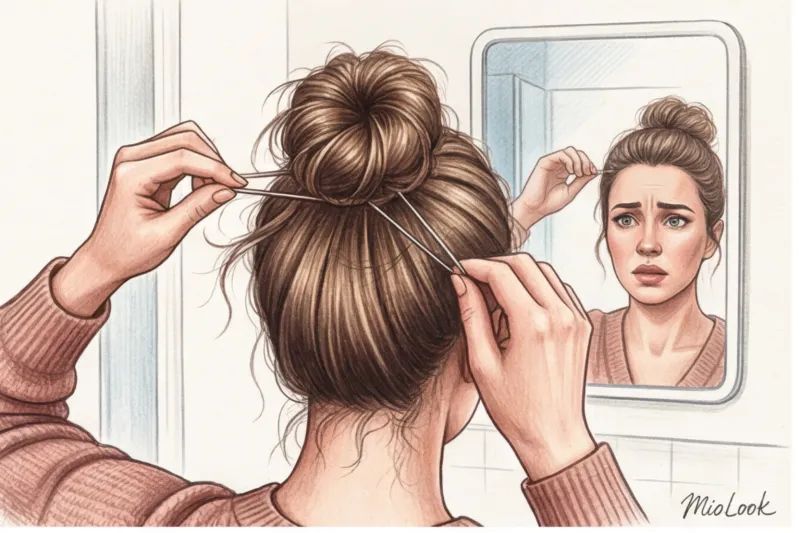
You know what annoys me most as a stylist and colorist about popular social media tutorials? The model ties her hair tightly with an elastic band at the crown and then aggressively starts pulling strands out to create the illusion of a casual look. For healthy hair, this is stressful, and for weakened hair, it's a surefire way to baldness.
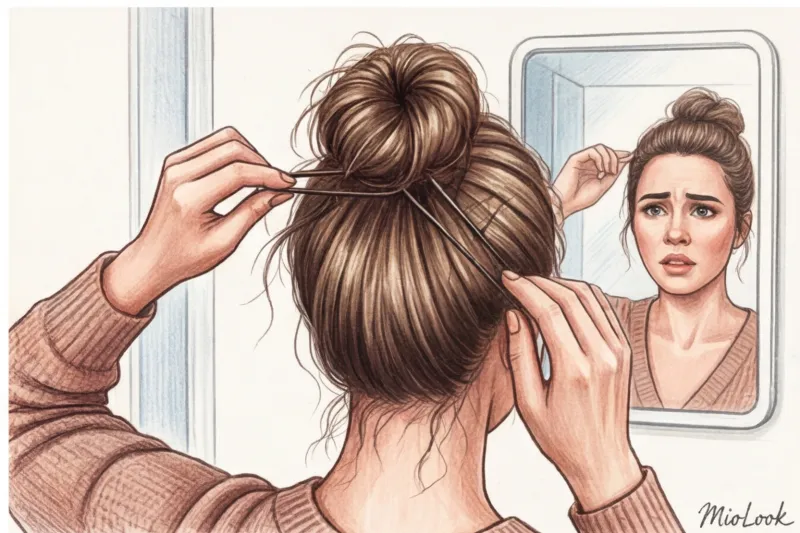
When I was faced with severe hair loss after the birth of my first child, my usual tight bun became my main enemy. Wondering, How to make a messy bun and without losing my hair, I completely revised the architecture of this basic hairstyle.
A proper bun holds not because of a tightly cinched elastic at the roots, but because of texture (friction) and a well-balanced style. We discussed the physiology of hair loss and how to restore volume in more detail in our guide. "Quick Hairstyles for Moms: Hair Health and Beauty" And today I'll show you three ways to style your hair in 45 seconds so it looks expensive, lasts all day, and won't ruin your hair follicles.
Anatomy of a Disaster: Why Your Regular Bun Is Killing Your Hair
Let's talk physics. One of my clients, Katya (a mother of twins), came to me complaining of a thinning hairline on her forehead and temples. Over the course of two years of maternity leave, she had become accustomed to pulling her hair back into a tight bun on top of her head every day. The trichologist's diagnosis was predictable: traction alopecia.
According to the International Society of Hair Restoration Surgery (ISHRS, 2023), prolonged mechanical tension on follicles causes microinflammation. If this is applied to Telogen Effluvium (natural postpartum hair loss, when up to 30% of hair goes into a resting phase), we get a disaster.
"Pulling strands out of a tight ponytail is the worst thing you can do to your cuticle. You're literally ripping the hair scales against the grain," a trichologist friend of mine always says, and I agree with every word.
Another hidden danger is wet hair. The cortex (the inner core) of wet hair can stretch by up to 30%. If you twist wet strands into a bun, you'll distort them. When they dry, they'll try to return to their original shape, but the hair tie won't let them. The result? Breakage along the length.
Stylists' secret: texture preparation in 10 seconds
Many people complain, "On my clean hair, a messy bun falls apart after five minutes, and I have to tighten it." This is the fundamental mistake.
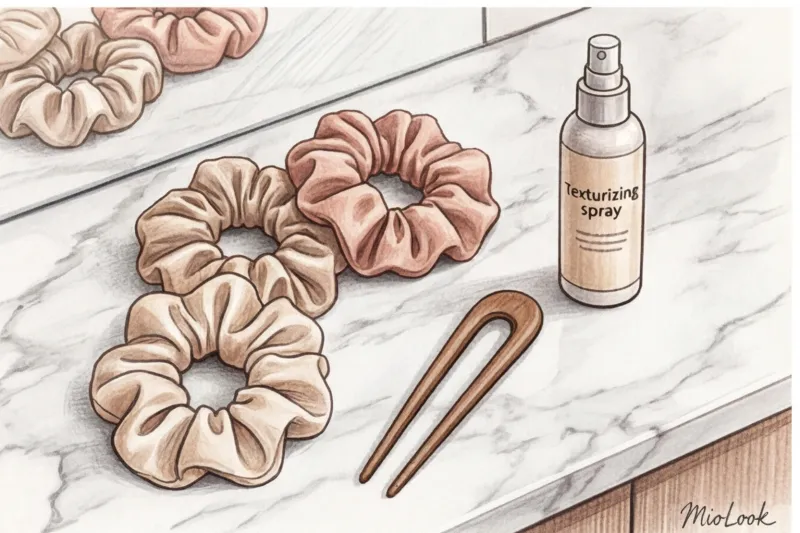
The basis of any casual hairstyle is the law of friction. Hair slides on smooth, freshly washed silk. To keep the bun in place without tension at the roots, we need to create an invisible frame. For this, I use a texturizing spray or dry shampoo. You don't have to buy a premium Oribe—Battiste (around €5-€8) or mid-priced brands like Ouai (around €25-€30) are excellent workhorses.
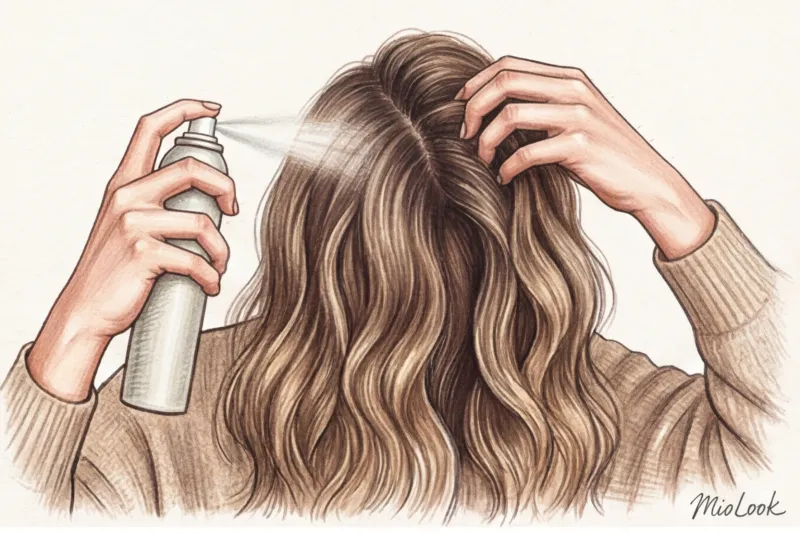
Quick life hack: Spray the product onto your roots and massage your scalp vigorously for 10 seconds with your fingertips. You'll instantly achieve root volume. And most importantly, ditch the brush. For the perfect messy bun, comb your hair with your fingers only. Fingerprints create that natural, slightly ribbed texture that a brush can't replicate.
Tired of monotonous hairstyles?
Try MioLook for free: A smart AI stylist will find the perfect look for your face type and hair texture in seconds.
Get access — €0.99 onceMethod 1: How to Make a Messy Silk Figure Eight Bun
If you have fine, damaged, or post-baby weakened hair, this method is for you. All you need is a voluminous silk scrunchie. Forget the thin elastic bands—three years ago, I threw them all out because they kept tangling in my fine, bleached hair.
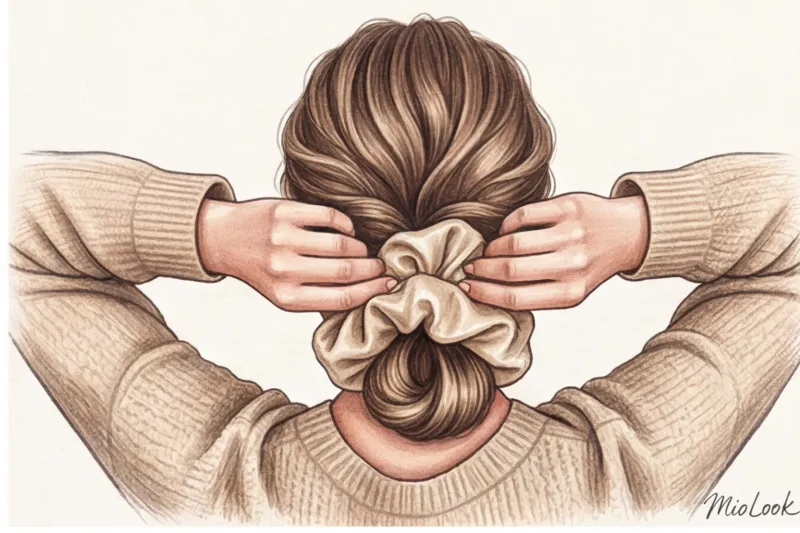
- Step 1: Gather your hair into a ponytail at a comfortable height without pulling on the roots.
- Step 2: Thread your hair through the silk elastic once.
- Step 3: Twist the elastic (make a figure eight) and on the second turn pull the tail out only halfway, leaving a loop.
- Step 4: Loosely wrap the remaining loose end of your hair around the base of the loop and tuck the tip under the elastic.
An important nuance: There should be some air between the elastic and your scalp (about 1-2 centimeters of space). If you can easily slide two fingers under the base of the bun at the back of your head, you've done it correctly.
Method 2: French Hairpin in 30 Seconds (No Rubber Bands!)
And here we come to a counterintuitive insight. This method is a lifesaver for those with thick, heavy hair. A regular hair tie can't support the weight and slips down, forcing you to redo your hair five times a day. The solution? Ditch the hair ties altogether.
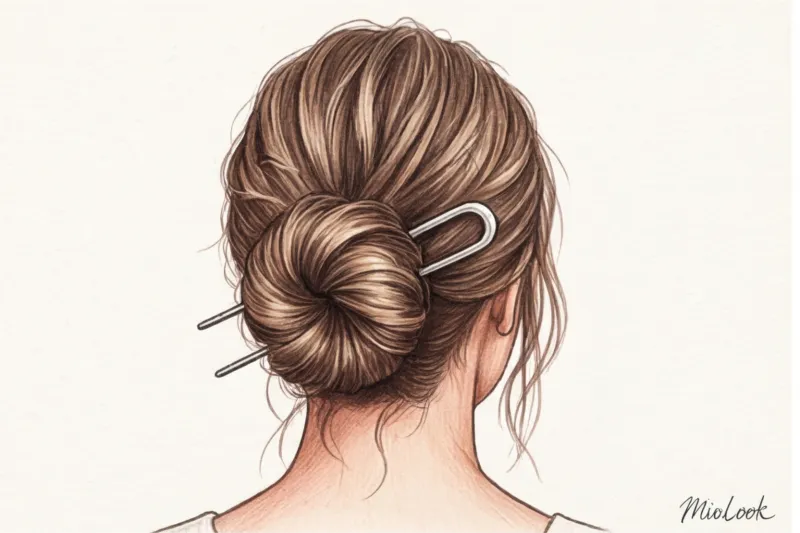
One well-placed metal or wooden U-shaped hairpin (French pin) holds a heavy mass of hair better than a dozen bobby pins. The physics of the process are simple: the pin distributes the weight along its entire length within the bun, balancing the structure.
- Gather your hair with your hands at the back of your head (low or medium bun).
- Twist them into a light rope and wrap it around its axis once or twice, forming a snail.
- Take the pin with the teeth facing up and catch a little hair from the very edge of the bun (just the edge!).
- Pull the pin towards your scalp, flip it 180 degrees (the teeth are now facing down) and push it through the base of the bun.
This move requires 2-3 practices in front of a mirror, but once your hands memorize it, it'll take exactly 30 seconds to get ready. This technique automatically creates the "expensive casualness" that street style heroines wear. If you want to create a wardrobe that perfectly complements this sophisticated aesthetic, I recommend uploading your items to MioLook — the app will help you create stylish casual looks without any extra effort.
Don't know what to wear with your new hairstyle?
Try MioLook for free: Start creating perfect looks with AI right now.
Get access — €0.99 onceMethod 3: "Stylist's Knot" for Short Hair and Bobs
What should moms do if they freaked out and cut their bob, and now their hair won't stay in place at the top, but instead falls out at the back? I have a special technique for shoulder-length hair.
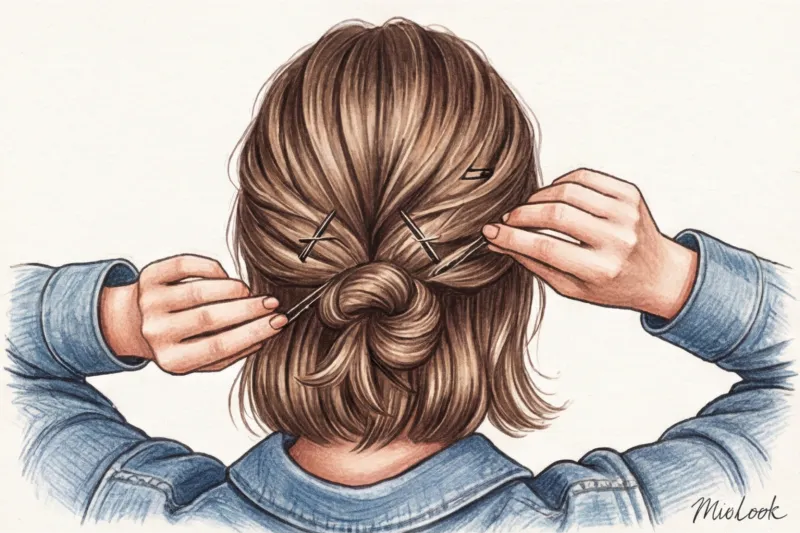
For the bob, we make a low bun, but use the “shading” method with invisible pins instead of elastic bands.
- Divide the hair at the back of your head into two equal parts (as for two ponytails).
- Tie them in a regular knot (like tying shoelaces). If the length allows, make a double knot.
- Press the knot firmly against the back of your head and secure it with 3-4 short bobby pins, crisscrossing them. The crisscross pattern creates a secure lock.
Don't try to sleek the short bottom strands that don't reach the top of the bun with hairspray. Leave them loose! Lightly spray them with a texturizing spray—this will make them look more intentional than disheveled.
A common mistake: how to properly release strands of hair near the face
The most important rule that is not mentioned in tutorials: the strands near the face are separated BEFORE that , how you secured the bun.
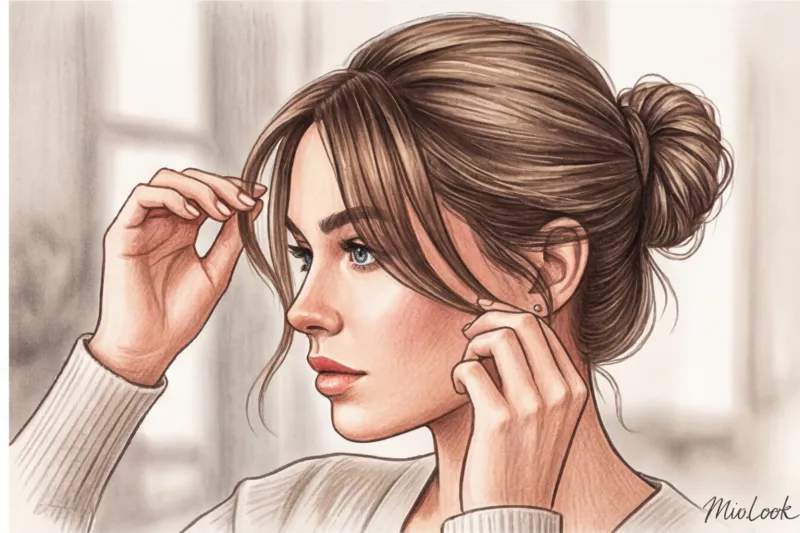
If you've already secured your bun with a pin or elastic and then begin pulling on the hair at the temples, you'll disrupt the tension of the entire structure (and damage the hair follicles, as we discussed at the beginning). Select a couple of thin strands at the temples beforehand. If they hang straight, simply twist them around a finger slightly dampened with water, or straighten them with a flat iron in one gentle motion away from your face. This will visually narrow your face and add softness to your look.
Checklist: 5 Golden Rules for Safe Express Styling
To reinforce this material, I've put together a short checklist for you. If you follow these five rules, you'll forget about the problem of broken hair near your face.
- 1. Never go to bed with your hair in a bun (even the most casual one). Friction from a pillowcase and securing it with an elastic band can cause hair breakage overnight. At night, only a loose braid or a silk cap are recommended.
- 2. Alternate heights. Don't wear your hair in the same bun every day. High today, low at the nape of your neck tomorrow, and loose the day after.
- 3. Throw away tight, thin rubber bands with metal fasteners. Metal is a cuticle guillotine. Switch to silk in the €10–€25 price range (the investment will pay off in healthy hair).
- 4. Do not brush wet hair with plastic brushes before styling. Let them dry 80% before you start creating the bun.
- 5. Listen to your body. If after creating a bun you feel the slightest tension or pain in your scalp (the so-called "tight ponytail syndrome"), immediately redo your hairstyle.
Your perfect look starts here
Join thousands of users who look flawless every day with MioLook. A virtual fitting room and smart wardrobe in your pocket.
Get access — €0.99 onceBeauty That Doesn't Require Sacrifice: Your New Standard
Our appearance is inextricably linked to our psychological state. When you're a mom on maternity leave, working remotely, or simply running late for the office in the morning, there's no time for complicated hair styling with a brush. But that doesn't mean you have to sacrifice the health of your hair or feel unkempt.

A quick bun isn't a sign of fatigue. With the right texture, subtle volume, and quality accessories (silk or pretty pins), it becomes a stylish statement piece. Try the "silk figure eight" method or master the French pin tomorrow morning. I guarantee you'll feel a huge difference in how your scalp feels, and in the mirror you'll see that effortless French style we all strive for.