Have you ever noticed that at Paris Fashion Week, glossy magazine editors often look more luxurious than A-listers, even though they might be wearing mass-market jackets? Over 12 years of working as a fashion journalist and stylist, I've learned an insider secret: the visual cost of an image almost never correlates with the price tag. For decades, the industry has taught us that status is bought with logos, but in reality, it's built according to the laws of physics and architecture.
Many of my clients ask, How to look expensive and elegant , on a very limited budget. The answer lies not in buying a tenth beige turtleneck, but in understanding how fabric weight, changing hardware, and fine-tuning alter body proportions. We discussed the fundamental approach to status looks in more detail in our The complete guide "Royal Style in Clothing: Secrets of Elegance" Today, we'll explore practical tools: how to deceive the eye and make mass-market pieces look like bespoke wardrobes.
Cut Architecture vs. Brands: Why Fit Matters
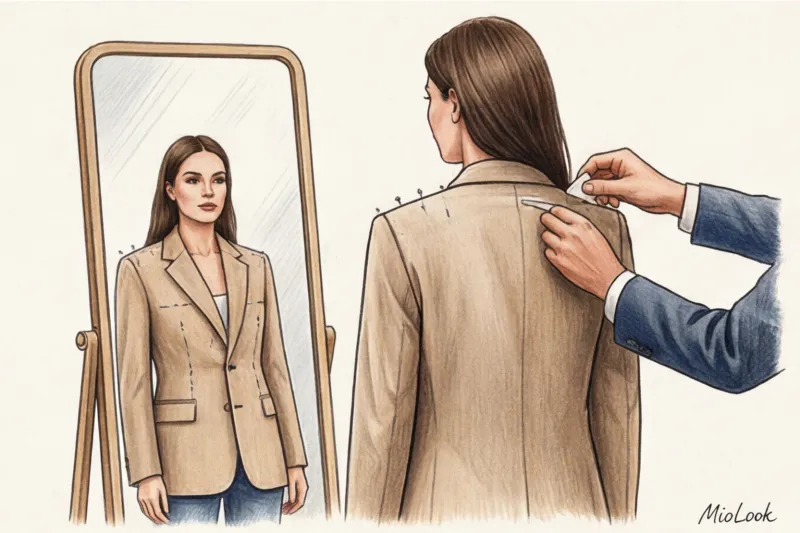
Let's debunk the biggest myth: luxury isn't determined by the label on the back of the neck, but by how a garment interacts with gravity. If you look at the men's tailoring principles of London's iconic Savile Row, adapted for women's wardrobes, you'll notice the rule of "hard points." These include the shoulders, waist, and hem. Clothes with a loose, sagging shoulder line will instantly make a look appear slouched and unsure.
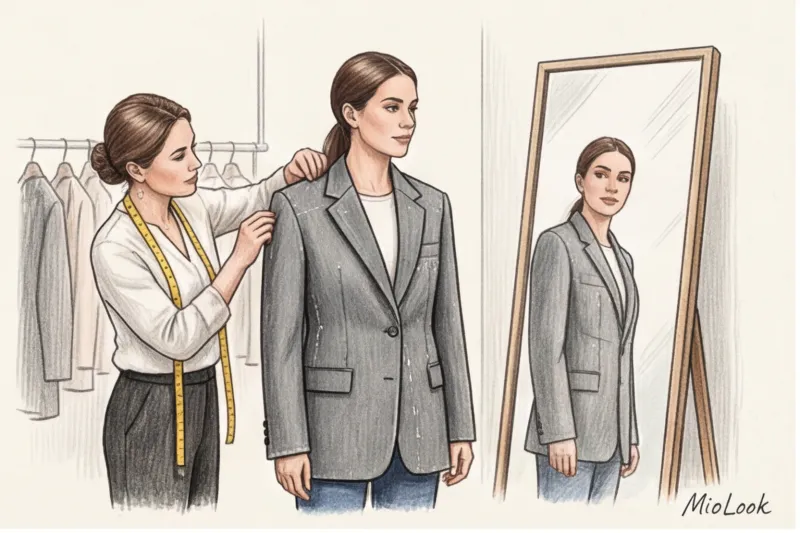
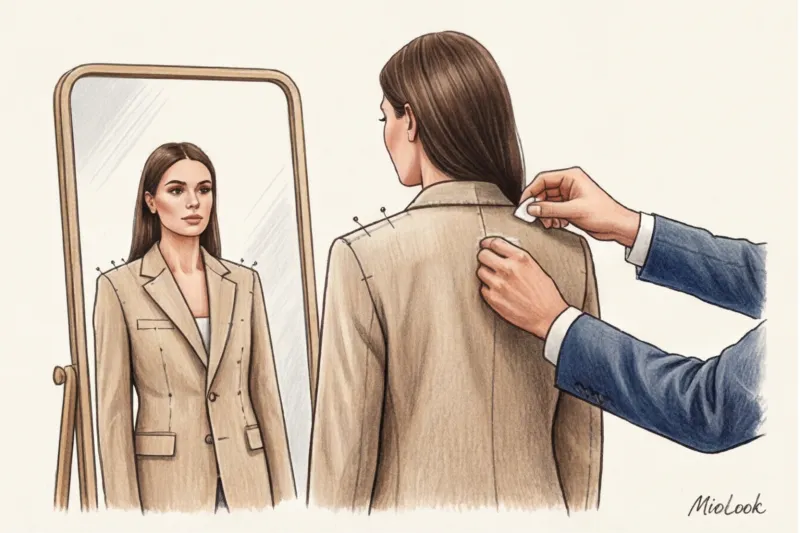
Royal protocol for power dressing has a strict rule: clothes must not deform when you move. Just look at Kate Middleton's outfits. You'll never see her wearing a coat or jacket where the fabric is taut around the buttons (creating unsightly folds). Such tautness is a sign of poor tailoring and a loss of visual status. My main advice: it's better to buy a jacket at Zara for €50 and pay a tailor €30 for a perfect fit of the sleeves and darts than to buy a designer jacket for €300 that fits "almost" perfectly.
The secret of glossy editors: mass-market adaptation
What exactly do we take to the tailor? First, the sleeves. Jacket sleeves should be 1–1.5 cm below the shirt cuff or end just at the wristbone if worn bare. Second, the placement of buttons—mass-market garments often have a mid-waist, and moving a button a couple of centimeters dramatically changes the silhouette. Third, the fit should be center-back to eliminate the "bubble" above the waist.
But it's important to be honest here: this doesn't always work Never attempt to alter garments with complex armholes made from cheap, thin fabrics, especially chiffon or loose knits. Altering the armhole design will cost more than the garment itself, and cheap fabric will simply unravel at the seams after being sewn with a machine.
Your perfect look starts here
Join thousands of users who look flawless every day with MioLook. A smart AI stylist will suggest looks based on your wardrobe.
Get access — €0.99 onceThe Illusion of Wealth: Fabrics That Look More Expensive Than They Are
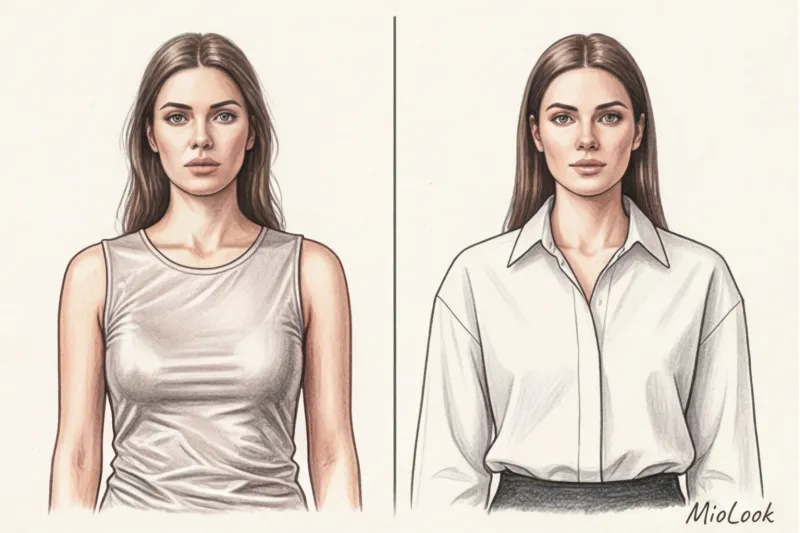
According to a 2024 WGSN study on tactile trends, consumers judge a garment's status in a split second solely by its texture and drape. In the industry, this is called visual weight theory and is determined by the fabric's density (GSM—grams per square meter). Cotton below 130 GSM will always be see-through, wrinkle, and appear cheap. For T-shirts and shirts, look for a density of 180 GSM or higher.
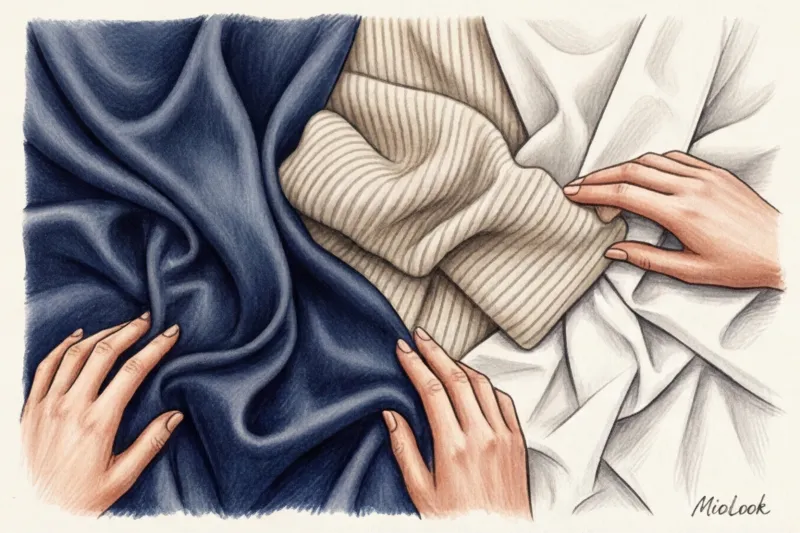
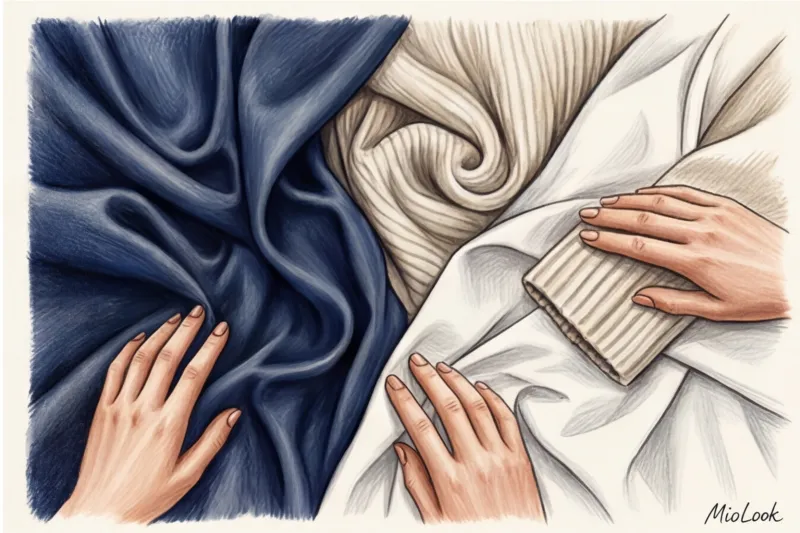
Now here's a counterintuitive fact that surprises many: buying cheap 100% cashmere or the finest silk from the mass market is a fatal mistake. Cheap natural fabrics are made from short-haired materials. This "cashmere," priced at €60, will roll into untidy lumps within a week. Meanwhile, high-quality blended fabrics—for example, dense matte polyester with a crepe effect or heavy viscose—look and wear much more expensive. They hold their shape, don't wrinkle like paper, and don't create that heavy, expensive fold when you walk.
"How do you test fabric in a store? Squeeze the edge of the item in your fist for 5 seconds and release. If the fabric remains wrinkled, leave it on the rail. If it shows a springy "bounce" and straightens out, it's a great investment."
Safe textures that signal status in the budget segment include tweed (it hides unevenness in the cut well), thick satin (not to be confused with cheap, shiny satin), and smooth suit wool or its high-quality equivalents.
Color: How to combine shades to look expensive and elegant
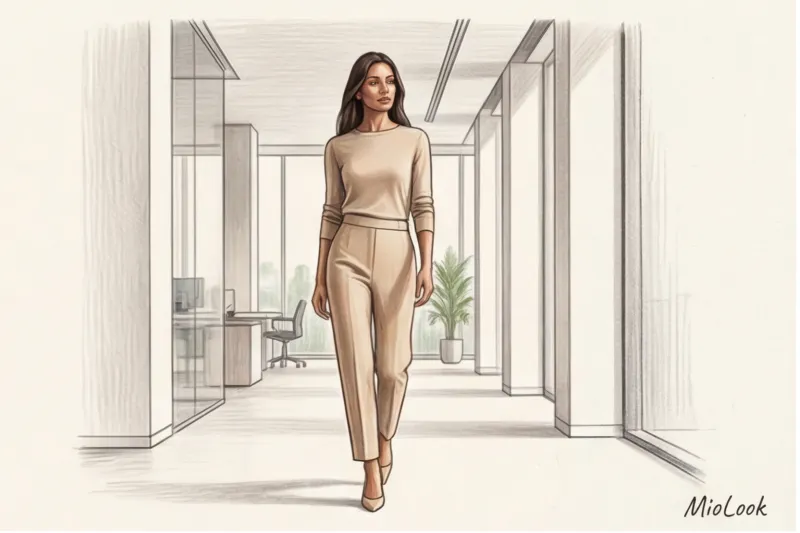
Monochrome, or the Total Look, is the fastest styling trick for instantly pulling together an outfit and hiding the price point of your clothes. By elevating the silhouette with a single column of color, you draw the viewer's eye continuously, which is interpreted by the brain as elegance. Look at the shows of The Row or Jil Sander – they masterfully use this technique, which is easily recreated with a budget of €100.

The main rule here is to avoid "pure" spectral colors. Bright blue, vibrant red, or piercing green almost always look flat in inexpensive versions. Choose deep, complex shades with added gray or black pigment. Not just blue, but cobalt or navy; not red, but burgundy or wine. Also, avoid bright, contrasting prints in the budget segment. The reason is purely technical: cheap pattern printing never meets at the seams, which immediately reveals the low production cost.
The Rule of "Complex" Primary Colors
Black, contrary to popular belief, is a color that demands a lot of fabric quality. Cheap black cotton quickly fades and becomes covered in a whitish fuzz. Replace it with a shade of black. midnight blue (midnight blue) or dark chocolate. They serve the same function as a base color, but look a hundred times more refined.
The magic lies in the shade camel Camel for outerwear. According to the PANTONE 2025 report, warm sandy-camel shades are subconsciously associated with classic cashmere and heritage brands, even if the coat is made of inexpensive wool.
Ready to get started?
Try the MioLook free plan—no commitments required. Digitize your belongings and learn how to organize them into status capsules.
Get access — €0.99 onceHardware as a Traitor: What Gives Away a Cheap Item and How to Fix It
Nothing screams savings like thin, shiny plastic buttons with a mother-of-pearl finish and "gold" zippers with the cheap, yellow sheen of a samovar. Hardware is the first thing mass-market brands cut back on to maintain profit margins.
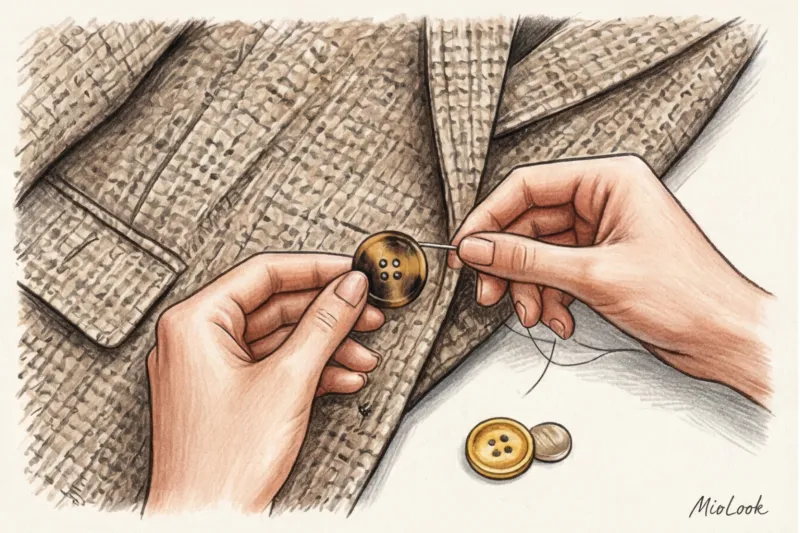
One of my clients once brought in a basic double-breasted H&M coat for €130 to be sorted. It was well-cut, but completely lacked character due to the hardware. We went to a Parisian flea market, found a set of heavy vintage brass buttons for €20, and took it to a tailor. This small investment worked wonders: the coat now looks like it came from a boutique on Avenue Montaigne. Replace plastic on cardigans and jackets with horn, matte metal, or fabric-covered buttons.
What if the hardware is difficult to replace? Look for minimalism. A hidden closure (a pop-up closure), no visible zippers, or a tie belt instead of a belt with a cheap buckle are the safest choices for budget-conscious purchases.
Status minimalism in accessories: the rule of one accent detail
Let's be clear once and for all: counterfeits and "brand-name" replicas are an absolute no-no. Nothing cheapens an image more than a fake Chanel bag or a belt with a huge logo buckle of dubious origin. True status always whispers, never shouts.
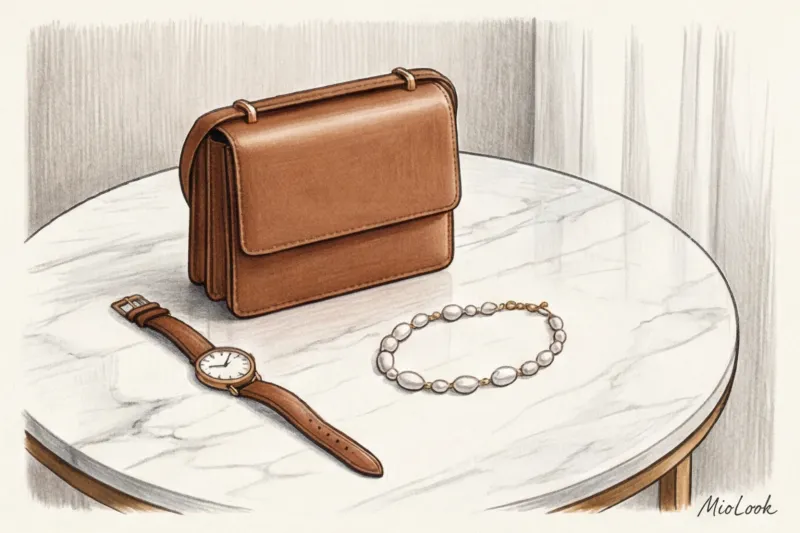
A 2023 study on luxury perceptions by McKinsey confirmed that structured accessories without logos are perceived as more expensive. The formula works: "structured bag + rigid shoes." Your bag shouldn't resemble a shapeless sack when empty. Clean geometric lines, a rigid base, and matte leather (or high-quality faux leather) always look premium.
As for jewelry, opt for smooth metal (gold or silver) or irregularly shaped baroque pearls. Avoid rhinestones and intricate embellishments—in inexpensive designs, stone settings always look crude. We discussed more nuances in this article. "Status Accessories: What Marks a Successful Expert".
Royal care: the invisible foundation of a luxurious look
Even luxurious silk from Loro Piana looks like a doormat when it's wrinkled and dust has settled on the shoulders. The royal look is, first and foremost, meticulous, almost sterile perfection.
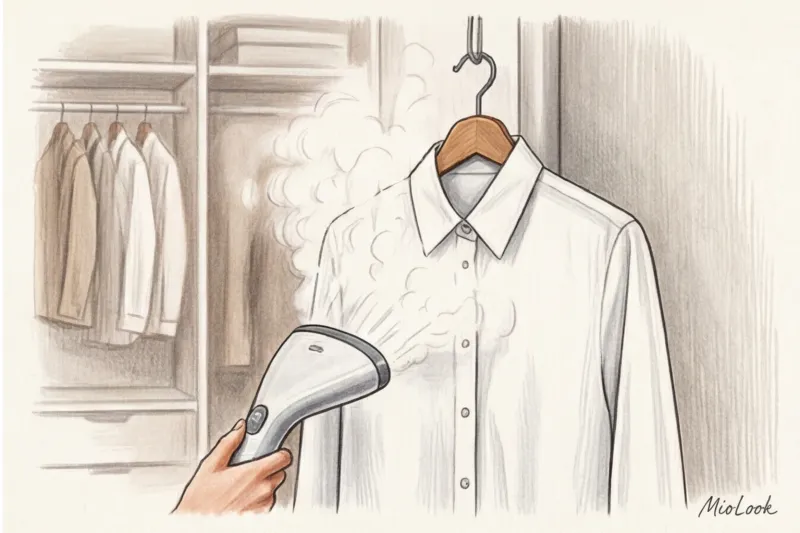
A good handheld steamer should be your best friend. Unlike an iron, which can leave shiny marks on dark fabrics and flatten the fibers, steam restores the fabric's volume and pristine appearance. Another essential item is a pilling machine. Use it on sweaters and knitwear after every third wear.
Don't forget about scent. The scent of your clothes directly affects their perceived value. Cheap chemical fabric softeners with the scent of "alpine meadows" ruin the aura of elegance. Use neutral laundry detergents and invest in a textile mist with notes of cedar, bergamot, or white musk.
Checklist: 5 steps to a visually expensive wardrobe on a mass-market budget
To summarize, let's translate this theory into a concrete action plan. Here are 5 rules to apply every time you shop:
- Buy one size larger. There should be some air between the body and the fabric. A tight-fitting fabric that gathers into horizontal folds will always be forgiving.
- Invest in a tailor. Make it a rule: set aside 20–30% of the price of a mass-market item for tailoring services to ensure a perfect fit in length and waist.
- Cut off all excess. Thin belt loops on dresses, cheap belts that come with outfits, unnecessary bows and embellishments—remove them ruthlessly.
- Choose dense textures. Look for a matte finish and the weight of the fabric. If the item is as light as a feather (and not summer silk), it won't hold its shape.
- Change the fittings. Keep a box of quality metal, wood and horn buttons at home.
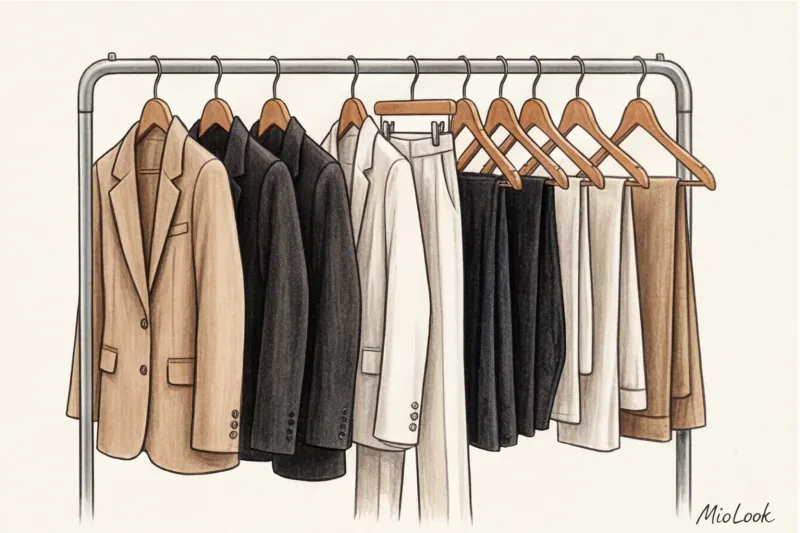
Before you run out to the store to buy new things, I highly recommend taking stock of what's already hanging in your closet. MioLook app and digitize your essentials. You'll be surprised, but often you don't need new clothes—you just need to replace the plastic buttons on an old jacket and find the right structured bag to complement it. Elegance isn't about the amount of money spent, but about attention to architecture, lines, and details.