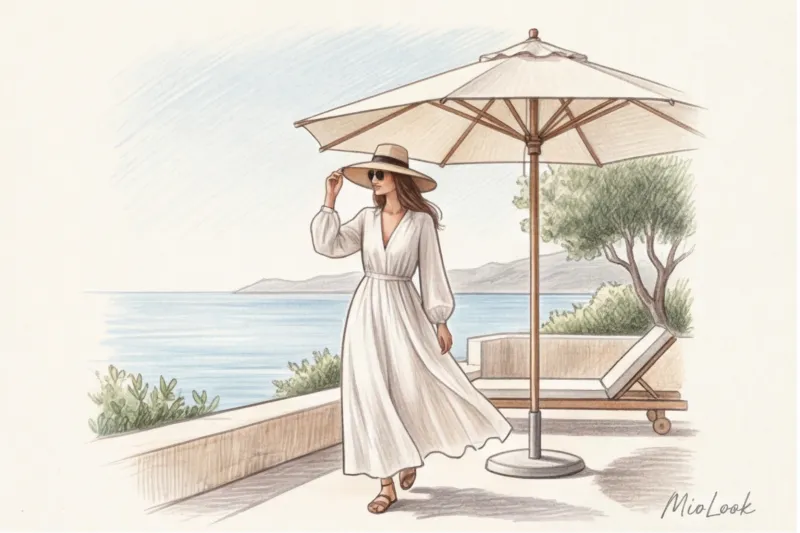
July, Rome, 38°C in Piazza Navona. My VIP client is sitting at a café table in an expensive 100% heavy cotton T-shirt, literally sweltering in the heat. I'm sitting across from her in three layers: a silk top, baggy palazzo pants, and an oversized linen shirt thrown over it—and I'm feeling completely comfortable. "How do you do it? I'm about to melt, and you're wearing so much!" she asked. The answer lies not in magic, but in the physics of fabrics. Proper summer layering isn't a way to complicate an outfit for the sake of a pretty face, but a powerful physiological tool for thermoregulation.

We discussed the origins of this approach in more detail in our The complete guide to modest fashion for summer , where closed-toe clothing is seen as protection and a new aesthetic. Today, I want to explore the mechanics of this process: how to layer items to create the effect of a portable air conditioner. Over 12 years of working as a personal stylist in Europe, I've developed formulas that save even the harshest urban heat.
Cooling Architecture: Why Summer Layering Works Like Air Conditioning
Remember how desert dwellers dress? They never wear tight tank tops with thin straps. They opt for layered, flowing, and covered garments. The secret is creating an air gap between the skin and the fabric. When you put on a tight top, sweat can't evaporate effectively—the fabric immediately becomes damp, clings to your body, and blocks air circulation.
If you're wearing a loose-fitting top (for example, a flowy top and an unbuttoned shirt), your body's movement acts as a cooler. Air circulates between the layers, instantly evaporating moisture and cooling the skin. Furthermore, the top layer protects from direct sunlight. My clients' dermatologists constantly remind them: photoaging is the skin's main enemy, and fabric provides protection better than any SPF cream.
The European approach to summer style has long since abandoned micro-shorts and revealing tank tops in favor of "aristocratic relaxation." The flowing silhouettes of the Italian Riviera convey not only status but also basic comfort.
The Biggest Label Myth: "Natural Fabrics Always Breathe" (Why You Still Sweat)
"I always buy only 100% cotton for the summer, but I'm still hot!"—I hear this phrase at every other consultation. And herein lies the biggest misconception. The fabric composition (cotton, linen, silk) is only half the truth. The other, much more important, half is the density of the weave (fabric weight).
A heavyweight cotton T-shirt from a mass-market store weighing around 200 g/m² retains heat and moisture worse than a high-quality blended fabric. Air simply doesn't pass through the tightly woven threads. At the same time, the modern textile industry has made great strides.
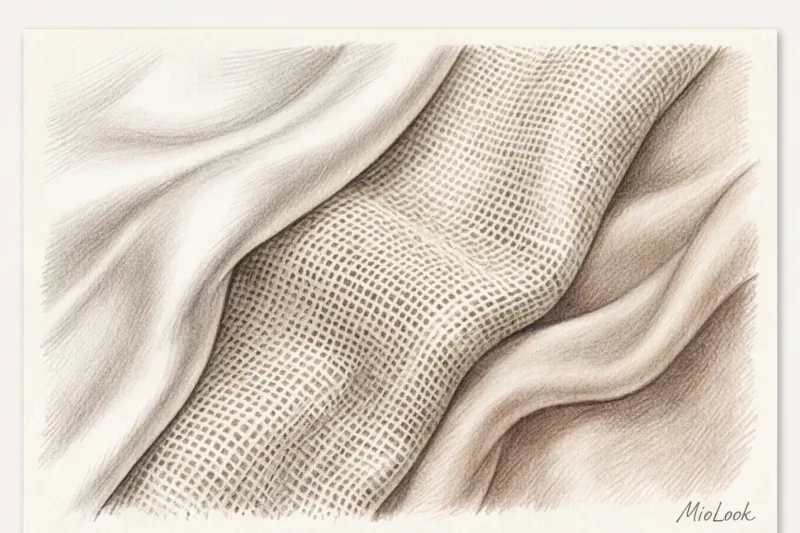
A study by the WGSN Trend Forecasting Institute (2024) on smart fabrics confirms that next-generation synthetic fibers, such as lyocell (Tensel) and cupro, cool the skin 1.5-2 degrees more effectively than dense cotton. They are made from wood cellulose, have a smooth thread structure, and wick away moisture instantly.
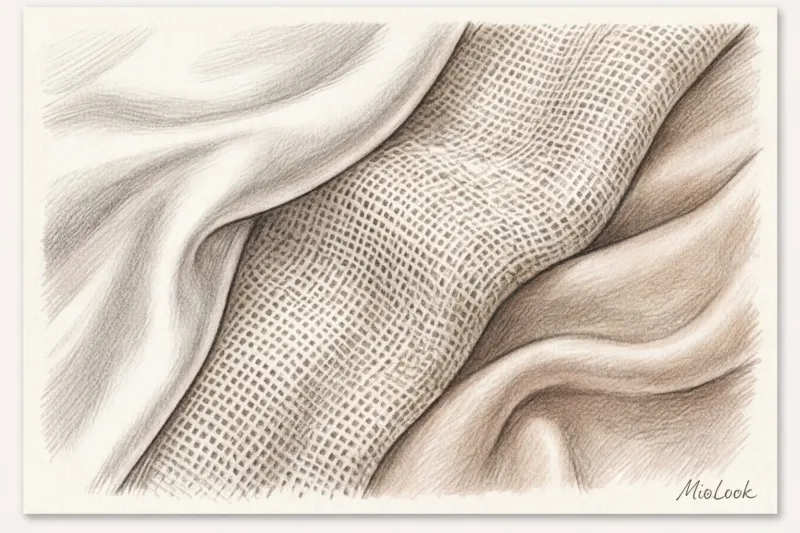
In practice, this means the following: a loose Tencel shirt bought at COS for €70 will perform much better in hot weather than a luxurious but dense silk blouse for €300. The optimal weight of summer linen or batiste for layering is less than 150 g/m².
Access to MioLook for €0.99 — one-time payment
A smart AI stylist will select the perfect layered look from your items, taking the weather into account.
Get access — €0.99 once4 working formulas: how to layer clothes without looking like cabbage
The main fear when layering clothes is adding 5-7 extra pounds. To avoid this, I use the rule of contrasting textures (combine smooth with loose) and strictly monitor the lengths. If the top layer is voluminous, the inner layer should create a clear vertical line.
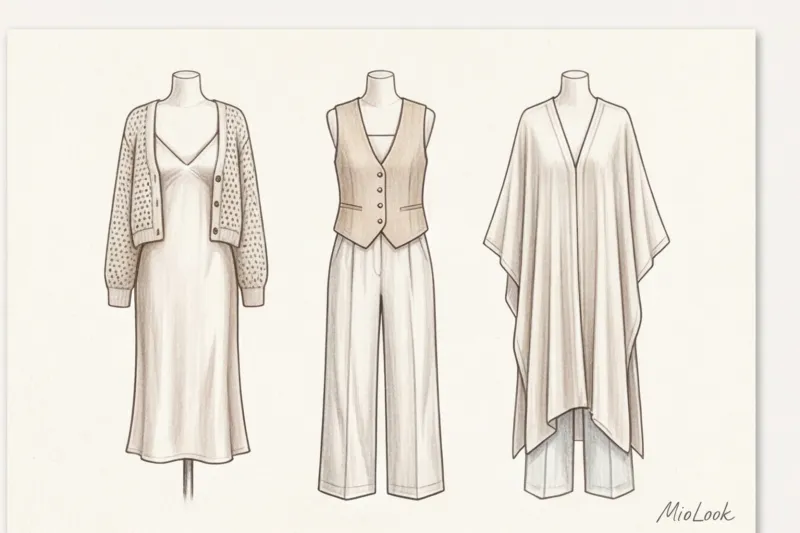
Formula 1: Smooth Base Layer + Structured Linen Shirt
This is a classic that's a lifesaver in any predicament. For a base layer, choose a top with thin straps made of silk, viscose, or Tencel. It's important that the top flows softly over the figure, not constricting it. Layer a men's linen shirt over the top.
Why structured? A shirt shouldn't hang like a rag. It should work like a sail. Pay attention to the collar and cuffs—they should hold their shape. Wear the shirt open or buttoned at the waist, with the sleeves casually rolled up.
Formula 2: Slip Dress + Crochet or Mesh
A bias-cut slip dress is phenomenally flattering. However, during the day in the city, exposed shoulders and back often look out of place, and the sun is merciless. For a top layer, add a cardigan, cape, or crochet top or open mesh.
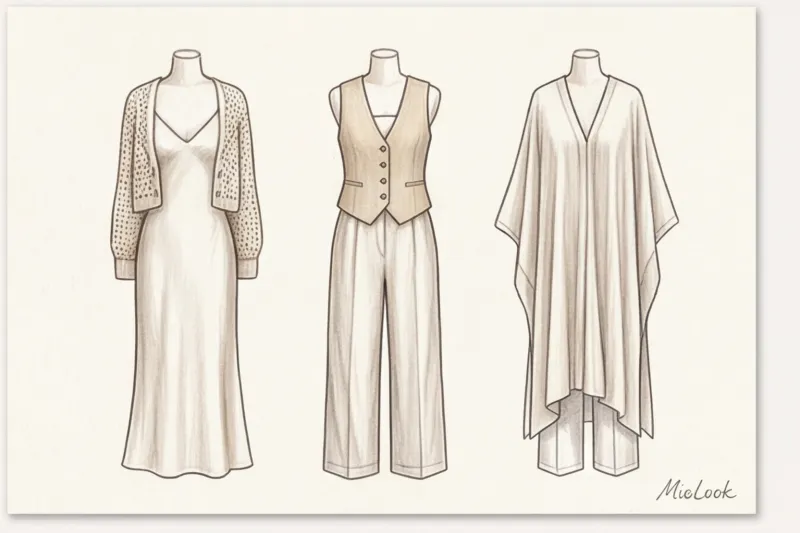
The result is a sophisticated, bohemian look. The mesh creates a visual barrier, concealing problem areas like arms or shoulders, while still allowing 100% airflow.
Formula 3: Crop Top + Linen Blend Suit Vest
A great option for smart-casual looks at the office or a business lunch. Swap stuffy jackets for oversized suit vests. To prevent the vest from itching or chafing (especially if it's linen), wear a sleek, basic crop top underneath.
In this case, the crop top acts as an invisible underlayer, absorbing sweat and protecting the main garment, while the vest creates the necessary status and strict lines.
Style Budget: Which Mass-Market Layered Pieces Look Like a Million Dollars
As a personal shopper, I know you don't have to spend thousands of euros to assemble the perfect summer capsule collection. Mass-market clothing offers excellent options if you know how to read the ingredients and feel the fabric.
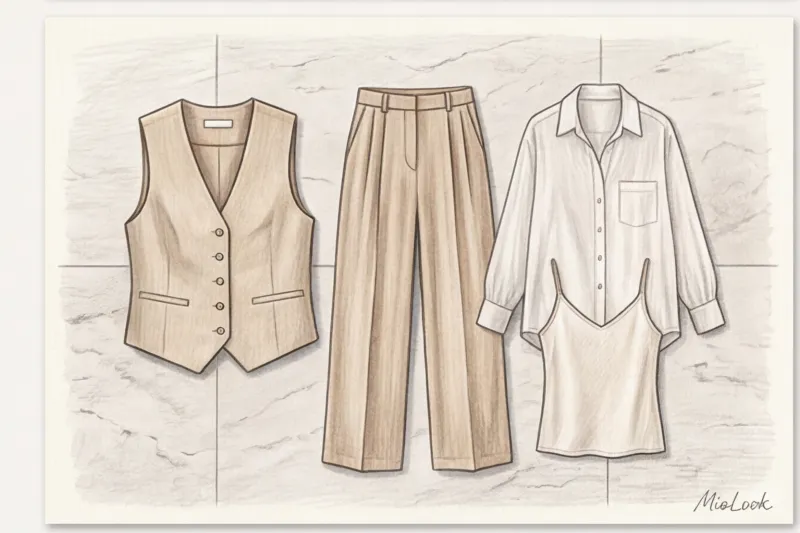
- Where to look for the base: Basic, smooth tops are best found in lingerie brands like Intimissimi (silk or micromodal line, budget around €30–40). They're tailored to your body and fit better than their Zara counterparts.
- Top shirts and vests: Massimo Dutti is the clear winner here. Their linen shirts (in the €50-€70 range) have the right looseness and the stiff collars I mentioned above. Their linen-blend (linen and viscose) suit vests look premium and don't wrinkle as easily as pure linen.
- Complex textures: For mesh and crochet, head to Zara or Mango (€30–€50). These items are often made of cotton and work well as a decorative, breathable layer.
- Dresses and architectural cotton: COS is a Mecca for lovers of poplin, batiste, and Tencel. Their cupro and Tencel slip dresses (around €90–€110) flow like water and will last for seasons to come.
By the way, to avoid buying too much and to understand what to wear with your new linen shirt, I recommend my clients digitize their current wardrobe. By adding their basic pieces to wardrobe at MioLook , you can check right in the store whether a new item will gather into the right layers.
Your perfect look starts here
Join thousands of users who look flawless every day with MioLook. Digitize your wardrobe in just a few clicks.
Get access — €0.99 onceTest Drive in the Fitting Room: 3 Ways to Check for the Greenhouse Effect
They don't teach this in glossy magazines. When I choose clothes for my clients, I conduct three mandatory tests right in the fitting room. And I advise you to do the same.

- Light test. Pick up an item (even a dark one) and hold it up to a fitting room lamp. If you can clearly see the light source through the weave, the fabric will breathe. If the fabric is as dull as cardboard, leave it in the store, even if the tag says "100% organic cotton."
- Test for lining stickiness. Often, a brand will make a great linen dress, but then sew a polyester lining onto it to prevent it from being see-through. This is a disaster. The polyester will ruin all the qualities of the linen. My advice: if the item is perfect, buy it, but take it to a tailor to have the lining removed immediately. Instead, wear a thin viscose slip.
- Crease test. Squeeze the edge of the fabric in your fist for 5 seconds. Linen will always wrinkle, which is normal. But high-quality linen and Tencel produce a soft, wavy wrinkle that recedes with body heat. If the fabric has hard, sharp creases, like paper, it will be uncomfortable to move in.
Important limitation: My layering advice does NOT work if the humidity exceeds 85% (for example, in the tropics or Asian megacities during the rainy season). In such conditions, sweat evaporation is physically impossible, and any air gap will turn into a hammam. Only one layer of high-tech sports fabric or ultra-thin batiste will do the trick.
Checklist: Building a Multilayer Summer Capsule for 30°C+ Heat
Let's move from theory to practice. You don't need a huge closet to create dozens of looks. A well-designed base, where all your pieces fit together like a construction set, is all you need.
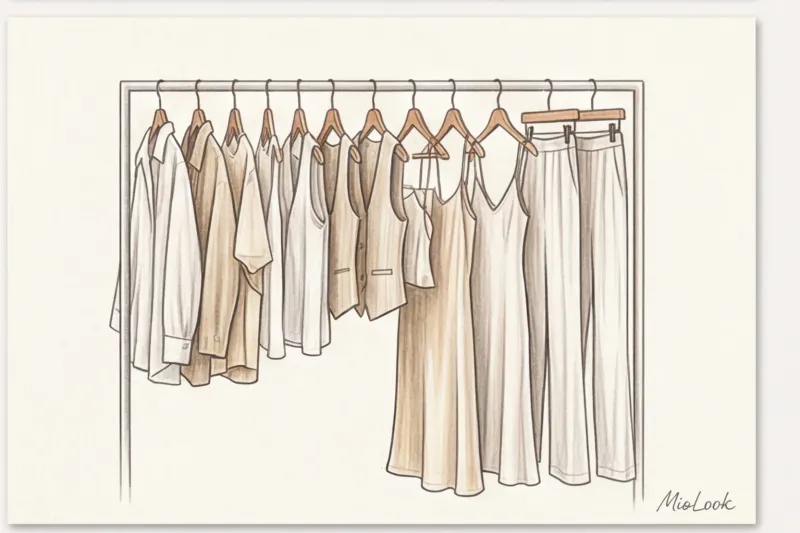
Here is the minimum set (checklist) that should be in your summer wardrobe:
- Bottom layers: 3 tops (one silk lingerie, one basic ribbed cotton, one crop top).
- Upper layers: 1 oversized linen shirt, 1 silk blend kimono or kaftan, 1 structured vest.
- Bottom: Wide palazzo trousers made of cupro or lightweight linen, an A-line midi skirt, loose Bermuda shorts (not tight!).
Summer layering isn't about adding more layers. It's about intelligently managing your body's microclimate through textures, volumes, and lengths. Remember: the key to staying comfortable in the heat is the air between you and your clothes. Choose the right weave, play with the contrasts of smooth and loose, and you'll forget about overheating.