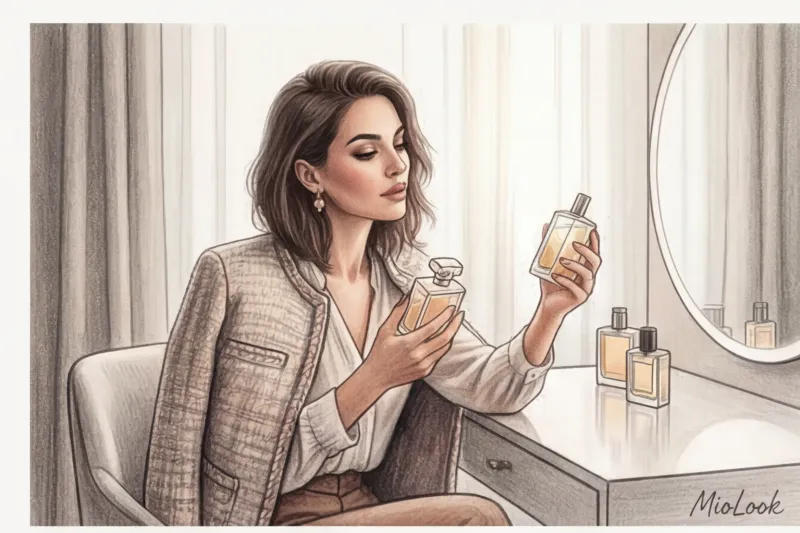
Perfume snobs often roll their eyes when they hear about blending niche fragrances. Their main argument is, "You're ruining the perfumer's genius!" But let's be pragmatic. The moment a drop of perfume touches your neck, your unique skin chemistry, pH level, body temperature, and even hormonal balance are already "breaking" the original formula. Layering (from the English word "layering") layering Layering isn't perfume vandalism. It's regaining control over your sillage.
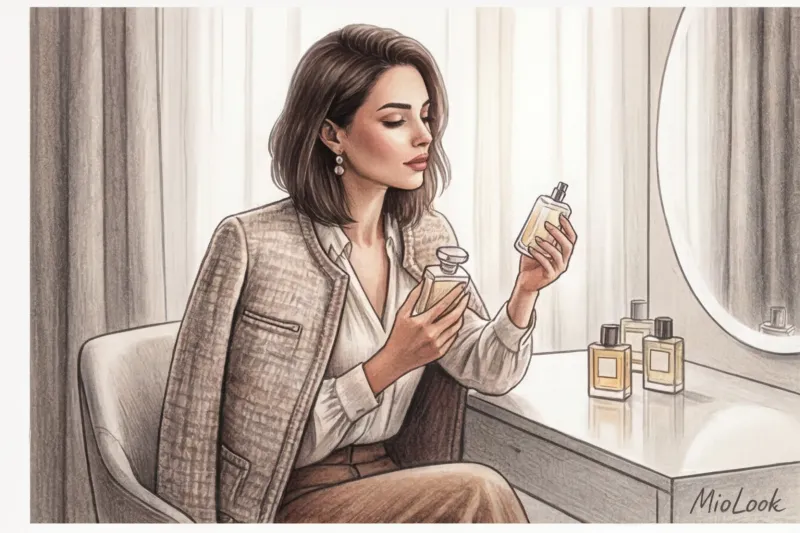
Over 12 years of working as a personal stylist, I've realized one thing: fragrance is as functional a part of a wardrobe as a well-tailored jacket. And the approach to it should be just as utilitarian. We've covered the basic concepts and choosing your first bottles in more detail in our The Complete Guide to Niche Perfumery: Where to Start And today we'll talk about how to make your perfume shelf work at 200%.
Why Mix Perfumes on Yourself: The Philosophy of a Perfume Wardrobe
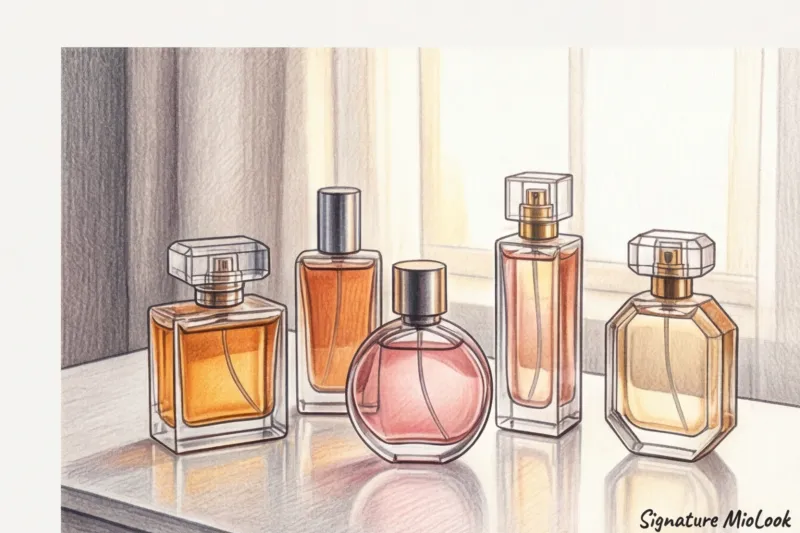
Buying a single, expensive, niche bottle for 200-300 euros rarely solves the problem of finding your own personal style. It's like buying one stunning evening dress: it's beautiful, but you wouldn't wear it to the grocery store or to a morning meeting. A single fragrance is static. Laering, on the other hand, applies the principles of clothing styling to perfume: we take a "base" and add "accents."
Let's do the math. On average, 1 ml of a good niche perfume costs between 2 and 5 euros. If you have three bottles (A, B, C), you can wear them individually. But if you know how to mix perfumes on yourself, these three bottles turn into seven unique compositions (A, B, C, A+B, A+C, B+C, A+B+C). Your cost per wear The cost per scent is rapidly falling, while variability is growing. Instead of buying a new perfume when you get tired of the old one, you simply change its scent with a different layer.
Layering is the perfect tool for those who want to smell expensive and unique, but aren't ready to buy out half a perfume boutique.
Basic Layering Rules: How to Avoid Chaos in a Niche
To prevent layering from becoming a cacophony, it's important to understand the physics of the process. According to cosmetic chemists, fragrance longevity and development depend on the volatility of its molecules. Citrus essential oils (such as bergamot or lemon) have low molecular weights. They evaporate from hot skin in 20–40 minutes. However, heavy resins, oud, or musk can linger on fabric for up to 48 hours.
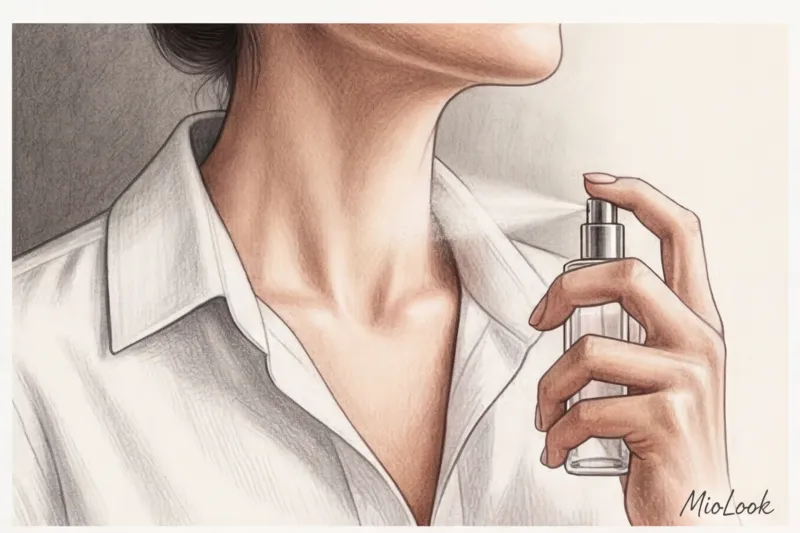
Preparing your skin is 50% of success. Perfume should be layered over a moisturized base. A simple drugstore life hack works well for me: use a basic body lotion with ceramides (fragrance-free) as a primer. Apply it to your pulse points 5 minutes before applying perfume. The oily base will "seal" the molecules, and even a light colon will last 3-4 hours longer.
Molecular weight rule: heavy first, light second
The main technical rule of layering: First we apply a thick layer, then a transparent one Oud, amber, leather, rich vanilla, and tobacco—this is your foundation. Let the first layer settle on your skin for a couple of minutes. Then, spray on lighter notes: citrus, greenery, aquatic notes, and tea accords.
What happens if you break this rule? If you apply heavy, oily oud over crystalline bergamot, the heavy molecules will simply crush the lighter ones. You'll get a dirty, smeared effect, where the top notes are suffocated before they have a chance to blossom.
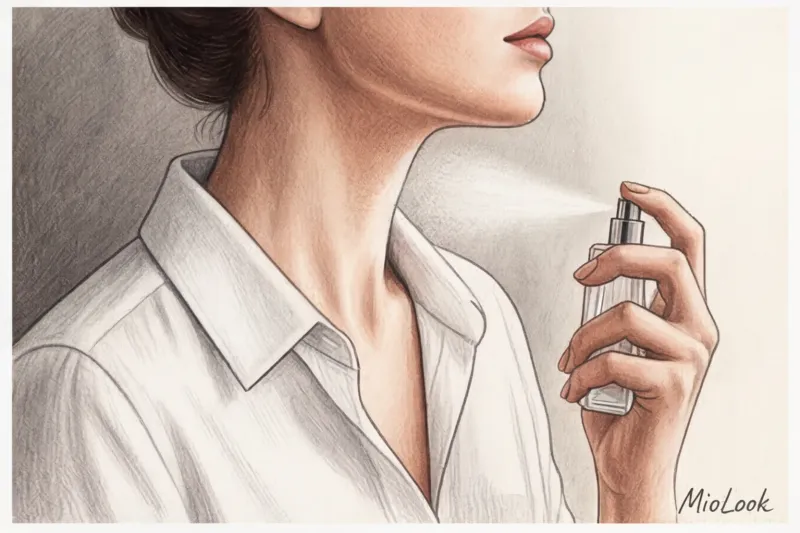
The Perfect Canvas: Molecular Fragrances Like a White Shirt
Molecular perfumery (built around synthetic molecules like Iso E Super or Ambroxan) is your basic white T-shirt of the fragrance world. Bottles like Escentric Molecules or Juliette Has a Gun Not a Perfume are designed to be amplifiers.
I often conduct this experiment with my clients: we take an affordable but beautiful mass-market perfume (for example, from the Zara and Jo Malone collaboration) and layer it over a molecular base. Ambroxan draws depth from the inexpensive scent, adds dimension, and doubles the longevity. No one will ever guess you're wearing a 25-euro perfume.
Your perfect look starts here
Join thousands of users who look flawless every day with MioLook. Your smart wardrobe is now on your smartphone.
Get access — €0.99 onceHow to Mix Perfume on Yourself: 4 Foolproof Formulas for Beginners
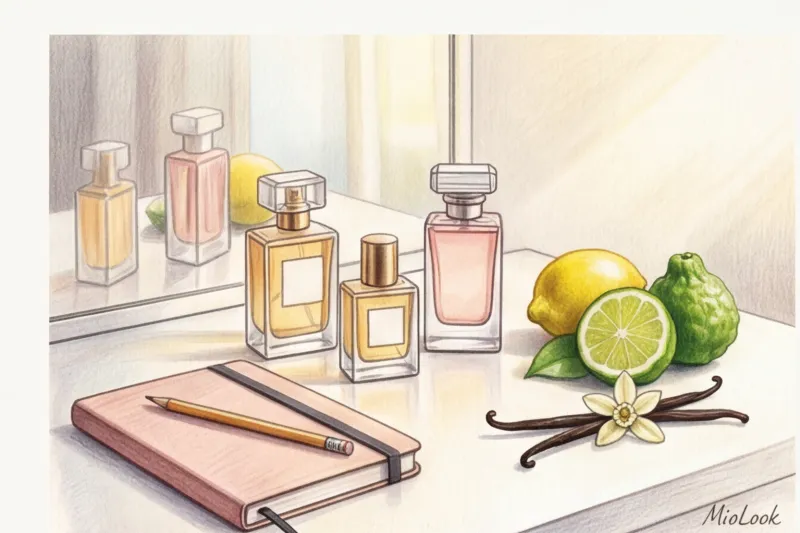
Concept Fragrance Combining (Fragrance combinations) were popularized by the British house Jo Malone London, but these formulas work with any brand. Here are four tried-and-true recipes.
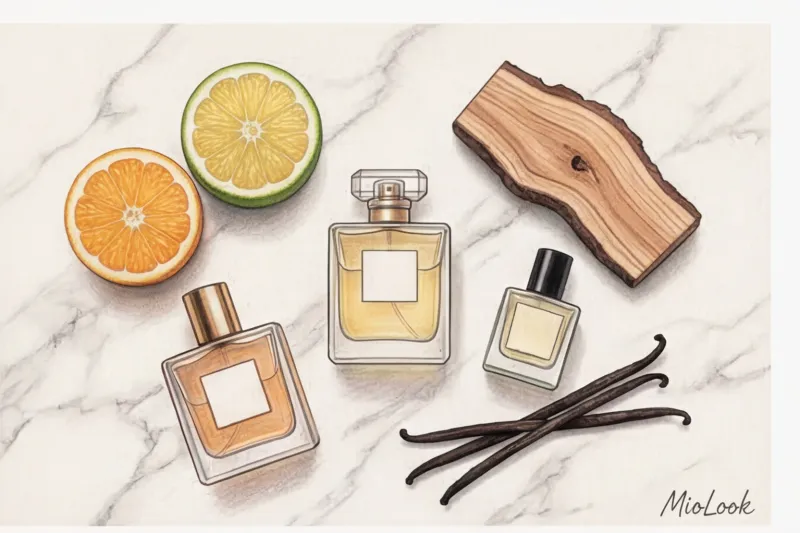
Formula 1: Citrus + Wood (Perfect for the office)
I had a lawyer client who adored a thick, animalic oud perfume. But wearing it to court was impossible—it literally filled the conference room, causing irritation. We solved the problem with layering: we applied a microdose of oud and then generously poured an icy, citrusy, grapefruit-infused cologne over it. The oud provided a status base, and the citrus added distance and freshness. It worked just as flawlessly as properly chosen business makeup - strict, but with character.
Formula 2: Rose/Floral + Patchouli/Leather (Transformation into evening)
How to transform a light morning rose water into a dramatic evening scent? Add a drop of leather- or earthy patchouli-infused fragrance. The rose will instantly become gothic, deep, and expensive.
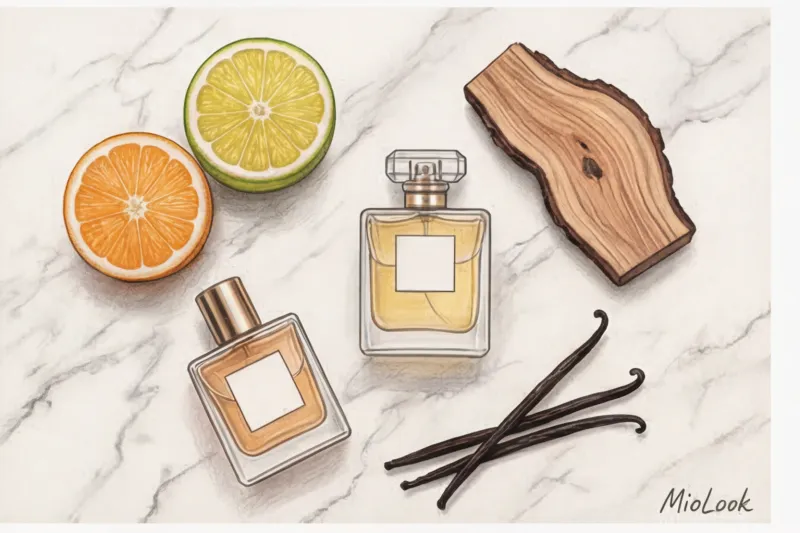
Formula 3: Fruits + Woody Vanilla (Dear Gourmand)
If you mix peach or cherry with dry (not bakery!) vanilla and cedar, you'll get the scent of an expensive niche boutique, not a bakery. The key is to avoid overly sugary bases.
Formula 4: Molecule + Unstable Favorite
The most practical hack: If your favorite fresh scent fades within an hour, apply Iso E Super underneath. It will act as an anchor for the volatile notes.
Layering mistakes: which notes should never be combined
Despite the creative freedom, perfumery has its own taboos. It doesn't work if you're trying to mix the incompatible or salvage a clearly flawed bottle. Here are three common mistakes:
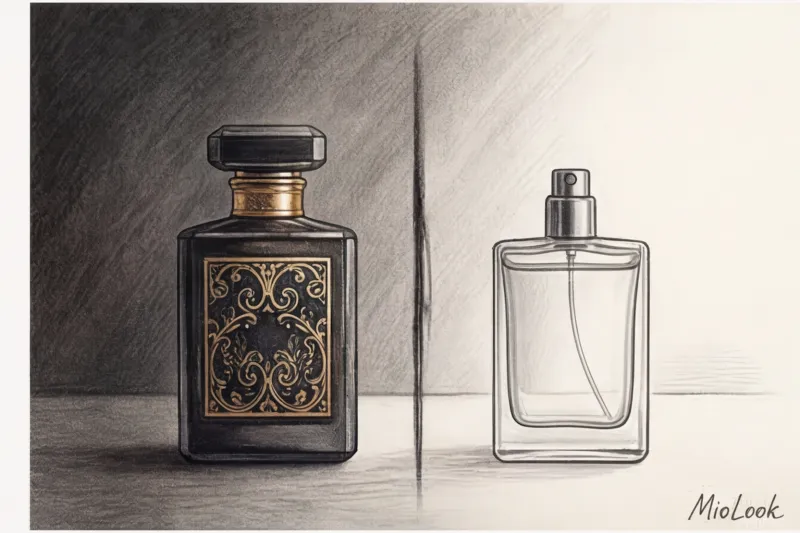
- Clash of the Titans. Never mix two complex "blockbusters." A heavy oriental scent (with incense and spices) and a rich gourmand (with praline and caramel) together will create the effect of a perfume shop where all the bottles have been broken. It's like stage makeup - If you overdo it with accents in everyday life, you will lose face.
- Aquatica + Heavy Sweetness. Marine, salty notes combined with dense vanilla or chocolate often give off the scent of cheap Sea Breeze air freshener.
- Excess of indole flowers. Jasmine, tuberose, and lily are selfish. Layer them on top of each other, and the coworkers in a closed open space will literally be suffocated.
Access to MioLook for €0.99 — one-time payment
A smart AI stylist will create the perfect look for you. Wardrobe analysis, ready-made capsule collections, and style advice.
Get access — €0.99 onceNot Just for Wrists: Alternative Spatial Layering Techniques
Who said fragrances have to be sprayed in one spot? Spatial layering is a favorite trick of stylists. The idea is to apply different scents to different areas.
Apply a heavy, dense scent (such as tobacco or resin) away from your nose: to your stomach, the back of your neck, or behind your knees. Apply a light, vibrant scent (citrus, tea) to your collarbones and hair. As you move, these two clouds will intersect, creating an incredibly beautiful, pulsating trail. This works especially well at events. Just like makeup for a photo shoot requires proper work with light and shadow, spatial layering creates olfactory “volume”.
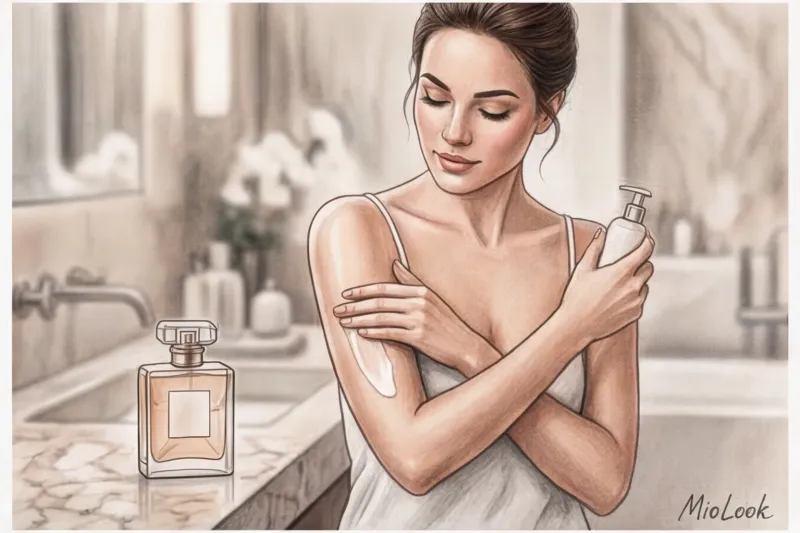
Texture layering. Use a vetiver-scented body lotion and spray a fig scent on top. The difference in texture (cream vs. alcohol spray) results in different evaporation rates.
Life hack from a stylist: If you have a strict dress code, apply a micro-dose of accent perfume to the inseam of your skirt hem or the lining of your jacket. The fabric will hold the base, and the scent will waft through you only when you move.
Checklist: How to build a basic perfume capsule on a budget
To start experimenting, you don't need to buy up TSUM. Simply take stock of what's already on the shelves and buy a couple of practical bottles.
- Find your base. Choose the heaviest, most lasting scent from your collection (woody, leathery, oriental). This will be your foundation.
- Find your accent. Choose the lightest, most volatile scent (citrus, green tea, aquatic).
- Buy a "white shirt" as well. Buy one bottle of molecular perfume (Iso E Super or Ambroxan). You can save money here: many local brands make excellent mono-molecule perfumes for a fraction of the price.
- Buy more freshness. Try a simple, mono-scented scent like grapefruit or bergamot. H&M, Zara, or the basic 4711 scents are all suitable. Their purpose is simply to give a fresh start.
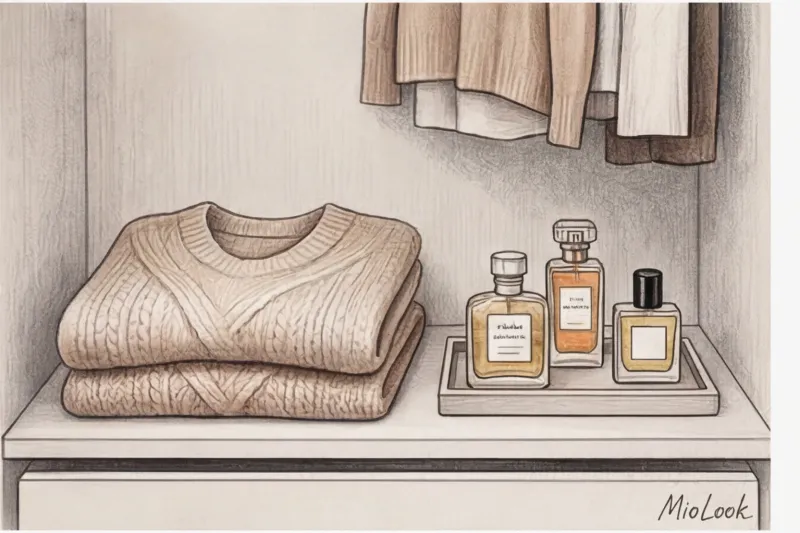
The golden rule of testing: Never test a new combination on your neck right before leaving the house. If the scents don't mesh, you'll have to shower. First, apply both layers to a blotter (or a regular paper napkin), wait 15 minutes, and only then evaluate the results.
Perfume isn't a museum piece to be simply admired. It's a tool for your personal style. Don't be afraid to break the rules, mix and match, and seek out that signature scent that will make passersby turn around and ask, "Oh my god, what is that perfume?" And the best part is, you'll be able to proudly say you can't find that scent in any store in the world.