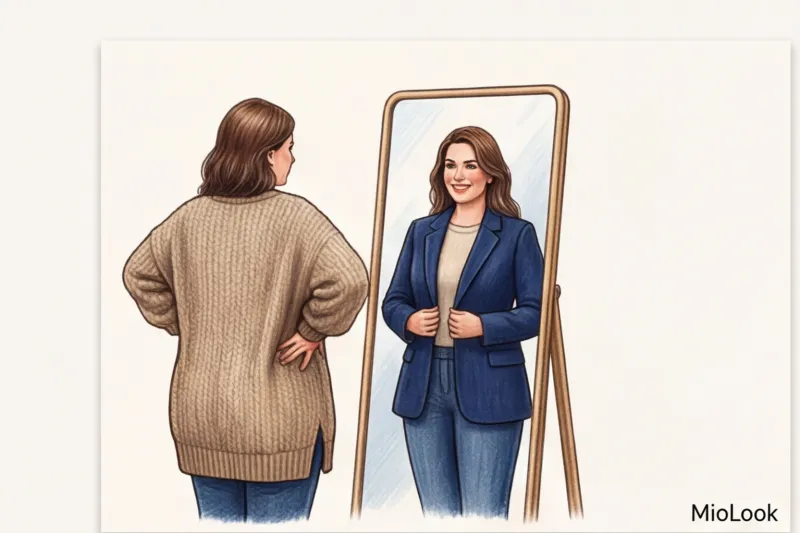
I still remember that moment in the Parisian COS boutique. My client, a successful 42-year-old woman, stood before the huge fitting room mirror in a thin knit dress, barely holding back tears. The garment, which on the hanger looked like the epitome of Scandinavian minimalism, betrayed the slightest bulge around her waist when worn on her body. She blamed herself, her age, and her belly. But when I brought her a structured, straight-cut jacket and threw it over the dress, her posture instantly changed. Her shoulders straightened, her gaze became confident. The problem wasn't her body. The problem was the fabric.
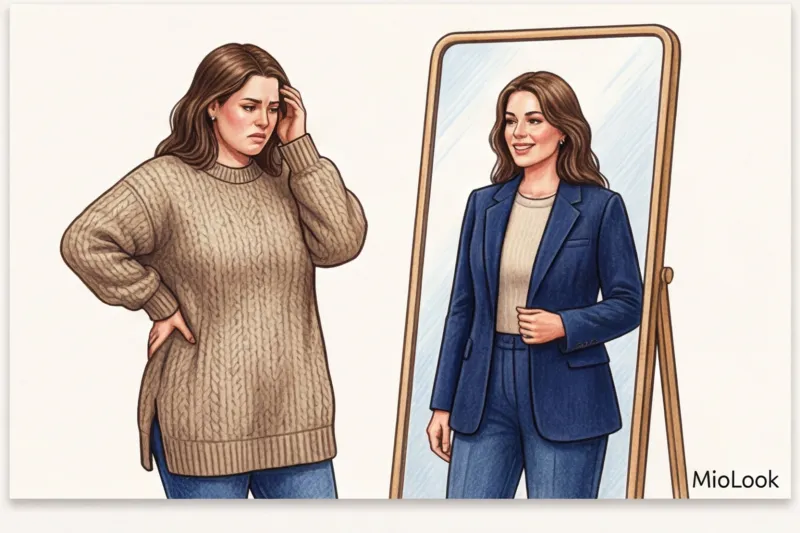
Having worked as a stylist at Paris and Milan Fashion Weeks for over 10 years, I constantly observe how premium brands like The Row and Jil Sander masterfully work with volume. They don't "squeeze" a woman; they build the right architecture around her. The question is, How to hide your belly with clothes , is not a question of strict diets or stifling shapewear. It's pure geometry and knowledge of materials science.
We too often try to "squeeze" ourselves into patterns that are sewn to an average, flat standard, ignoring real anatomy. We discussed this phenomenon and how technology is solving it in more detail in our A complete guide to the MioLook AI app for choosing clothes based on your body shape Today, we'll explore an architectural approach to the Apple-shaped figure—no robes, no complexes, and a complete understanding of your proportions.
Silhouette Anatomy: Why Standard Advice No Longer Works
For decades, the fashion industry has fed us a dangerous myth: if you have a large waist, wear a high-waisted dress (empire style) or wrap yourself in an oversized outfit. According to a 2024 report by the WGSN trend research institute, approximately 40% of women over 35 experience a natural redistribution of waist size toward the abdomen due to hormonal changes. This is physiologically normal. But fashion advice remains the same as it was in the 2000s.
Let's bust the biggest counterintuitive myth: empire dresses and tunics with gathers under the bust don't hide belly. They create a strong visual association with maternity wear. The fabric, falling from the fullest point of the bust, transforms the figure into a monolithic "tent," completely obscuring your actual, more slender proportions beneath.
"The worst thing you can do to an apple-shaped figure is to hide it in a shapeless cocoon. Women like these typically have stunningly slender legs, graceful ankles, and a beautiful décolleté. The focus should be there, not on trying to drape the waist," I repeat this principle to every client.
Instead of masking imperfections, we'll redirect the viewer's gaze. And the first tool in our arsenal is the right material.
Fabric architecture: density is everything
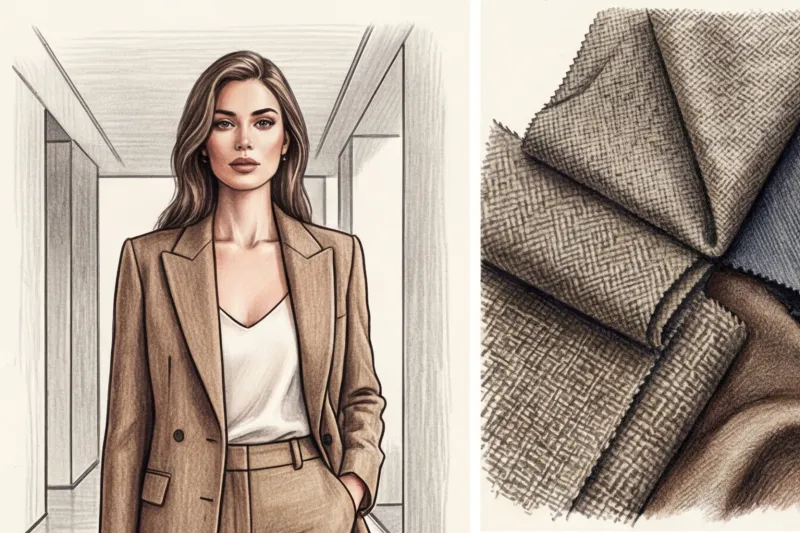
There's a huge difference between the terms "fit" and "frame." Thin fabric fits: it sinks into every fold, accentuating the contours of your underwear and belly. Dense fabric frames: it creates an independent shell around your body, leaving air between your skin and the garment.
The great couturier Cristóbal Balenciaga revolutionized fashion back in the 1950s with his famous cocoon dresses and sack dresses. He liberated women from the dictatorship of Dior's wasp-waisted style, proving that elegance lies in the shape of the garment itself. But his secret wasn't just in the cut—he worked with stiff, almost stand-up fabrics: gazar and thick silk.
This rule works flawlessly in a modern wardrobe. Remember the density indexes:
- Absolute taboo: jersey (thin T-shirt jersey), cheap viscose with a density below 150 g/m², shiny satin.
- Ideal investments: structured cotton (from 200 g/m²), suit wool (virgin wool), dense diving crepe, denim with an elastane content of no more than 2%.
If you pick up a garment and it flows limply through your fingers like water, it won't hold its shape for an Apple-shaped figure. Look for fabrics that "stand up" when slightly bent.
Your perfect look starts here
Join thousands of users who look flawless every day with MioLook, an AI stylist who selects clothes based on your body shape.
Get access — €0.99 onceThe Rule of Thirds and Optical Illusions: Creating a Vertical
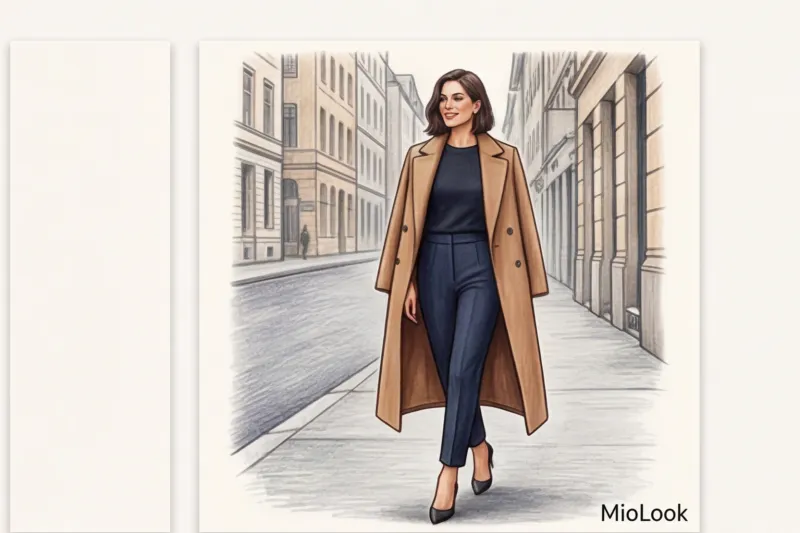
One of the most powerful styling techniques I love to use on shoots is the mathematical application of proportions through layering. We call it the "rule of thirds." Pants and a top are just the basics (two pieces). Your look only becomes more sophisticated with the addition of a third layer: a jacket, a long vest, or a thick, straight-cut cardigan.
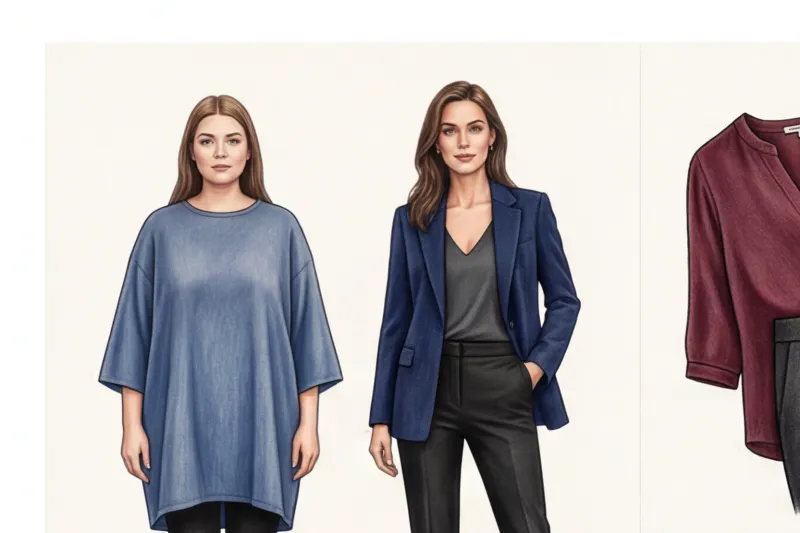
The secret lies in the unbuttoned lapels. When you wear a structured blazer unbuttoned, its lapels create two sharp vertical lines along your torso. The center of the top, visible between them, visually becomes yours. new waist This optical illusion "cuts off" up to 30% of the actual volume on the sides.
How to enhance this effect (create a Column of Color):
- Wear a top and pants/skirt in the same color (for example, deep navy or graphite). This will elongate the silhouette into a single, monolithic column.
- Layer a jacket in a contrasting shade over the top (such as sand or camel; you can find great options at Massimo Dutti or in the premium Zara line for between €100 and €300).
- Make sure the top has a V-neck—it elongates the neck and draws the eye away from the stomach area and toward the face and collarbones.
Ideal trousers and jeans for the Apple figure
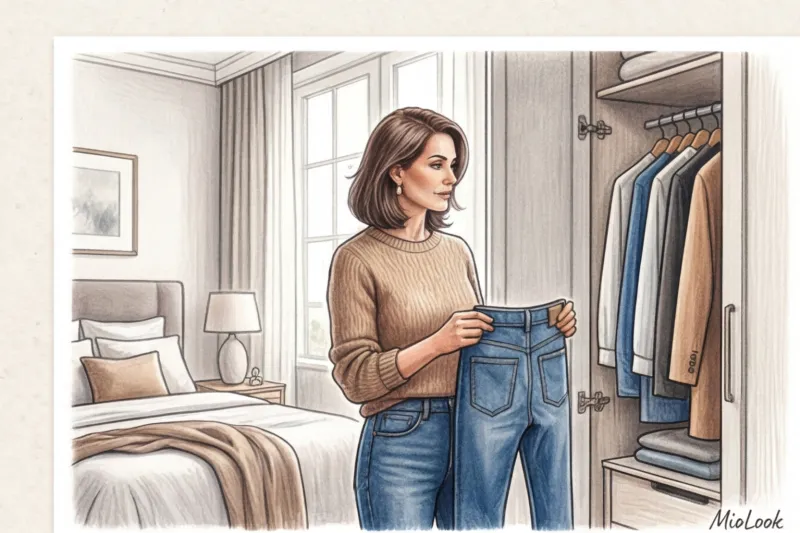
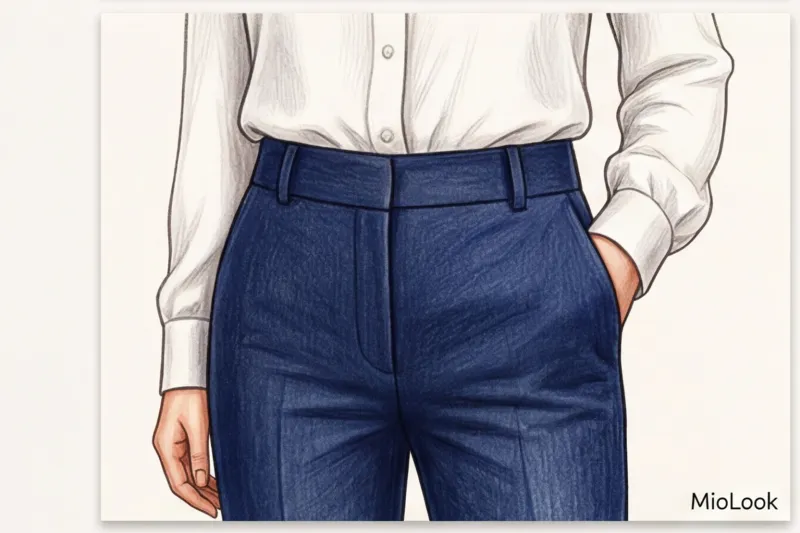
Shopping for pants for a woman with a large waist can often be a struggle. The pants either fit tightly around the stomach but hang baggily around the hips and buttocks, or they fit perfectly around the hips but don't fasten at the waist.
The first thing to avoid is pants with elastic or drawstrings if they're made of thin fabric. Gathering at the waist physically adds inches where you're trying to remove them. Also, avoid low-waist pants, which create the notorious muffin top effect (the effect of a belly hanging over the waistband).
Your ideal cut is called flat-front (flat front). These are mid- to mid-high-rise trousers that have no pleats, creases, or patch pockets in the front. Ideally, the zipper is moved to the side seam, creating a completely smooth surface across the stomach.
When it comes to jeans, forget about skinnies. Tapered jeans, contrasting with a voluminous top, create an inverted triangle shape. Opt for straight-leg styles or slightly flared from the knee (bootcuts). They restore the balance between the waist and ankle width.
Dresses that actually flatter your silhouette
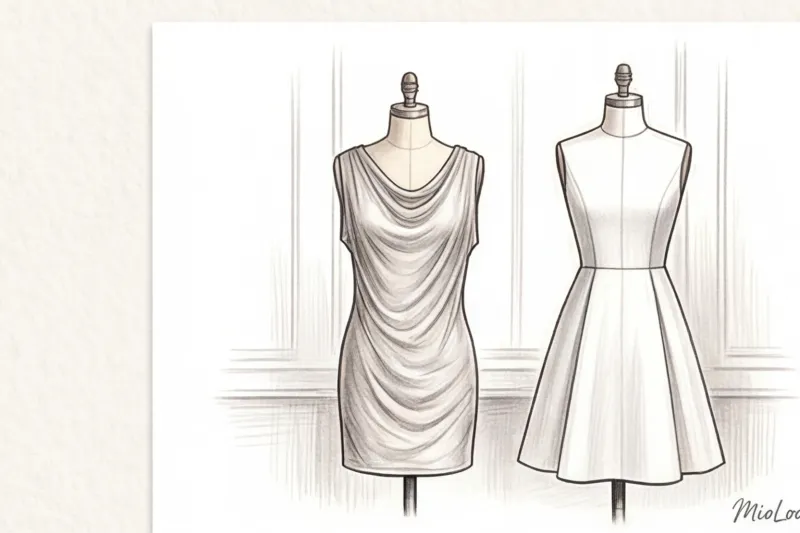
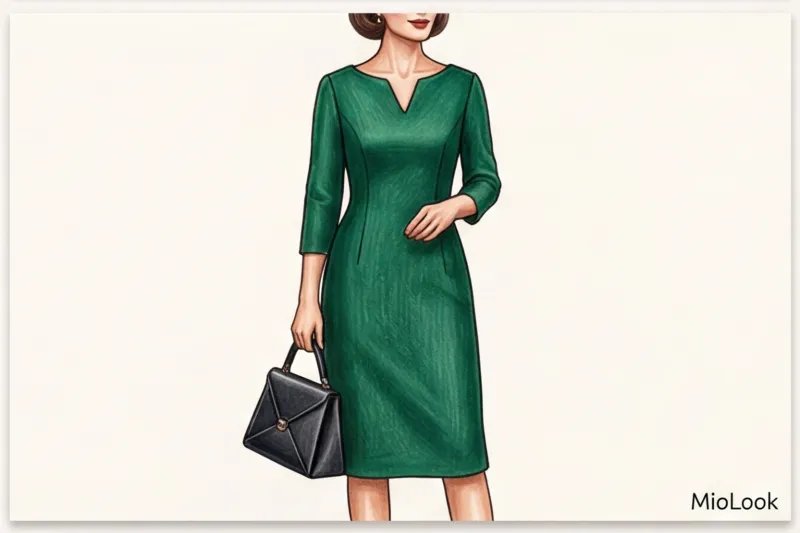
There's a common misconception among stylists that sheath dresses only suit hourglass figures. This is a dangerous misconception. Historical fact: when Christian Dior introduced his famous H-shaped silhouette (straight lines parallel to each other) in 1954, fashion critics were shocked—the collection was designed specifically to level out A '60s-style shift dress, loosely fitting, will flatter your waist and elongate your figure.
But here it is important to make an honest reservation about the popular wrap dress Glossy magazines have been saying for years that Diane von Furstenberg's dress suits everyone without exception. From my experience: This does NOT work for the Apple shape. If the dress is made of thin knit fabric and the knot is tied right in the center of the stomach, this will only emphasize the curves.
How to adapt dresses to suit yourself:
- If you choose a shirt dress made of thick cotton (basic styles cost €50–€90), go for asymmetrical styles. Tie the belt in a French knot at the side, not in the center.
- Look for dresses with diagonal draping that cuts through the silhouette, rather than horizontal folds.
- The length should highlight your best features—slender calves and ankles. Midi or just below the knee is the best choice.
Prints and colors: distractions
Color and texture work as optical illusions. Large polka dots on the stomach will visually widen the figure, making it appear spherical. Horizontal Breton stripes aren't your best friend either.
Your choice is medium-sized abstract prints without clear geometric lines (for example, leopard in muted tones or watercolor splashes). They make the observer's eye glide over the surface, without focusing on the contours of the body. And most importantly: always choose matte textures For the abdominal area. A satin blouse will act like a mirror, reflecting light and highlighting every millimeter of volume, while a matte crepe will absorb the light and smooth out the contours.
Ready to get started?
Upload your parameters to MioLook, and the smart algorithm will automatically filter out models that aren't suitable for you. Try the free plan—no commitments.
Get access — €0.99 onceChecklist: Putting together a smart capsule wardrobe for a figure without a defined waist
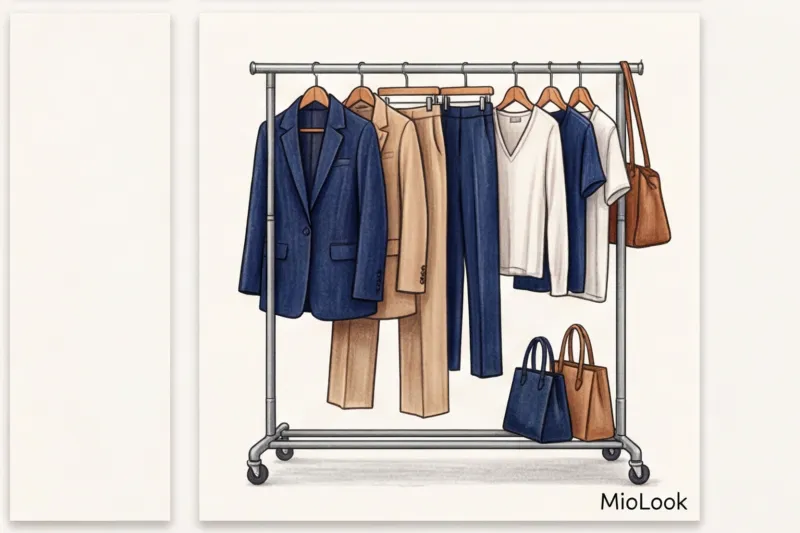
Theory is dead without practice. If you hired me to sort through your wardrobe today, here are the first items I'd add to your capsule shopping list. And it won't require an exorbitant budget—a high-quality basic wardrobe is easy to assemble in the mid-market.
- Structured single-breasted blazer. Slightly longer, covering the widest part of the hips. The shoulders should be well-shaped (possibly with small shoulder pads) to balance the waist.
- V-neck top made of raw silk or thick viscose. No thin straps, only wide straps.
- Straight-leg flat-front trousers in dark blue. Pinches are prohibited.
- The right shoes. Your goal is to highlight your slender legs. Invest in block heels or stylish loafers with a pointed toe. They visually extend the line of your legs.
- Rigid bags. If you have a soft, rounded figure, accessories should be geometric. Avoid shapeless hobo bags that hang loosely. A good structured tote made of thick leather (from €150 to €350 at local brands) will pull the whole look together.
A Smart Approach to Wardrobe: How Technology Is Replacing the Pain of Trying on Clothes
To summarize, hiding your belly isn't about becoming invisible. It's about managing your attention. Your body is beautiful just the way it is, it's just that industry-standard patterns are hopelessly outdated.
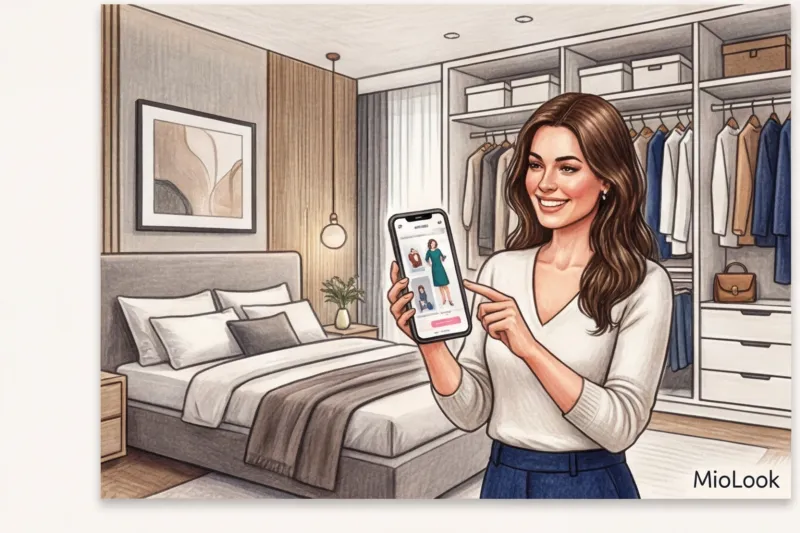
Luckily, today we don't have to spend hours in fitting rooms, frustrated by ill-fitting styles. An AI stylist in an app MioLook A game-changer. The algorithm analyzes your actual proportions, not just an abstract size "M" or "L." The virtual fitting room lets you see in advance how a structured blazer will create that perfect vertical line, and how the density of the fabric will smooth out your silhouette.
Forget the "black is slimming" rule. What slims is the right cut, the right fabric density, and your self-confidence. Stop hiding your body in hoodies and start building a proper, beautiful structure around it.