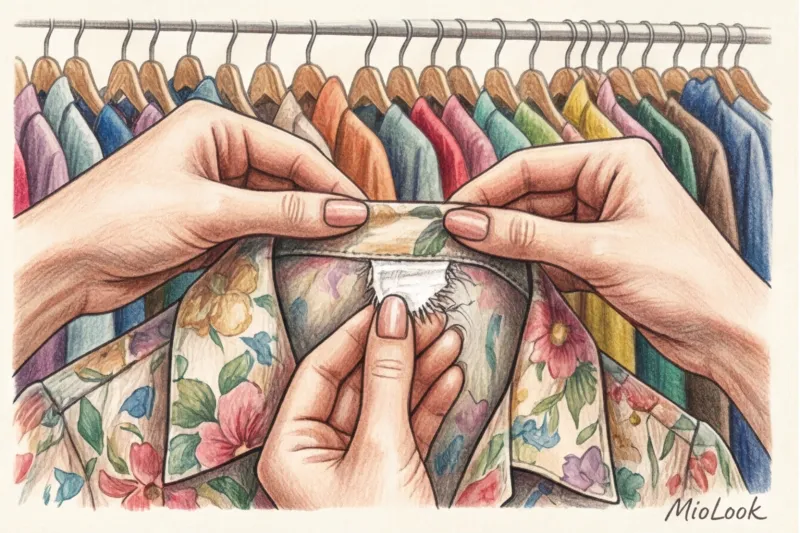
Four years ago, in a tiny vintage shop in Berlin, my fingers accidentally slid across an unremarkable black blouse. It hung between creaky '80s polyester and stretched acrylic. There were no tags, the lighting was poor, but my hands had already sent a signal to my brain: "Get it, no need to look." It turned out to be a vintage silk Max Mara blouse, which had cost me 4 euros. The secret to this find wasn't luck, but a simple knowledge of materials science.
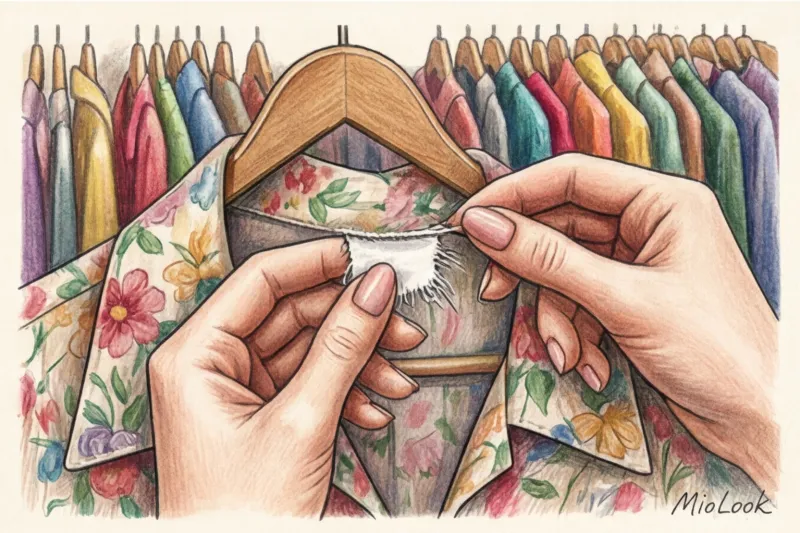
The internet is full of advice along the lines of "just light a thread." Let's be realistic: if you pull out a lighter in the middle of a store, at best, you'll be escorted out by security. So today we'll talk about... How to recognize silk in a second-hand store exclusively through sensory analysis. We utilize optics, acoustics, and thermal conductivity. We've already discussed the basic properties and value of this material in more detail in our the complete guide to status fabric , but today we move from theory to harsh but exciting practice.
Cut Tags: Why You Can't Trust Thrift Store Tags
If you frequent vintage shops, you know: the most interesting pieces usually don't have the ingredients listed. This isn't a conspiracy by the sellers. Natural silk is often worn next to the skin, and the harsh synthetic tags are incredibly scratchy. They're usually cut off within the first week of purchase.
But there's a second, more insidious problem: mass-market labeling. Brands love to write on their labels silky touch (silky touch) or artificial silk (rayon). One of my clients, Anya, once proudly brought in a luxurious "heavy silk" dress she'd bought secondhand for a wardrobe cleanout. Unfortunately, it turned out to be cupro. Yes, cupro is a beautiful, breathable material made from recycled cellulose, but it's not silk, and its market value is significantly lower.
Moreover, relying solely on your eyes in a second-hand store is a fatal mistake. Cheap fluorescent lamps distort color rendering and make even obvious plastic items shine. We need more reliable tools.
Your perfect look starts here
Join thousands of users who look flawless every day with MioLook. Our AI stylist will help you incorporate vintage finds into your modern wardrobe.
Get access — €0.99 onceFabric Optics: Pearlescent Glow vs. Glossy Sheen
Let's turn to physics. A cheap polyester thread is round and smooth when cut. It acts like a mirror, reflecting light directly into your eyes. This is why synthetics produce a flat, sharp, white glare—the effect of cheap gloss.
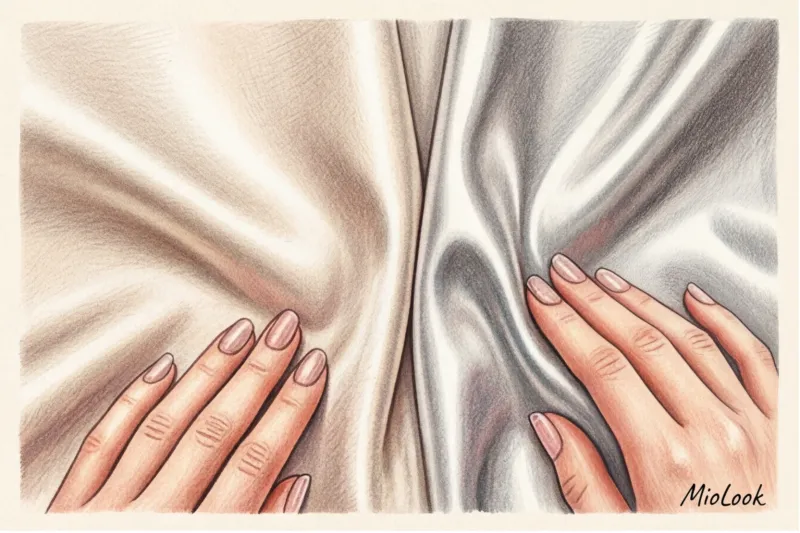
Natural silk fiber (fibroin) is shaped like a triangular prism. When light hits this microscopic prism, it isn't simply reflected, but refracted, scattering at different angles. The result? Silk doesn't shine. glows from within with a soft, pearly shine that flows smoothly into the folds.
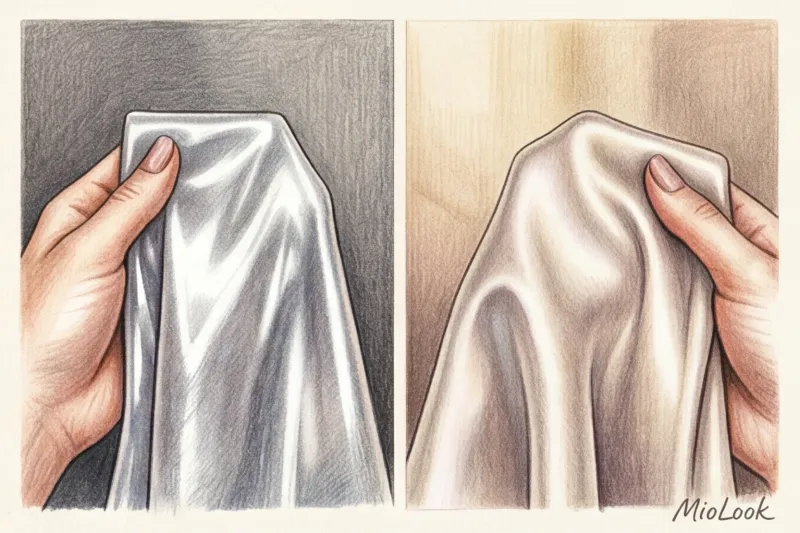
"Natural silk absorbs dye deep into the protein structure of the thread. Polyester, on the other hand, dyes only on the surface. Therefore, colors on silk always appear complex, multifaceted, and deep, while synthetic pigments often appear flat and garish."
As a colorist, I always pay attention to this. According to the Textile Exchange report (2023), natural protein fibers hold pigment at the molecular level differently than synthetics. If you see a complex, deep emerald or rich wine hue that subtly changes temperature when the fabric is tilted, you're most likely looking at a noble material.
Tactile Expertise: 3 Ways to Feel Status
Our fingers and skin receptors are the best spectrometers if we know how to use them. Let's shift our attention from our eyes to our senses.
Temperature test (cheek test)
Polyester is a plastic (polyethylene terephthalate). It always feels cool, lifeless, and foreign. If you press it against your skin, it will remain cold or cause you to sweat instantly, creating a greenhouse effect.

Do the so-called "cheek test." Place the fabric on your wrist (where the skin is thin) or cheek. Natural silk has phenomenal thermal conductivity. In just 2-3 seconds, it will warm up to your body temperature and no longer feel like a foreign object. It will seem to blend with your skin.
Acoustic test (Scroop effect)
Few people know this, but real silk can "talk." There's a special term for it in the textile industry: scroop (scruple), which translates as silky crunch.
Hold the edge of the garment close to your ear and squeeze the fabric tightly in your fist, gently rubbing the layers together. Natural silk will produce a characteristic, soft crunch—a sound similar to footsteps on freshly fallen, dry snow. Viscose will remain silent in this situation, while polyester will rustle or creak cheaply, like a plastic bag.
Flowability test (water effect)
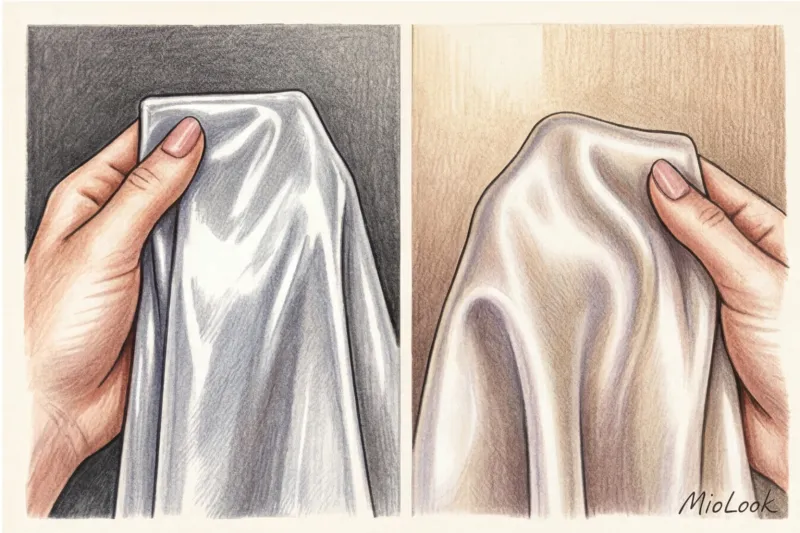
The fabric needs to be tested dynamically. Gather a good portion of the hem or sleeve in your palm, squeeze, and then unclench your fingers, allowing the fabric to slide down.
Silk flows like heavy water. It literally slips through your fingers, instantly straightening under its own weight. Synthetics, on the other hand, due to the stiffness of the threads, will bulge, "spring," and cling to the unevenness of your skin. By the way, when you find your perfect silk blouse, I recommend adding it to MioLook smart wardrobe — the app will help you create dozens of unusual outfits for different weather conditions.
Try MioLook
A smart AI stylist will create the perfect look for you and help you organize your vintage finds.
Get access — €0.99 onceBusting the Myths: When Silk Doesn't Look Like Silk
This is where the main trap for beginners lies. Many believe that real silk is always a perfectly smooth, shiny satin fabric. This is a dangerous myth that causes vintage hunters to miss out on the most prized pieces.
Myth 1: Silk always shines.
Nothing of the sort. Crêpe de Chine, habotai, or silk chiffon are completely matte. Their surface is slightly rough, grainy.
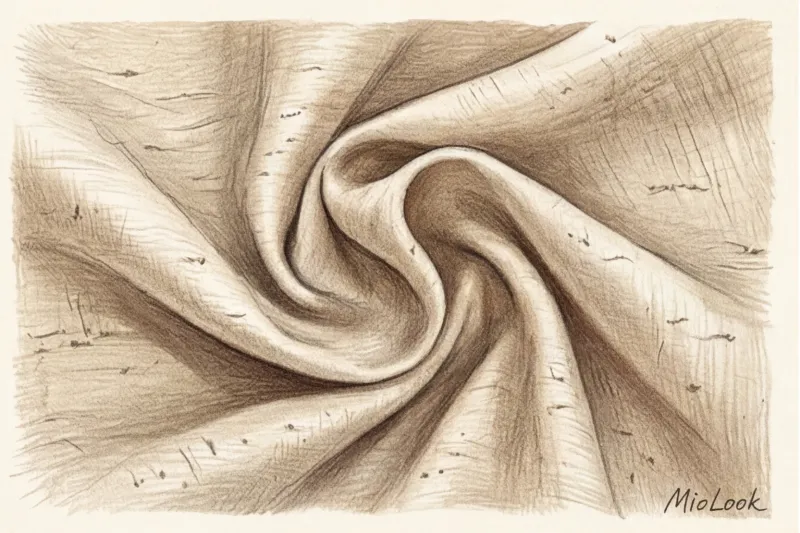
Myth 2: Silk is perfectly smooth.
Meet wild silk (bouret, tussah, and tussah). This is the yarn collected after the butterfly emerges from its cocoon. The resulting thread is short and thick. Wild silk fabric has knots and uneven textures, resembling coarse linen or thick cotton. At the same time, it maintains phenomenal temperature regulation: it stays cool at 30°C. Important limitation: Visual glow tests do NOT work for bourette silk; only heat and combustion tests will help here.
Myth 3: Silk doesn't wrinkle.
It wrinkles, and how. But it does so differently. Synthetics and stiff viscose wrinkle into sharp, prickly corners (think of the creases at the elbows of cheap jackets). Silk forms soft, smooth, rounded folds that often straighten out on their own under the influence of body heat.
The flip side of status: how cut and seams reveal an expensive item
Even if you have a runny nose, poor eyesight, and are wearing gloves, you can spot luxury by the inside. Expensive brands never use cheap methods to create high-status silk. The fabric is capricious; it frays and peels at the seams, requiring complex tailoring.
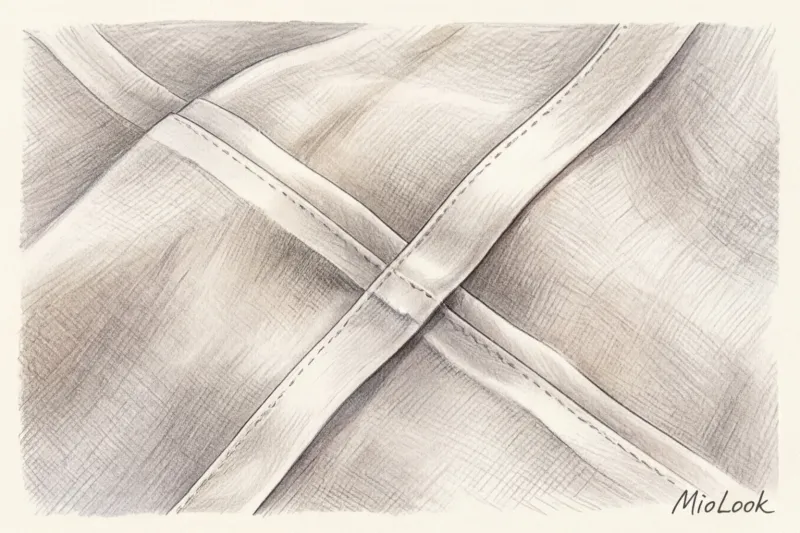
Turn the item inside out. What do you see?
- French (lingerie) seam. If you see a neat, closed rib on all sides, and no loose threads from an overlocker, you're looking at a quality item. Mass-market manufacturers don't waste time and meters of fabric on closed seams.
- Hand-rolled hem. If you're choosing a silk scarf (a square), look at its edges. Luxury scarves (a standard set by the House of Hermès) have edges rolled up to the right side and hand-stitched with invisible stitches. Machine stitching is a sign of low-cost production.
Home Lab: Burn Testing Your Purchased Item
You bought the item. You brought it home. And now a worm of doubt demands absolute proof. Now it's time to use fire. Find an invisible thread on the inseam or carefully pull a fiber out of the seam allowance.
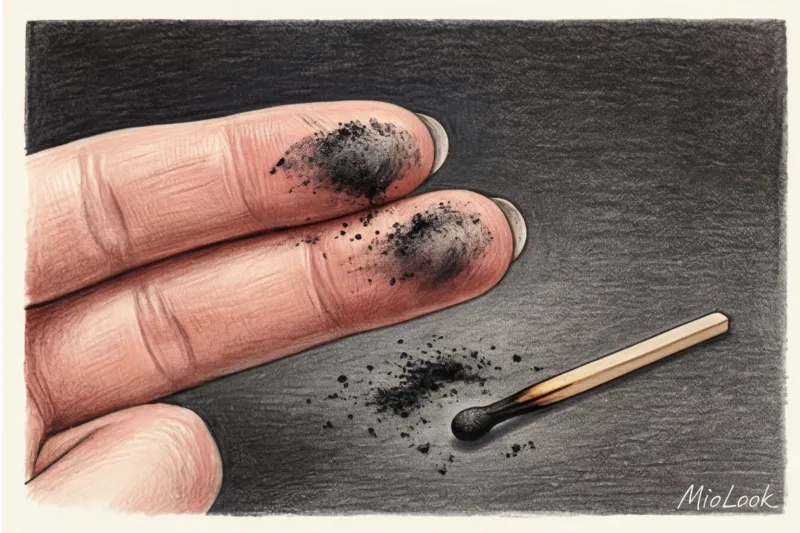
How synthetics (polyester, nylon) burn:
It melts. The thread shrinks, drips, and turns into a hard, unbreakable black or brown plastic ball. The smell is sharp, chemical, and slightly sweet (like burnt plastic).
How cellulose (cotton, viscose, cupro) burns:
It burns quickly, with an even flame, leaving a light gray ash. It smells like burning paper or autumn leaves.
How real silk burns:
Silk is an animal protein. It burns slowly and goes out when the flame is removed. It smells exclusively of burnt hair or singed feathers. The remaining black lump of ash easily crumbles between the fingers into a fine dust, leaving no solid particles. But be careful: If the fabric is a blend (for example, 70% silk and 30% polyester), the test results will be blurred - you will smell both odors, and the ash will be semi-solid.
Checklist: How to spot silk in a second-hand store in 5 minutes
Finding prestigious items amid the chaos of a second-hand store isn't a lottery, but a skill. Practice your observation skills and finger sensitivity. To avoid forgetting the theory in the store, keep this quick algorithm in mind:

- Light: Look for a deep, pearly glow in the creases, avoiding flat white highlights.
- Warm: Place it on your cheek. Does it warm up in 3 seconds? Great. Cool? Put it back.
- Sound: Squeeze the fabric near your ear. Look for a soft, "snow crunch" (scroop effect).
- Design: Let's look at the back. We're looking for closed French seams and no sloppy overlocking.
Practice this sensory pattern every time you enter a store. Soon, your hands will automatically begin to snatch luxury fabrics from dense rows of hangers, even if your eyes haven't noticed yet. Learning to "read" fabric with your hands will save you tens of thousands of euro and dramatically change the appearance of luxury in your wardrobe.