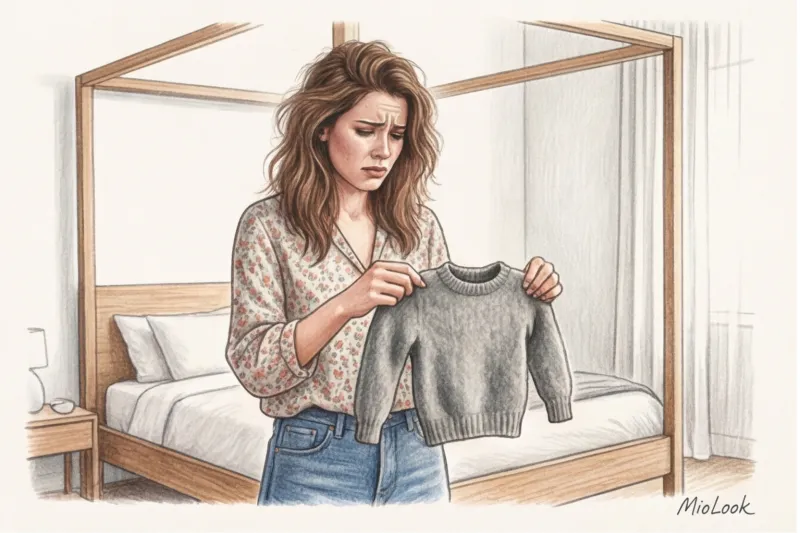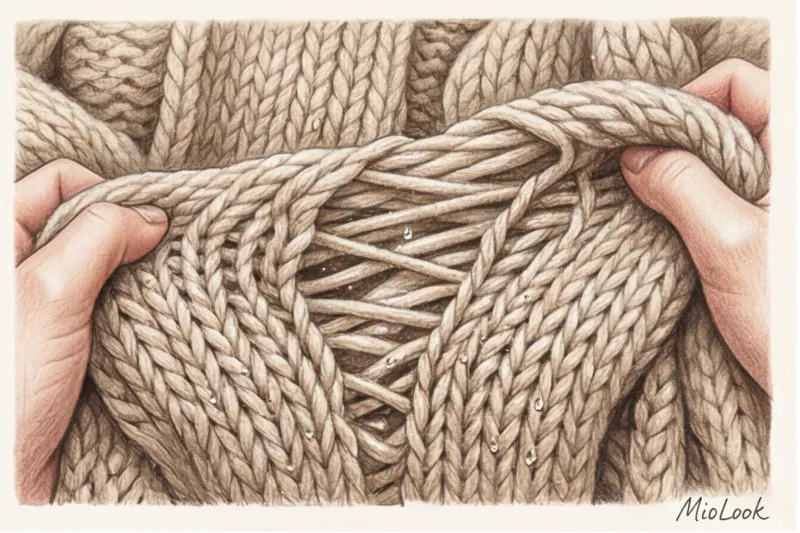
Imagine taking a wet €1,500 Loro Piana cashmere cardigan out of the washing machine, mindlessly hanging it over the back of a chair, and a day later discovering something resembling a sad ogre's chainmail, with the sleeves stretched to the knees. This is exactly the state a client came to me in three years ago, hoping to save her beloved garment. And we did. But this incident made me realize: we spend hundreds of euros on high-quality knitwear, but we're ruining it with a simple ignorance of the basic laws of fiber physics.
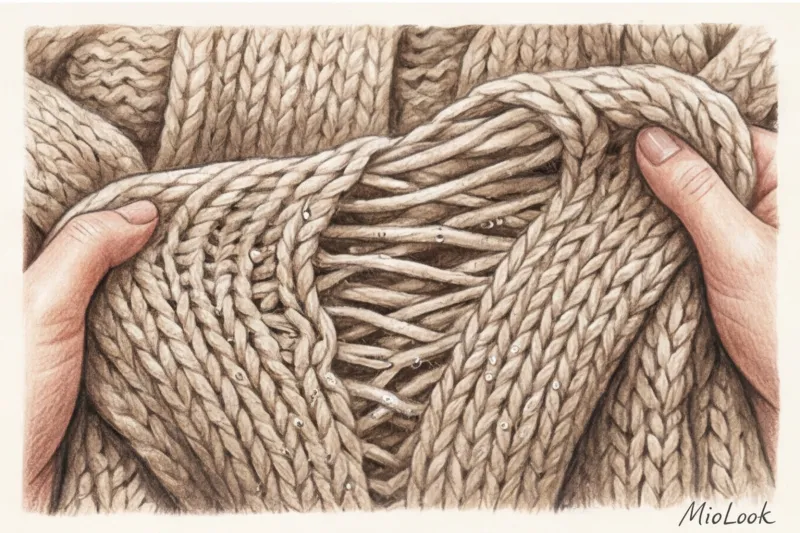
As a stylist and colorist, I constantly review wardrobes and see the same picture: misshapen shoulders, stretched elastic bands, and out-of-shape silhouettes. Most women are convinced the problem is poor quality, when in fact, the problem is... How to dry knitted items after washing. We talked about a comprehensive approach to wardrobe in more detail in our a complete guide to proper clothing care.
In this article, we'll forget the clichéd advice on labels. I'll explain how water changes the fiber structure, why towel-drying is a myth that ruins your sweaters, and how a professional "blocking" method can bring back to life even those items you've mentally written off.
The Anatomy of Wet Knitwear: Why Do Knitted Items Deform?
To understand care instructions, you first need to understand the physics of fabric. The main difference between knitwear and regular fabric (like cotton shirts) is that it's not woven but knitted. This system of movable loops is called knitting. When dry, this system is elastic and resilient. But add water, and the rules of the game change dramatically.
According to laboratory data from The Woolmark Company, natural wool can absorb up to 30% of its own weight in moisture without becoming wet to the touch. When completely wet, the weight of a garment increases two to three times. Water penetrates the cortex (core) of the fiber and weakens the hydrogen bonds responsible for the fiber's structural "memory."
"When wet, wool fibers can stretch up to 30% of their original length without breaking. The problem is that if the thread dries in such a stretched state, new hydrogen bonds will lock in this distorted shape. The garment will 'remember' the deformation."
This phenomenon explains why a sweater, heavy with water, will inevitably turn into a dress when hung on a hanger. Gravity pulls the moisture downward, stretching the loops, and as they dry, they settle into their new position.
Preparing for Drying: 3 Critical Steps Without Which Everything Is Lost
Mistakes begin long before the sweater hits the dryer. Rule number one: avoid thermal shock. If you washed the item in warm water, rinse it in water of exactly the same temperature. A sudden change (for example, from 30°C to 15°C cold rinse) causes the wool scales to instantly shrink and stick together. The result? Irreversible felting. A size M will result in a thick, stiff sweater fit for a five-year-old.
Second rule: never pull a wet item out of the water by the shoulders or sleeves. When removing wet knitwear from the basin or drum of the washing machine, gather it into a tight ball with both hands underneath, supporting the entire weight of the fabric. Imagine lifting a fragile ball of dough.
The "Roll" Method: The Only Safe Way to Press
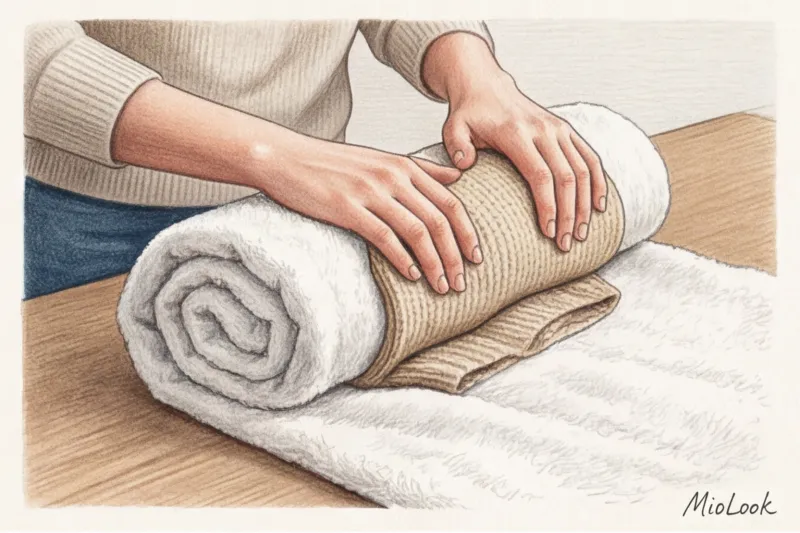
Wringing knitwear is strictly prohibited. Twisting tears microfibers (especially delicate cashmere and alpaca) and irreversibly breaks the elastane in blended fabrics.
Here's a step-by-step algorithm that all professional stylists use on shoots when an item needs to be quickly prepared:
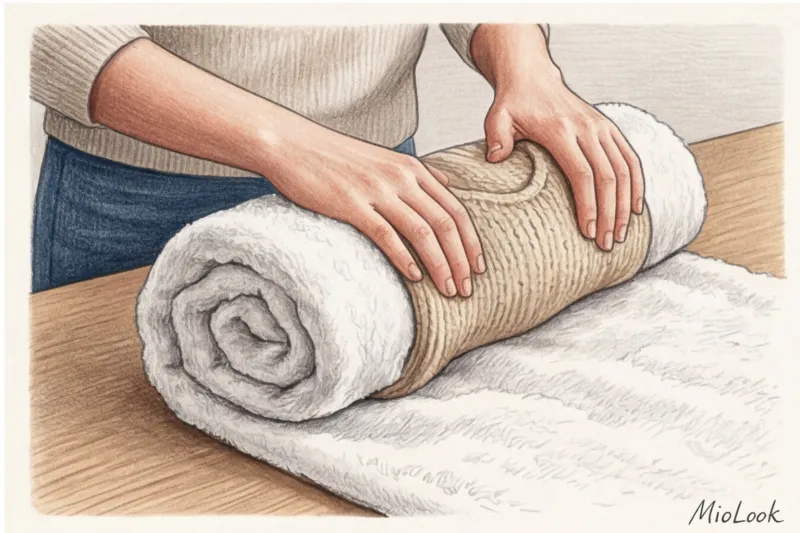
- Lay a dry, thick terry towel on the floor or table.
- Lay the wet sweater out on it in a straightened state (without folds or creases).
- Start rolling the towel and sweater together into a tight roll, as if you were making a roll or a carpet.
- When the roll is ready, press it gently with your hands or even walk on it (if it's heavy cotton). The towel will absorb up to 70% of the excess moisture.
- Unroll the roll and start drying.
Digitize your wardrobe
Do you know how many sweaters in your closet need special care? The MioLook app will help you create a smart catalog of all your items, so you always know what's in your closet.
Get access — €0.99 onceHow to Dry Knitwear Based on Fabric Composition: A Stylist's Guide
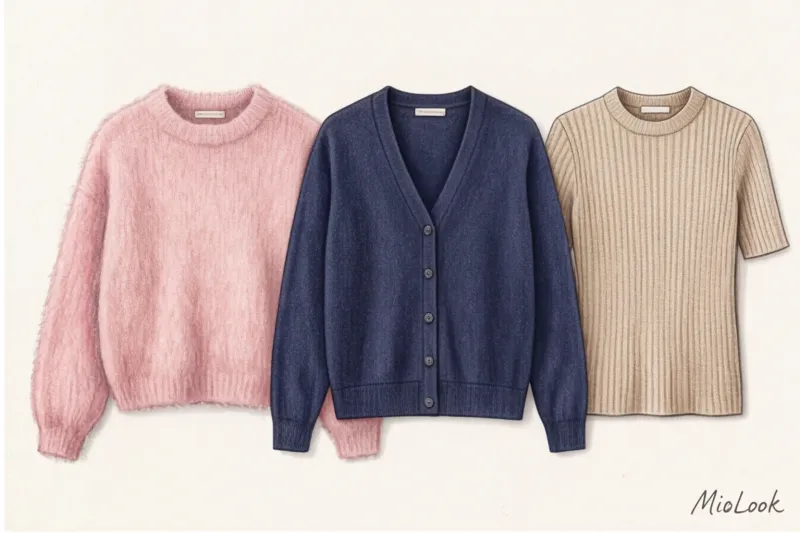
One of the most common mistakes I see when sorting through wardrobes is treating all knitwear the same way. You can't dry a thick cotton cardigan from Zara the same way as a fluffy mohair.
Animal fibers (wool, cashmere, alpaca, merino).
These materials are most sensitive to aggressive heat and loss of lanolin (a natural fat). They require active ventilation with room air. They dry relatively quickly if excess water is removed using the "roll" method.
Plant fibers (cotton, flax, viscose).
The most insidious materials. Cotton knits retain three times more moisture than synthetics of the same volume. In my experience, women most often "kill" basic items made of premium viscose (for example, from Massimo Dutti or COS). Wet viscose loses up to 50% of its strength. If you gently tug it while wet, it will not return to its original shape. Such items take a long time to dry and require cross-ventilation.
Synthetics and blends (acrylic, polyester, polyamide + elastane).
They dry the fastest because they don't absorb water into the fiber, but rather trap it between the threads. But there's another danger: elastane is terribly sensitive to heat. If you place a sweater with elastane near a radiator, the elastic on the sleeves will "cook" and become permanently wavy.
Debunking the Myths: Why Grandma's Towel Method No Longer Works
We've all been taught to "dry your sweater on a towel laid out on the table." Today I declare: this is the worst advice for expensive knitwear, unless you plan to change that towel every 2-3 hours.
Why is this bad? A thick terry towel underneath a sweater quickly absorbs moisture, but when laid flat on a table, it doesn't release it into the air. A damp, warm greenhouse forms. The wool fibers begin to literally "rot," developing a characteristic musty odor (the result of bacterial growth), and the threads lose their elasticity.
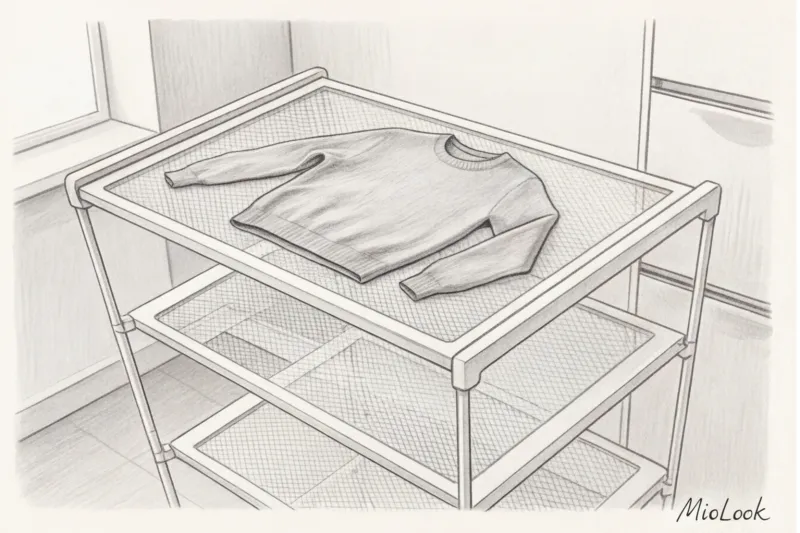
The modern alternative that every woman must have is mesh drying rack (a hanging drying net for sweaters). It costs about €10-15 on any marketplace. It folds into a small circle and hangs on a shower rod or a regular drying rack. The net provides 360-degree air circulation. Sweaters dry twice as fast, without getting damp or misshapen. According to a WGSN study (2023), proper horizontal drying with ventilation extends the lifespan of knitwear by 40%.
Perfect looks without effort
Does your knitwear look flawless after proper drying? Let MioLook's AI stylist create dozens of new stylish combinations from your items for every day.
Create images in MioLookSecret Technique: Blocking to Get Back in Shape
What should you do if a garment has already become misshapen? Professional knitters and stylists have a magical technique called "blocking" at their disposal. This method is what saved that €1,500 Loro Piana cardigan I mentioned at the beginning.
Blocking is the process of shaping wet knitwear into the desired dimensions and shape, then holding it in place until it dries completely.
How to do it at home:
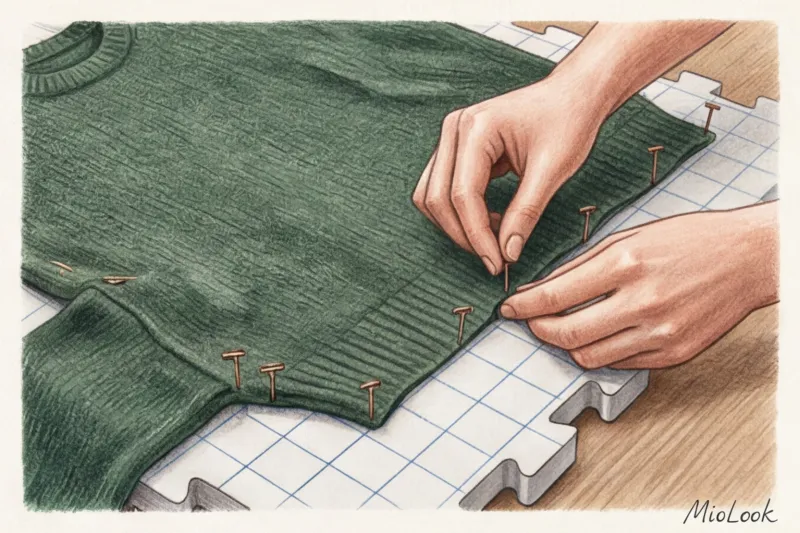
- You will need special foam puzzle mats (regular children's mats or fitness mats will do) and stainless steel T-pins. Please note: Using regular sewing pins will leave rust stains on light colored items that will not be removed with anything.
- Dampen the deformed sweater (preferably with a spray bottle, without soaking it completely if the item is clean).
- Lay it out on the mat.
- Arm yourself with a measuring tape. Gently squeeze or stretch the fabric with your hands, creating the correct geometry: a straight hem, parallel side seams, and equal sleeve length.
- Pin the edges to the mat every 3-5 cm.
- Leave until completely dry (100%).
This does NOT work if the sweater has felted (shrunk due to washing in hot water). Felting is irreversible, as the wool scales are tightly fused together. However, if the item has stretched, become warped, or shrunk due to improper drying, blocking will restore it to its original shape.
Checklist: 5 Signs You're Drying Knitwear at Risk of Deformation
Let's recap. If your routine includes even one of these points, you're slowly killing your wardrobe:
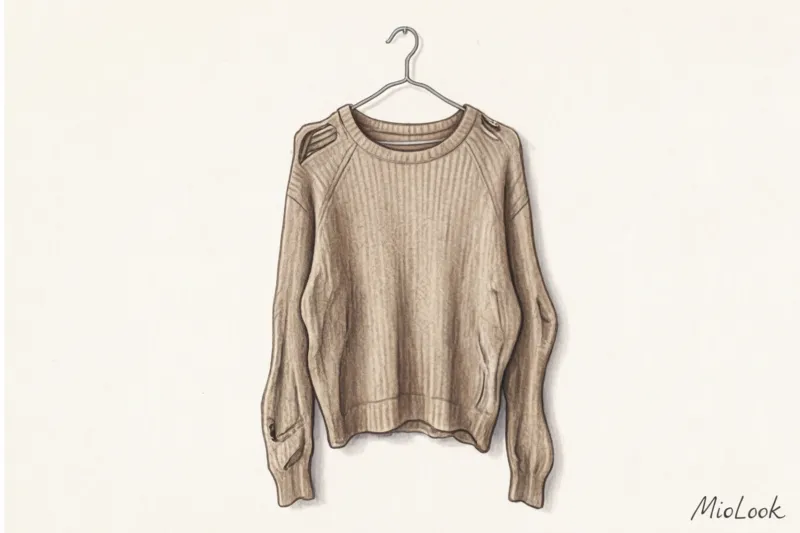
- The sweater is hanging on a hanger. Guarantees the appearance of unsightly shoulder "bags" (hanger bumps) and a elongated silhouette. These hangers are designed only for woven garments (jackets, shirts).
- The item is dried in direct sunlight or on a radiator. Ultraviolet light destroys pigment (dark clothes fade in patches), and the battery makes natural fibers brittle, like over-dried hair.
- Clothespins are used. On loose knitwear they leave permanent dents, destroying the loop structure.
- Drying on an ironing board without perforation. This is back to the greenhouse problem - there is no air flow from below, the item can become moldy.
- Speed up the process with a hair dryer. Localized spot heating leads to uneven shrinkage: one sleeve may become shorter than the other.
Bottom Line: Smart Drying as an Investment in Your Style
According to a McKinsey report (2024), extending the life of clothing by just nine months reduces its carbon, water, and waste footprint by 20–30%. But it's not just about ecology. How "expensive" and prestigious your wardrobe looks depends not on the brands on the tags, but on the impeccable condition of the fabrics. A €40 Uniqlo sweater, line-dried with its elastic waistband intact, will look more luxurious on you than a stretched-out brand that costs hundreds of euros.
Invest €10 in a hanging drying rack, buy a pack of stainless steel safety pins, and make it a habit to read the ingredients, not just the brand. Understanding how wool, cotton, and viscose fibers behave when wet will save you from laundry frustration.