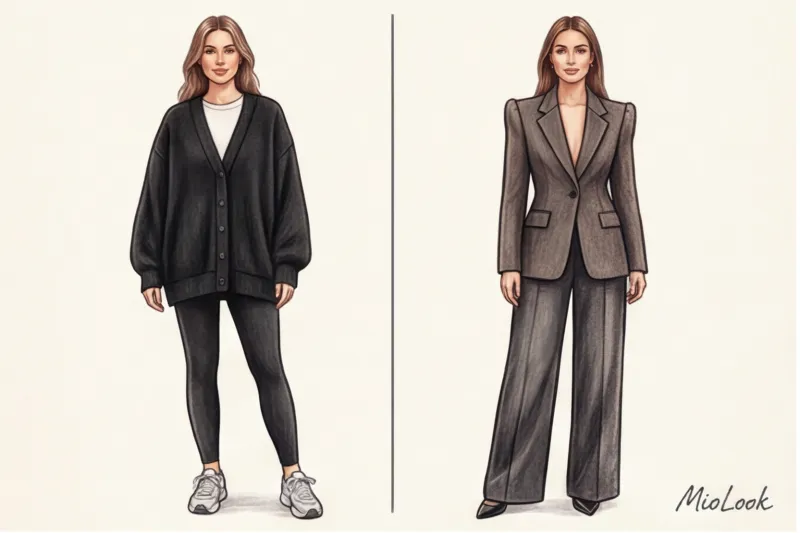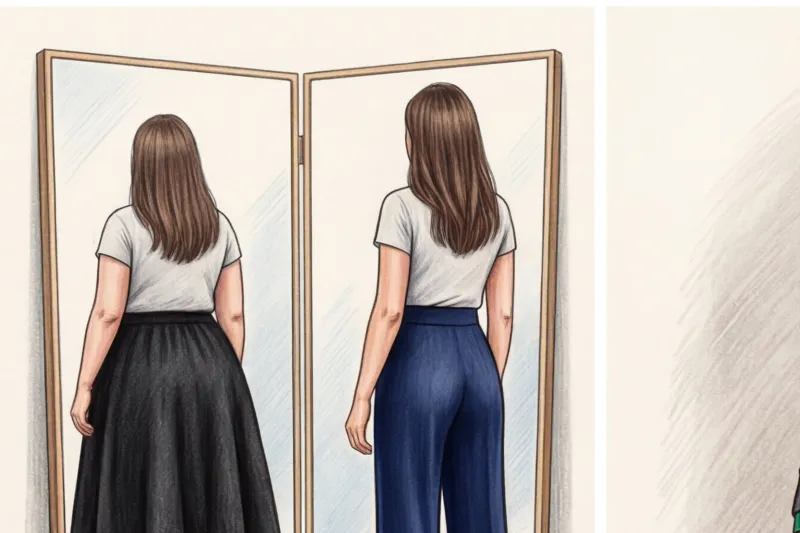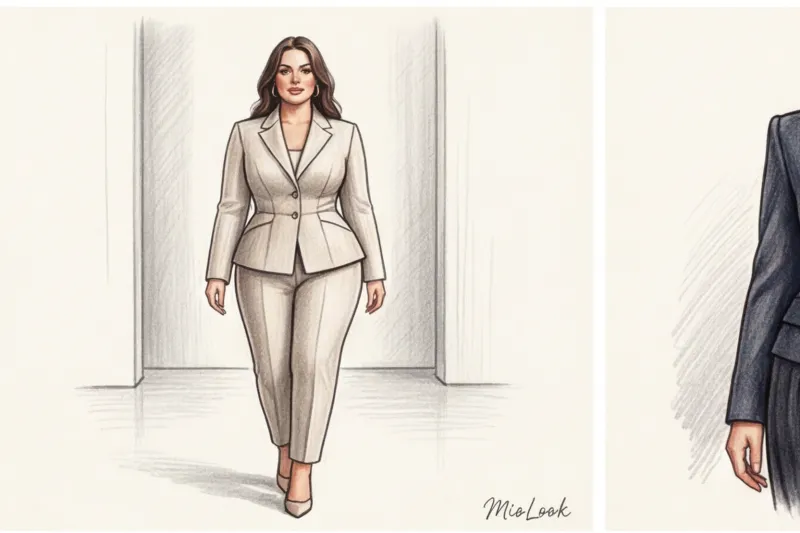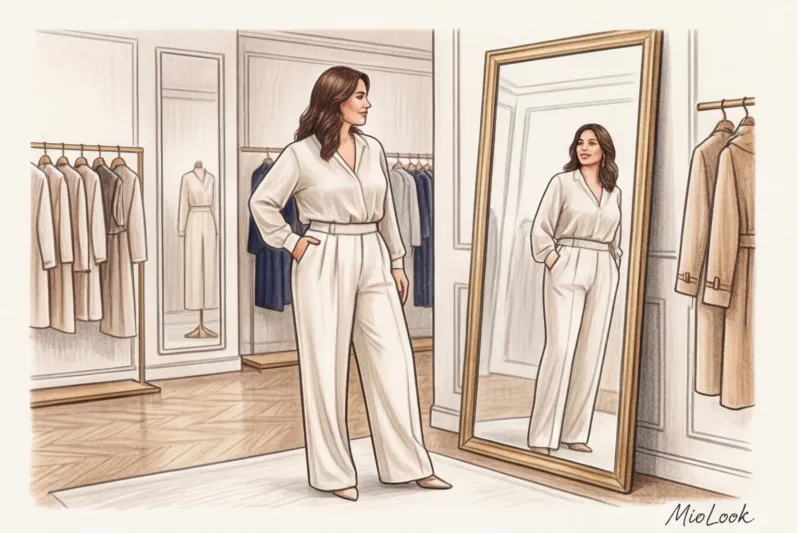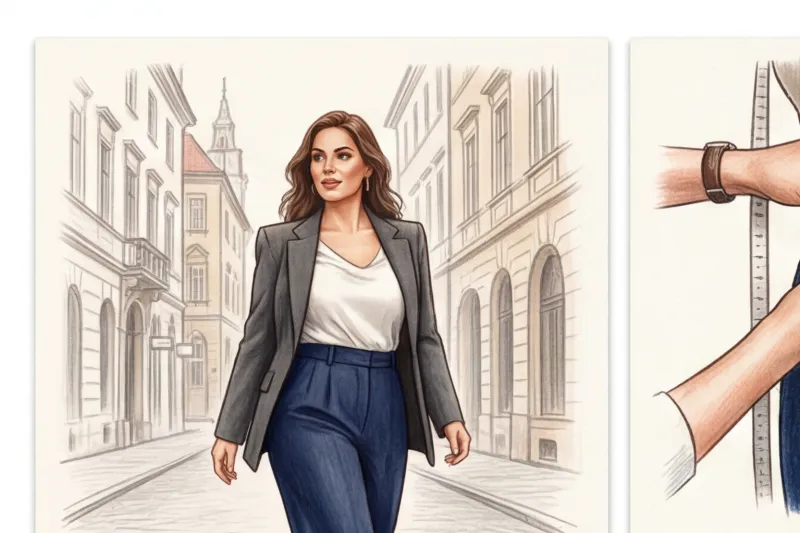
How many dark, shapeless items are hanging in your closet simply because someone once told you to "hide" your wide hips? In my 14 years as a personal stylist, I've heard the phrase "I can't wear light bottoms" from hundreds of clients. And every time, I've proven them wrong, suggesting they try on the right white jeans.
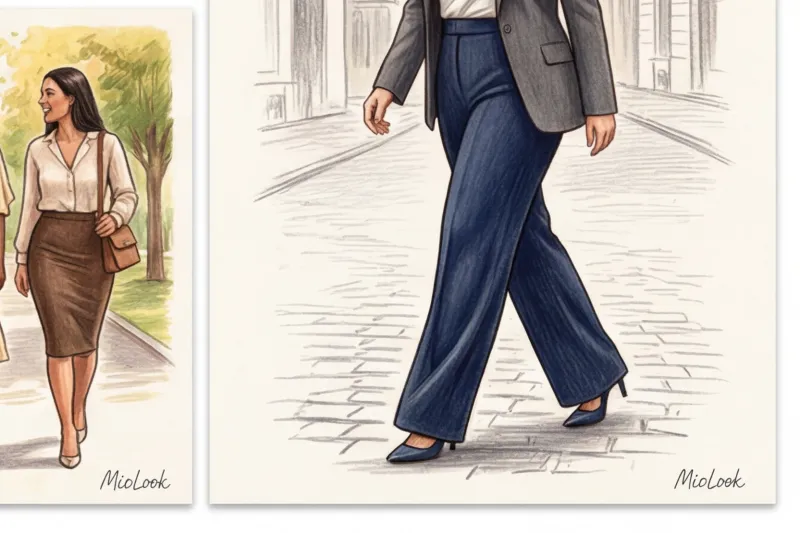
We're used to thinking that a pear-shaped body type, as taught by toxic glossy magazine articles from the 2000s, is a "problem" that needs to be concealed. But let's be honest: the problem isn't your curvaceous figure. It's fast fashion patterns and outdated style rules that make women feel ashamed of their bodies.
If you're tired of your jeans not fitting at the hips but bulging at the waist, it's time to change your approach. We've covered how technology is changing the rules of the game in more detail in our The Complete Guide to MioLook: An AI App for Body-Styling Today we'll explore the math behind tailoring that will change your wardrobe forever.
Pear-Shaped Body Type: How to Dress Without Outdated Stereotypes
When Anna came to see me for her first consultation, she honestly admitted, "I've been wearing only black pencil skirts and long, mid-thigh-length tunics for 10 years." Her fear of light-colored trousers was so great that she didn't even look at them. We found her the perfect palazzo pants in thick ecru crepe. When Anna left the fitting room, she was crying. It turned out that her figure was a beautiful feminine silhouette that simply needed the right architectural frame.
The pear (or triangle) shape is about geometry, not weight. Your key feature is a pronounced difference between a narrow waist, graceful shoulders, and full hips.
Instead of swaddling our lower bodies in meters of black fabric, we're shifting our focus to creating the right architectural proportions. According to McKinsey & Company's 2023 report on the transformation of the fashion industry, brands have finally begun to shift from the concept of "concealing flaws" to "accentuating geometric shapes." We're no longer hiding anything. We're creating balance.
The Anatomy of a Fit: Why Do Pants Bulge at the Waist?
Now for some boring, but vitally important, math. Why can't you find the perfect pair of jeans, whether in the budget €30-€50 segment or the premium one? The answer lies in a phenomenon technologists call waist gap (gap at the waist).
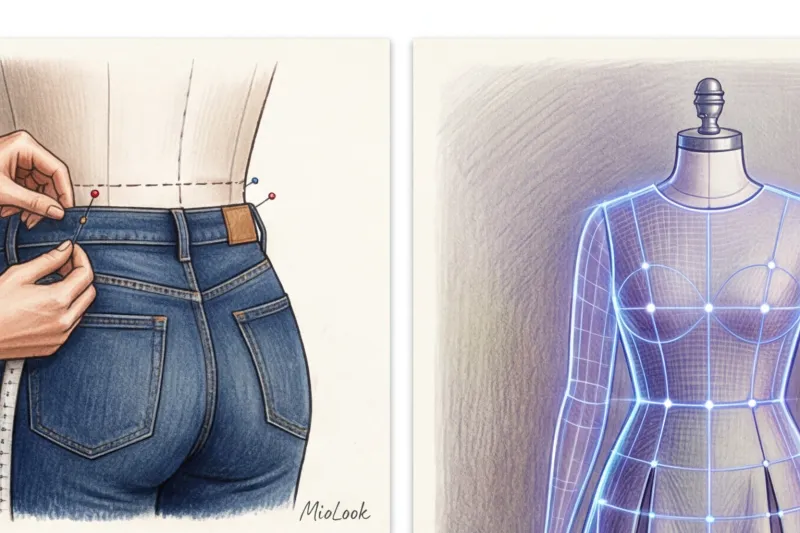
The standard sizing chart for mass-market brands assumes a difference of approximately 24–26 cm between the waist and hip measurements. However, for a pronounced pear shape, this difference is often 30–35 cm or more. Factory-made patterns are flat. When you pull flat pants over full hips, the fabric is wasted on contouring the buttocks, causing the waistband to slide down and bulge out at the back.
In bespoke tailoring, this problem is solved by a darting system: two deep darts on the back of the trousers neatly gather in excess fabric. In mass-market clothing, each dart is an additional step, increasing production costs, so brands cut straight. Over the years, I've noticed a pattern: as soon as horizontal tension in the fabric (the so-called "whiskers") appears in the crotch or side pockets, the hips appear 1-2 sizes larger. It's not your fault; it's the cheap, flat-cut fit.
Access to MioLook for €0.99 — one-time payment
A smart AI stylist will select the perfect look based on your individual parameters.
Get access — €0.99 onceHow a virtual fitting room can help balance wide hips
The end of tearful fitting rooms has arrived. Today, we can delegate the search for the perfect fit to algorithms. An AI stylist analyzes your unique geometry even before you click the order button.
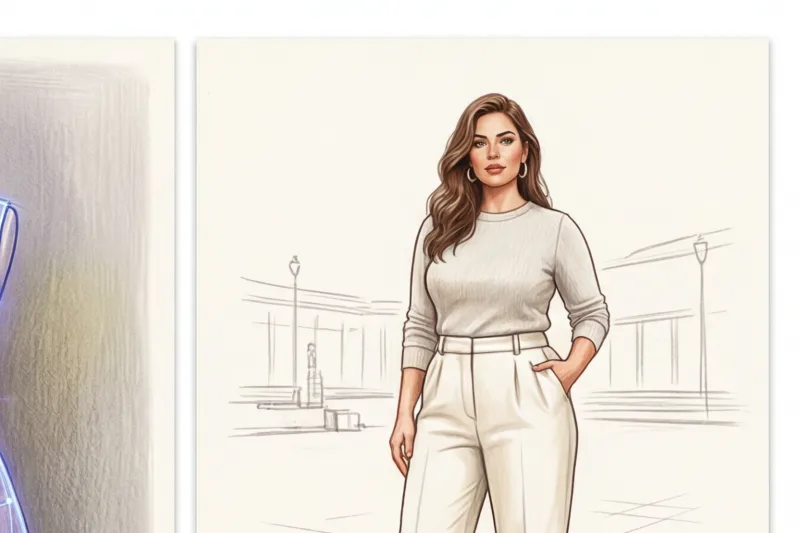
The app creates an accurate 3D model of your body. It "sees" that your 'M' shoulder size is completely different from your 'L' hip size. The algorithm MioLook reads the actual measurements of the garment, assessing whether the cut contains the necessary additional volume of fabric for the hips, and how the material will behave when stretched at specific points.
You no longer have to order three adjacent sizes of trousers in the hopes that at least one will fit properly. The virtual body mapping system calculates the ideal fit with mathematical precision, eliminating endless returns of unsuitable items.
The formula for the perfect bottom: fabrics, cut, and architecture
The main secret of a stylist for a pear-shaped figure: The density of the fabric decides everything If the fabric doesn't hold its shape, it's absolutely not suitable for accentuating hips.
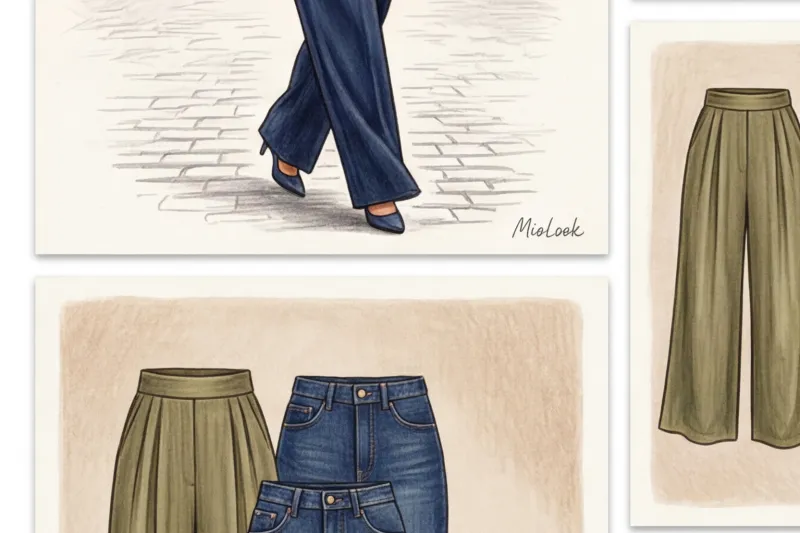
Remember the golden rule: choose fabrics with a minimum weight of 200 g/m² (and for denim, 12 to 14 oz). Heavy suiting wool, high-quality gabardine, and stiff cotton create a defined contour. They act as a support frame, smoothing out unevenness and creating a clean hip line. Thin viscose or loose knits, on the other hand, will cling to you, revealing even the folds you don't have.
Shape-stabilizing fabrics create space between the body and the garment. It's this millimeter-sized "air" that creates a visually slimmer look, not the dark color of the fabric.
Trousers and jeans for a pear-shaped figure
Your best friends are palazzo pants, straight-leg styles, and classic bootcuts (slightly flared from the knee). Why do they work better than skinny pants? Straight and flared lines create a visual counterbalance to wide hips. They smooth the silhouette into a harmonious rectangle, counteracting the effect of a heavy bottom.
It's crucial to pay attention to pockets. Side pockets (called "hooligan pockets"), often found on chinos, add unnecessary bulk exactly where you want to avoid it. Look for trousers with a smooth front or pockets hidden in a horizontal seam.
Fair Limit: A super-high rise is a classic advice for pear-shaped figures, but it doesn't work if you have a short torso and a full bust. In this case, a high rise will make you look like a solid square. Opt for a mid-rise, which ends 2-3 cm below your belly button.
Skirts that really flatter your figure
An A-line silhouette is a must-have. This skirt flows softly across the hips, widening at the bottom without creating sharp angles. Bias-cut skirts in thick silk also work beautifully. The diagonal placement of the threads allows them to flow across the body without clinging.
What should you avoid? Classic, slim pencil skirts with a back slit, made of thin fabric. On wide hips, the slit almost always flares out unattractively, creating tension, and the skirt itself gathers in horizontal folds with each step.
Your perfect look starts here
Join thousands of users who look flawless every day with MioLook.
Get access — €0.99 onceBalancing Your Silhouette: Upper Body Strategies
To make your hips appear more compact, you need to make your shoulders slightly wider. This is a basic rule of visual illusions. The architectural volume of your shoulder girdle is your main asset.
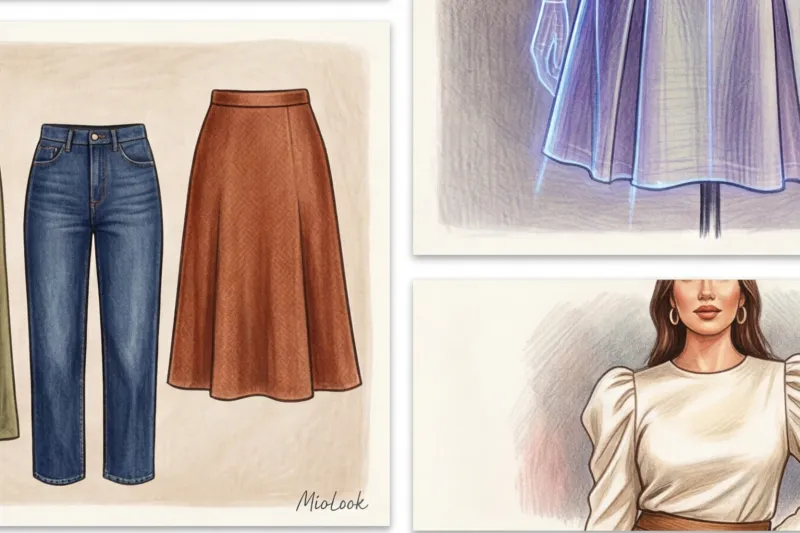
Use shoulder pads (they're trending again thanks to the '80s aesthetic), a boat neckline to widen the collarbone, or subtle puff sleeves. One of my clients was literally transformed when we added a structured, straight-cut blazer with a sharp shoulder to her everyday wardrobe. Her hips literally dropped two sizes simply by widening the top line!
Pay attention to the length of your top. Your sweater or blazer should NEVER end at the widest point of your hips. They should either be shorter above this line or cover it completely (a longer jacket). Layering is a great technique. How to stylishly pair a hoodie with a jacket To create a vertical stretch, as we've already discussed, the rigid top layer hides the actual transition from the waist to the hips.
What to Avoid: The Biggest Mistakes (And They're Not Light-Colored Pants)
It's time to debunk the biggest myth: "black bottoms make you look slimmer, while light bottoms make you look fat." This is the most persistent misconception in glossy magazines.
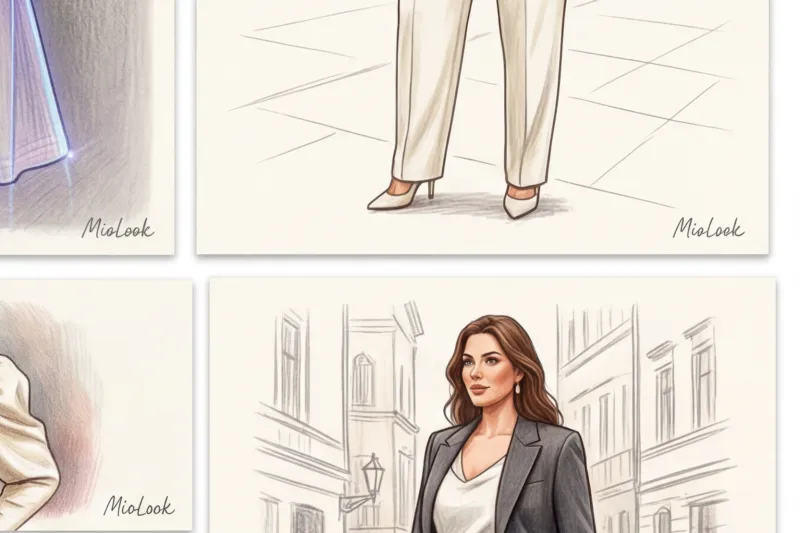
In fact, 14-ounce white jeans will make your thighs look much more defined than 180-g/m² black jersey. Let me explain: black absorbs light, but if the fabric is thin, it stretches across the thighs. Micro-reflections form along the curves, and the eye instantly perceives this volume. White denim acts like architectural plaster—it evens out the texture, doesn't deform under tension, and creates a crisp, matte outline without unsightly glare.
The real enemies of the pear-shaped figure are:
- Thin culotte knitwear: things that resemble sweatpants, which immediately deform at the knees and buttocks.
- Decor in the hip area: Cargo patch pockets, large embroidery, contrasting abrasions on the jeans that work like a magnifying glass.
- Horizontal lines: wide straps dropped to the hips, or a contrasting color block that falls exactly on the line of the largest volume.
Checklist: Assembling a Pear Capsule with AI
To stop buying things that upset you, create a smart capsule wardrobe. Here's a basic formula for ideal proportions that can be easily implemented using clothing selection algorithms.
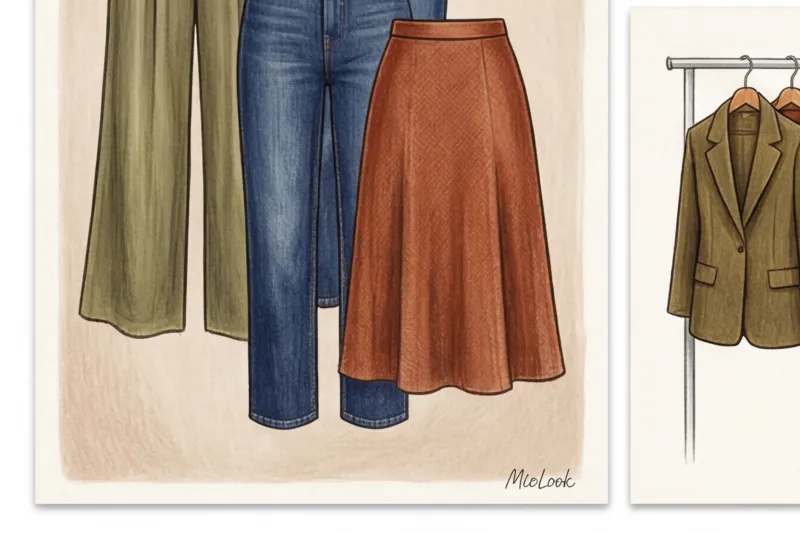
Your basic 3 bottoms that cover all your needs:
- Dark palazzo trousers made of thick gabardine (with creases for extra verticality).
- Thick straight jeans without abrasions with hidden pockets.
- A-line midi skirt made of thick cotton, eco-leather or suit wool.
Add to this four architectural tops: a structured blazer, a V-neck blouse, a boat neck top, and a textured knit jumper (length just to the hipbone).
How to choose the right size when shopping online? Upload your exact measurements (chest, waist under ribs, widest part of hips) to MioLook virtual fitting room Artificial intelligence will automatically filter out those models whose flat patterns don't accommodate your volume differences.
Summary: your hips are flawless, the problem is in the patterns
Over the years of working with thousands of women, I've learned one key lesson: let go of self-criticism. Clothes should fit your body, not your body, squeezed into a piece of fabric cut in a nameless factory.
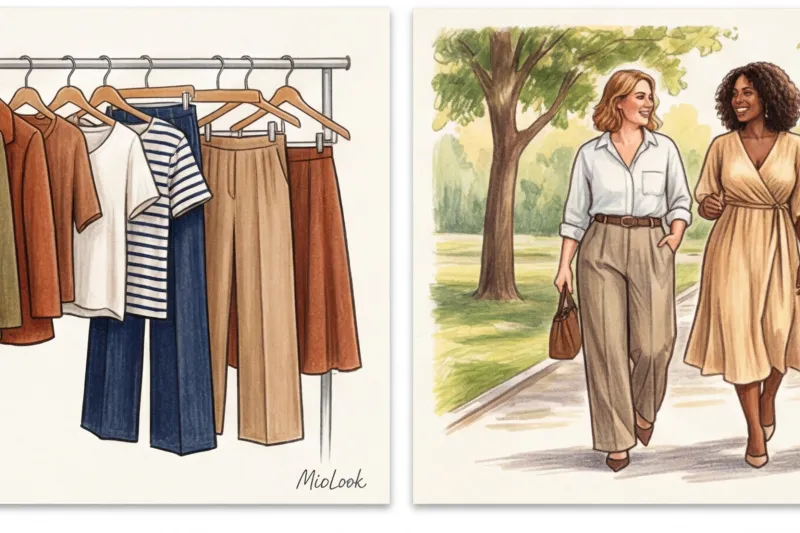
Virtual fitting rooms, 3D mapping, and smart algorithms have finally destroyed the dictatorship of standardized sizes. Learn to read fabric density, choose the right cut, and entrust the tedious routine of fitting to AI assistants.
Remember the most important thing: you don't have to wear black. The only thing you really need to do with your wardrobe is allow yourself to take up as much space as your feminine nature demands.