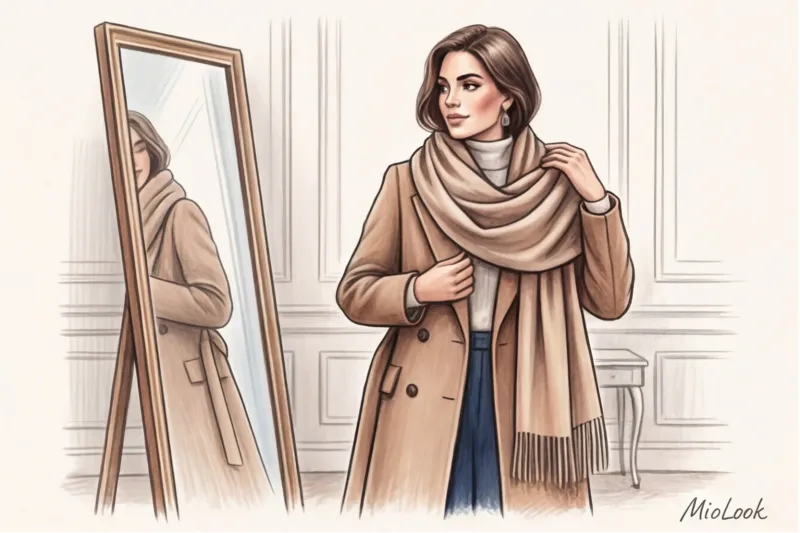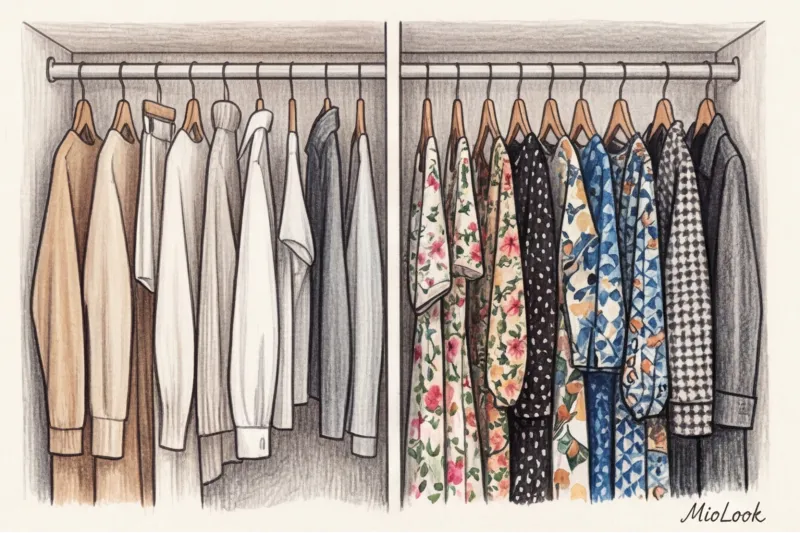
I remember my first experiment with patterns 12 years ago. I enthusiastically donned a large tartan skirt and a vibrant red rose blouse. The reflection in the mirror wasn't of a stylish city dweller, but of a city madwoman who'd accidentally robbed a theater costume department. The mistake wasn't a matter of taste, but a simple ignorance of the visual mathematics of scale.
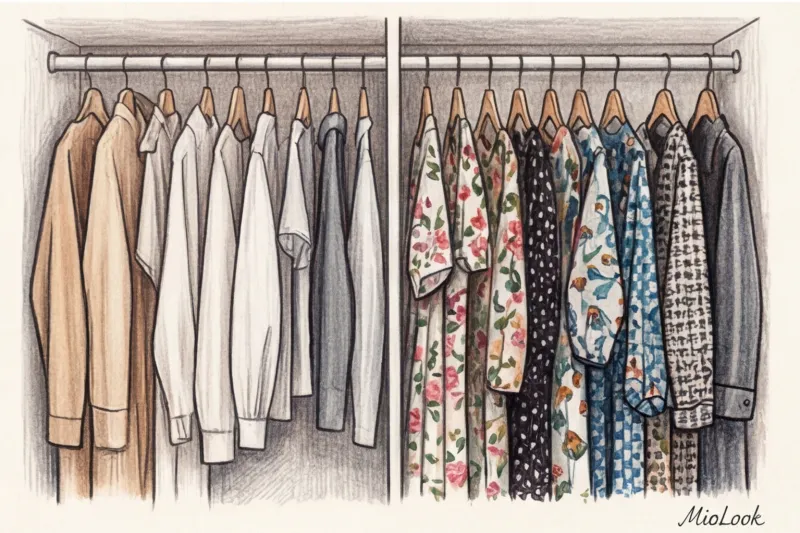
I have already talked in more detail about the basic principles of working with a wardrobe in our the complete guide to the rules of a stylish capsule wardrobe But today we'll go further. Forget the abstract advice "just trust your taste." If you want to understand, How to combine different prints in clothing To receive compliments rather than puzzled glances, you need a clear algorithm. We'll explore the most complex, yet most striking, pairing: strict geometric shapes and romantic florals.
From plane to volume: why prints are vital for capsule collections
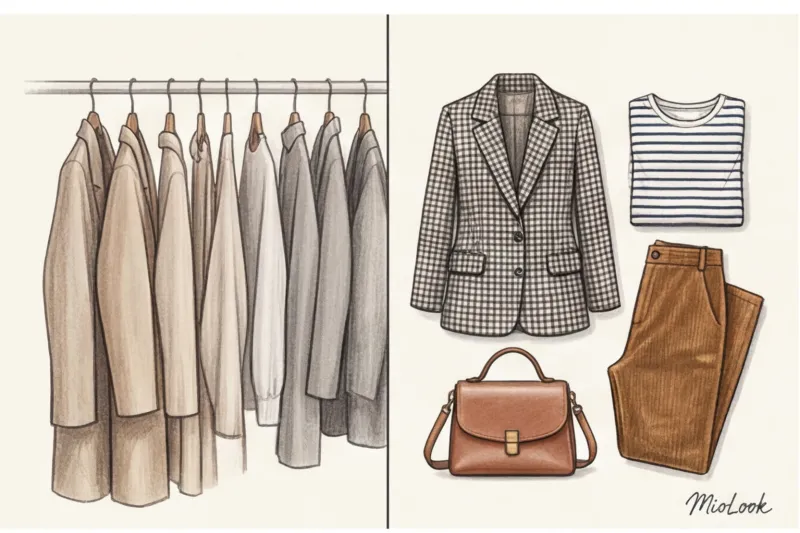
Sleek, monochromatic minimalism is safe. But in my experience, it often becomes a trap. Consider Anna, a top IT manager whose story we explored in previous articles. Her wardrobe consisted exclusively of high-quality, smooth fabrics in beige, gray, and black (the average price for an item was €150 to €300 at brands like COS and Massimo Dutti). Quality? Yes. Boring? Incredible. Her looks resembled expensive but bland uniforms.
The print acts as a visual anchor. It draws the other person's gaze to you, scanning your image, and comprehending the complexity of the texture.
When we added just two pieces to Anna's wardrobe—a silk blouse with microfloral print and a structured jacket with a subtle chalk stripe—magic happened. Flattering ensembles gained depth. And most importantly, she no longer had to puzzle over complicated accessories, because the prints themselves became the main decoration.
The Mathematics of Style: How to Combine Different Prints in Clothes Without Risk
The main secret of stylists: patterns are combined not by meaning ("flowers to flowers"), but solely by geometry and color. Statistics from wardrobe apps are merciless: 78% of women have striped items in their closets, but only 12% dare to wear them with other patterns. Why? For fear of making a mistake.
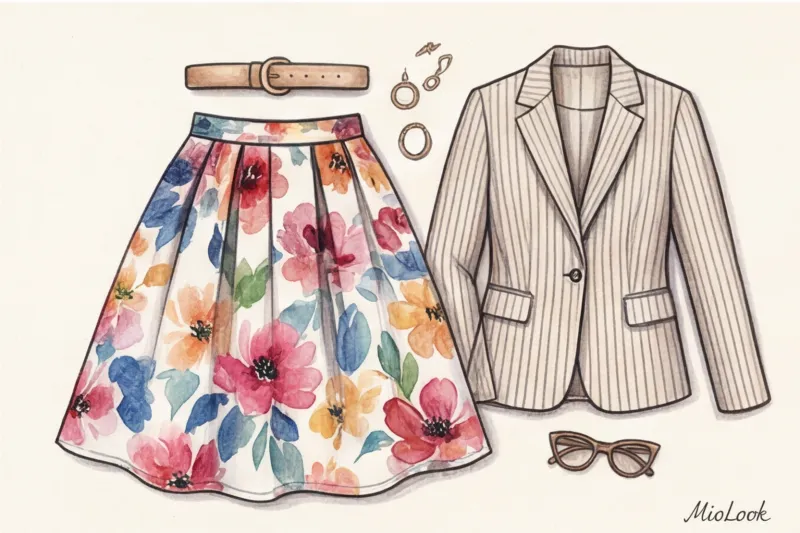
An analysis of over 500 successful street style images from around the world reveals a rock-solid rule: in 85% of cases, one print is at least twice as large as the other. rule of scale It is strictly forbidden to use two drawings of the same size—they will begin to clash visually and become dazzling.
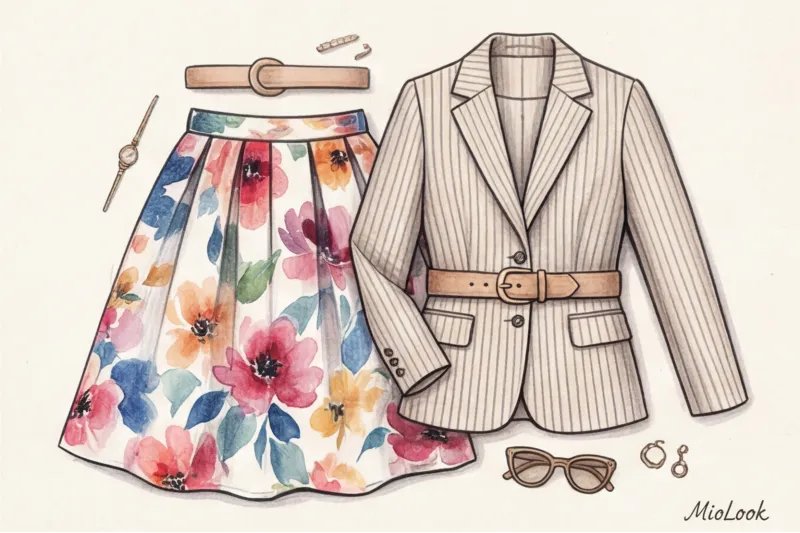
Perfectly matching colors in different prints (so-called match-matching) makes a look look cheap and dated. Modern styling calls for a subtle mismatch or the use of a neutral base "bridge color."
The 60/30/10 formula for working with patterns
This rule came to the fashion industry from interior design, and it works flawlessly. To prevent the image from becoming visual noise, distribute the space as follows:
- 60% - dominant print. Typically, it's a large pattern (for example, a coat with a voluminous check or a long skirt with large watercolor flowers).
- 30% - accent print. A small, rhythmic pattern (a thin stripe on a shirt, polka dots on a scarf).
- 10% - solid color "air". A basic, sleek piece (a white T-shirt, a solid-color belt or bag) that gives the eye a rest.
Access to MioLook for €0.99 — one-time payment
A smart AI stylist will select the perfect look based on your parameters and show you how to mix patterns correctly.
Get access — €0.99 onceFloristry and Geometry: The Perfect Balance of Chaos and Order
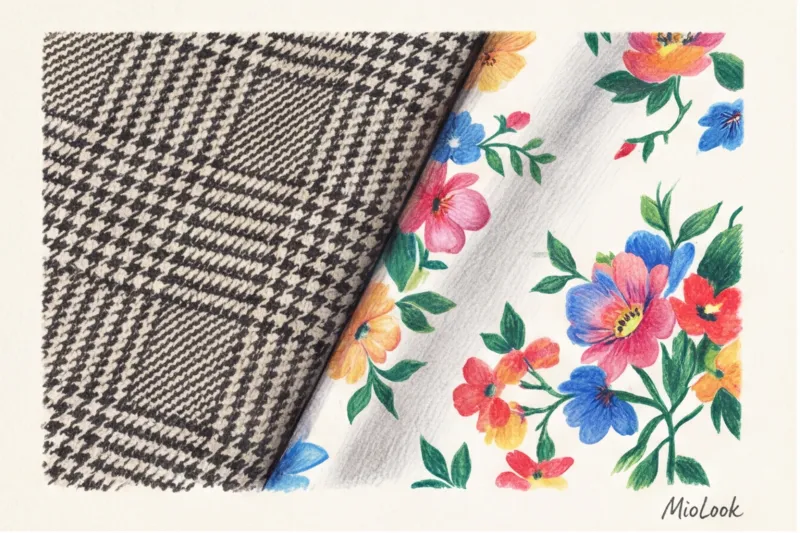
Why is a duet of flowers and lines considered the height of style? The answer lies in the psychology of perception and the theory of contrasts, described by Johannes Itten back in 1961. Floristry is fluidity, organicity, emotion, and a touch of chaos. Dressing yourself in flowers head to toe risks veering into a "provincial romantic" style. Geometry (checkered, striped) is clarity, structure, logic, and masculinity.
When you juxtapose them in a single look, a grounding magic happens. A strict architectural jacket calms the naivete of a flowing floral dress. And a striped Breton top or shirt (which is the "new black" in today's wardrobe) tone down the bombast of an intricate jacquard skirt with roses.
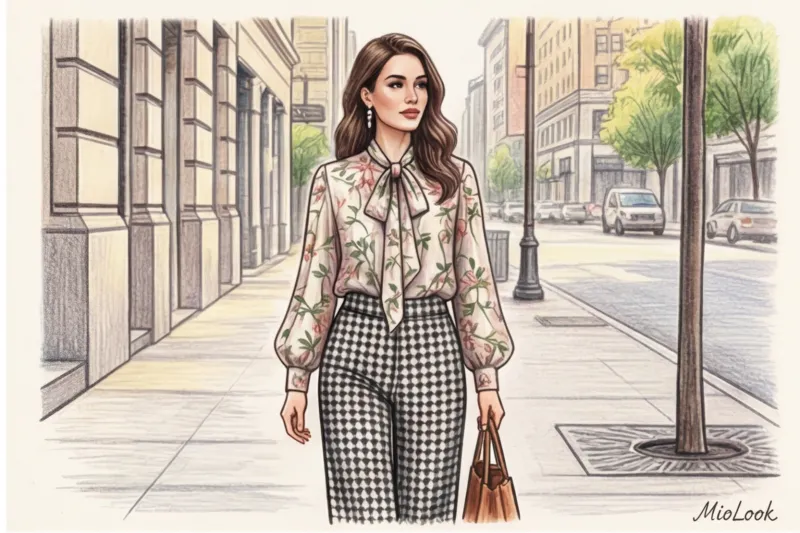
Fair Limit: This method does NOT work if both printed items are made of cheap, shiny, and shapeless fabrics (such as 100% thin polyester). For the check pattern to hold together, it should be on a dense texture—wool, heavy cotton (180 g/m² or more), or structured viscose.
Three Win-Win Schemes (The MioLook Formula)
If you're just starting to experiment, I recommend testing these combinations in smart wardrobe MioLook Before buying real things:
- Small peas + Large watercolor flowers. Polka dots act as the base texture, while the washed-out florals steal the show. Perfect for a spring trench coat and blouse.
- Architectural pinstripe + Small floral pattern (millefleur). A classic for the office without a strict dress code. These €80–€120 office trousers in thin white stripes look stunning with a blouse featuring a small calico flower.
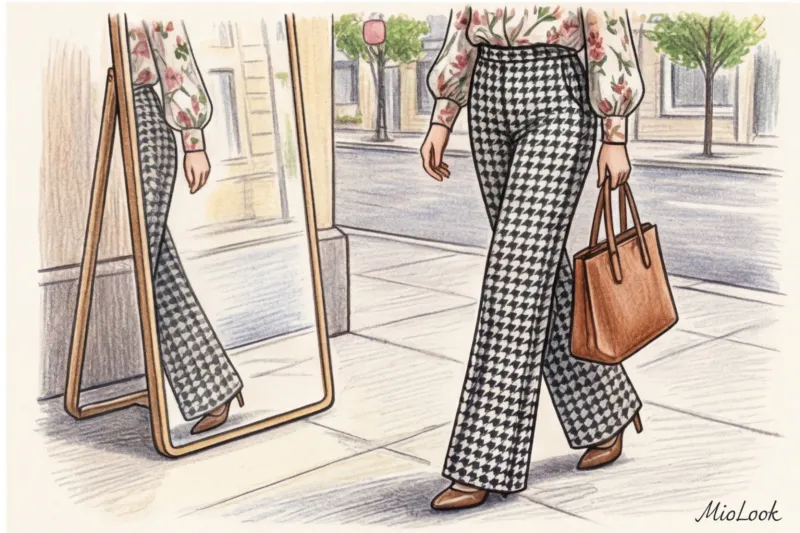
- Classic houndstooth (pied de poule) + Abstract plant motifs. Black and white houndstooth prints work as a graphic backdrop for bright, neon or pastel leaves.
The Biggest Myth: Prints Ruin a Capsule Wardrobe
Many girls, striving for minimalism, ruthlessly throw out everything with a pattern from their closet. This is a catastrophic mistake. A capsule wardrobe isn't a warehouse of identical beige turtlenecks. It's a mathematical system of interchangeable elements.
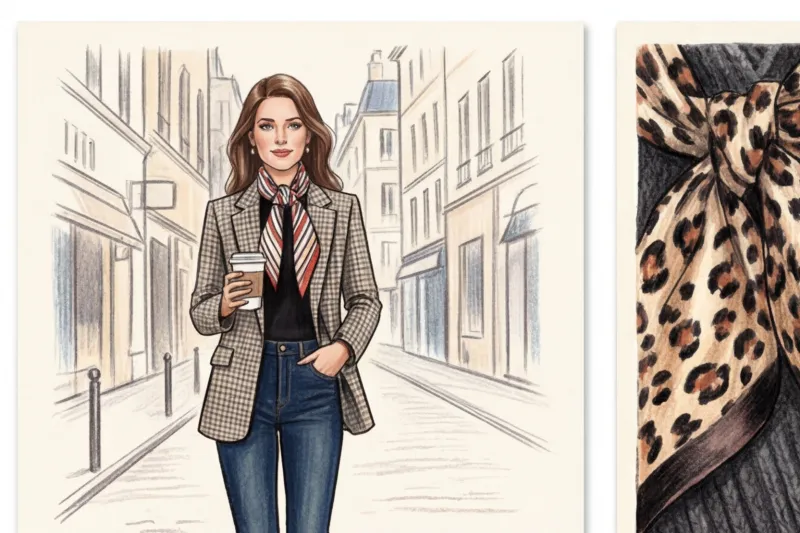
There's the concept of a "basic print." Leopard in muted caramel and black tones, classic Breton stripes, and tartan—all of these have long since become neutral backdrops. According to research by retail analysts WGSN (2024), a basic item in the right stripe offers 35% more styling options than a plain black one.
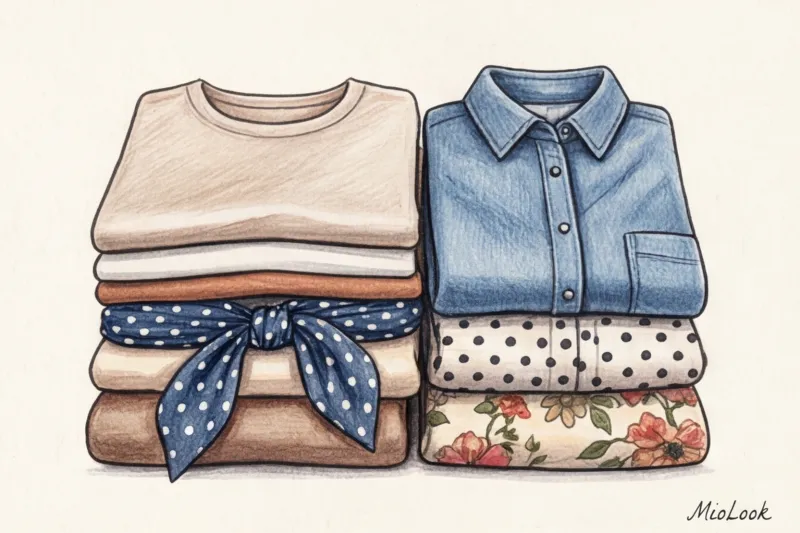
Let's do the math: if you have 10 solid-color basic items, you can create N outfits from them. If you replace just two solid-color items with printed ones (in the same colors), the number of visually interesting, complex looks increases by almost 40%. You spend the same amount of money, but look like your wardrobe is three times larger.
Your perfect look starts here
Join thousands of users who look flawless every day with MioLook, mixing prints in a couple of clicks.
Get access — €0.99 onceChecklist for Beginners: Image Assembly Algorithm
It's easy to feel overwhelmed when faced with an open cabinet. To avoid panic, use this step-by-step assembly algorithm:
- Step 1: Choose a dominant. Choose a piece with the brightest or largest pattern. Maybe it's a midi skirt with tropical leaves.
- Step 2: Find the "color bridge". Look closely at the skirt and find one secondary color (not the background!) in the pattern. For example, a pale yellow vein on a green leaf.
- Step 3: Choose a second print. Find a geometric pattern (like a gingham shirt) where this pale yellow is the background or main color.
- Step 4: Add a smooth texture. Calm down the look with a solid beige trench coat and sleek leather shoes.
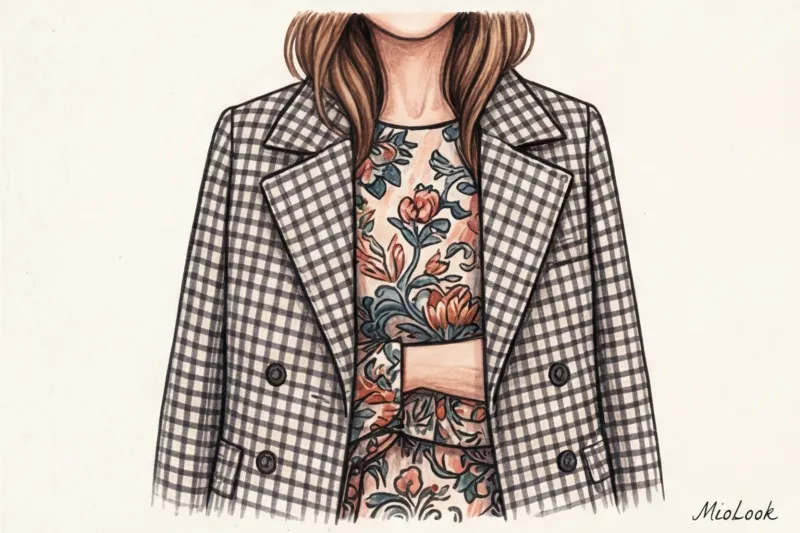
Squint Test: Get dressed, take two steps away from the mirror, and squint hard. If the images merge into one messy mess, the scale contrast is low. If you clearly see one large "spot" and a rhythmic, small background, you've done a flawless job.
Digitizing Style: How to Train Your Eyes Without Spending a Lot
The ability to masterfully mix flowers and cells isn't an innate talent passed down through genes. It's a mechanical skill, learned through observation, trained by algorithms.
Before, to test a bold combination, you had to turn your entire closet upside down, sweat, get tired, and end up wearing old jeans. Today, I teach clients how to digitalize their wardrobe. By adding your items to MioLook virtual fitting room , you can combine seemingly incompatible items while sitting on the couch with a cup of coffee. The algorithm will automatically tell you whether items share that common "color bridge."
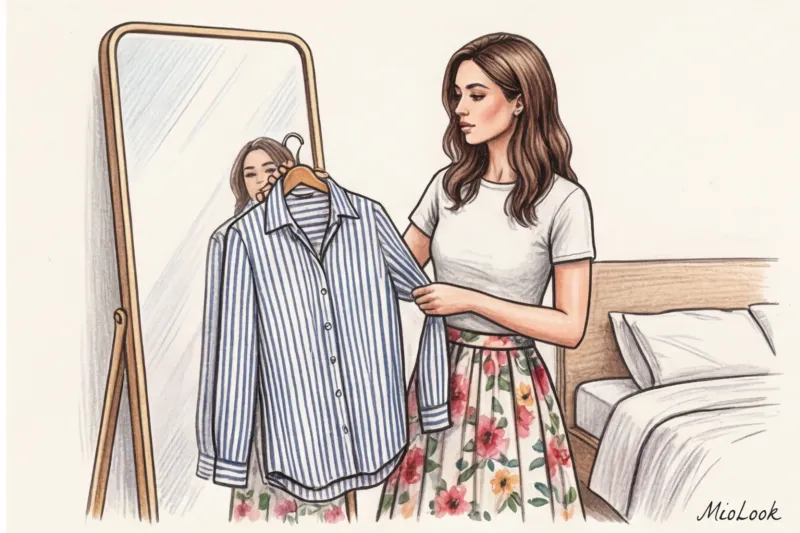
Remember the most important thing: prints fear uncertainty. If you've combined geometric patterns and florals according to the mathematical rules of contrast and scale, wear this look with dignity. You're no longer hiding behind a safe gray monochrome—you're commanding attention.