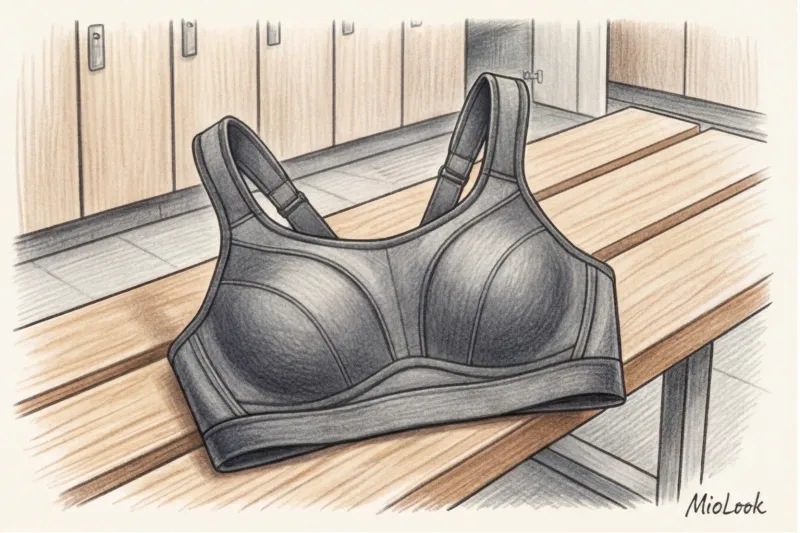
Three years ago, a client came to me who hated running. "It's just painful, Olena," she confessed. When we started sorting through her workout gear, I saw the reason: a basic knit crop top from a mass-market store for €15. It was a beautiful powdery shade, looked great in photos, but absolutely failed to fulfill its primary function. That day, we swapped her shapeless top for a high-tech encapsulated bra. A month later, she ran her first 5 kilometers without a single complaint.
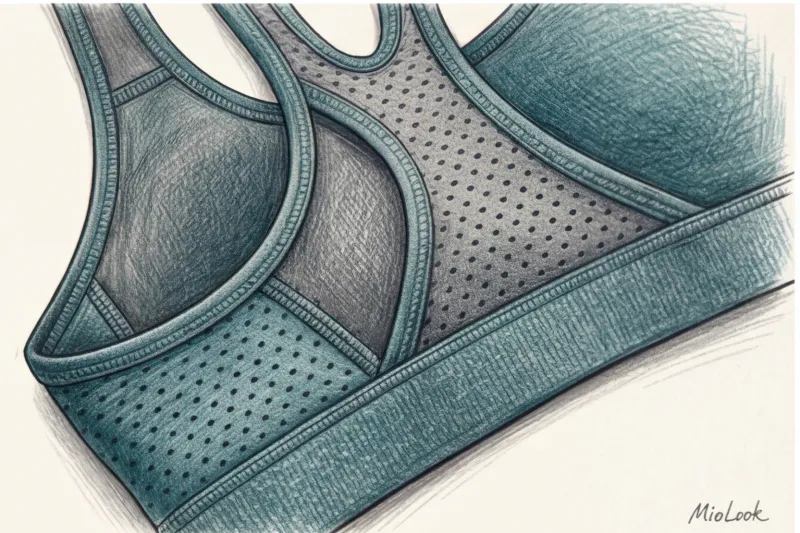
As a stylist with 14 years of experience, I often see women invest hundreds of euros in the perfect cushioned sneakers but skimp on bust support. If you don't know, How to choose a sports bra , you're risking not only your comfort but also your health. A sports bra isn't just a piece of clothing; it's a complex architectural structure. I discussed building a proper foundation in more detail in our The Complete Guide to a Sports Wardrobe: How to Put Together a Premium Capsule.
The Anatomy of a Perfect Bra: Why a Regular Bra Won't Work for Sports
Let's forget about fashion for a minute and look at pure biomechanics. According to the data Research Group in Breast Health (University of Portsmouth Breast Health Research Group, 2023) When running, a woman's breasts don't just move up and down. They perform complex figure-eight movements, the amplitude of which, without proper support, can reach 14–21 centimeters!
Regular everyday underwear is designed to provide support from below—it works against gravity when static. A sports bra should absorb inertia in all three dimensions: up and down, left and right, and forward and backward.
"There are no muscles in your chest that can be pumped up. Only the skin and Cooper's ligaments maintain their shape. These are extremely thin connective tissues that, unlike muscles, don't contract back after being stretched. Once they're stretched due to poor support during exercise, you lose their elasticity forever." I repeat this anatomical fact during every shopping session.
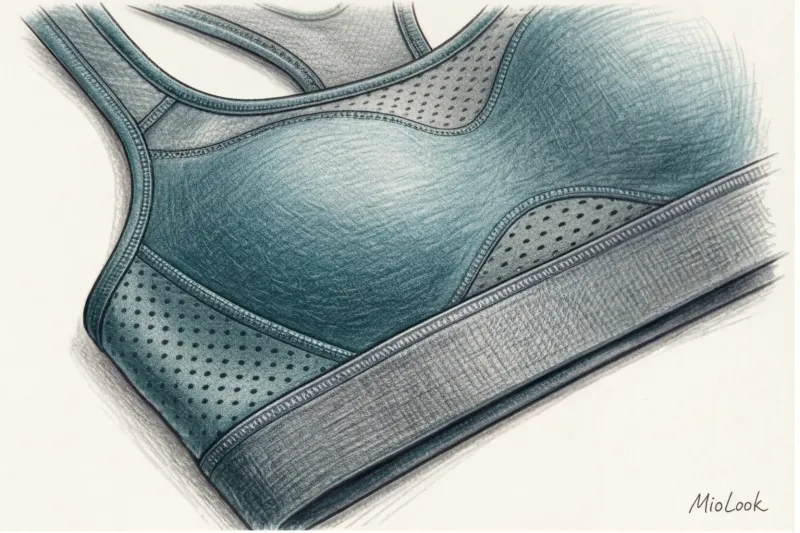
That's why a basic cotton bra for €15 is the worst thing you can wear to a workout. A quality sports bra is an investment. It's constructed from complex blends of polyamide and elastane, features stabilizing inserts made of non-stretch mesh (power mesh), and a dense, architectural underbust frame. Yes, such a high-tech bra will cost between €60 and €120, but that's the price we pay for preserving our body tissues.
How to Choose a Sports Bra by Support Level: A Beginner's Guide
The key rule to remember is that the level of support is chosen based on your type of exercise and breast size, not simply on color or brand. And there's an important exception here, one that manufacturers often overlook.
Fair Limit: The standard classification (Low, Medium, High) works perfectly for cup sizes A-C. If you're a D or larger, the rule shifts one step. Women with larger breasts will need Medium Support even for gentle yoga, and Low Support is absolutely not suitable for them—the thin straps will simply cut into their shoulders.
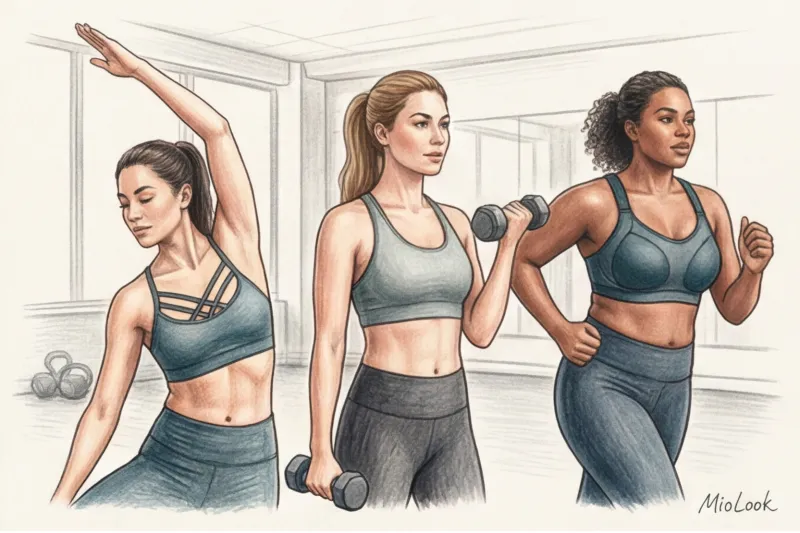
Low Support: Yoga, Pilates, Stretching
These are the most photogenic and elegant tops. Their distinctive features include thin straps, soft, breathable fabrics (often with modal), deep necklines, and the absence of rigid frames.
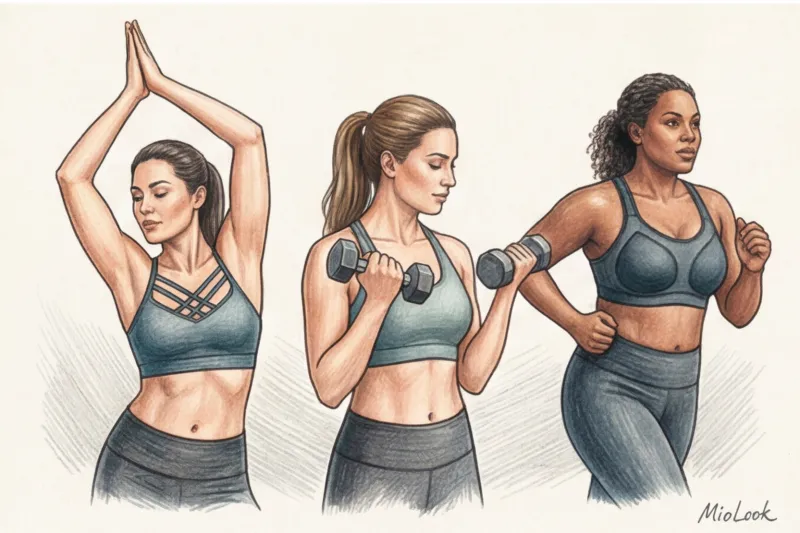
- Task: Do not restrict deep diaphragmatic breathing and ensure maximum amplitude in complex twists.
- Who is it suitable for: Sizes A-B (sometimes incomplete C) exclusively for low-impact training without jumping.
Medium Support: Strength training, cycling, dancing
A true fitness wardrobe workhorse, this top covers approximately 70% of standard training needs.
- Distinguishing features: Wider straps (often T-back or racerback), thicker and wider elastic under the chest, light compression inserts.
- When to wear: The ideal choice for strength training in the gym. While you're not jumping on a box, you're doing deadlifts or bends—your chest should be securely supported and not fall out of the cups when you bend over.
Access to MioLook for €0.99 — one-time payment
A smart AI stylist will select the perfect look for your workouts and help you put together a functional capsule wardrobe.
Get access — €0.99 onceHigh Support: Running, HIIT, CrossFit
An absolute must-have for any impact activity. Research shows that a high-quality high-impact bra reduces bounce (chest bounce) by up to 74%.
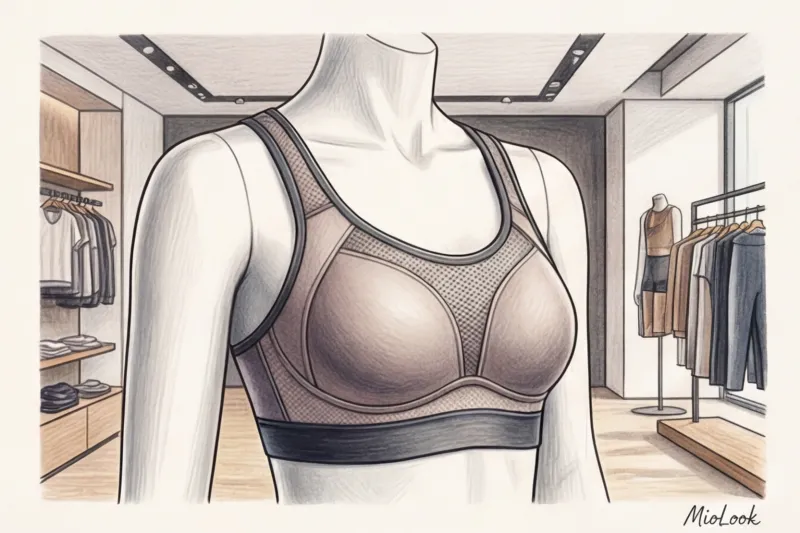
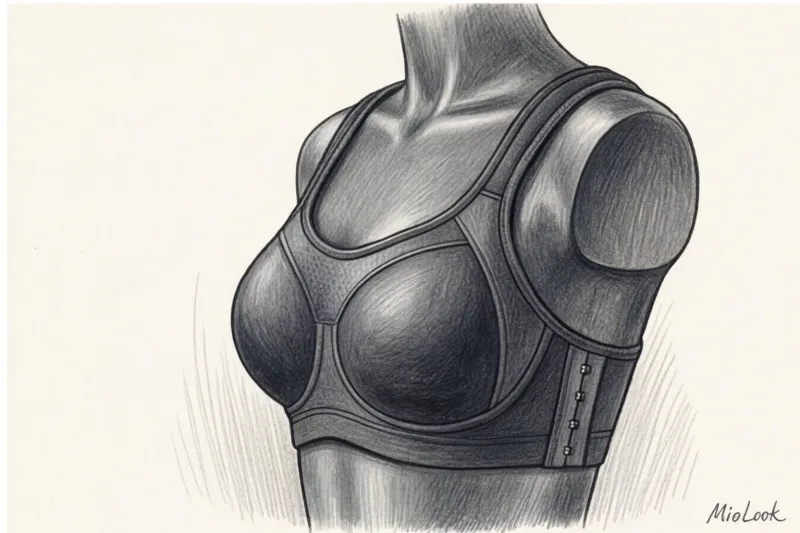
- Distinguishing features: Adjustable, wide straps (often with gel inserts), a back fastening like a regular bra, rigid molded cups, and a high neckline that completely covers the décolleté are a must.
- To put on: For any activity that includes a flight phase (running, jumping rope, burpees).
Compression vs. Encapsulation: The Biggest Myth About Sports Bras
This is perhaps the most important insight in this article, the one that changes everything. 90% of women believe that to prevent breasts from bouncing during exercise, they need to be squeezed and compressed as much as possible.
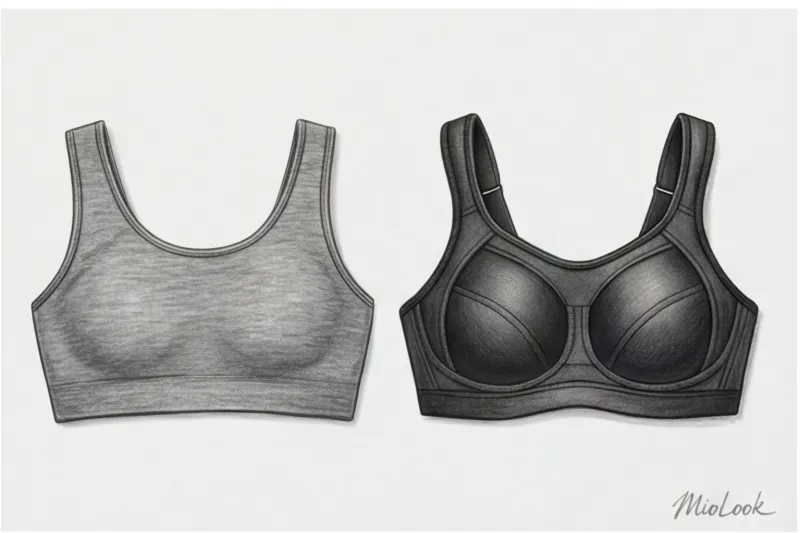
That's exactly how cheap, mass-market tops work. They create what's called compression—they simply press the breasts against the rib cage, creating a uniboob effect. As a stylist, I hate this effect. A flattened bust visually adds extra pounds to the waist, makes the back hunched, ruins the silhouette even in the most expensive tracksuit, and, most importantly, impairs circulation.
The premium alternative to compression is encapsulation.
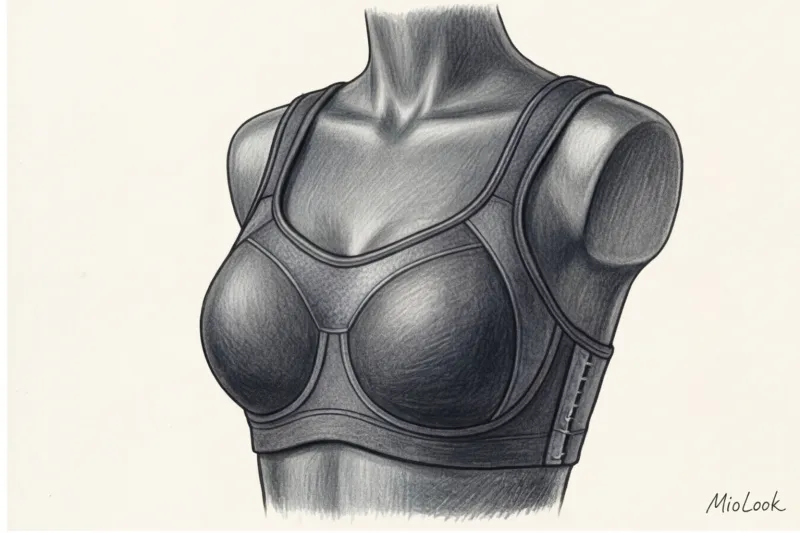
Encapsulated tops create a separate molded cup for each breast. Breasts aren't compressed, but rather held in their natural position. The fabrics don't rub against each other (goodbye, chafed skin between your breasts during a sweaty workout). Any form-fitting t-shirt or rashguard fits perfectly over this top, maintaining your feminine proportions.
5 Signs It's Time to Ditch Your Current Top
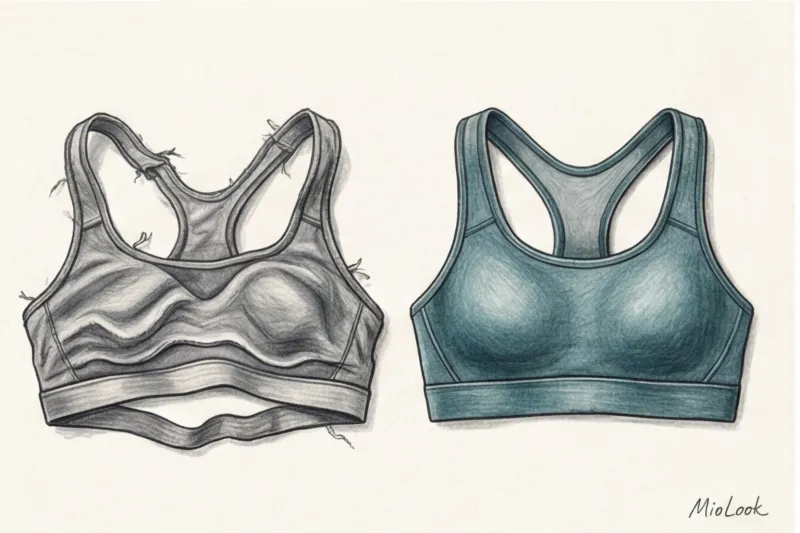
My clients often regret wearing old workout clothes. "But they're only for the house, to do abs workouts," they say. I forbid wearing stretched-out tops, even for gentle home workouts. How do you know when a piece is dead?
- Belt test: After putting on the bra, try pulling the bottom band away from your back. If it moves more than 5 cm away from your body, the band is no longer holding anything in place.
- Elastane degradation: Small white, rubbery fibers have appeared on the fabric (especially along the edges and seams). This means the polymer threads inside the fabric have burst due to sweat and repeated washing.
- Loss of return: After washing, the top remains slightly stretched and does not take on its original rigid shape.
- Chafing of the straps: The straps have started to dig into your shoulders, leaving red marks. This is the main sign that the band has stopped working. In a proper bra, 80% of the breast weight is supported by the band (underband), not the straps.
- Cost-per-wear math: The lifespan of a high-quality investment bra (from brands like Shock Absorber, Anita, or premium Nike/Lululemon lines) is 100-150 intense workouts. A cheap, mass-market top loses compression after 20-30 washes. Throwing it away and buying a more expensive one is mathematically more cost-effective. Incidentally, tracking the cost of each garment is very convenient by adding it to a digital database. MioLook wardrobe.
Your perfect look starts here
Join thousands of users who look flawless every day with MioLook. Digitize your wardrobe in one click.
Get access — €0.99 onceTry-On Like a Stylist: A Pre-Purchase Checklist
When I'm shopping with clients, I encourage them to move around the fitting room. Trying on a sports bra is very different from buying lace lingerie.
The most common mistake: a woman puts on a bra, feels the band is too tight, and goes up a size. At this point, she destroys 80% of the future top's support with her own hands! The band should fit snugly, like a second skin.
Here is my personal verification algorithm:
- The two-finger rule: Fasten your top. Try slipping two fingers under the waistband (from the side, under the ribs). They should enter with noticeable force. If your fingers slide in easily, the girth is too large.
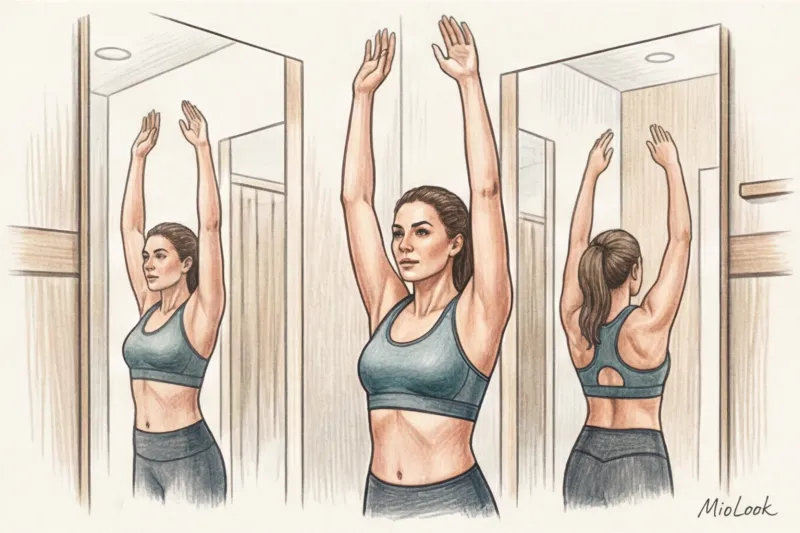
- Raised Hands Test: Raise both arms sharply upward. Is the belt still in place? Great. Has the belt ridden up, revealing the lower part of your chest? You need less underbust size, not the smaller cup.
- Jump test: Right in the fitting room, jump up and down, do a couple of sharp twists, and wave your arms. Your breasts should stay inside the cups, and there shouldn't be any "dropping out" anywhere.
- Checking the seams: Run your fingers along all the inner seams. They should be either taped or flatlocked. A regular raised seam will rub your skin raw after 10 kilometers.
Caring for an investment sports bra
You bought a fantastic high-tech bra for €80. But after a month, it's become a rag. Why? Because you washed it with fabric softener.
Remember the main rule of care: Air conditioning is the main enemy of any sportswear. It coats the fabric fibers with an invisible silicone film. This stops the membrane from wicking away sweat, and the elastane fibers lose their elasticity and become stuck. The garment loses its breathability and stretches.
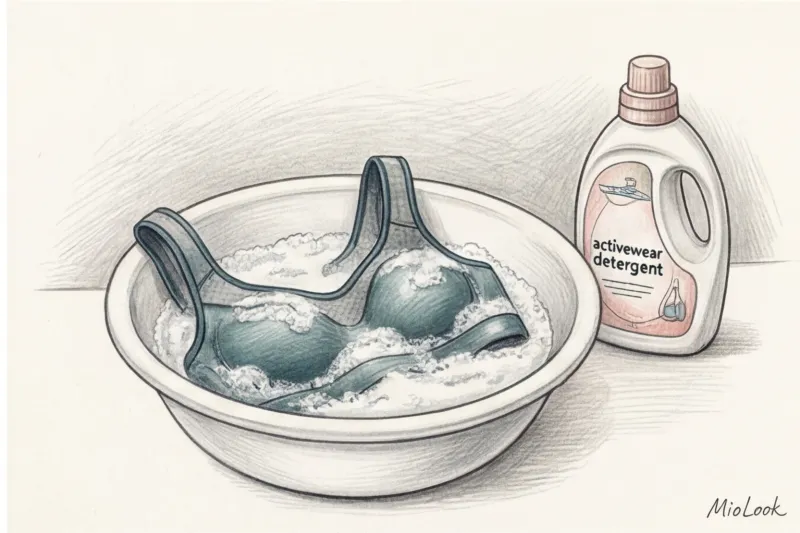
- Wash tops only in cold water (up to 30 degrees) or on the special “Sport” cycle.
- Use liquid gels for washing membrane fabrics - powder granules clog the pores of high-tech materials.
- Never put athletic underwear in the dryer or dry it on a hot radiator. High temperatures instantly destroy the elastic threads.
- When storing in a drawer, don't turn one molded cup inside out to nest it inside another (as many people do to save space). This will break the internal frame. Place them flat, one cup inside the other.
Next time you're packing your gym bag, take a critical look at your sports bra. If you're constantly tugging at it, adjusting the straps, or feeling discomfort in your chest after jumping, your gear is sabotaging your results. Investing in the right encapsulated sports bra isn't about fashion. It's about freedom of movement, self-confidence, and respect for your body. Start building your workout wardrobe with the right support, and you'll be surprised how much easier your workouts become.