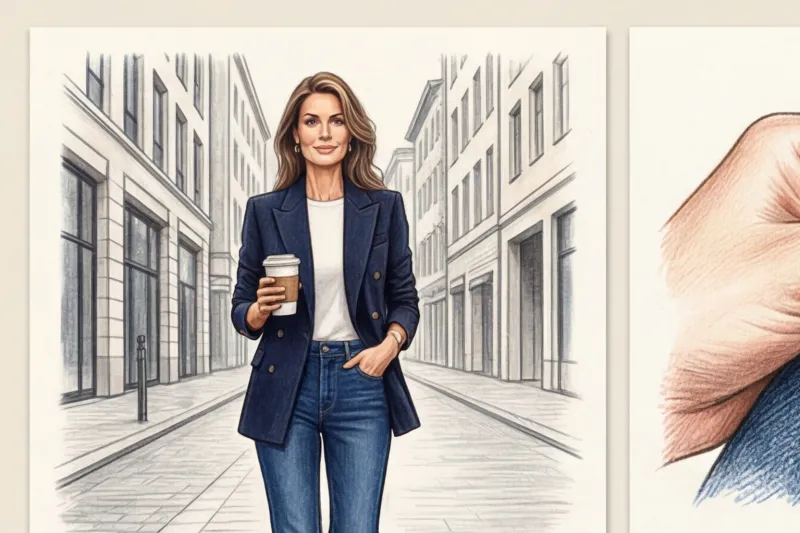
You know what question I hear most often from new clients? "Darina, I'm 42. Maybe it's time to give my jeans to my nieces and buy some 'decent' trousers?" Most glossy articles echo this fear, advising women to hide their figures behind plain, straight-leg styles and avoid any trends. But as a stylist and colorist, I'm ready to prove otherwise.
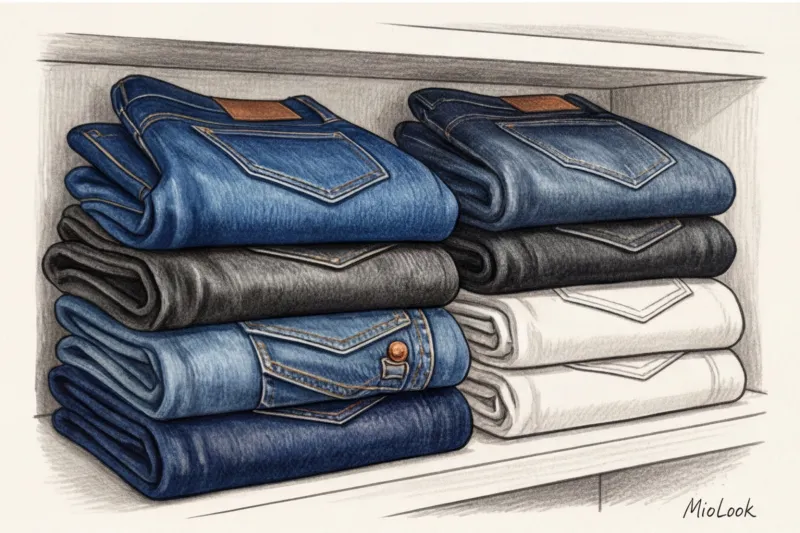
The secret to perfect jeans lies not in a boring basic cut, but in the "architecture" of the fabric and the mathematically precise geometry of the pockets. If you understand how denim ounces work, you can indulge in bold palazzos and micro-distresses while still looking luxurious. We discussed this shift in fashion paradigm in more detail in our complete guide to Clothing style for women over 40: how to stay yourself And today we'll take denim apart, down to the last thread.
The Comfort Trap: The Biggest Mistake When Choosing Jeans After 40
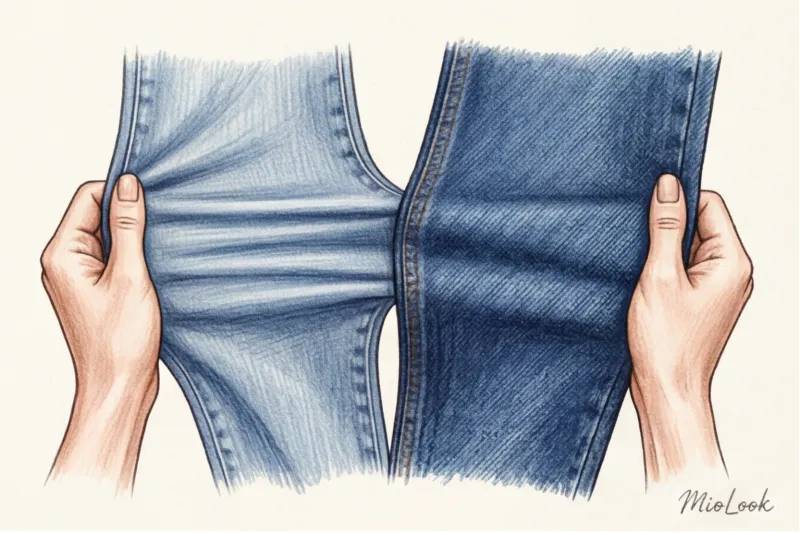
I had a telling experience in my practice. Elena, a 44-year-old top manager at an IT company, came to see me. She showed up for her first meeting wearing dark blue skinny jeans made of 8% elastane. "They're so soft, comfortable to sit in at the computer," she explained. The problem was that this "comfortable" stretch mercilessly accentuated the slightest imperfections in her legs, and by evening, the fabric had stretched at the knees, making her look tired and unkempt.
The concept of "dressing for your age" no longer works. Today we're talking about a status statement. The main enemy of your elegance isn't extra pounds, but jeans with too much elastane (more than 3-5%), which are essentially jeggings.
Thin stretch denim is a crime against your figure: it accentuates age-related skin changes and gravitational droop. It's form-fitting, but it doesn't shape. As soon as we replaced Elena's soft skinnies with stiff, shape-defining wide-leg pants, magic happened. The dense fabric visually "gathered" her figure, elongated her height, and she instantly dropped 10 years. Structured pieces cure the "invisibility syndrome," restoring your authority in any space.
Access to MioLook for €0.99 — one-time payment
A smart AI stylist will select the perfect look.
Get access — €0.99 onceDenim Architecture: What to Look for Before You Go to the Fitting Room
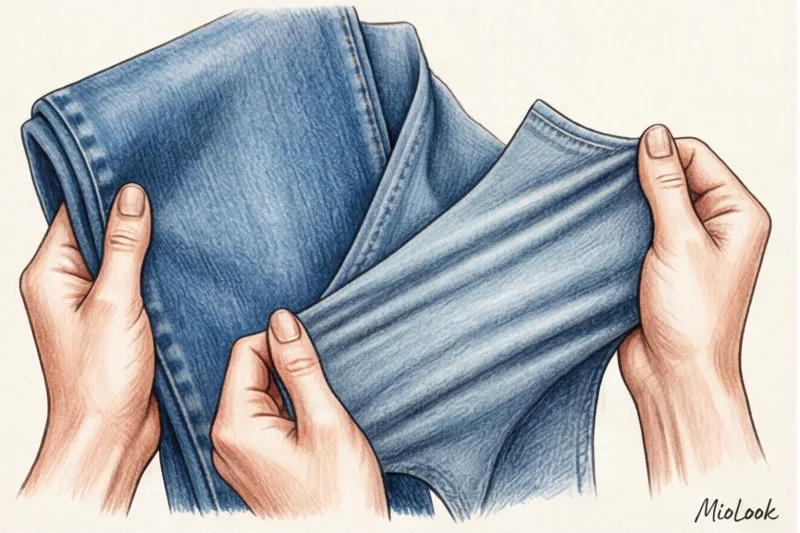
Choosing a pair doesn't start with trying them on, but with reading the tag and feeling them. In the premium denim industry, there's a concept called "ounces" (oz), which refers to the weight of the fabric. According to WGSN's 2024 textile trend analysis, global brands have shifted their focus to authentic, heavyweight denim. Look for a weight of 12-14 oz. If the tag doesn't indicate this, simply weigh the jeans in your hand: the right pair should feel heavy.
The second golden rule is the 98/2 ratio. The ideal composition for high-status jeans is 98–99% cotton and no more than 1–2% elastane. Yes, they will feel unusually tight for the first 15 minutes. But statistically, 100% cotton jeans shrink after 3–4 wears, adapting to your body's anatomy under the influence of heat. They create a soft corset effect.
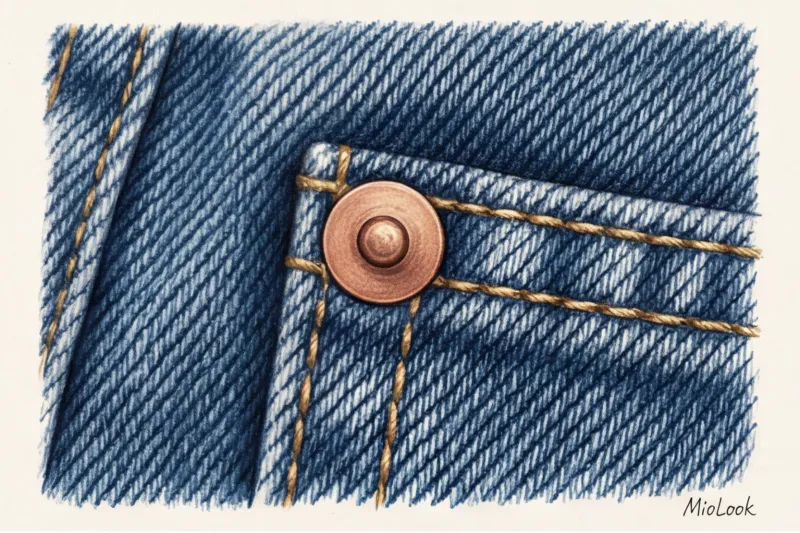
"You can spot quality denim with your eyes closed. Run your finger along the fabric: you should feel a distinct diagonal twill. This weave visually elongates the silhouette, acting as vertical micro-lines," says Darina Marchenko.
As a colorist, I want to warn you against another mistake: dirty shades. Ever notice how some blue jeans make your legs look dull and your look cheap? It's the undertone. Avoid denim with yellow, greenish, or gray undertones. Deep indigo is your choice. This color creates the perfect contrast with your skin, looks expensive, and is appropriate even in offices with a relaxed dress code. High-quality jeans like these from brands like COS or Massimo Dutti cost €70-€100, while premium lines start at €150.
How to choose jeans for a woman over 40: top trending styles that make you look younger
When wondering how to choose jeans for women over 40, the first rule is to stop focusing solely on TikTok trends. We look at silhouettes through the lens of your body's architecture. The most important change you need to make is to allow air between your body and the fabric. Here's a professional breakdown of the styles that work best for you.
Straight Fit Jeans - The New Skinny Basic
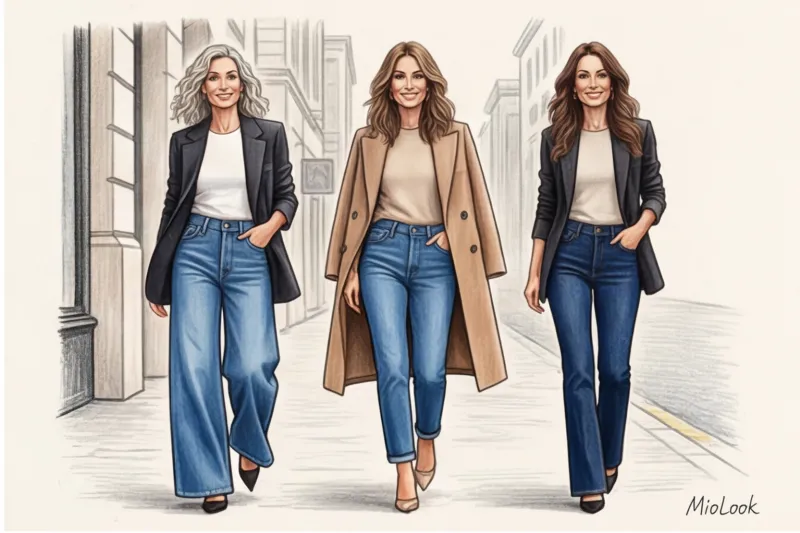
Straight-leg jeans are a canvas. They're perfect for any body type because they don't taper at the ankle, preventing your thighs from becoming a massive triangle. Length is key here. Cropped styles (cut to the ankle) work great in spring and summer with loafers or mules. But if you want endless legs, choose a floor-length version and pair them with pointed ankle boots. The pointed toe peeking out from under the straight edge of thick denim makes your feet appear graceful and adds height.
Wide Leg and Palazzo Jeans – Status Relaxation
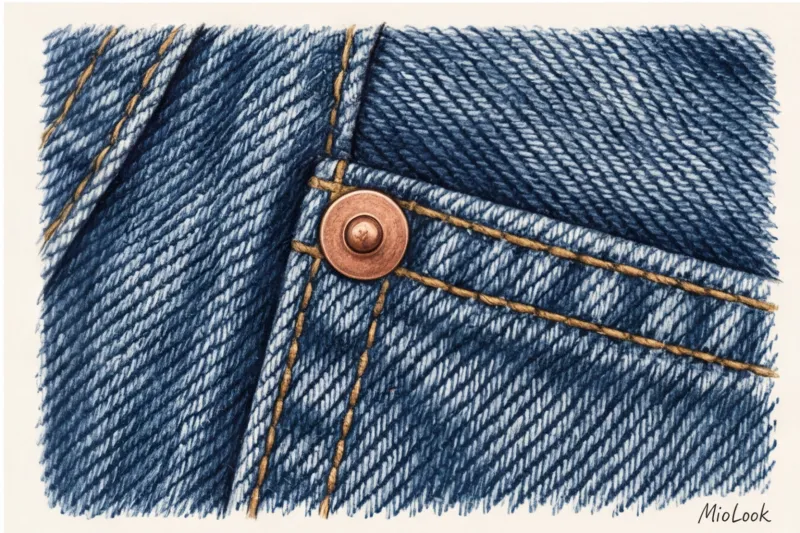
Let's bust the biggest myth: "Wide-leg jeans make me look bigger." This is an optical illusion. They only make you look bigger if they hang loosely on your hips. The secret to palazzo jeans is the perfect, snug fit at the waist and the top 10 centimeters of your thighs. The contrast between the narrow waist and wide legs makes the upper half of your figure appear fragile. Wear them with a structured top: a tucked-in heavy cotton shirt or a cropped tweed jacket. If you're unsure about combinations, upload a photo of your jeans to MioLook , and the application will offer dozens of volume balancing options.
Bootcut and Flare – the perfect correction of proportions
The 70s aesthetic is back, and for women with a pear-shaped figure, it's a real lifesaver. A bootcut or flare is a brilliant way to balance wide hips. However, there's a strict limitation: when it does NOT work Flared heels are absolutely contraindicated with flats. If you only wear sneakers, forget about this style. Bootcuts should only be worn with heels or platforms, and the pant leg should cover two-thirds of the shoe. This creates the illusion that your legs end where the heel ends.
Your perfect look starts here
Join thousands of users who look flawless every day with MioLook.
Get access — €0.99 onceThe Anatomy of a Perfect Fit: Waist, Pockets, and the Secret to Lifting
Even the most expensive €300 jeans will disfigure your figure if they're not cut correctly. Let's start with the waistline. Many women with a small belly instinctively seek out an extremely high-rise waistband, hoping to slim it down. In reality, the tight waistband digs into your ribs, and the fabric bunches up right at your belly. A safer and more elegant choice is a mid-rise or mid-high waistband, ending just below your belly button.
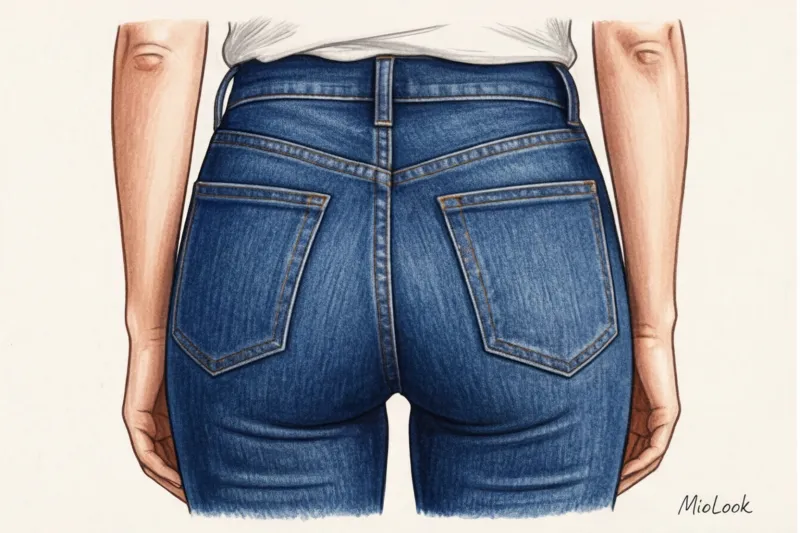
And now my favorite styling trick—an optical illusion we call "a surgical butt lift without the gym." Over 12 years of work, I've learned that shifting the back pockets just 1.5 cm dramatically changes the look from behind.
- Pocket size: It should be proportionate to your curves. Tiny pockets on a full buttocks will make them look oversized. Overly large pockets on narrow hips will eat up volume.
- Location: Pockets that sit too low (where the bottom edge touches the hip) create a sagging effect on the buttocks. The ideal pocket starts high and slopes slightly toward the center seam.
- Yoke (V-shaped seam at the back): The deeper and sharper the angle of this seam, the stronger the push-up effect. A straight yoke will create a flatter back.
3 Myths About Jeans for Women Over 40 That It's Time to Forget
The fashion industry is full of stereotypes that are long overdue for removal. Let's take a hard look at three of the most annoying myths.
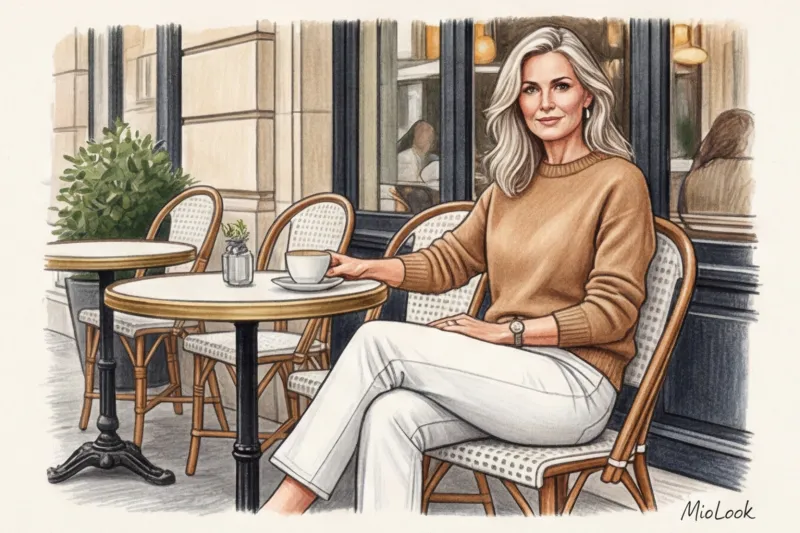
Myth 1: “Only teenagers wear ripped jeans.”
Huge holes in the knees are truly best left to those in their 20s. But micro-fading along the pocket edges or raw hemlines look ultra-stylish. As a stylist, I love playing with contrasts: rough, slightly distressed denim paired with the softest cashmere sweater and pumps creates a look with intellectual chic.
Myth 2: “White jeans make you look fat and are inappropriate in winter.”
My background in painting always makes me think about light. Heavy white denim (especially ecru) works like a photographic reflector. It illuminates the face from below, erasing signs of fatigue and visually rejuvenating. The main rule is that white jeans should not show through pockets or skin. And yes, in winter they look much richer and more prestigious than the usual black ones.
Myth 3: “I need a classic with embroidery or rhinestones so it’s not boring.”
Any factory-made embellishments on denim (embroidery, rhinestones, appliqués) immediately cheapen the look. Period. Denim is a workable material. What makes it "interesting" is the design of the cut itself, a quality leather belt, the texture of the upper (silk, tweed, suede), and the accent shoes, not rhinestones on the back pocket.
Stylist's Checklist: 5 Fitting Room Tests for Jeans
To help you never buy jeans that end up gathering dust in your closet again, I've put together a practical checklist. Perform these 5 tests right in the fitting room.
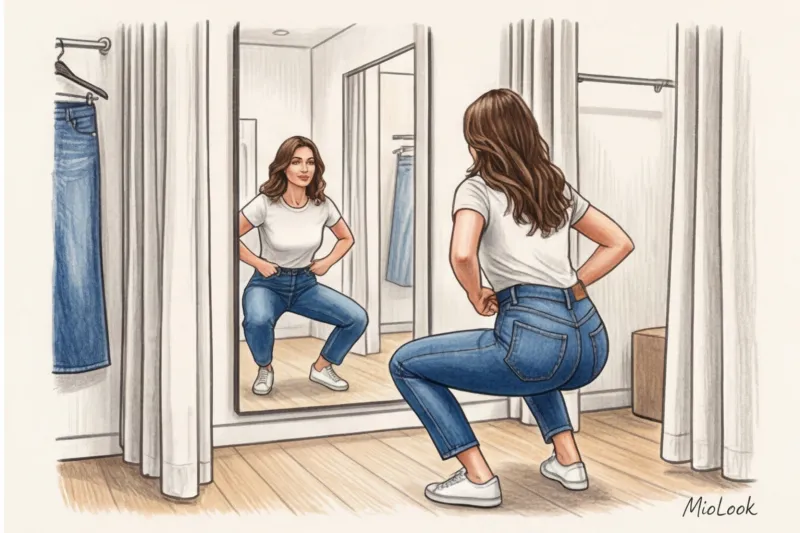
- Pinch test: Stand up straight. Grasp the fabric at the side of your thigh with your fingers. If you can pull more than 2 cm of fabric (for straight styles), immediately ask for a smaller size. Cotton will stretch further.
- Squat test: Sit on a ottoman in the fitting room or do a half-squat. Check the depth of the back seam—the waistband shouldn't expose your lower back. Your knees should feel snug, but not painful.
- Two-finger test: Slide two fingers through the waistband. They should fit with slight force. If you have to squeeze a whole palm through, the jeans will slip down and distort the silhouette.
- The "groin ache" test: Look straight ahead in the mirror. If the fabric bunches up in the groin area or forms a "camel toe," this is a critical sign of poor fit or insufficient depth. Remove them immediately; this defect cannot be corrected.
- Side seam test: The side seam should run strictly vertically from the hip to the ankle. If it curls forward, the fabric was not cut along the grain. After the first wash, the leg will be completely twisted.
Bottom line: Your denim, your rules
It's time to stop thinking of jeans as "weekend wear for the dacha" or a way to hide. Today, they're a staple in the modern wardrobe of a woman who knows her worth. Stop looking at the size tag—numbers mean nothing. Focus on how the fabric density (that same 12-14 oz) interacts with your body's structure.
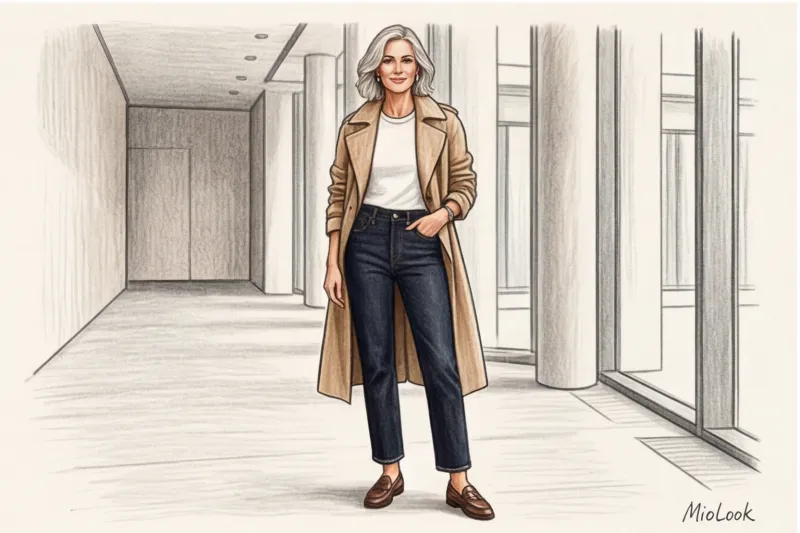
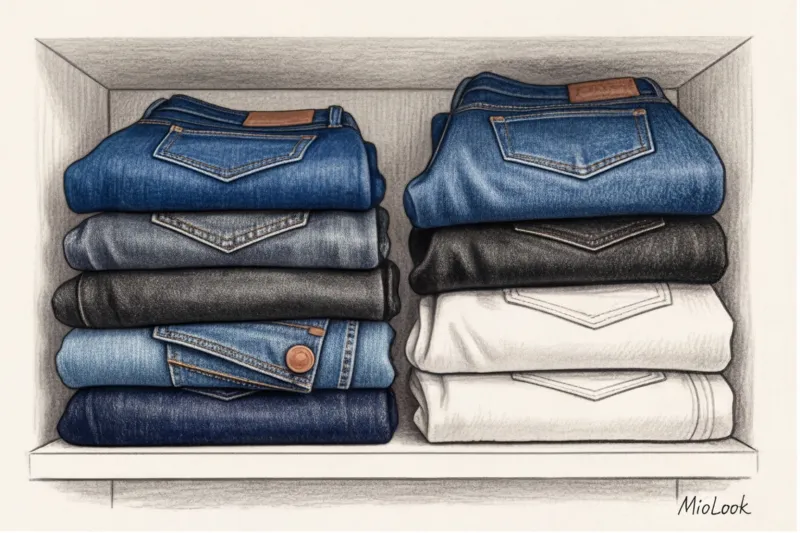
Look for a clean color, well-placed pockets with a slight slope, and a modern cut with a little air to it. You deserve to wear things that work for you, not against you. If you need help integrating the perfect new pair of jeans into your closet, MioLook Always at hand to digitize your wardrobe and offer fresh solutions for every day.