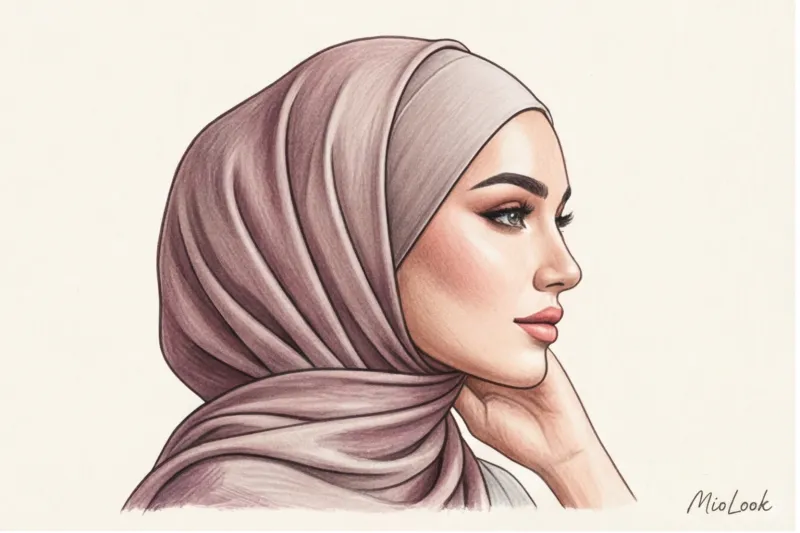
Most articles on modest fashion view the basic hat as a purely utilitarian item: put it on, tuck your hair in, and forget about it. But as a stylist and wardrobe optimization enthusiast, I see it entirely differently. My approach is true "wardrobe engineering." I view the base layer not just as a piece of fabric, but as a structural foundation directly responsible for the architecture of your face, the health of your hair, and even the physics of fabric adhesion.
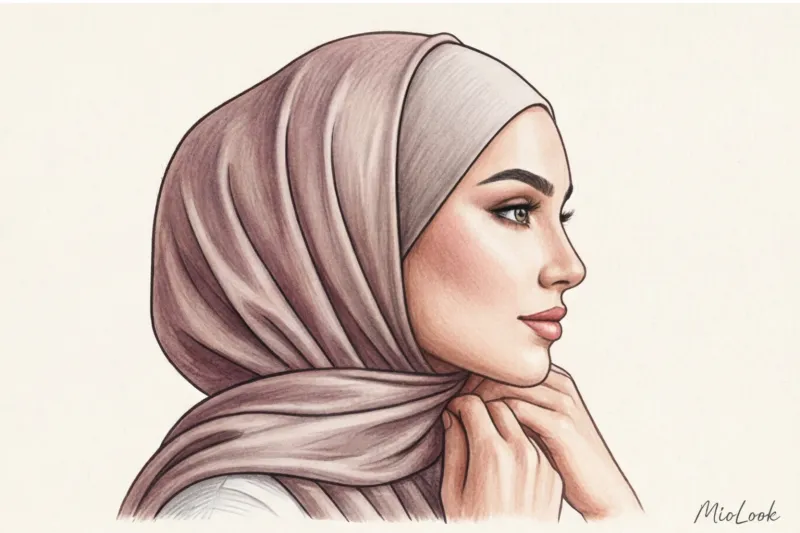
If you've ever wondered, How to choose a hat for a hijab To prevent your scarf from slipping and your head from splitting in the evening, you've come to the right place. We've already discussed color and working with the portrait zone in more detail in our The complete guide to choosing a hijab color , but today we'll talk about the very framework of your image. Let's break it down into molecules.
The Anatomy of a Perfect Look: Why a Hat is More Important than a Scarf
I often repeat one thing to my clients: a hijab is the façade of a building, but the hat underneath is its foundation. If the foundation is "sagging," no amount of gold pins will save the façade from collapse.
Besides providing a secure hold, the visible edge of the cap acts as a reflector right next to your face. According to the PANTONE Color Institute's 2024 report, a strip of fabric just 1–2 centimeters wide, placed against your forehead, can both visually erase signs of fatigue and accentuate under-eye circles. If you have a warm olive undertone and wear a crisp white base with a cool blue undertone, your face will instantly take on a sallow appearance.
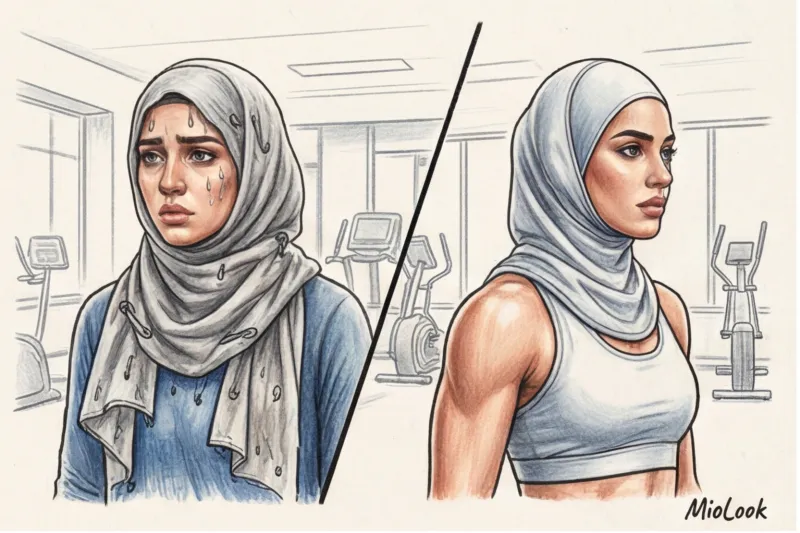
Now, about the most important thing—health. Skimping on a base layer is too expensive. Cheap synthetics disrupt your scalp's thermoregulation: your scalp overheats, your follicles produce excess sebum, and by midday, you feel like you're in a hothouse. A high-quality base layer is an investment in your comfort for the next 10–12 hours.
Access to MioLook for €0.99 — one-time payment
A smart AI stylist will select the perfect look.
Get access — €0.99 onceTypes of Hijab Hats: From Classics to Architectural Designs
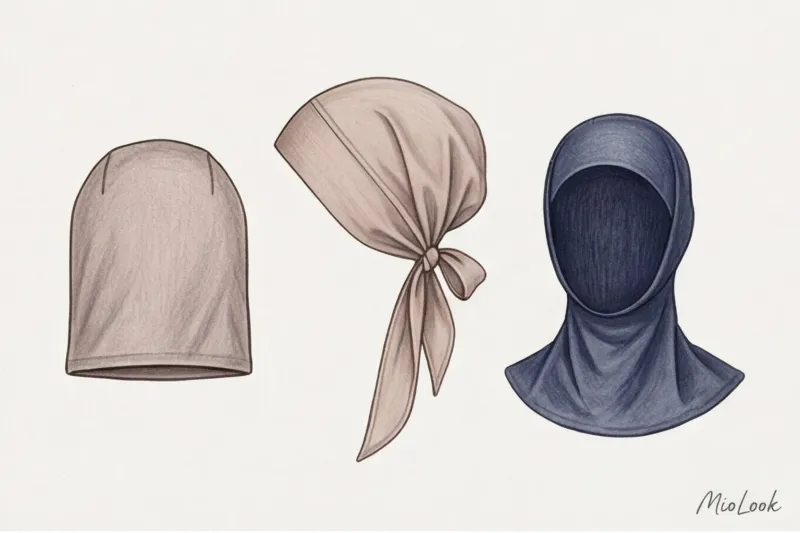
The modern market offers dozens of options, but in the professional stylist community, we divide them into strict functional categories. You're not just buying "some kind of hat"; you're choosing a tool for a specific task.
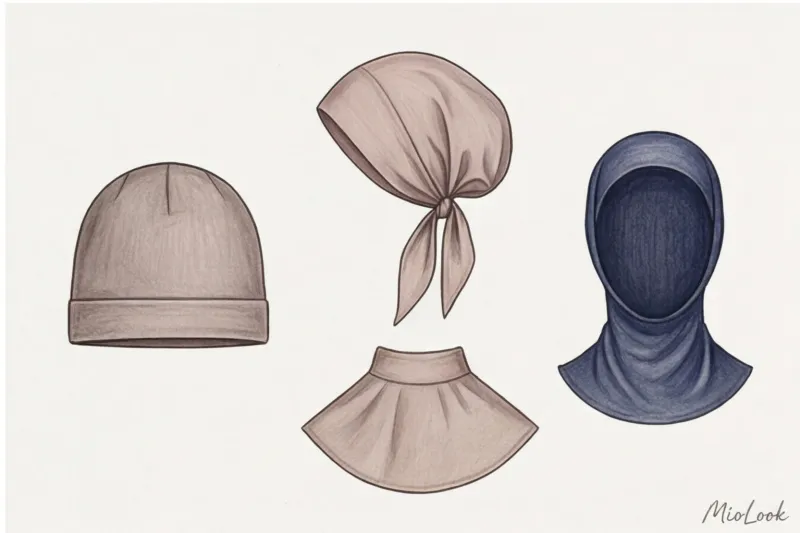
Tie-Down Bonnets and Beanies: Basic
Bonnet with ties at the back of the head — are the gold standard. Their main advantage is the ability to adjust tension to the millimeter. In my practice, one of my clients complained of terrible migraines in the afternoon. It turned out she was wearing a tight synthetic tube cap, which was constricting her blood vessels. We replaced it with a boning cap with soft ties, and the headaches disappeared within the first day.
Tube cap — a champion in terms of speed of application. A great choice for morning rushes. However, it has a serious drawback: due to the uniform circular tension, it often flattens the natural volume of the hair at the back of the head. This is absolutely not suitable for smooth, volume-less hair—the profile will be flat.
Balaclavas (Ninja) and hoods: maximum protection and sport
Ninja-style tops, covering the neck and décolleté, are essential in two situations: when wearing semi-sheer fabrics (like summer chiffon) and when your look includes a V-neck or an open shirt collar. Today, tech brands like Uniqlo with their AIRism line offer excellent breathable options that fit perfectly with smart-casual and sporty styles.
Debunking the Myths: Why 100% Cotton Is Harmful to Your Hair
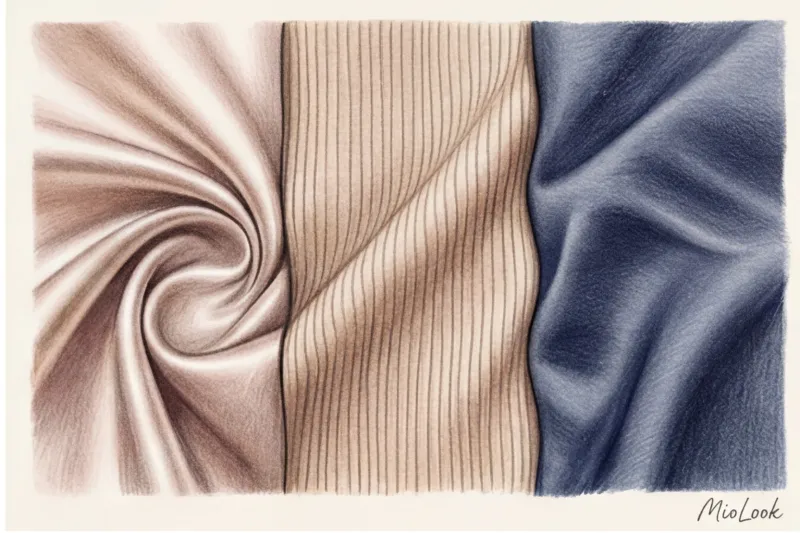
And now for the most counterintuitive insight that mass-market store salespeople won't tell you. It's commonly believed that "100% cotton is the best natural material." For T-shirts, maybe. For a hijab hat, it's a disaster for your hairline.
Trichological studies prove that cotton is highly hygroscopic. It literally draws moisture and natural oils from the hair cuticle. Add to this the physics of constant micro-friction when turning the head. The stiff cotton fibers cling to the dry cuticle, which over time leads to breakage and thinning of hair at the forehead (so-called traction alopecia).
"The ideal base should be two-faced: smooth on the inside to protect the hair and clingy on the outside to secure the scarf."
Technological alternatives:
- Bamboo fiber: It has a natural antibacterial effect, stretches well and cools the skin in hot weather.
- Modal: A smooth, silky material made from wood pulp that does not create aggressive friction.
- Silk-lined under-scarves: An absolute premium trend. The inside is a gliding silk or satin that retains style and moisture, while the outside is a grippy viscose.
Your ideal image
it begins Here
Join thousands of users who look flawless every day with MioLook.
Get access — €0.99 onceHow to choose a hijab hat based on your facial shape
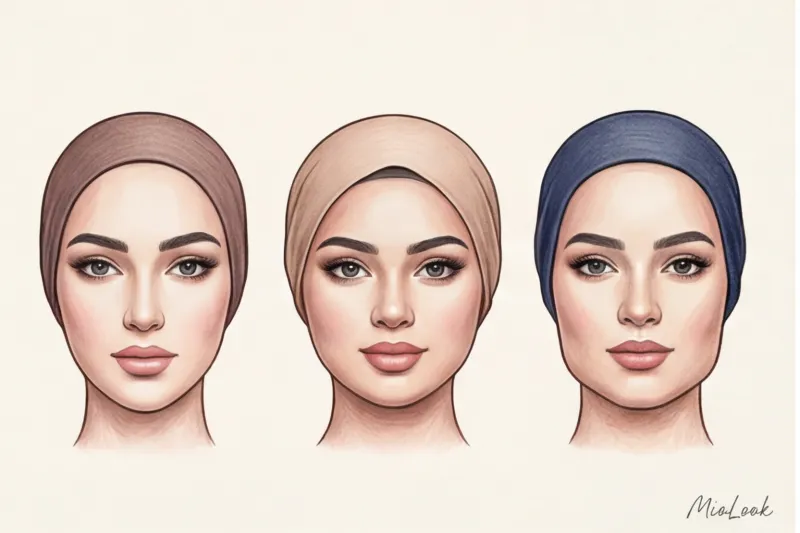
You can contour with bronzer or use the geometry of the fabric. The line created by the cap on the forehead radically changes the proportions of the face.
- Round face: To avoid the "moon" effect, never pull the hat down low on your forehead in a straight horizontal line. Pull it slightly higher and create a slight angle (or "house") in the center. This will visually elongate the oval of your face.
- Long / Oval Face: The opposite rule applies here. A straight, horizontal line will help visually "cut" a high forehead and balance out proportions.
- Square face: Attention, restriction! Sharp angles and fabric "houses" are a definite no-no here—they'll only highlight a heavy jawline. Opt for a soft, semi-circular waistline.
Don't forget about volume at the back of your head (scrunchies and velvet rolls). If you wear voluminous oversized items (COS trench coats or puffer jackets), a sleek, small head will create disproportion. You need volume at the back for balance. Conversely, a huge roll at the back of a tight turtleneck will add a comical look.
An engineering approach: combining hat and scarf fabrics
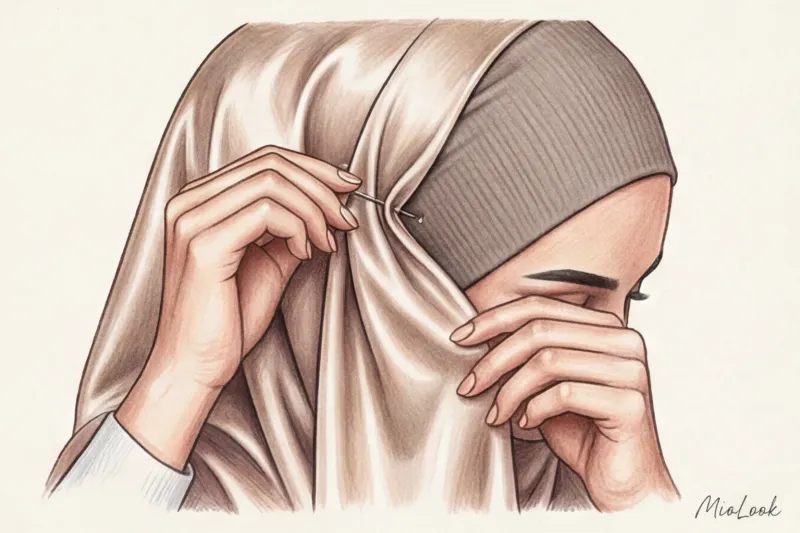
I once conducted a personal experiment: I wore a heavy, slippery chiffon stole for 12 hours, first with a smooth viscose base, and then with a ribbed base the next day. On the first day, I adjusted the scarf around my face 34 times. On the second day, only 4.
80% of problems with a slipping scarf can be solved not by a dozen needle-like bobby pins, but by choosing the right fabrics with different coefficients of friction. Remember this: The Rule of Opposites:
- Smooth hijab (silk, satin, crepe) Requires a strictly textured base. Look for ribbed jersey hats or models with velvet grip bands sewn onto the edges. The velvet acts as micro-hooks, clinging securely to the silk.
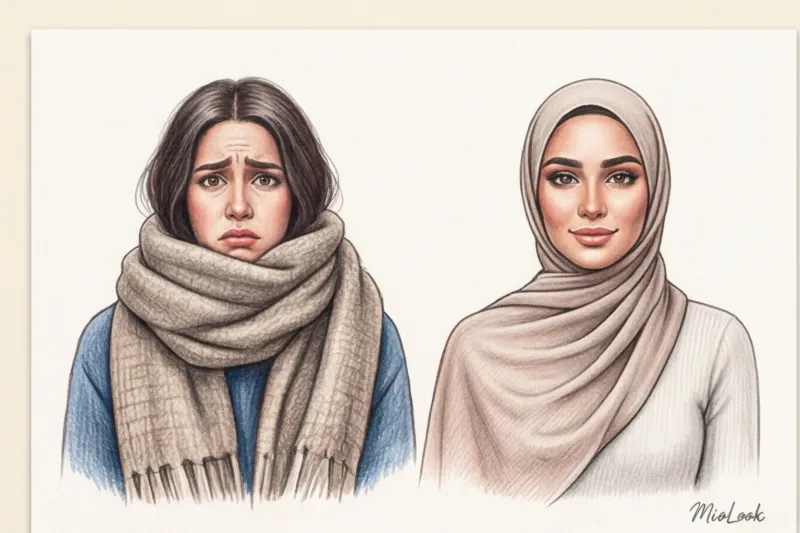
- Heavy textured fabrics (jersey, thick pashmina) They need the smoothest, thinnest base possible (Lycra or modal). Wearing textured cotton under a thick jersey will create unnecessary bulk, bulges around the face, and overheating.
- Chiffon and georgette They're tricky because they're see-through and don't hold their shape. They're ideal for thick matte foundations in the same color as your skin or scarf, which are held securely by magnetic pins.
Ready to get started?
Try the free plan—no commitments, a smart algorithm will collect your capsules
Get access — €0.99 onceChecklist: 5 Signs It's Time to Change Your Basic Hat
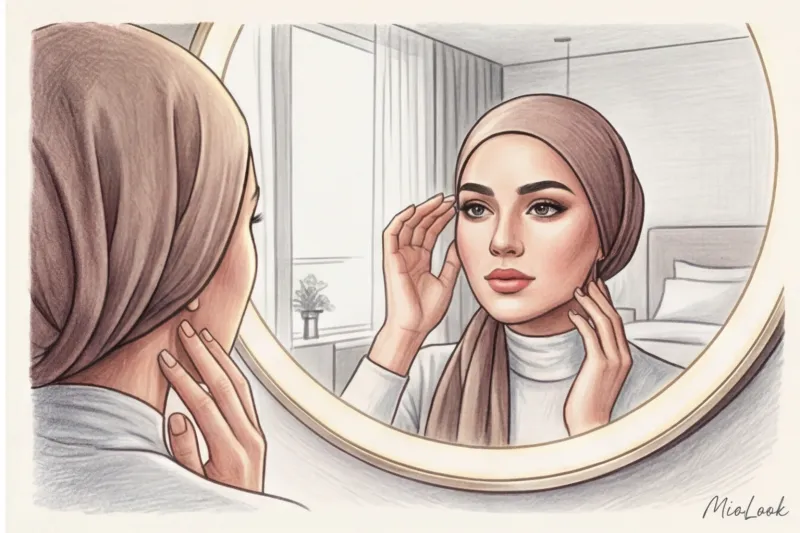
Even the most expensive foundation has an expiration date. We often get used to things and don't notice how they ruin our appearance. Check your hats with this strict checklist from a stylist:
- Loss of elasticity: The fabric no longer springs back when stretched. If the edge frays when the hat is lying on the table, throw it in the trash. This is why you need to use more pins.
- Pilling: Micro-pilling creates an untidy, washed-out look right next to your face. Furthermore, it ruins the smooth texture of an expensive silk scarf by snagging its threads.
- Discoloration: The jet-black color turns dusty gray over time. This is critical if a gray stripe peeks out from under a deep black hijab—it immediately cheapens the look.
- Discomfort: If by 3:00 PM you feel pressure on your ears or a nagging pain in the back of your head, your hat has shrunk after washing and is now too small.
- Bias: the base moves onto the eyebrows when walking or creeps onto the top of the head during an active conversation.
Smart Wardrobe: How Many Hats Do You Really Need?
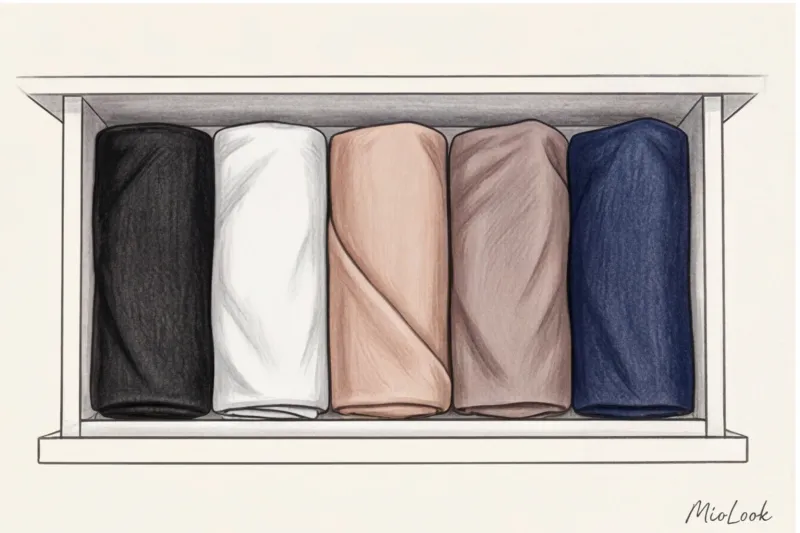
Marketers try to convince us to buy a new hat to match every new scarf color. As a capsule wardrobe expert, I declare: this is a marketing trap. The ideal basic capsule consists of just 3-5 items that will cover 95% of your wardrobe needs.
You need a universal set: Deep Black, Pure White (or Milky White), Your Ideal Nude (blends with skin tone) and Cool Taupe (gray-beige) Nude is a lifesaver for any light, translucent hijab, as it creates the illusion of no base.
When I do a wardrobe review using an app MioLook , we first digitize the base layers. The app's artificial intelligence recognizes the predominant hijab colors in your collection and automatically suggests which hat (based on color and texture) will tie together the most items. In my experience, this simple optimization of base layers reduces my clients' morning getting ready time by 15 minutes each day.
Next time you're shopping for a hijab, don't start by looking for a pretty print. Start with the basics. Because confidence in your look doesn't come from what others see, but from how you feel, knowing that every detail is in its place and works for you.