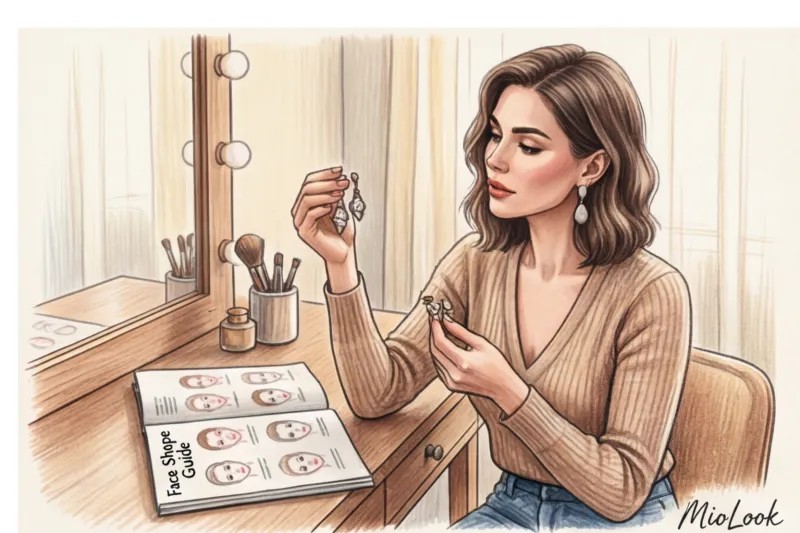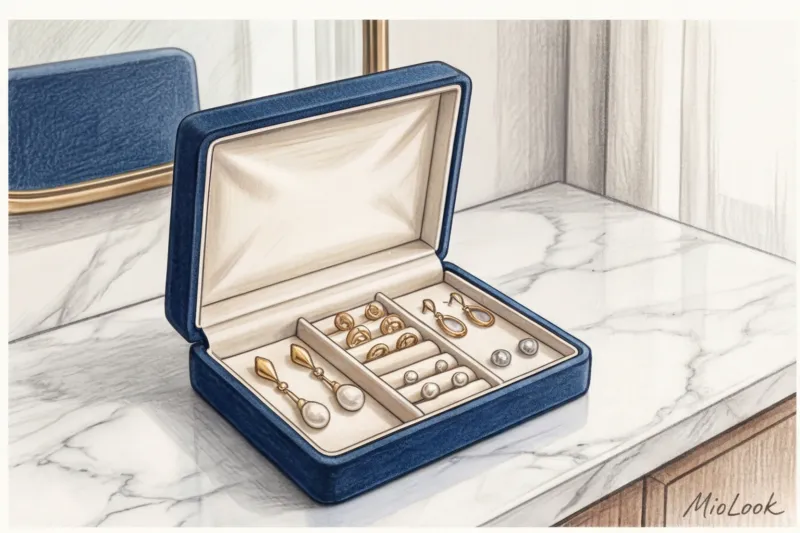
Over 12 years of auditing my clients' jewelry wardrobes, I've uncovered some disheartening statistics: about 80% of jewelry sits idle in their jewelry boxes. Women buy it on impulse, succumbing to a passing trend, and then wonder why their face in the mirror looks tired and their overall appearance cheap. The answer lies not in the price of the piece, but in a simple lack of understanding of their own proportions. Understanding how to choose earrings for your face shape isn't just a matter of aesthetics. It's a matter of return on investment and visual status management.
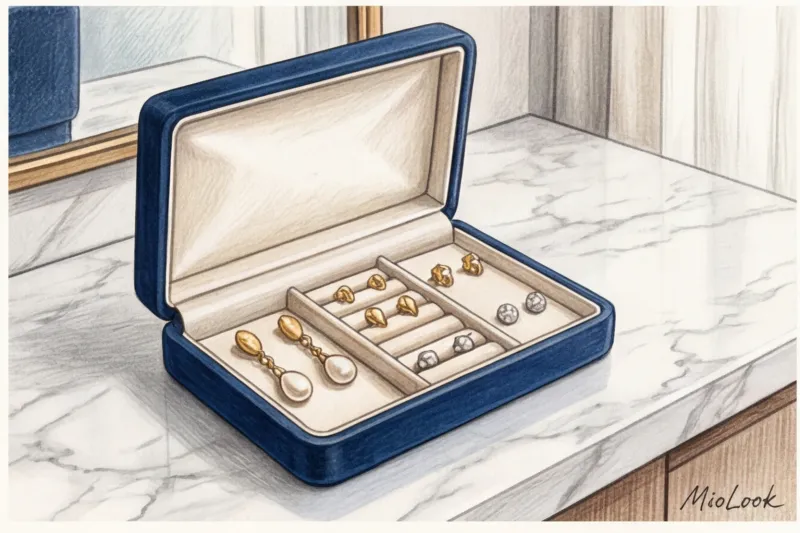
Unlike typical glossy advice that reduces our faces to flat 2D shapes (circles and squares), I suggest viewing yourself as three-dimensional architecture. Earrings are the supporting structures of your portrait image. We discussed this systematic approach to accessories in more detail in our the complete guide to your jewelry wardrobe Today, we'll explore the mathematics of ideal proportions, metal weight, and rules that actually work.
Investment Geometry: Why It's Important to Know How to Choose Earrings for Your Face Shape
During business meetings or on a first date, your conversation partner spends 90% of their time looking at your "portrait triangle"—the area from your eyes to your collarbone. Earrings are the main focal point here. They can highlight your skin and visually lift your facial contours, or they can pull your earlobe down, adding five years to your age.
I always teach my clients to count. Cost-per-wear (cost per wear). Let's say you bought 20 pairs of trendy mass-market jewelry for $20 each. The result: $400 spent, the alloy oxidized after a month, and the poor shape accentuated the asymmetry of your chin. For the same $400, you could buy one pair of perfect, basic gold stud earrings whose geometry perfectly matches the lines of your cheekbones. You'd wear them 300 times a year, and the cost per wear would be just over a dollar.
To track the actual frequency of use of your accessories and clothing, try digitizing them. For example, by uploading your items to MioLook , you will be able to visually assess which jewelry really works for you every day, and which ones are time to give away or melt down.
Facial architecture: defining your proportions without outdated stereotypes
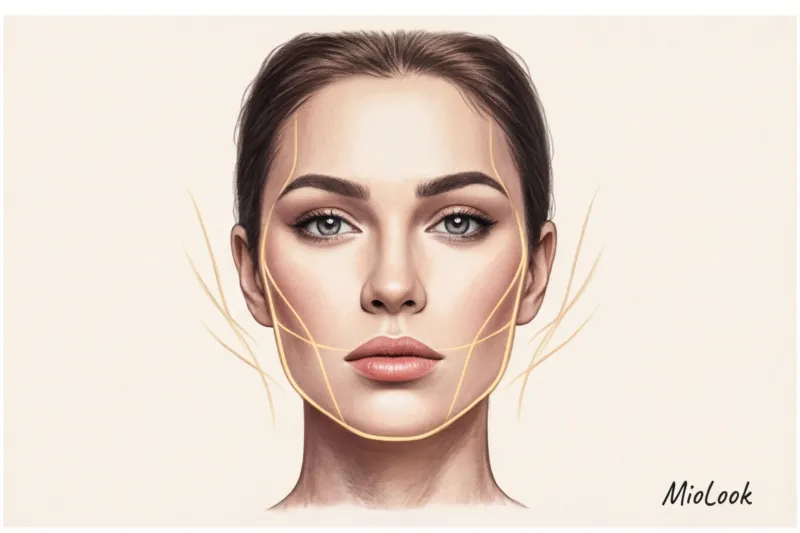
The face has depth, cheekbones, a specific jawline angle, and eye set. To accurately determine my dominant facial structure, I use a professional test with my clients.
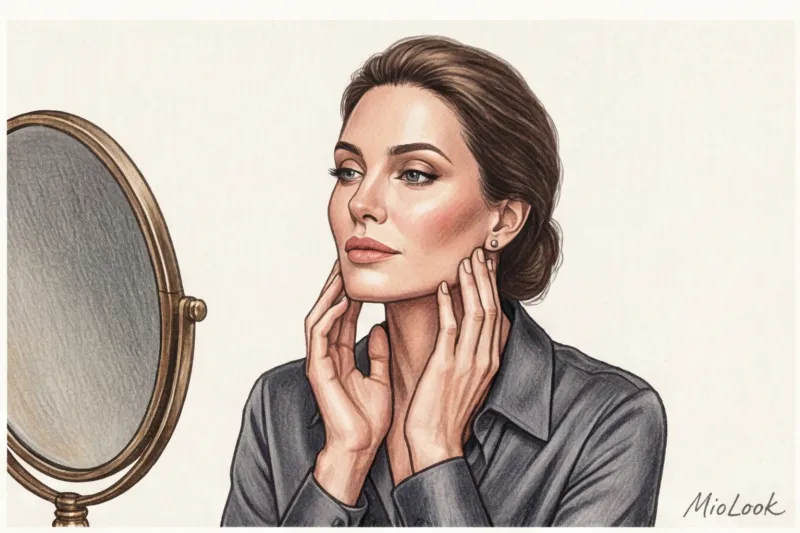
Stand in front of a mirror, pull your hair back into a tight ponytail (hair dramatically changes apparent proportions!), and trace the outline of your face directly onto the glass with lipstick or a washable marker. Step back. Observe the relationship between three lines: the width of your forehead, the distance between the outermost points of your cheekbones, and the width of your jaw.
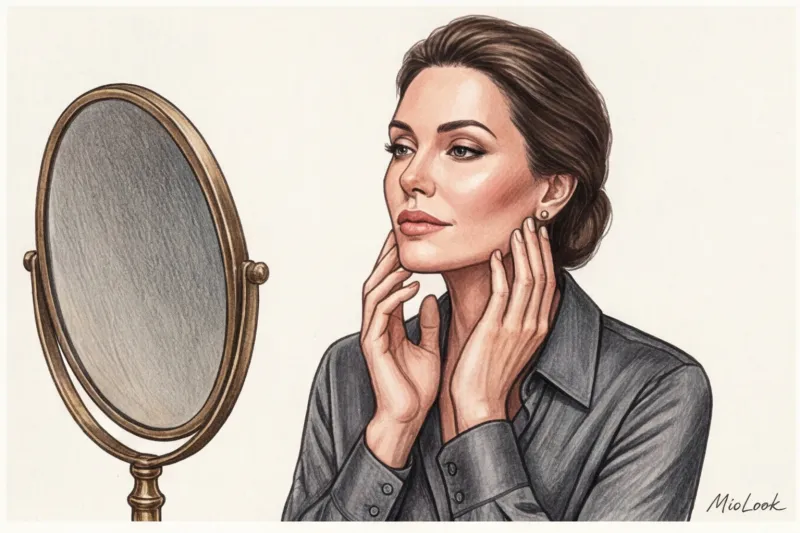
- If the lines of the cheekbones and jaw are almost equal, and the angles are sharp, we have a rectangle or square in front of us.
- If the widest part is the forehead and the chin tapers to a sharp point, it is a heart or inverted triangle shape.
- If the outline is soft, without sharp angles, and the length is noticeably greater than the width, it is a classic oval.
The Golden Ratio and Jaw Lines: What We Can Influence
Leonardo da Vinci, in his work on the Golden Ratio, demonstrated that the human eye perceives beauty in anything that follows the mathematical proportions of 1:1.618. In the context of the face, this means harmony between the thirds: from the hairline to the eyebrows, from the eyebrows to the tip of the nose, and from the nose to the chin.
Jewelry can visually intervene in these thirds. Long linear earrings visually elongate the neck, compensating for a heavy jaw. However, there's a fair limitation here: this technique is absolutely doesn't work For women with naturally short necks, earrings that rest on the shoulders will only emphasize the lack of verticality.
A Guide to Perfect Proportions: Choosing Earrings for Every Shape
Let's get down to specifics. Your jewelry wardrobe should be based on basic, statement pieces that won't go out of style season after season.
Oval and Circle: Create a vertical line and emphasize status
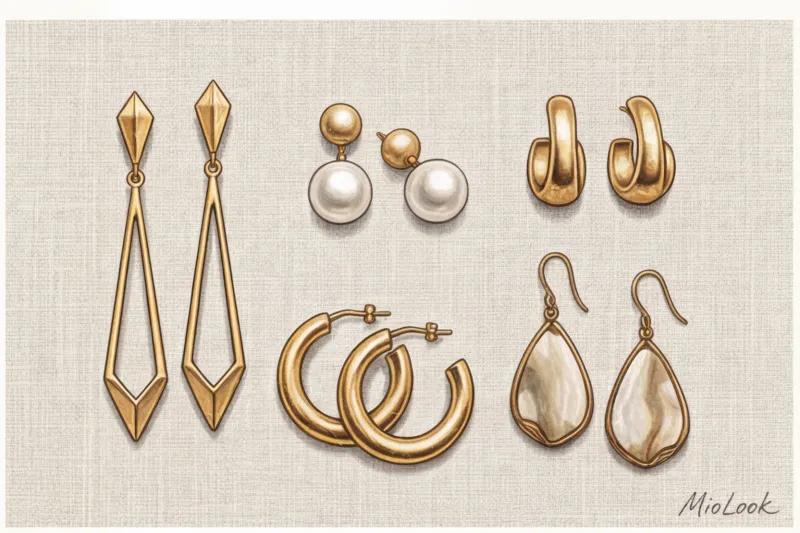
For girls with oval face Luckily, you have a blank canvas. You can afford to invest in absolute classics: princess-cut diamond studs or baroque pearls. The main rule is to maintain a scale relative to your facial features.
For round face The rule is strict: avoid perfect spheres and small round studs. Your goal is to create a vertical line. Choose elongated teardrop shapes or strict geometric shapes (elongated rectangles, anchor chains). They will draw the viewer's gaze up and down, narrowing wide cheekbones.
Your perfect look starts here
Join thousands of users who look flawless every day with MioLook. Our smart AI stylist will select jewelry to suit your body proportions.
Get access — €0.99 onceSquare and Rectangle: To Soften or Strengthen Authority?
For years, glossy magazines have been telling women with square or rectangular faces: "Soften hard jaw angles with large round rings!" I strongly disagree with this approach in the context of the modern business world.
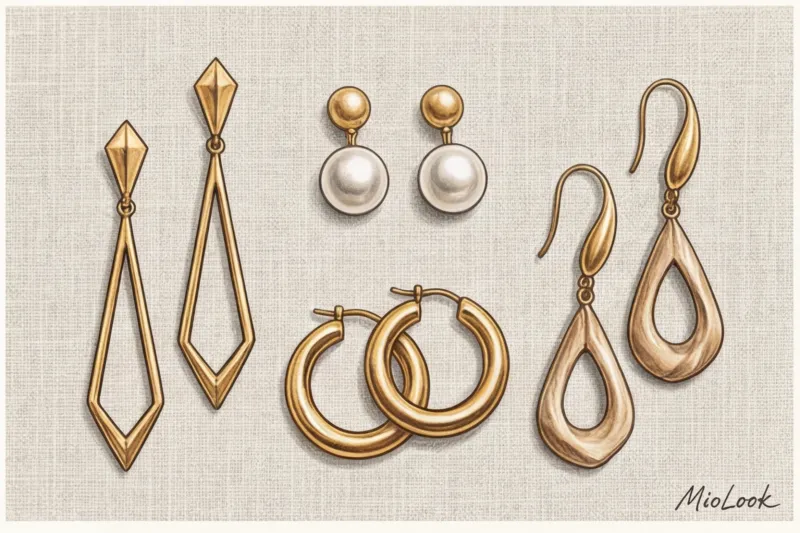
One of my clients, a top manager at an IT corporation, complained that she was perceived as too soft during negotiations. She wore round pearl clip-on earrings, which clashed with her strong, square chin. We replaced them with strong, architectural white gold plate earrings. By emphasizing her angular jaw with geometric shapes, we created the image of a tough, confident leader. In business, a strong jawline is a sign of strength. Don't hide it behind childish curves if you want to project power.
Triangle and Heart: The Mathematics of Lower Third Balance
The problem with a heart-shaped face is that the chin is too narrow against the broad forehead. To balance the lower third, we need to add volume precisely where the face narrows.
The ideal choice here are teardrop-shaped chandelier earrings that flare out at the bottom. Large hoops of the right diameter also work well—they fill the space between the cheekbone and shoulder, making the chin appear more proportional.
Mass-market myths: why fit and weight are more important than shape
Even if you've chosen the perfect shape, quality workmanship can ruin everything. Remember how often you've seen women with beautiful but incredibly heavy earrings that pull down their earlobes so much that the piercing becomes visible? This instantly creates a "tired face" effect and cheapens the look, just like other things. outdated style rules.
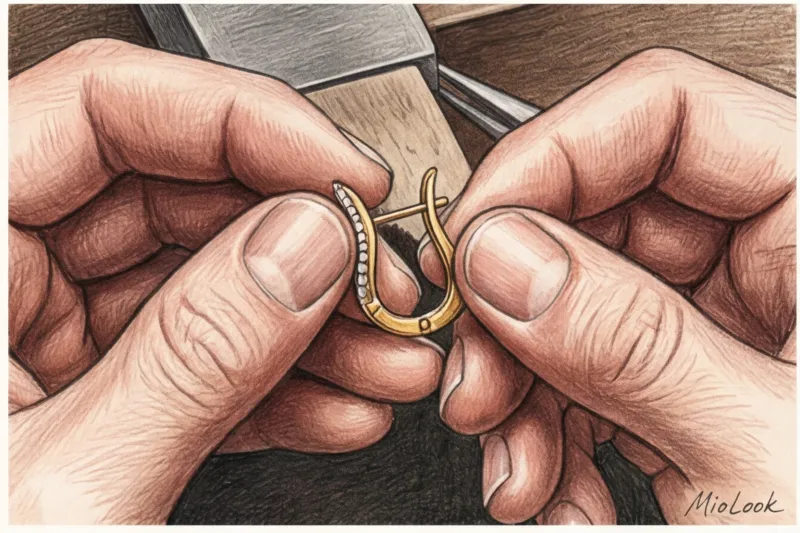
According to fine jewelry standards, an earring is designed with the center of gravity in mind. The post of a stud or clasp is often soldered not exactly in the center, but slightly higher, at the correct angle (usually around 5-7 degrees). This ensures that the earring fits snugly against the lobe and points straight forward, rather than drooping sadly downward.
Also, pay attention to the reflectivity of the metal. Cheap alloys have a dull, gray undertone that casts unsightly shadows on the face. High-quality 18K gold or rhodium-plated silver act as mini spotlights (reflectors), illuminating the skin from within.
Earrings as a Tool of Influence: Choosing the Right One for a Business Wardrobe
In a strict dress code, whether Business Formal or Smart Casual, there is a strict "one accent" rule. If you are speaking on stage or giving a presentation, earrings should be that accent, as they are closest to the audience's eyes (we discuss this rule in detail in the article about body types and style ).

My absolute favorite for executives are knot earrings made of smooth gold, 1-1.5 cm in diameter. They're large enough to be noticeable, but their closed, interwoven shape conveys composure, professionalism, and control. No jingling pendants—the sound distracts others and undermines your authority.
Ready to get started?
Try the MioLook plan for free—no commitments required. Organize your wardrobe and find the perfect combination of accessories and clothing.
Get access — €0.99 onceChecklist: Audit Your Jewelry Box Before Buying New Earrings
Before heading to the boutique for a new pair, I highly recommend a ruthless inventory of what you already own. Do it this evening.
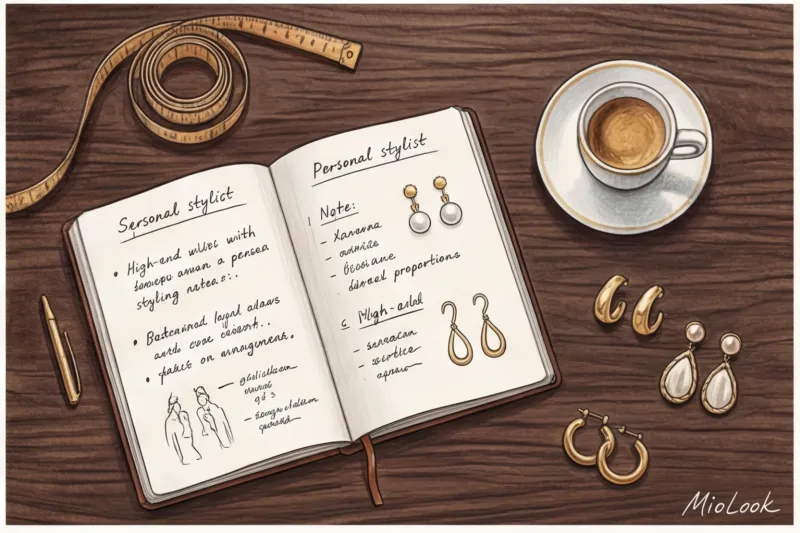
- Step 1: Sanitary cleaning. Box up (or better yet, throw away) anything that's darkened, out of shape, causes allergies, or weighs more than 7-8 grams per ear. Something that's physically painful to wear doesn't make you more beautiful.
- Step 2: Architecture analysis. Take the remaining jewelry and divide it into two groups: "soft/rounded" and "hard/graphic." Compare it to your facial features using the mirror test. Keep only those that achieve your goal (elongating your face or emphasizing your jawline).
- Step 3: Investment plan. Make a shopping list. Start with the basics: high-quality metal congo earrings of medium diameter (up to 3 cm) and basic stud earrings. Until you've covered these items, avoid buying fancy jewelry.
Your style isn't an innate talent, but a trained eye and knowledge of your proportions. Treat buying earrings not as a spontaneous whim, but as an investment in the architecture of your face, and then every piece of jewelry will work for you with 100% efficiency.