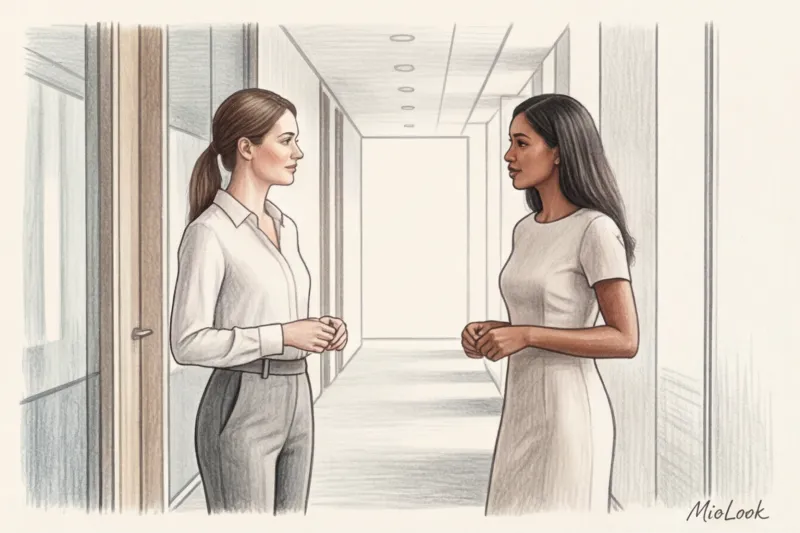
Have you ever noticed how, in an empty elevator or conference room, the person who left five minutes ago lingers invisibly? A thick, almost tangible scent trail gives them away. And more often than not, it evokes not admiration but a desire to open the window. As a stylist and textile researcher, I'm convinced: fragrance isn't just a scent. It's a fully-fledged part of your wardrobe, an invisible accessory that can either enhance your status or completely ruin a carefully crafted look.
The question is, How to apply perfume correctly , lies at the intersection of business etiquette, leather chemistry, and textile materials science. We discussed the basics of choosing compositions in more detail in our the complete guide to perfume etiquette , but today I want to break down the physics of the process. We'll discuss why your favorite perfume smells flat on polyester, why you should forget about the "perfume cloud," and how to maintain personal boundaries using the arm's length rule.
Sillage Anatomy: What is Sillage and Why is the "Arm's Length Rule" Important?
In professional perfumery there is a beautiful French term sillage (sillage) – this describes the olfactory trace left in the air when a scent wearer passes by. The physics of its diffusion directly depends on temperature: the warmer your skin and the air in the room, the greater the diffusion (volatility) of the molecules.
"Scent is your communication with the world before you even utter a word," the head nose of one of the oldest perfume houses told me during my visit to the Grasse Institute of Perfumery (GIP). And this communication must be polite.
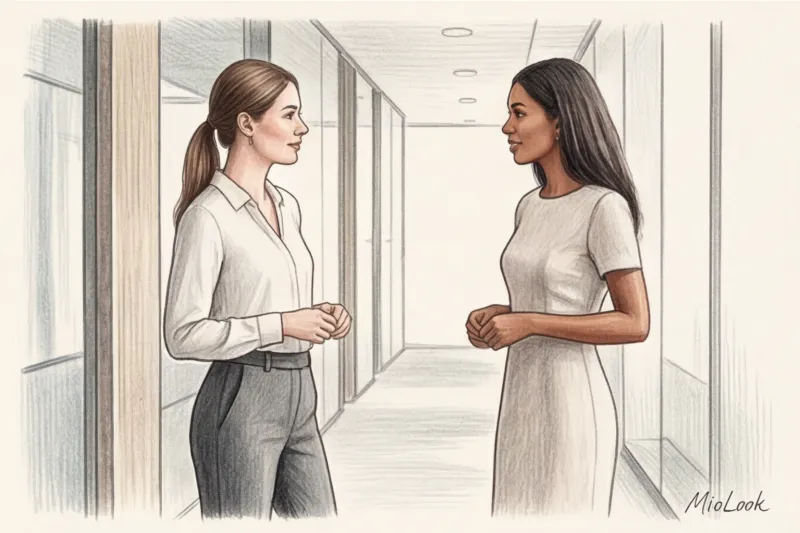
In business and everyday life, the gold standard of respect for other people's boundaries is considered arm's length rule Your perfume should be detectable within a radius of your intimate area—approximately 40–60 centimeters. If someone can smell your perfume from two meters away, you're invading their personal space.
According to a 2024 report by the analytical agency WGSN, the global trend has shifted toward olfactory "quiet luxury." Loud, room-filling scents are now associated not with status, but with a lack of taste and a misunderstanding of context.
Access to MioLook for €0.99 — one-time payment
A smart AI stylist will create the perfect look, to which all that remains is to add the right fragrance.
Get access — €0.99 onceHow to Apply Perfume to Your Skin: Pulse Points and Common Mistakes
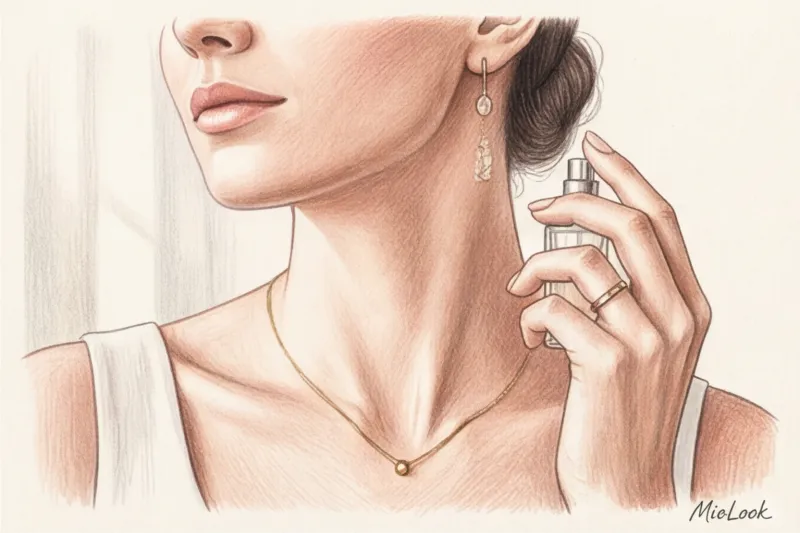
The classic perfume application chart is based on pulse points: the wrists, the sternal notch (the hollow of the neck), behind the ears, and the back of the neck under the hairline. Why these points? These are where blood vessels are closest to the skin's surface. The microscopic increase in body temperature in these areas acts as a natural diffuser, smoothly evaporating the aromatic compounds.
However, this is where skin chemistry comes into play. In my experience, eight out of 10 clients don't realize that the same fragrance smells radically different on "cool" and "hot" skin. For people with hot skin (often darker skin or those with close-packed blood vessels), the top citrus notes fade within 15 minutes, revealing the base. On cool skin, the fragrance can be monotonous, not developing for hours.
But the worst mistake I see regularly is the habit of applying perfume to one wrist and aggressively rubbing it on the other.
- Why this shouldn't be done: Friction increases the temperature of the skin's surface in a local area and literally "breaks" the fragile molecules of the top notes (bergamot, neroli, light flowers).
- Consequences: The composition loses the opening the perfumer intended, evaporates faster, and you get a flat, distorted base note.
The myth of the "perfume cloud"
If you ever read glossy magazines in the 2000s, you'll likely remember the advice: "Spray perfume into the air and walk into the cloud." As an expert, I declare: this is the worst, most ineffective, and even harmful application method of all.
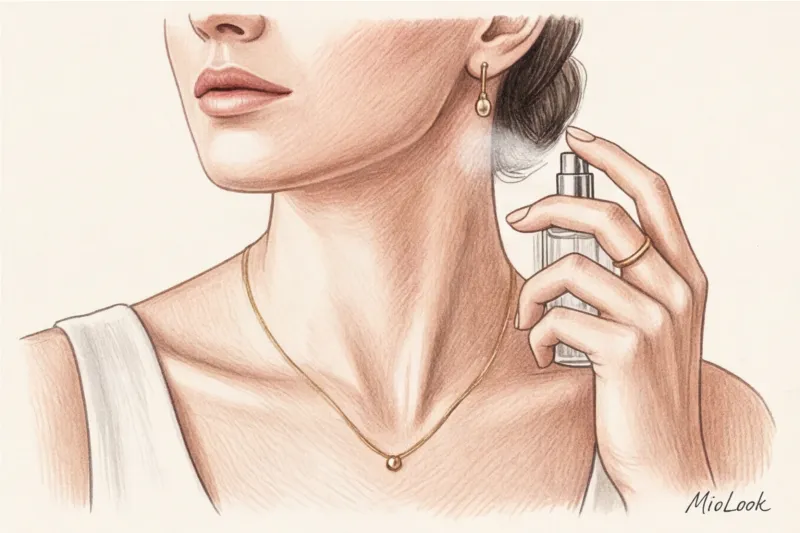
Firstly, it's a colossal waste of an expensive product. About 70% of the droplets settle on the floor, carpet, and furniture. Secondly, the fine dispersion gets on your hair. Considering that most perfumes are alcohol-based, regular use of the "cloud" inevitably dries out the hair cuticle, making the ends brittle. Thirdly, it's a surefire way to leave permanent stains on your clothes, which we'll discuss further.
Perfume and Fabrics: A Textile Expert's Opinion
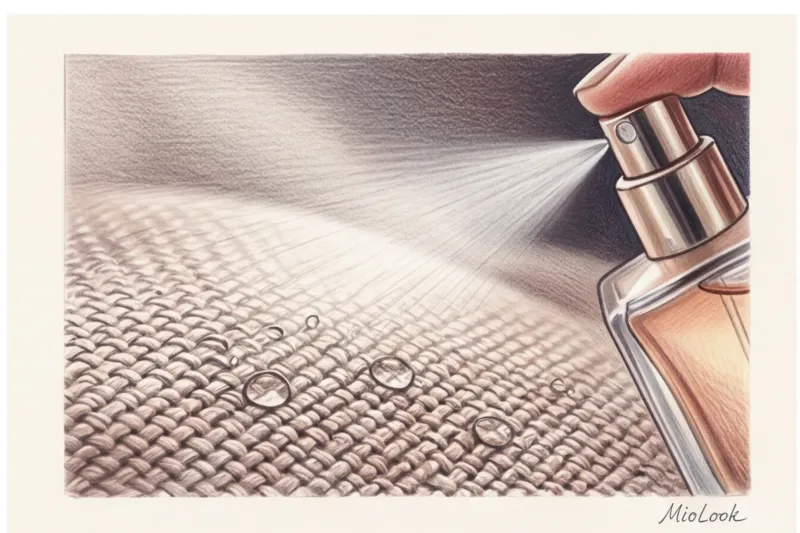
As a textile specialist, I often rescue clients' wardrobes from the consequences of improper perfume use. Applying perfume directly to the outer surface of a garment is a crime against the fabric. Essential oils and alcohol leave persistent yellow halos on natural silk and light-colored viscose (especially those with elastane), and can also locally dissolve dyes on delicate fabrics.
If you want your clothes to smell like your favorite scent, apply it only on the wrong side , on hidden seams or the lining of the jacket from a distance of at least 20 centimeters.
Different tissues interact with the olfactory pyramid in different ways:
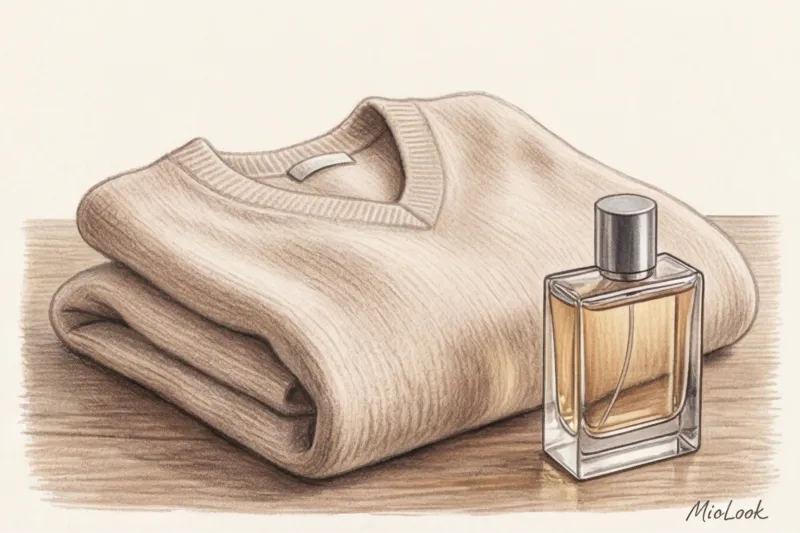
- Natural fibers (cashmere, merino wool, thick cotton from 180 g/m²): The perfect base coat. Thanks to their porous structure, they absorb heavy molecules of amber, musk, and wood, holding them in place for weeks. That's why your favorite cashmere sweater smells cozy even after a month.
- Synthetics (polyester, acrylic, nylon): Polyester fibers don't breathe and don't absorb moisture like natural fibers. Perfume remains on the surface as a film. As a result, the scent doesn't develop, smells flat, harsh, and often takes on an unpleasant metallic or sour note.
My personal life hack: before applying a new perfume to an expensive item, test it on the inside seam allowance. Wait 24 hours. If the fabric hasn't changed color or texture, it's safe to use.
Your perfect look starts here
Join thousands of users who look flawless every day with MioLook. Manage your wardrobe smartly.
Get access — €0.99 onceConcentration Matters: How to Apply EDP, EDT, and Extracts
One of the most frequent questions I get from my clients is: why do some perfumes last a day after a single spray, while others disappear within an hour, even though they cost the same? The answer lies in the International Fragrance Association (IFRA) standards and the percentage of fragrance ingredients used.
Not only durability but also application etiquette rules depend on concentration:
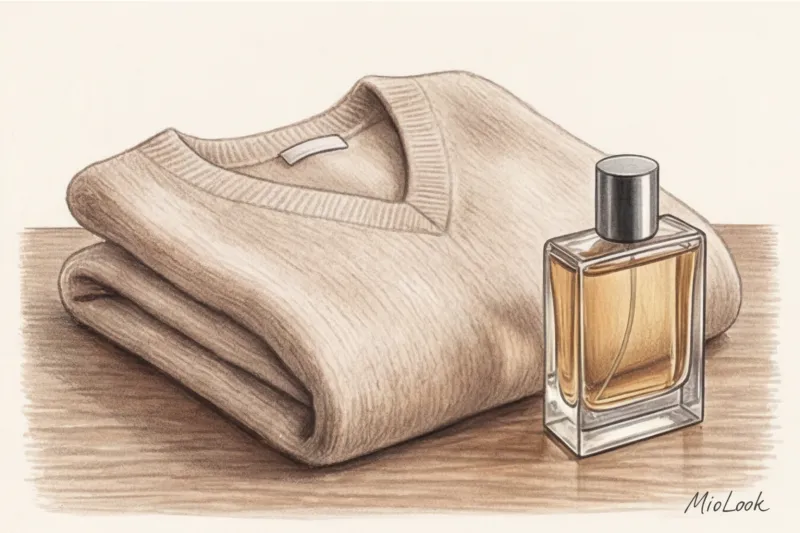
- Extrait de Parfum (Perfume / Extract): 20–40% fragrances. Paradoxically, extracts leave almost no sillage. They contain little volatile alcohol, so they sit close to the skin, creating an intimate aura. They are applied exclusively by smearing (microdroplets) onto pulse points. No sprays.
- Eau de Parfum (EDP / Eau de Parfum): 15–20% concentration. The most popular format. The optimal dosage for the office is 1, maximum 2 sprays (for example, one on the back of the neck, one on the crook of the elbow).
- Eau de Toilette (EDT / Toilet Water): 5–15%. Eau de toilette creates the longest sillage! Due to the high alcohol content, the molecules quickly detach from the skin and fill the space. Three to four sprays are acceptable, but you'll need to reapply every four to five hours.
It's important to understand that if you've purchased a concentrated extract, increasing the dosage won't make the scent last longer—it will only make it overpowering for anyone who gets too close to you.
Office Perfume Etiquette: The Invisible Dress Code
A few years ago, a top manager at a major bank approached me. She had an impeccable wardrobe—dark blue suits made of fine wool, a perfect fit, and a well-designed business makeup But at morning board meetings, her colleagues instinctively distanced themselves from her. The reason? She generously applied Baccarat Rouge 540 before leaving the house. This thick, medicinal-gourmand scent literally consumed the oxygen in the closed conference room, ruining the image of a stern professional.
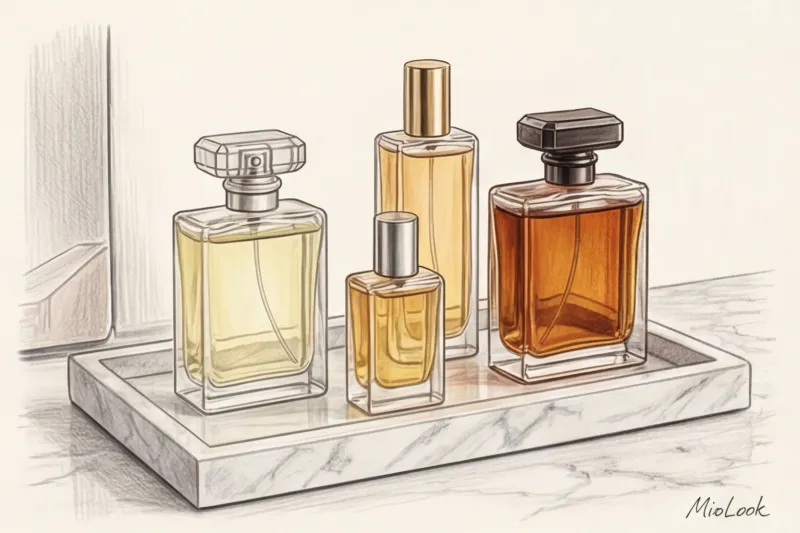
Perfume is as much a part of the business dress code as the length of a skirt or the closed toe of shoes. Heavy oriental, oud, or overtly gourmand scents (vanilla, chocolate) are absolutely inappropriate in the morning and in open-plan offices.
The ideal office scent profile:
- Citrus (bergamot, vetiver) - associated with energy and composure.
- Light fougere and green notes do not distract attention.
- Aldehyde compositions create that very “smell of cleanliness” and a freshly ironed white shirt.
And the most important rule of office etiquette: never apply perfume mid-day at your desk. If you need to refresh your scent before an evening meeting, do so in the restroom by applying a micro-dose to your wrist. By the way, to avoid worrying about whether your look is appropriate for a particular meeting, I recommend using wardrobe analysis feature in MioLook — the app will help you choose a base, and the fragrance will be the finishing touch.

Checklist: How to Tell if You've Applied Too Much Perfume
Why do people overdo it with perfume? Physiology is to blame, specifically the phenomenon of olfactory fatigue (or partial anosmia). Our brain is designed to ignore a constant background odor after 15-20 minutes in order to free up receptors for new, potentially important, danger signals. You lose the scent of your perfume and feel as if it's worn off. Your hand reaches for the bottle, and suddenly you're a walking chemical attack.
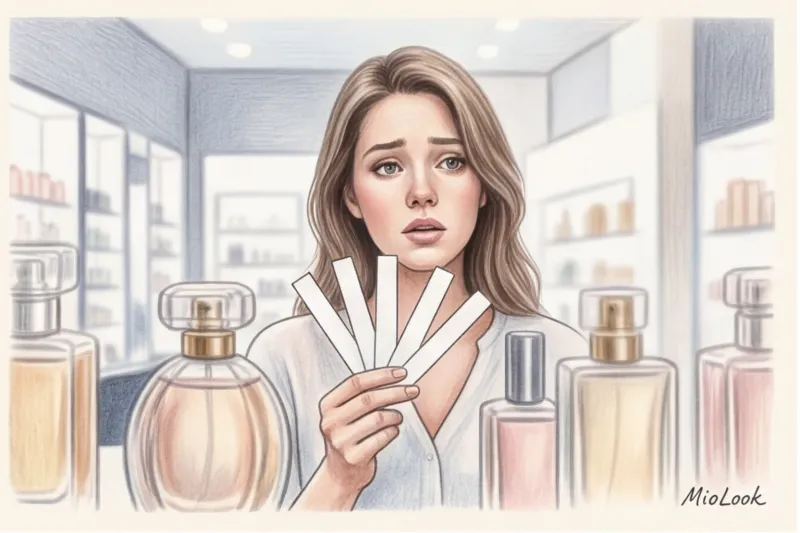
In perfume shops, we're often offered to sniff coffee beans to "reset" our noses. This is another myth. Coffee is a powerful olfactory irritant, which only further overloads the receptors. To restore your sense of smell, simply take a sip of clean water or sniff a patch of skin without perfume (for example, the inside of your forearm) or a clean wool scarf.
3 sure signs that you have violated etiquette:
- During a conversation, the interlocutor unconsciously takes a step back or leans back in his chair.
- Your scent can still be clearly smelled in the elevator or hallway minutes after you leave.
- Your clothes smell like perfume even after washing (this means the oils have penetrated deep into the fibers due to over-application).
Of course, there are exceptions to every rule. If you're going to an outdoor evening event or a well-ventilated theater hall, the sillage might be a little wider. But in everyday life, elegance always speaks in a low voice. Let your scent be an intriguing whisper that you want to unravel when you get closer, not a scream that makes you want to cover your ears.