

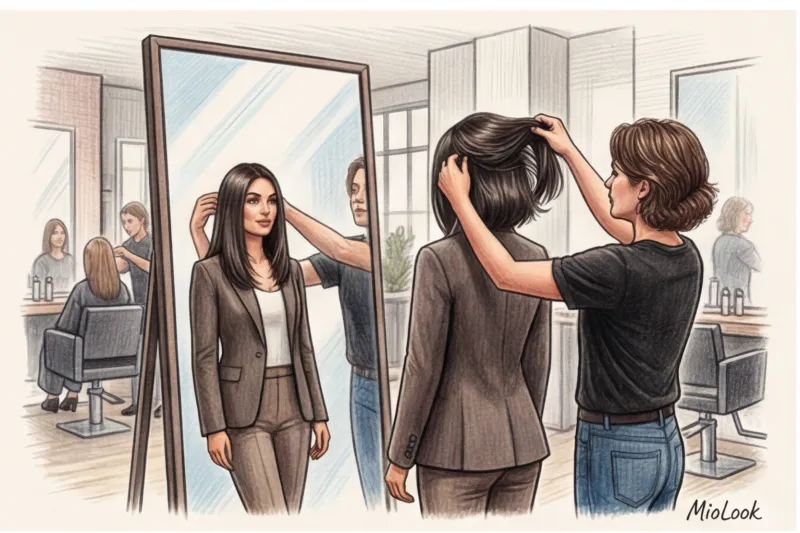
Why choosing a haircut for your body type is more important than choosing a haircut for your face shape
Have you ever noticed how often we make the same beauty mistake? You find the perfect photo of a celebrity, bring it to the salon, the stylist does everything exactly as pictured, but in the mirror you see a different and dissonant image. In 12 years of working as an image consultant, I've seen this scene hundreds of times. The problem is that 90% of women choose their hairstyle exclusively for their face shape—oval, round, or square. But the truth is... haircut according to body type plays a much more important role in the perception of our appearance.
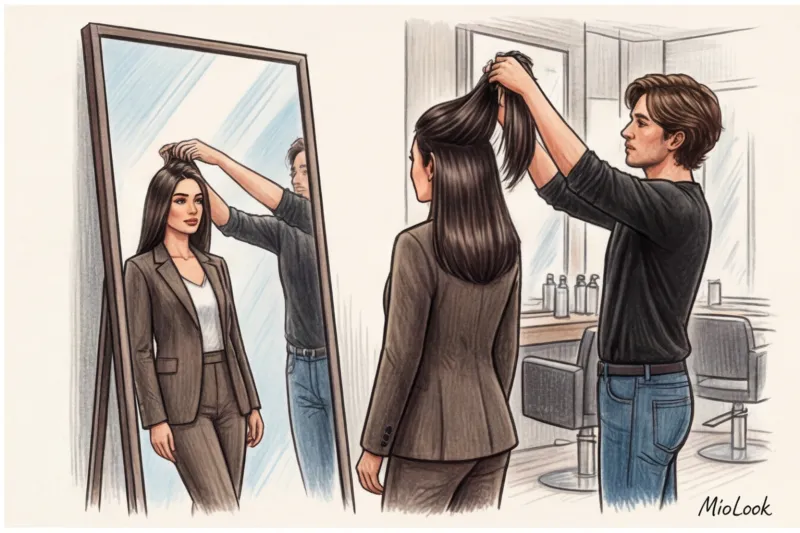
My art education taught me the cardinal rule of composition: one cannot consider a detail in isolation from the whole. From a Gestalt psychology perspective, others don't see us as a "levitating head." Our brain processes the image as a whole—we see the silhouette, the form, the proportions. In this coordinate system, hair acts as a direct extension of the body's architecture.
Treat your hair like an architectural element. It's like the "roof" of a building. If you put a massive, heavy roof on a graceful, miniature structure, it will visually "sag." This styling principle is called visual weight Hair volume, thickness, and length all have their own weight, which can either add a few visual pounds or make you look slimmer.
For example, an overly voluminous, waist-length mane on a woman 155 cm tall will literally "pin" her to the ground, eating up the length of her neck and weighing down her upper body. Conversely, an ultra-short, sleek pixie on a statuesque plus-size woman will create a disproportion known as the "small head effect," making her shoulders and hips appear significantly wider than they actually are.
This is where it comes into play the rule of thirds and the golden ratio in the perception of the female silhouette. The ideal, pleasing proportion is not divided in half (50/50). Harmony is built on a ratio of 1/3 to 2/3. If your hair ends exactly at the waistline (visually cutting the figure in half) or breaks off exactly at the widest point of the hips, you disrupt the natural aesthetic of the body. Hair length should end at "breakpoints"—where the body narrows, not widens: at the collarbone, under the shoulder blades, or just below the waist.
Geometry of Lines: How Hair Changes Body Proportions
Hair creates specific guide lines around our face and neck. They work just like the contour lines in clothing. Let's explore this geometry.
Horizontal lines — straight, graphic cuts (like a classic bob) and thick, even bangs. The key property of horizontal lines is that they always broaden the silhouette at their point. If you have broad shoulders or a large chest, a graphic bob that ends right at shoulder level will create a clear horizontal line, making your upper body even more defined. In this case, it's best to avoid horizontal lines.
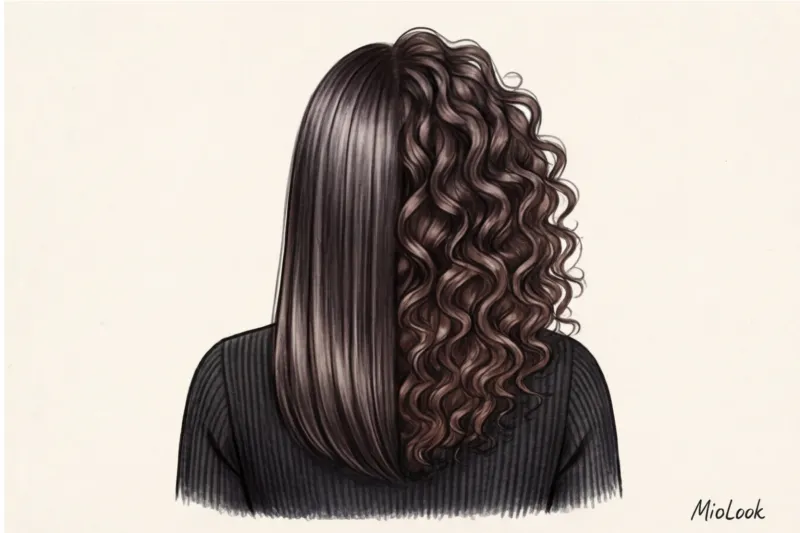
Vertical lines — long, straight, and sleek strands. They act as an optical illusion of lengthening. By creating a long vertical line along the torso, the hair makes the figure appear taller and slimmer. This is the same visual trick we discussed in the article about Layering for petite girls: elongating the silhouette The vertical, loose hair works like an unbuttoned, elongated cardigan—it cuts off the sides and forms a narrow central column.
Diagonals — asymmetrical haircuts, side-swept bangs, layered cuts, and long bobs (with an angled, elongated cut toward the face). Diagonals are the most complimentary lines in styling. They create dynamism, draw the eye along, and distract attention from any problem areas. Layered cascades work on the principles of rules for the third layer of clothing , adding texture and complexity to the look without weighing it down.
To learn to see your figure abstractly, as a set of lines and volumes, I always recommend that my clients take full-length photos in form-fitting clothing. To simplify the process of analysis and subsequent image selection, you can upload your photos to MioLook This smart assistant will not only help you organize your wardrobe but also allow you to visually evaluate how a new haircut will pair with your usual silhouette and the necklines of your favorite dresses.
The Impact of Height on Length Choice: Debunking Old Myths
"Short girls should definitely avoid long hair, otherwise they'll appear even shorter." Let's conduct a thought experiment and recall how many times you've encountered this rule in glossy magazines of yesteryear. As a practicing image stylist, I officially declare: this postulate is hopelessly outdated. Today, we no longer think in the clichéd categories of style encyclopedias from twenty years ago, because we understand how the complex architecture of the body works.
The point is that growth really does determine the so-called hair length "step" , but this doesn't act as an outright ban, but rather as a scaling system. Imagine a lock of hair exactly 40 centimeters long. For a woman 180 cm tall, this hair will barely touch her collarbones, creating the effect of a dynamic mid-bob. But for a petite woman 150 cm tall, these same 40 centimeters will translate into a full-length cut that reaches the shoulder blades, or even longer. In other words, anatomical landmarks—the collarbones, shoulder blades, and waist—should always be the primary focus, not abstract centimeters measured with a tape measure.
The key concept I work with when choosing a haircut for my body type is breakpoint In visual styling, this is the point where your hair ends. This line acts as a rigid horizontal line. If your hair ends exactly at the widest part of your hips or at a waistline that's less defined, the viewer's eye will inevitably stop there. A proper cutoff point should never "cut" your figure at the most problematic or wide part. It should be either above or below this area, drawing the focus away.
A haircut isn't just about shaping your face. Hair creates a frame for your upper body. The wrong length can visually add 5 kilograms or, conversely, shave 10 centimeters off your height simply by cutting off the natural proportions of your neck and shoulders.
Let me share a real-life case from my practice. One of my clients, Marina (155 cm tall), had dreamed of long hair her whole life, but salon stylists stubbornly cut her hair into a bob, citing the notorious "rules for petite women." She tried to argue, even tried extensions, paying €300 to €450 for touch-ups every few months, but the result always looked like her hair was weighing her down. The problem wasn't the length per se, but her overall look and her wardrobe.
How did we achieve the perfect long hair for her 5'5" frame? First, we implemented a hidden layering technique—the inner strands were shortened, removing excess volume and weight from the lower third of her hair, creating a flowing, lightweight look. Second, we shifted her wardrobe paradigm. Long hair visually shortens the torso. To compensate, Marina began wearing only high-waisted pants and skirts, elongating her legs. This combination—light, textured, shoulder-length hair and a high waist—allowed her to wear her desired length without losing, and even gaining, the appearance of height.
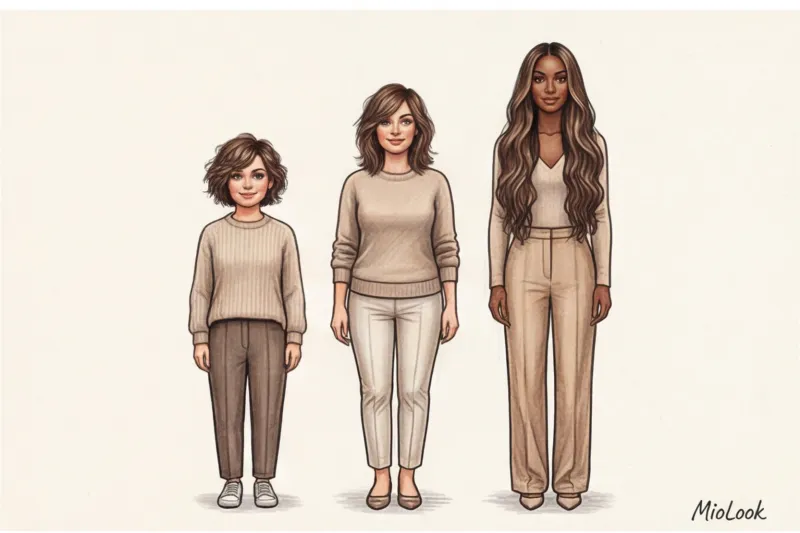
For petite (up to 160 cm): secrets of stretching
If you're shorter than 160 cm, your main stylistic goal for portraiture is to avoid visually overweighting your silhouette. This is where the main danger of the so-called "Rapunzel effect" lies. Overly long, thick, and heavy hair without layers or gradation literally eats up the space of the neck and shoulders. As a result, the head appears disproportionately large, and the figure beneath it appears squat.
Ideal lengths for petite women emphasize airiness and texture. Consider pixies with a voluminous crown, shaggy cuts (great for creating diagonal lines), long bobs that expose the back of the neck, or layered cuts with maximum length right to the shoulder blades. The key is exposed collarbones and a visible neckline.
Why is this so important? An open neck creates a powerful vertical line that automatically elongates your silhouette. If you still want to keep your hair length below the shoulders, ask your stylist to style the strands around your face so that when you move, your neck isn't obscured by a thick curtain of hair. Want to try out different lengths beforehand and see how they change your proportions? I recommend uploading a photo of yourself to MioLook and test the artificial intelligence-based hairstyle selection function.
Average height (160-170 cm): a field for experimentation
This height range is considered the most versatile in professional circles. You're truly in a unique position: your height allows you to wear virtually any length, from an extremely short bob to flowing, waist-length locks, without risking a dramatic shift in proportions.
However, the proportions of the torso and legs are paramount here. Women of average height and a short torso (with a high waist) are advised against very long, straight hair—it will completely obscure the torso, leaving only the legs visible, which looks comical. In this case, it's best to stick to a collarbone-length hairstyle.
Another critical factor is neck length. It determines the choice between a classic bob and a long bob (an elongated bob). Measure the distance from your earlobe to the intersection of your shoulder and neck. If it's shorter than four finger widths, avoid a classic straight bob that ends right at the middle of your neck—it will make your neck appear even shorter. A long bob with a longer edge toward the face is your best bet.
Not sure which length is right for you?
Upload your photo to MioLook, and a smart AI stylist will analyze your proportions to suggest the perfect haircut and wardrobe options.
For tall people (from 170 cm): balance and scaleTall women have their own unique way of dealing with proportions. The most common mistake I see in women 175 cm and taller is choosing haircuts that are too short, sleek, and smooth, like a classic pageboy or an extremely short pixie with no volume. This leads to what's known as "small head syndrome."
The law of harmony demands scale: tall stature, long limbs, and large bones require proportionate volume on top, otherwise the head will appear disproportionately tiny against a long, stately body. Sleek buns and micro-cuts are great for glossy shoots, but in real life they often distort the silhouette.
Your ideal hairstyle is volume. Long, flowing locks in the style of '90s supermodels, a large, layered cascade, or a voluminous bob styled with a brush. If you choose a medium length, it should definitely have texture—soft waves, curls, or choppy ends. The scale of your features and your height simply demands a hairstyle that's noticeable, textured, and vibrant. The hair acts as the main balancer here, balancing the length of your torso and legs.
The Right Haircut for Your Body Type: A Practical Guide
When you sit down at the hairdresser's, the first thing they do is wrap you tightly in a cape. And this, from an imageological perspective, is the industry's biggest systemic flaw. The hairdresser sees only your head and facial shape, completely losing sight of the body's architecture. But the head doesn't exist separately from the body. That's why a technically flawless haircut can catastrophically ruin your figure.
To avoid this, we use the concept visual weight Hair is like clothing, but we wear it every day. A thick mane of curls adds volume, sleek straight strands act as a vertical extension, and a straight, thick cut at collarbone level creates a strong horizontal line. By properly distributing this volume, we can shift the focus: draw the eye away from problem areas and compensate for imbalances in the width of the hips or shoulders.
The secret to a harmonious silhouette lies in the principle of counterbalance: where the body lacks natural volume, we add texture with the hair. Where volume is excessive, we use the hair to create elongating diagonals or remove the accent entirely.
Interestingly, this concept is closely intertwined with David Kibbee's body type theory, which links the body's bone structure (the balance of Yin and Yang) with hair texture. If your figure is built on sharp angles and straight lines (Dramatic), smooth textures and geometric cuts will suit you naturally. If your body is dominated by soft curves (Romantic), geometric shapes will look out of place—you need soft waves and layered textures. Let's explore how this works in practice for the main body types.
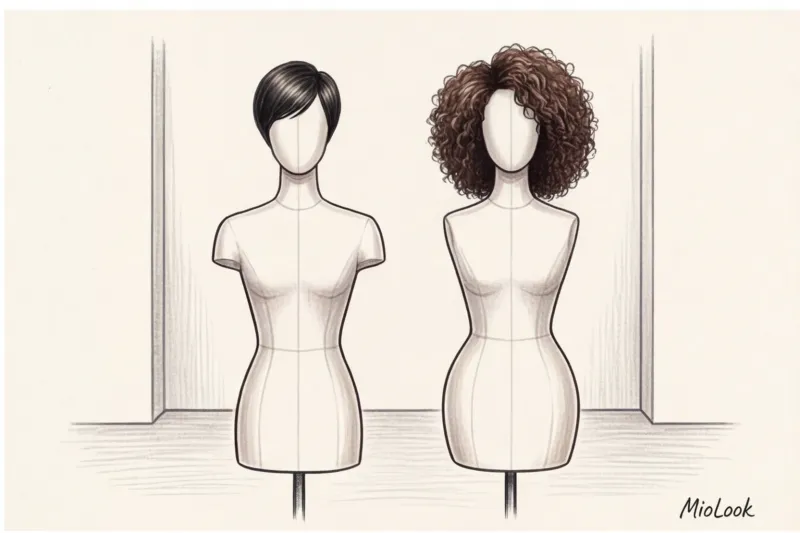
Pear (Triangle) Type: Adding Weight to the Top
Those with a pear-shaped figure have a low center of gravity: their hips are significantly wider than their shoulders, and their upper body (chest and shoulder girdle) appears fragile. If you have this body type and a sleek hairstyle, you'll develop the so-called "pinhead syndrome." A small, sleek head against a voluminous bottom will visually make your hips appear even larger.
Main goal: broaden the shoulder line, add visual weight to the upper body and draw attention to the face.
I had a telling case in my practice. A client with a pronounced pear-shaped face regularly underwent keratin straightening (a premium treatment costing her around €150) and constantly complained that her hair looked "heavy." Once we washed out the treatment, restored her natural porosity, and created a textured shaggy bob with a more prominent crown, her proportions magically balanced out. Her wide hips no longer dominated her silhouette.
Recommendations:
- Voluminous haircuts of medium length (slightly above or right to the collarbone).
- Textured curls, beach waves, airy styling.
- Voluminous curtain bangs - they expand the portrait area horizontally.
- Layered haircuts (cascade, mullet, wolf cut), where the most active volume is at the level of the temples and cheekbones.
Taboo: Sleek, long hair of one length, sleek low ponytails and buns, and a straight parting with no volume at the roots. They'll accentuate narrow shoulders and create a striking contrast with your hips.
Inverted Triangle: Softening the Shoulder Line
Here, the challenge is completely opposite: the shoulders are naturally broad and athletic, while the waist and hips are narrow. Adding volume at the shoulders will transform the figure into a massive square. According to research from London styling academies, a horizontal hairline at the widest part of the body adds up to 15% visual volume to this area.
Main goal: to draw attention away from broad shoulders, break up the hard horizontal line and shift the visual weight down to the chest or waist.
Recommendations:
- Long hair (below the shoulder blades) with the main volume at chest level and below.
- A deep side parting is a powerful tool. The asymmetry breaks the broad horizontal line of the shoulders, making them appear narrower.
- Elongated V-shaped cascades, where the strands softly frame the neck, but do not create a cap on the shoulders.
To visually see how a side parting changes the appearance of your shoulders, you don't have to go to a salon right away. Upload your photo to MioLook and look at the preview - you'll be surprised how much the asymmetry in the portrait area narrows the shoulder girdle.
Taboo: A short, voluminous bob, a mid-neck bob, or a straight cut that ends right at the shoulders. This will create an extra horizontal line that will broaden your shoulders to the proportions of a professional swimmer.
Rectangle and Apple Shapes: Creating Diagonals
Although these two body types differ in the presence of excess weight, they share a common problem: the lack of a defined waist and a predominance of straight, rectangular lines in the silhouette. However, their approach to haircuts will differ.
The main goal for the Rectangle: Break up the straight, androgynous lines of the body and add a touch of femininity (Kibbe's Yin energy). If the figure lacks curves, we should compensate with curves in the hair. Soft Hollywood waves, voluminous layers, and rounded bangs are ideal for you. Try to avoid graphic, linear haircuts—they will only emphasize the "boxiness" of the figure.
The main goal for Apple: To elongate the silhouette vertically and de-emphasize a prominent belly, soft curls will do the trick—they'll make the look too round and bulky. Here, we need the magic of strong diagonals.
Recommendations for Apple:
- Asymmetrical long bob (A-line bob): When the back of the head is shorter, and the front strands fall below the collarbones in sharp angles. These elongated front strands create two powerful verticals that literally "cut" the sides and elongate the neck.
- Length below collarbone: It is very important that the hair ends below the widest part of the chest, leading the eye vertically downwards.
- Smooth textures: Unlike the Rectangle, the Apple requires more disciplined, sleek hair. Excessive fluffiness on the head will add bulk to the entire body.
Pro tip: If you have an apple-shaped body, try to style your hair so that at least one side of your neck is exposed (for example, by tucking your hair behind your ear). A neck covered with heavy hair makes your upper body appear monolithic, visually adding a few extra pounds.
Plus-size volume issues: "small head syndrome"
At a recent masterclass on silhouette architecture, we addressed a particularly insidious yet popular beauty myth: the idea that if you gain weight, you need to get a short haircut to "refresh" your look and take a few years off your appearance. This misconception costs many women their harmonious proportions.
A common mistake is when a plus-size client comes to the salon and asks for an ultra-short pixie or a classic sleek bob. The stylist trims the length, completely revealing the neck and shoulders. The result is a statuesque, massive figure, topped off by disproportionately small hair volume. Professional stylists call this "small head syndrome." Instead of the desired lifting and rejuvenating effect, such a cut only emphasizes the body's size, creating a contrast.
The main principle of working with a curvy figure is the law of proportionality. Larger body shapes require perfectly proportional hair texture and mass.
If your clothing size is XL or larger, your hair shouldn't look slicked back. We need volume. This doesn't mean short haircuts are strictly prohibited, but they should have texture, movement, and volume.
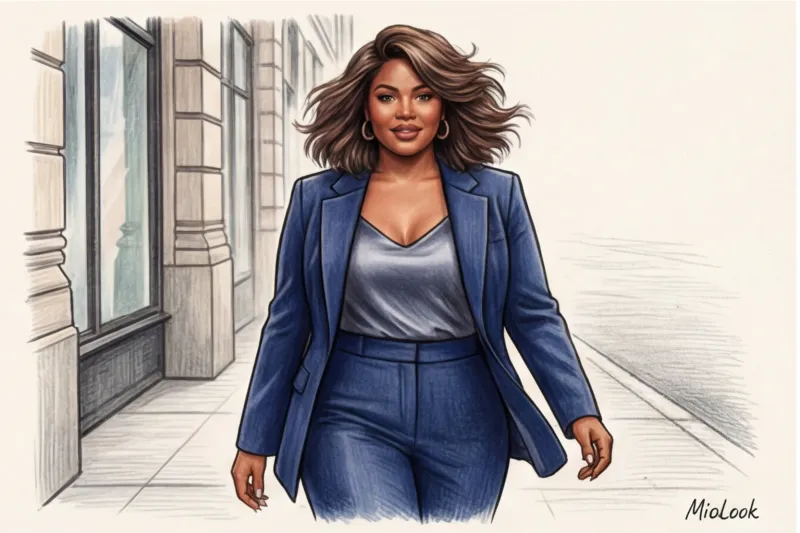
Here lies a crucial nuance that even experienced hairdressers forget: Where exactly are we building this volume? A fatal mistake is creating volume at the cheeks or chin (as in a typical round bob). This horizontal line instantly widens the face, making it appear heavy, and shortens the neck. The correct strategy is to shift the volume upward. Accentuated volume should be concentrated exclusively at the crown and the crown. This design creates a powerful vertical line, elongating the entire silhouette.
From my personal experience, a layered long bob (collarbone length) or a textured cascade is often the ideal solution for correcting plus-size proportions. We use an internal layering technique: the stylist removes excess thickness from the inside to prevent the hair from hanging in a heavy triangle, while maintaining the outer length. This way, we maintain the volume of the hairstyle, avoiding a monolithic "helmet" effect. Maintaining this shape will require good styling products (a high-quality texturizing spray will cost around €20-35), but the visual effect of going down a size is definitely worth it. A well-chosen haircut for your body type works flawlessly: when you have the right volume on top, even a basic jumper will look completely different.
Access to MioLook for €0.99 — one-time payment
Start creating perfect images with the help of artificial intelligence
Get access — €0.99 onceHow Hair Length Interacts with Your Wardrobe
According to a large-scale study by the WGSN trend bureau (2024), the hairstyle's silhouette shapes up to 40% of the first impression of an image, being perceived even faster than the cut of clothing. When I begin putting together a seasonal capsule collection with my clients, the first question I ask is: "Are you planning on changing your hair shape?" It's a huge mistake to view a haircut as something separate from your body. Hair is your most important, basic accessory, which you wear every day without taking it off.
A haircut is the foundation of your personal style and directly affects how your clothes fit. If you've put together a flawless capsule wardrobe but haven't considered the geometry of your hairstyle, the proportions can visually fall apart. That's why I strongly recommend uploading your everyday portrait photos with different hairstyles to the app. MioLook — this way you can clearly see how the mass of hair changes the perception of your favorite tops, jackets, and dresses.
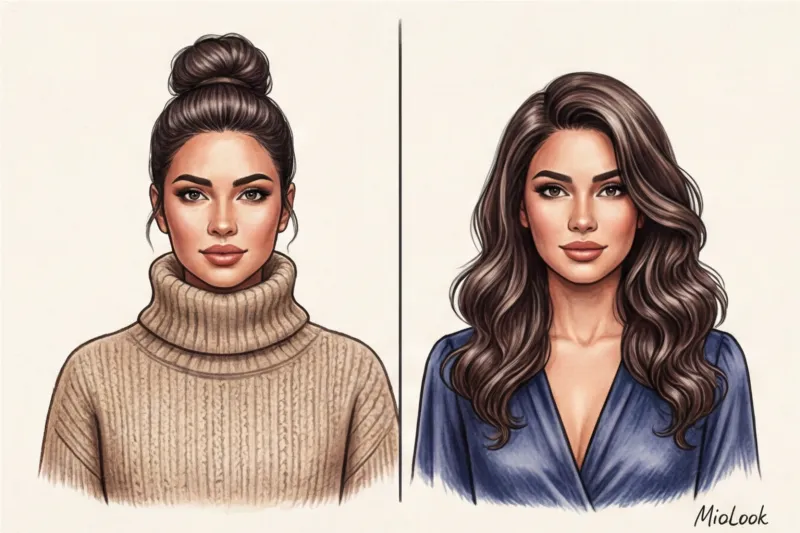
Difficulties most often arise when combining hair length with neckline shapes. A strict rule of tailoring applies here: the guide lines should not conflict with each other.
- V-neck: It works perfectly with hair swept up or cut well below the collarbone (drawing the eye vertically). If your long bob or bob hits the edges of a V-neck, it visually shortens the neck and creates a clash of angles in the portrait area.
- Bateau neckline: This elegant French collar is designed solely to showcase the graceful line of the collarbone and the horizontal line of the shoulders. Long, loose strands completely defeat the purpose of the style, visually narrowing the chest. The best companions for the boat-cut are short haircuts (pixie, pageboy) or high, sleek buns.
- Turtleneck: The most insidious wardrobe item. If you have thick, medium-length hair, it tends to curl unattractively over your collar, creating massive volume at the base of your neck. The solution is to either comb your hair back smoothly or tuck strands into your sweater (the trick French tuck (for hair that street style bloggers adore).
The conflict between length and clothing is even more acute in the winter wardrobe. Layers, heavy coats (especially voluminous styles in the €150-€300 price range, popular with minimalist brands like COS or Arket), and chunky wool scarves require space. Shoulder-length or shoulder-length hair suffers the most in winter: the ends rub against the rough texture, become staticky, and distort the silhouette, making the upper half of the figure appear bulky. If you wear voluminous outerwear, the optimal solution is either a cropped style that completely frees up the neck, or a sufficient length (from the shoulder blades and below) that falls beautifully over the fabric without bunching up.
Hair and Fabric Texture: Combination Rules
Besides length, texture is crucial. Clothing material and hair texture should interact consciously, supporting or complementing each other.
Sleek, ironed hair with a perfectly even, tight cut is geometric in its purest form. This texture luxuriously complements tailored suiting fabrics, heavy gabardine, and architectural tailoring. It's the foundation of a "quiet luxury" aesthetic, where the disciplined lines of the head logically follow the crisp lapels of the jacket.
Curls, loose waves, and intense root volume, however, require a different approach. They pair beautifully with soft, fluid textures—natural silk, viscose, fluffy mohair, and chunky knits. Strict, rigid office attire paired with wild, natural curls often looks disjointed, as if the head and body are living separate lives.
However, the pinnacle of personal styling is playing with carefully crafted contrasts. Try pairing a romantic, flowing slip dress with a bold, ultra-short pixie. The masculinity and sharpness of the cut will instantly offset the dress's excessive sweetness, making the look sophisticated and expensive. Conversely, an oversized men's jacket looks incredibly feminine when its sharp shoulder line is broken up by a cascade of long, deliberately careless waves, reminiscent of the '70s.
Hairdresser's Checklist: How to Choose Your Perfect Haircut
Statistically, 8 out of 10 times, disappointment after leaving a beauty salon is not due to the stylist's poor technique, but to a fatal communication error. We bring reference images of beautiful faces, cut out of context of their figures. To forever forget the saying "hair is not teeth—it will grow back," I've developed a strict step-by-step algorithm for my clients. This is your technical specifications for the hairdresser, written in the language of proportions.
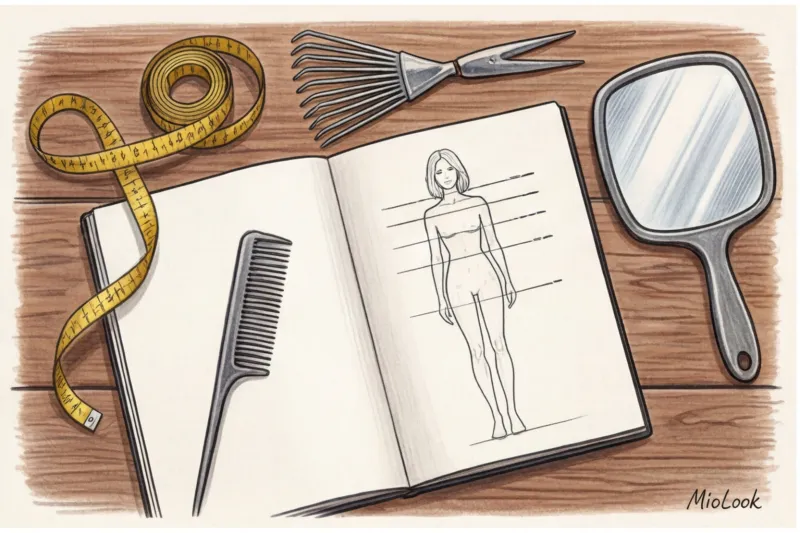
Step 1: Assessing proportions through the lens. Our mirror often distorts reality due to our usual viewing angle. For an honest analysis, we need a full-length photo. Mount your phone on a tripod or ask someone close to you to take a photo of you. The most important nuance: The camera lens should be positioned exactly at the level of your stomach. Shooting from top to bottom will artificially shorten your legs and enlarge your head; shooting from bottom to top will distort the size of your hips. Wear the most form-fitting clothing possible (a basic top and leggings set costing €30–€50 is ideal). Your goal is to see your true volume, not a silhouette draped in fabric.
Step 2: Identify the dominant geometry. Take a close look at the photo: what do you have more of—hard lines or soft curves? Consider the width of your shoulders relative to your hips. If your shoulders are noticeably wider, you need a haircut that creates elongating diagonals near your face and a tight, heavy cut at the ends to balance out your narrow hips. If your figure is curved, sleek, ironed hair will look out of place. Texture is essential: textured layers or soft waves that support your body's natural geometry.
Step 3. Consider your lifestyle and clothing habits. A haircut doesn't exist in a vacuum; it lives within the context of your wardrobe. If you wear hoodies, turtlenecks, or formal shirts with stiff collars every day, then shoulder-length hair will become your biggest pain point—the ends will constantly kink and stick out untidily. I recommend analyzing your looks beforehand. By uploading your everyday outfits to the "smart wardrobe" feature in MioLook , you will be able to objectively assess which necklines and collars predominate in your closet and choose a length that will not conflict with them.
Step 4. Setting the task for the master. Forget requests like "just give me a layered cut" or "I want a bob." Hairdressers think in terms of shapes, and you should ask them silhouette The correct technical specifications sound like this: "I need to visually elongate my neck and draw attention away from my heavy jawline. So, let's avoid a horizontal cut at chin level. I want some volume at the crown, and the main length should fall below the collarbones, creating a vertical line.".
My main advice: a skilled stylist works with the whole person, not just the head. Give the stylist the coordinates of your proportions, and they'll find the perfect technique, even without glossy references.
Your ideal image
it begins Here
Join thousands of users who look flawless every day with MioLook.
Get access — €0.99 onceSummary: Hair as the main tool for silhouette correction
In the world of styling, there is one law that I always voice at the first meeting with a client: the most expensive and technically flawless work of a colorist or hairdresser (even if you paid from 150 to 300 € for it in a premium salon) will lose all its shine if it exists separately from your body. Ideal haircut according to body type It's not a matter of dry mathematics. It's always a living, dynamic balance between your physical height, your dominant body measurements, and the clothing style you convey every day.
The main secret of modern imageology lies in a radical shift in perspective. We no longer live in the glossy fashion paradigm of the 2000s, where women were forced to "conceal problem areas." Attempts to hide broad shoulders with a thick, monolithic cascade or to cover round cheeks with thick, straight strands are a stylistic failure. This only creates a massive frame around the area you desperately wanted to hide.
Instead of concealment, we use a principle of attention management—the focal point theory. The idea is to draw the eye away from a heavy bottom (if you have a pear-shaped figure) with light highlights and dynamic texture at the cheekbones. By creating beautiful volume at the crown and revealing the graceful line of the neck, the viewer's gaze focuses on the portrait area and simply doesn't wander lower. You direct how people read your proportions.
But how do you know if a new hairstyle will work in your real life? This is where the most important step begins: integrating the hairstyle into your existing capsule wardrobe. Hair is your only "permanent accessory." If you prefer strict minimalism and clean, architectural shapes in your clothing, romantic, careless curls can create visual dissonance.
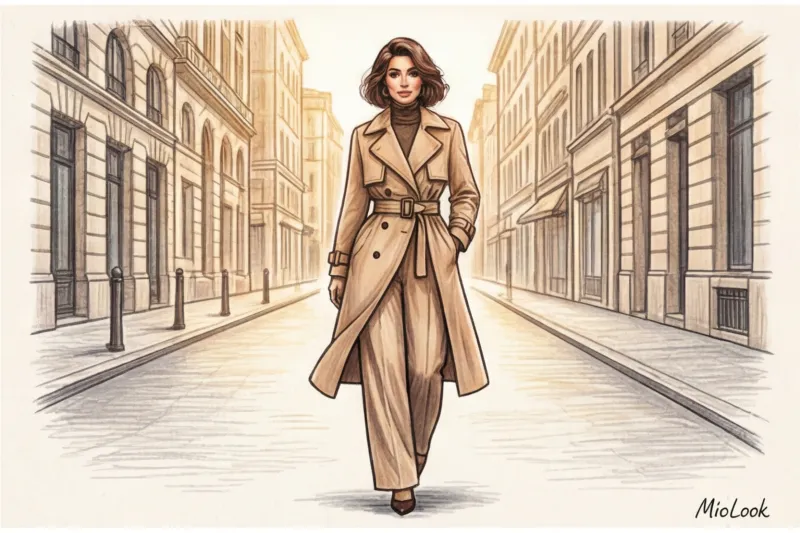
To avoid clashing shapes, I always give my clients this practical advice: conduct a "three-collar test" at home. Pull out three pieces from your closet that form the basis of your seasonal capsule wardrobe. For example: a thick cotton crewneck T-shirt, a tailored jacket with an English collar, and your favorite oversized chunky knit sweater (or hoodie). Pin your hair back the way you plan to cut it and try it on with each top. You'll immediately see whether the geometry of your new, thick bangs clashes with your favorite V-neck, or whether a short bob with a thick knit makes you look wider.
To simplify this process and avoid having to rely on blind imagination, I recommend using MioLook Upload your essential everyday pieces to the app, assemble them into familiar looks, and view the resulting capsules through the lens of your new haircut. You'll clearly see: if your wardrobe is dominated by harsh oversize, you'll need more air and texture in your styling to prevent your head from appearing tiny against the voluminous shoulders of your coat.
To sum it up, I want to emphasize the most important thing: let go of rigid boundaries. Any stylistic typology is merely a wonderful guide, but it shouldn't become your prison. We no longer force ourselves to fit ideal standards; we adapt the laws of visual illusion to our unique bodies.
In my personal practice, I've seen dozens of cases where a seemingly "forbidden" length for a particular height or build turned out fantastically well. Why? Because it perfectly resonated with the woman's inner energy, her gait, and the texture of her favorite fabrics. Study your individual lines, don't be afraid to break the rules (if you understand the mechanics behind them), and remember: the perfect hairstyle lives in the rhythm of your body, without requiring constant adjustments in the mirror.
Guide Chapters
Haircuts for skinny girls: how to create the right volume
A huge backcombing and extreme length won't hide thinness, but rather accentuate it. We'll explore common mistakes and select the perfect haircut for a thinner body type.
Neck-Lengthening Haircuts: 5 Best Options
Hair can either accentuate the grace of your neck or visually "eat away" its length. Discover 5 haircuts that will make your silhouette appear slimmer and taller.
The Best Haircuts for Tall Girls: Maintaining Proportions
Hair is an architectural element of your body. We'll explore how heights over 175 cm dictate hairstyles and which haircuts will add a lighter silhouette.
Ideal hairstyles for large breasts and apple-shaped faces
Learn how to balance an apple-shaped figure and visually lighten the silhouette of a fuller bust with the right haircut. Real-life examples and stylist advice.
Ideal Haircuts for Broad Shoulders: Stylist Tips
Trying to hide broad shoulders with your hair? Find out why this is a mistake and which hairstyles will visually balance the inverted triangle body shape.
Pear-Shaped Haircuts: Balancing Wide Hips
Hair is an architectural material that directly influences body proportions. Learn how to balance an A-line silhouette with the right hairstyle.
Haircuts for Short Girls: How to Add Height
It's not long hair that "kills" height, but poor proportions. We'll explore the silhouette architecture and choose the perfect haircuts for petite women.
Try on a haircut online: choose your length with an AI stylist
The wrong hair length can add weight and distort your figure's proportions. Find out how artificial intelligence can help you choose a haircut that suits your entire silhouette.
Haircuts for Plus Size Women: Balance and Proportion
Learn how the right hairstyle can enhance your silhouette. Learn a stylist's secrets for balancing a curvy figure with volume.
Frequently Asked Questions
What is your color type?
Find out your seasonal color type and choose clothes that highlight your natural beauty.
About the author
Unlock MioLook
for €0.99
Start creating perfect outfits with artificial intelligence
Get access — €0.99 onceRelated Articles
How to choose a haircut for your face shape: stylist's advice
The oval face is no longer the standard. A personal stylist explains how to choo...
Visual figure correction: concealing flaws
Forget about shapeless clothes that hide your potential. Discover how the right ...
How to choose a hat according to your height: the rule of proportions
Forget the clichéd advice from glossy magazines. Discover how headwear architect...
Body Types: How to Choose Clothes and Forget About Pears
Comparing a woman's body to fruit is so last century. Learn how modern stylists ...