
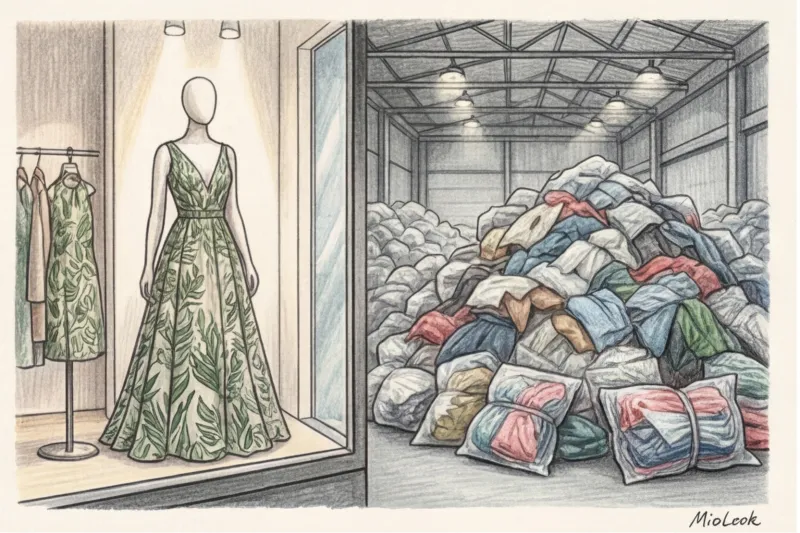
A few years ago, at Paris Fashion Week, I received an invitation to a private presentation of a very famous brand's new "sustainable" collection. Models on the runway showcased flowing organic cotton dresses, and the press releases were full of talk about saving the planet. There was just one catch: the entire gigantic pavilion where the show was held was covered floor to ceiling in single-use virgin plastic, which would be sent to landfill the next day. It was then that I truly grasped the scale of the contemporary fashion industry's greatest illusion.
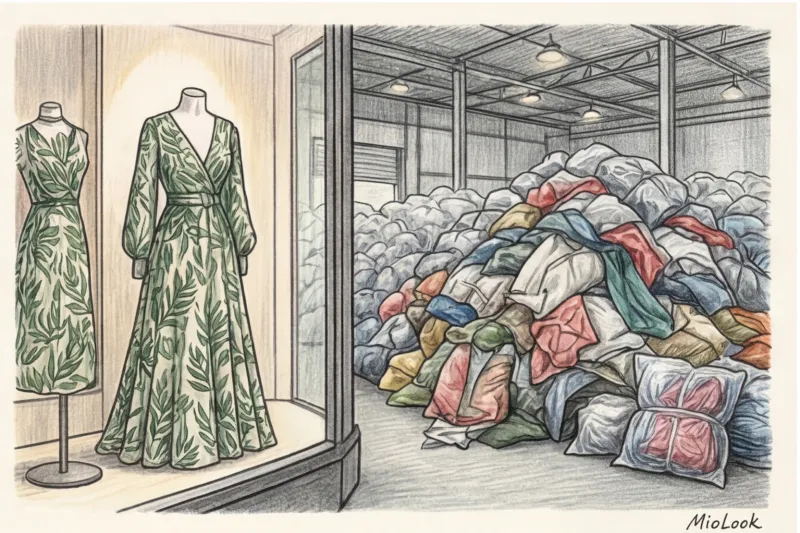
Today greenwashing in clothing It's not just a marketing ploy; it's a multi-billion dollar industry of deception. Brands have realized that we, consumers, want to save the planet, and they've started selling us on that sentiment. We've covered more about what actually makes up an eco-friendly wardrobe in our the complete guide to conscious fashion In this article, I want to take off the rose-colored (or rather, green) glasses and show you the dark side of eco-marketing. We'll analyze specific brand tactics and learn how to spot the pitfalls even before you try them on.
What is greenwashing in clothing: the anatomy of a fashion illusion
The term "greenwashing" refers to the creation of a false eco-friendly image to boost sales, instead of truly implementing sustainable practices. In fashion, this trend has morphed from a niche initiative into an aggressive tool of manipulation.
According to the UK Competition and Markets Authority (CMA) in 2022, up to 60% of sustainability claims by major fashion brands were either exaggerated or outright false. Companies use vague language to trick us into paying premium prices for items whose production costs and environmental impact are no different from those of standard mass-market brands.
Fortunately, the industry is beginning to change under legal pressure. In 2024, the European Union adopted the Green Claims Directive. Brands within the EU are now prohibited from using terms like "eco-friendly" or "carbon neutral" without rigorous independent certification. But until these rules are implemented globally, the responsibility for making choices lies with us.
Your perfect look starts here
Join thousands of users who look flawless every day with MioLook. Our smart AI stylist will help you create your wardrobe without unnecessary purchases.
Get access — €0.99 onceThe Main Tricks of the Mass Market: How We Buy Plastic at Eco-Premium Prices
Over 12 years as a stylist, I've studied hundreds of collections and can confidently say: the main trick of fast fashion giants is the mathematics of hypocrisy. A brand will fanfarely launch a capsule collection of 20 organic cotton items, spending millions on advertising. Meanwhile, they're simultaneously producing 10,000 items from virgin polyester produced in coal-fired factories. The PR budget for "sustainability" exceeds the budget for actual eco-initiatives.
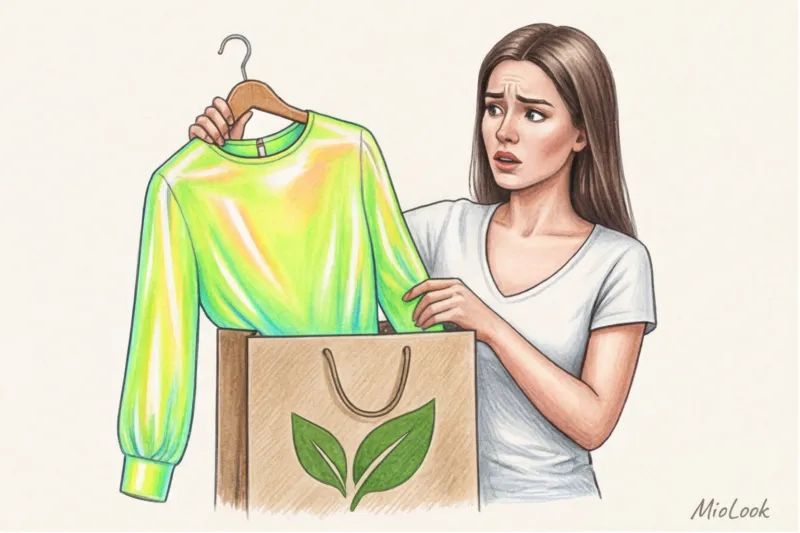
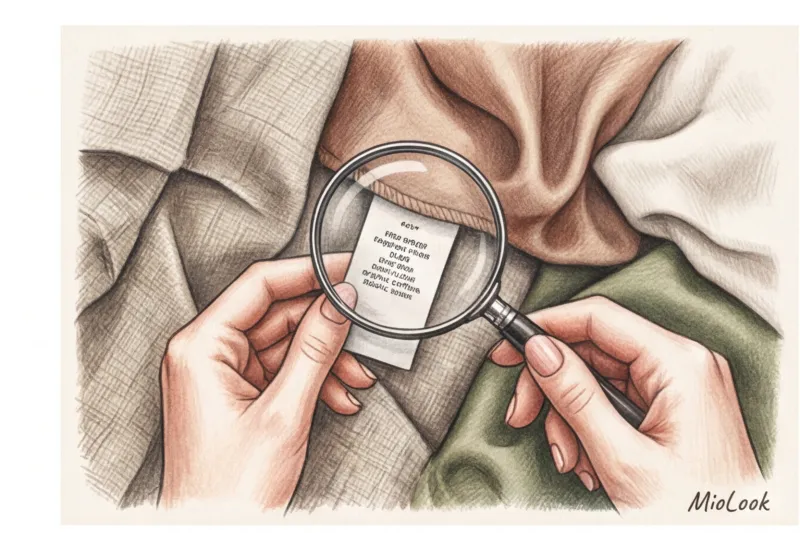
Report Changing Markets Foundation This eloquently demonstrates that fashion's dependence on fossil fuels is only growing. Consider the concept of "blended fabrics." You see a sweater in the store with a huge green tag that says "Contains Wool." It sounds natural. But if you look at the inside label, the composition turns out to be 10% wool, 85% acrylic, and 5% elastane. You're buying a plastic bag for the price of a wool garment.
The myth of "vegan leather" and recycled polyester
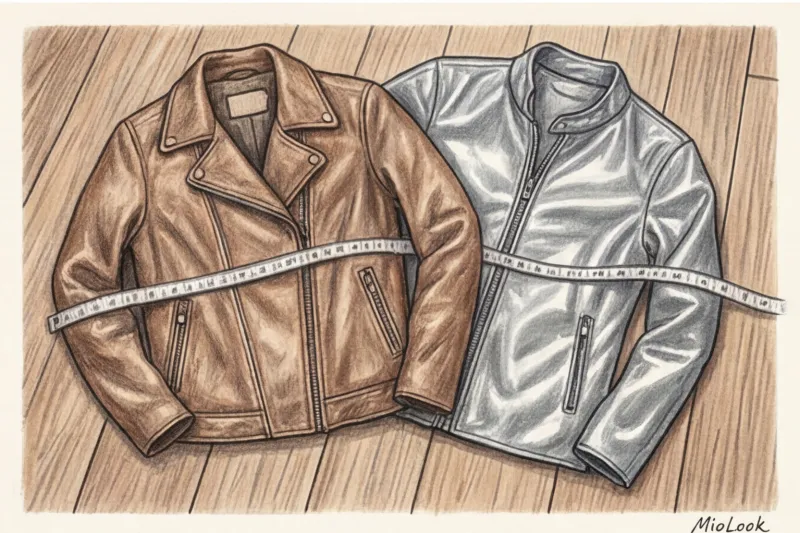
Here we come to the biggest deception of the decade. One of my clients proudly showed me her new "cruelty-free" wardrobe, made of vegan leather, and complained of constant allergic reactions and greenhouse gases. I had to break it to her: 90% of so-called "vegan leather" on the mass market is polyurethane (PU) or polyvinyl chloride (PVC). These are toxic petrochemical products that are not breathable and will take up to 500 years to decompose in a landfill. The word "vegan" here is just a cover for cheap plastic.
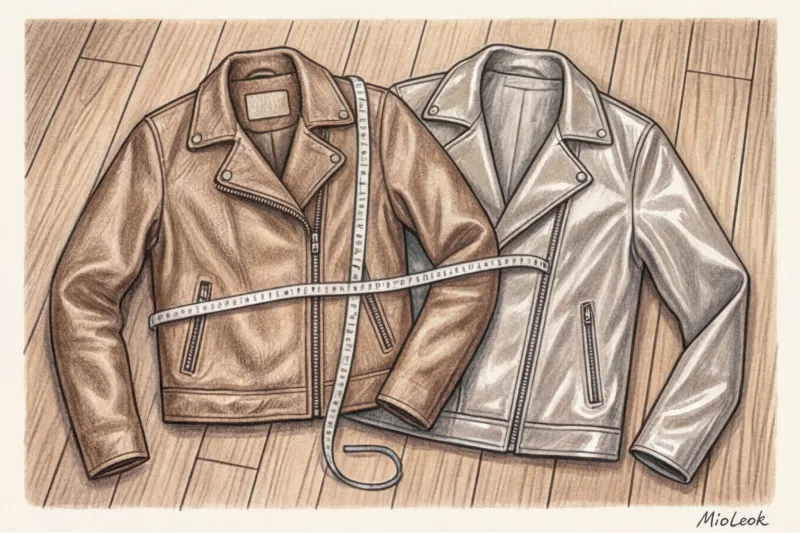
The second paradox is recycled polyester (rPET), which is made from plastic bottles. It would seem we're saving the ocean! But the Ellen MacArthur Foundation, which researches the circular economy, is sounding the alarm. A PET drinking bottle can be recycled into a new bottle up to 10 times—a perfect closed-loop process. But when H&M or Zara turn that bottle into a fleece sweater, the cycle is interrupted. Less than 1% of clothing is recycled back into clothing. In other words, the brand takes recyclable material and turns it into a non-recyclable sweater, which will end up in a landfill after a season, releasing microplastics with every wash. This isn't saving the planet; it's a reprieve.
"True innovations you can trust are next-generation materials: Piñatex made from pineapple leaves, Desserto from cactus, or Mylo from mushroom mycelium. But they're expensive. If you see a $30 'vegan leather' bag, you're looking at oil, not ecology."
Capsule "eco-collections" as a smokescreen
Even if a brand uses 100% organic cotton, certified to all standards, it makes no sense in a fast-fashion business model. The problem isn't just the materials; it's the volume. Releasing 52 micro-collections a year (one every week) depletes water resources and soil.
That's why the concept of minimalism and integrating items works better than any eco-label. Investing in one high-quality jacket made from premium wool that you'll wear for five years is hundreds of times more eco-friendly than buying three cheap eco-friendly T-shirts for one season. To avoid overconsumption, I always recommend that clients use wardrobe digitization feature in MioLook - When you see all your things on your phone screen, impulse purchases simply disappear.
Marker Words: A Marketer's Vocabulary You Can't Trust
Marketers love terms that have no legal force. If you see large print on a label with the words Natural , Green , Earth-friendly or Conscious — Be careful. More often than not, there's nothing behind them other than a desire to sell.
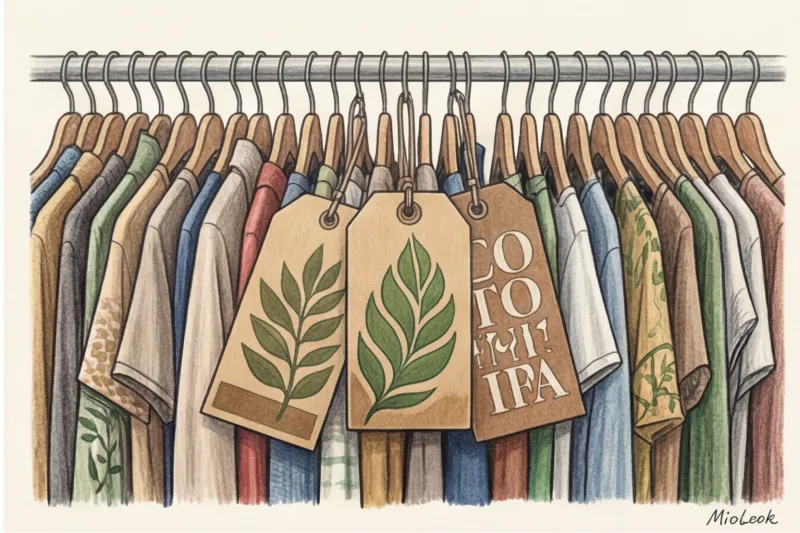
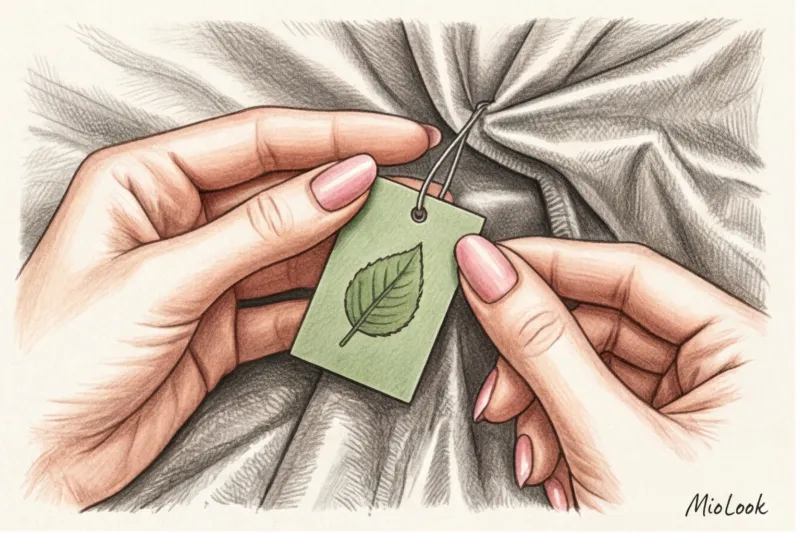
There's also visual greenwashing. Have you noticed how the tag design on "conscious" lines changes? The brand uses rough craft cardboard, earthy tones, twine instead of plastic fishing line, and prints with twigs. Your brain thinks, "Oh, this is natural!" But in reality, attached to that craft paper is a 100% polyester blouse.
Another elegant substitution of concepts: the inscription Recyclable (recyclable) instead Recycled (Made from recycled material). Theoretically, a glass button can be recycled. But who would rip it off a shirt before throwing it away? Almost no one.
Ready to get started?
Try the MioLook plan for free—no commitments required. Organize your closet and create stylish looks in just a few clicks.
Get access — €0.99 onceHow to spot greenwashing in a fitting room: A stylist's guide
Let's leave the theory aside. What do you do when you're standing in the fitting room with an item in your hands? Over the years, I've developed a strict quality control algorithm that works flawlessly.
1. Tactile and olfactory test.
Squeeze the fabric in your fist for 10-15 seconds. If it immediately develops hard, sharp creases, it's cheap synthetic or low-quality cotton, liberally treated with formaldehyde to make it look marketable. Speaking of formaldehyde, if a new item emits a strong chemical or "fishy" smell, hang it back up immediately. It's not "green" in any real sense.
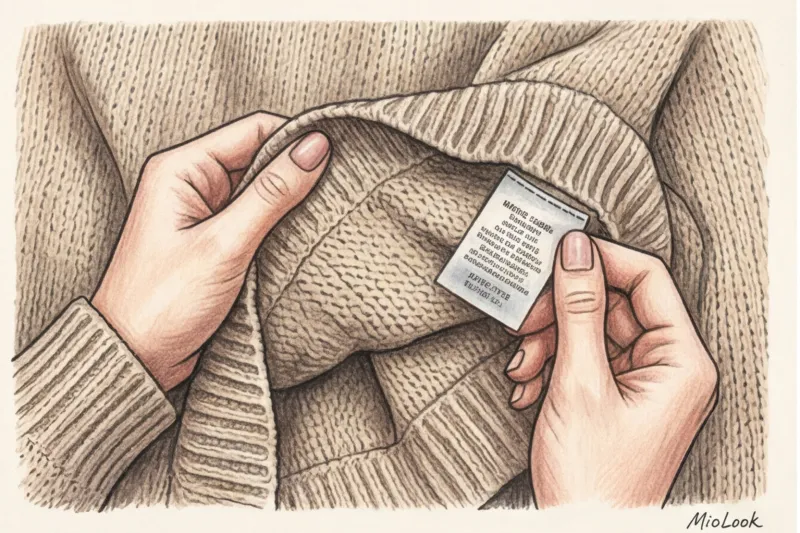
2. Analysis of fittings and seams.
Gently pull the fabric apart along the seam line. If you see gaps or taut threads, the item will unravel after the third wash. Interesting fact: brands that truly care about recycling (like MUD Jeans) use cotton threads. Mass-market brands always use reinforced polyester threads because they're cheaper. The problem is that when cotton is machine-recycled, these plastic threads don't dissolve and ruin the new yarn.
3. Financial adequacy test.
Can a truly ethical T-shirt made from organic cotton, harvested without slave labor, cost $5? No. If the item is suspiciously cheap, it means the difference was paid by someone else: a farmer in Bangladesh, a seamstress working 14 hours a day, or a polluted river where toxic dyes were dumped.
Reading the ingredients: What to look for besides the loud green labels
Rule number one: look for mono-materials An item made of 100% wool, 100% cotton, or 100% viscose can be easily recycled. However, a mix of 60% cotton, 35% polyester, and 5% acrylic is a technological dead end; separating these fibers is virtually impossible today.
But I promised to be honest, so here's an important limitation: this is the rule It doesn't work For skinny jeans or slim-fitting trousers. 2-5% elastane in denim isn't greenwashing, but a technological necessity. Without elastane, jeans will stretch out at the knees within a week and end up in the trash. In this case, the long-lasting fit is more environmentally friendly than a pure composition.
Real eco-certificates versus painted-on leaves
If pretty words mean nothing, what can you trust? Only independent international certificates. Obtaining these marks costs brands enormous amounts of money and time, so they never hide them. If a product is certified, you'll see the abbreviation on the sewn-in inner tag (not just on the cardboard).
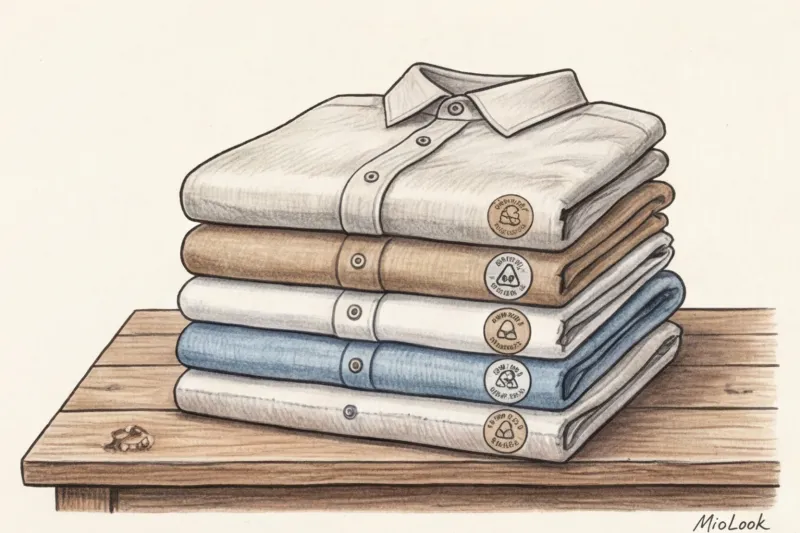
- GOTS (Global Organic Textile Standard) — the gold standard for cotton, flax, and hemp. It guarantees not only the absence of pesticides in the fields but also safe dyes and fair wages for factory workers.
- Oeko-Tex Standard 100 — means the finished product has been tested to ensure it is free of hundreds of harmful chemicals. This is critical for underwear, children's clothing, and those with allergies.
- B Corp — certification of the entire business, not just a single T-shirt. If a brand is a B Corp (like Patagonia or Veja), it means it has undergone a rigorous audit of its entire supply chain.
- Leather Working Group (LWG) If you're buying genuine leather, look for this symbol. It means the tannery treats its wastewater and minimizes its carbon footprint, rather than dumping chrome into the nearest river.
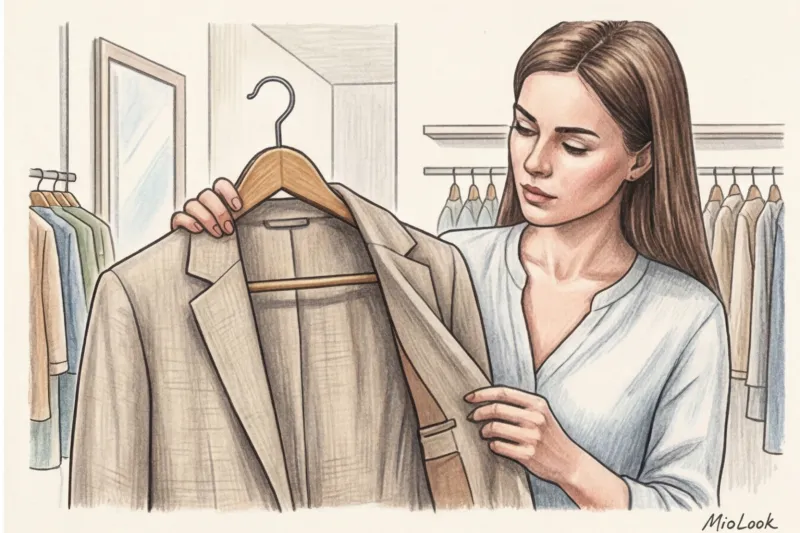
Checklist: 5 Questions to Ask Before Buying an Eco-Friendly Product
Mindfulness doesn't start in the store, it starts in your head. Before you take that green-tagged item to the checkout, ask yourself these five questions:
- Is the item made of a single material (or the right blend)? Look for 100% cotton/wool or acceptable blends (up to 5% elastane).
- Will I be able to wear this at least 30 times? The famous #30wears rule. If the answer is "no, it's only for one party," refuse the purchase or rent the item.
- Is the eco-friendliness certified (GOTS, Oeko-Tex)? Or is it just marketing text on craft cardboard?
- Do I know how to take care of it? A wool sweater will require hand washing. If you know you'll be throwing it in the washing machine at 60 degrees, it will be ruined, negating its eco-friendliness.
- Does this fit into my capsule? The least eco-friendly item is the one hanging in the closet with a tag. Check through MioLook smart wardrobe , does this top go with at least three bottoms from your base.
Greenwashing exists only because brands prey on our haste and lack of knowledge. Carefully reading product labels, understanding the difference between polyurethane and natural fabrics, and avoiding impulse purchases deprives marketers of their main weapon. Choose quality, not catchy slogans—that's where true style lies.