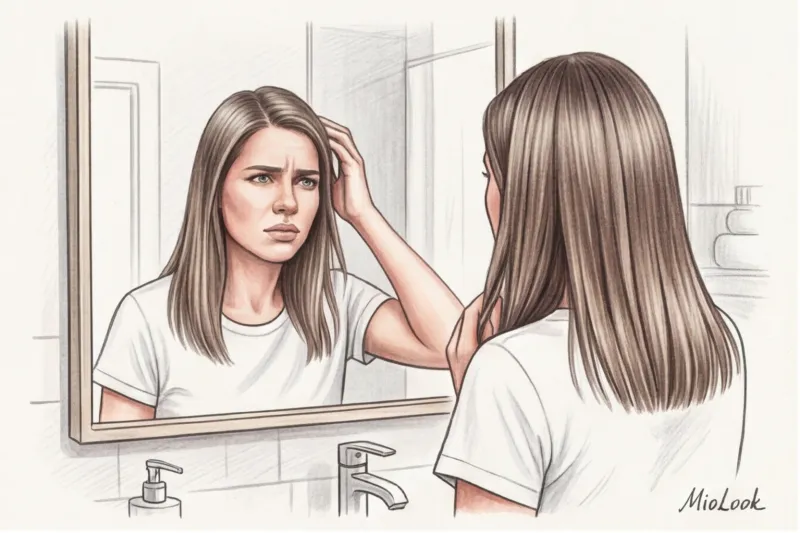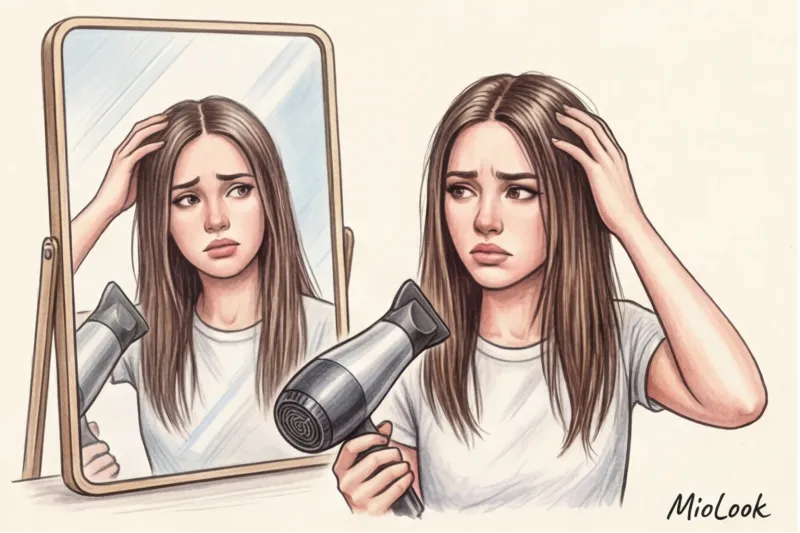
One day, a client came to me with a massive makeup bag, brimming with "heavy luxury" hair products. It included nourishing shea butter masks, thick leave-in creams, and thick oil serums. She genuinely couldn't understand why her fine hair looked like lifeless icicles just an hour after a thorough brushing. And you know what we did? We threw away 80% of her arsenal. Because caring for fine hair isn't about "nourishment" and "hydration." It's about pure physics, strength of materials, and defying gravity.

As a textile expert, I often use a simple analogy: you wouldn't wash a fine silk blouse with a harsh detergent for coarse sheep's wool and then douse it with conditioner? The same principle applies to hair. We discussed the architecture of a basic routine in more detail in our a complete guide to proper hair care for perfect styling , where we discussed how any hairstyle starts in the shower. Today, we'll apply this knowledge to the most delicate textures.
The Anatomy of Fine Hair: Why Volume Destroys According to the Laws of Physics
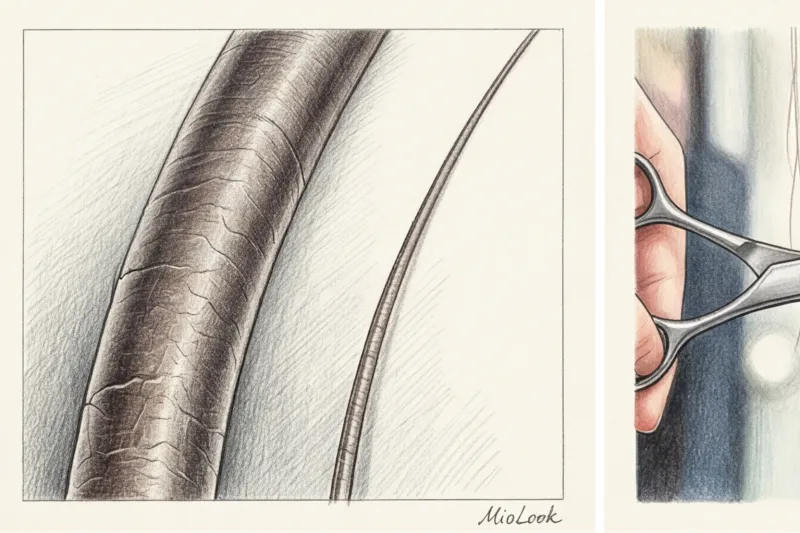
To understand why your volume is disappearing, look at your hair under a microscope. Standard, coarse Asian hair is about 120 microns in diameter. Fine Slavic or Scandinavian hair is only 50 microns, sometimes even less. This means that fine hair physically contains 50% less keratin (a protein) than coarse hair.
Moreover, most fine hair simply lacks a medulla—the internal brain stem that functions like a building's skeleton. Without this core, the hair becomes incredibly soft and pliable. When you apply a standard mass-market hair mask to such hair, a microscopic catastrophe occurs.
Cheap products with heavy polymers and oils leave up to 3-5% of their original weight as a permanent residue on the cuticle. For coarse hair, this smoothing effect is a detriment. For fine hair, it's an unbearable burden that physically pulls the roots down.
That's why no strong hold mousse will save the situation if you've previously applied a heavy base coat. Film-forming agents build up on top of each other, and gravity inevitably wins.
Access to MioLook for €0.99 — one-time payment
A smart AI stylist will select the perfect look based on your individual characteristics.
Get access — €0.99 onceBasic care for fine hair: the "don't weigh it down" rule
My main insight from 12 years of working with style and fabrics is that proper care must be molecular, not superficial. And here we encounter the main pitfall of the modern beauty industry—the trend for sulfate-free shampoos.
Let's be honest: the sulfate-free trend is great for dyed blondes or coarse curls. But for fine, uncolored hair, constant use of mild coco-glucosides is a surefire way to a flat crown. According to research published in the International Journal of Trichology (2022), mild surfactants often fail to completely remove sebum, urban smog, and styling residue. As this film builds up, it dulls hair and robs it of its natural volume.
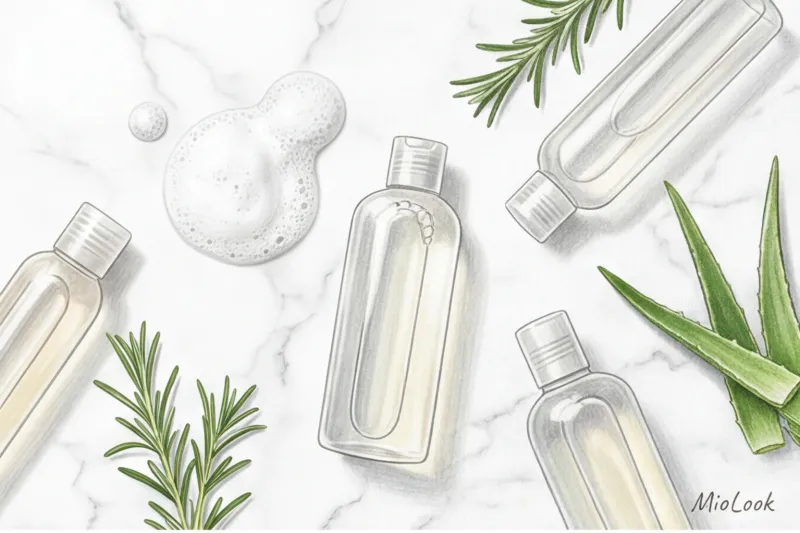
If you live in a region with hard tap water (which includes most large European cities), calcium and magnesium salts also accumulate in your hair. The solution? Invest in a good deep-cleansing shampoo (DCS)—decent options can be found in the €15–€30 range. Use it every two weeks to "reset" the base.
Cleansing: Choosing the Right Surfactants
For daily use, look for shampoos with balance. We need transparent, gel-like textures, not pearlescent, thick creams (pearlescence is often caused by the clouding agent Glycol Distearate, which also settles on the hair).
Washing technique:
Always use double lathering. The first time you break down the sebum, the second time you rinse it away. And the main rule: massage only the root zone A stream of foam running down the lengths will sufficiently cleanse the ends. Fine hair doesn't tolerate aggressive friction along the lengths—its cuticle opens, causing tangling.
Conditioning: The illusion of hydration
The most paradoxical, but working method for very fine hair is the technique reverse washing (reverse washing). First, apply a light conditioner to damp ends, leave it on for a couple of minutes, and then shampoo the roots, rinsing everything out. This protects the hair from surfactants without leaving a heavy film.
Important limitation: This method does NOT work on heavily bleached fine hair (total blonde). This type of hair absolutely requires a classic cuticle seal with an acidic conditioner at the very end of the treatment, otherwise, the hair will simply break off when combing.
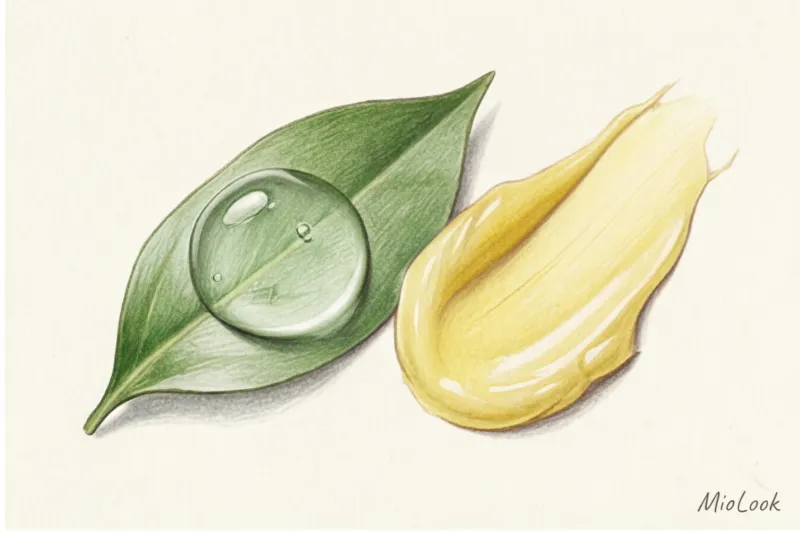
Reading Labels: Ingredients That Save and Kill Fine Hair
I always teach my clients to read clothing ingredients (look for silk, viscose, and heavy cotton), but reading the INCI (International Nomenclature of Cosmetic Ingredients) on shampoo bottles is equally important. You can buy a product for €80, but if it contains the wrong ingredients, it won't work.
Red Flag (Avoid or Minimize):
- Heavy oils at the top of the list: Coconut oil, Butyrospermum Parkii Butter (shea butter), and Castor oil. These have molecules that are too large to penetrate fine hair, instead settling on top as a thick layer.
- Dense silicones: Dimethicone, Dimethiconol (especially if they're listed second or third in the mask's ingredients). This is the real volume cement.
Green light (Looking in the composition):
- Construction material: Hydrolyzed Keratin, Hydrolyzed Wheat/Silk Protein. Hydrolyzed proteins (broken into small fragments) fill the voids in the hair, making it stiffer and denser to the touch.
- Moisturizing without weight: Panthenol, Aloe Barbadensis Leaf Juice, Hyaluronic Acid.
- Volatile silicones: Cyclomethicone, Cyclopentasiloxane. Unlike dimethicone, they coat the hair for easy combing and then evaporate completely during blow-drying, leaving no weight.
By the way, in the app MioLook When we analyze facial geometry and select the ideal haircut, AI always takes hair texture into account. After all, a pixie cut on thick hair and a pixie cut on thin hair are technically two completely different haircuts.
Volume Architecture: How to Dry Your Hair to Keep Your Style in Place
Even if you've washed your hair perfectly with the right shampoo, you can still lose volume during the drying process. There's a rule in textiles: wet fibers are most vulnerable. Wet, fine hair stretches to 30% of its length and breaks easily.
Never rub fine hair with a rough terry towel. The stiff strands of terry cloth catch on the slightly open cuticle, causing it to bulge. The result is frizz instead of smoothness and broken ends. Use a smooth microfiber towel or an old cotton T-shirt, simply blotting away the moisture.
The 80/20 drying rule:
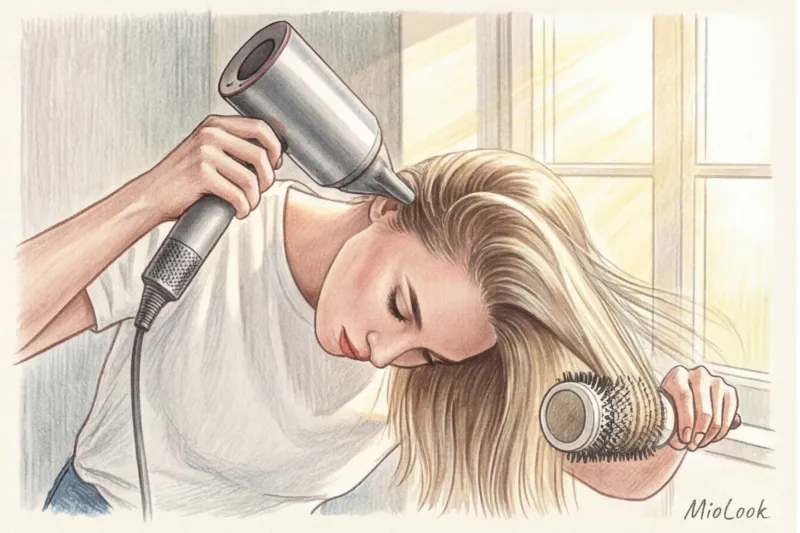
- Dry your hair 80% with your hands (no brush!), with your head upside down or tossing strands from one side to the other. Direct the airflow. strictly against hair growth.
- Only when the hair is almost dry, use a brush (a round brush with a ceramic body) for the remaining 20% of styling and polishing the lengths.
- The secret of endurance: The shape is fixed when the hydrogen bonds in the hair cool. Blow-dried a strand with hot air on a brush? Don't remove it right away! Press the button. Cold Shot (Cool shot) on a hairdryer for 5-7 seconds. Cool and remove. This is the only way to maintain volume at the roots.
Your ideal image begins Here
Join thousands of users who look flawless every day with MioLook.
Get access — €0.99 onceStyling tricks: creating the illusion of thickness
I often recommend to my clients: avoid classic strong-hold hairspray. On fine hair, it sticks strands together, creating a "helmet" effect through which the scalp is treacherously visible.
Instead, we use prestyling—products that are applied to damp hair before blow-drying to alter its texture.
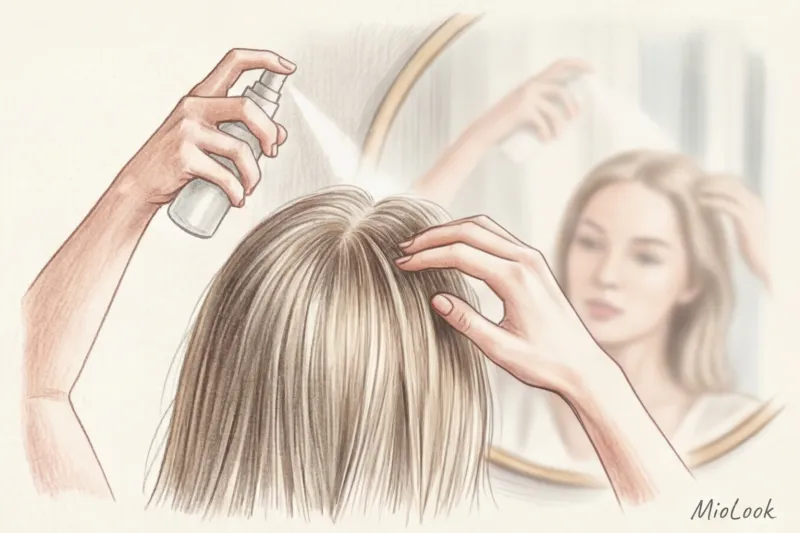
Texturizing and salt sprays They work brilliantly. When the salt dries, it crystallizes on the hair cuticle, making it microscopically rough. Hairs stop sliding over each other and begin to "catch," creating an air cushion. The ideal price range for a good salt spray is €18–€35 (cheaper ones often contain too much alcohol and dry out the skin).
Insider secret of stylists: How to maintain freshness all day long? Most women use dry shampoo on the second day, when the roots are already oily. Famous celebrity stylist George Northwood advises doing the opposite. Apply a light dry shampoo to absolutely clean , freshly dried hair. The talc or rice starch in the formula will sit on clean skin and absorb sebum as it's released throughout the day, preventing hair from falling out.
The Biggest Myths About Hair Care and Volume (Spoiler: You Didn't Do It)
For years, glossy magazines have been rife with advice that is not only useless, but also detrimental to fine texture.
- Myth 1: “Frequent washing will cause even more oiliness and hair loss.”
Reality: Sebum, when oxidized in the air, creates an ideal environment for bacteria and physically weakens the hair follicle. Fine hair can and should be washed as often as it requires—even daily. The key is to use the right mild sulfate shampoo. - Myth 2: “Natural oils will save split ends.”
Reality: This is a counterintuitive insight that's hard for eco-cosmetics enthusiasts to accept. Oils don't contain water. When you apply pure coconut or argan oil to the dry ends of fine hair, you create a hydrophobic film. Moisture from the air can no longer penetrate the hair, and under this layer of oil, the hair shaft slowly but surely dries out, becoming brittle. - Myth 3: “Backcombing is the best way to lift the crown.”
Reality: Brushing against the cuticle literally strips the cuticles of fine hair. A couple of backcombing parties, and you'll be trimming off 5 centimeters of thinning, broken ends. Use volume powder—it creates the same root-strengthening effect, but washes out with regular shampoo without damaging your hair.
Checklist: The Perfect Hair Care Routine for Fine Hair
Let's distill all the theory into a clear, step-by-step plan that you can apply tomorrow morning.
- Preparing the base: We wash our hair twice. We use a clear shampoo. Every 10-14 days, we use a demineralizing shampoo to remove mineral deposits and style.
- Proper hydration: Apply a lightweight conditioner with hydrolyzed keratin (dimethicone-free) starting from ear level and below. Leave on for 2–3 minutes, then rinse thoroughly.
- Gentle drying: Blot (don't rub!) the lengths with a microfiber cloth. Apply a protein or salt pre-styling spray to the roots.
- Architecture: Dry your hair upside down with warm air. Finish with a brush and be sure to pin each strand. Cold Shot for 5 seconds.
- Fixation: Instead of hairspray, spray a little dry shampoo onto clean partings to prevent oiliness.
Fine hair isn't a punishment, it's a luxurious material. Its lightness allows for dynamic, flexible styles that are impossible for those with heavy, thick hair. Stop fighting your natural hair with heavy oils and harsh styling products. Switch to a molecular, "textile" approach without weighing it down, and you'll see your hair retain its perfect volume all night long.