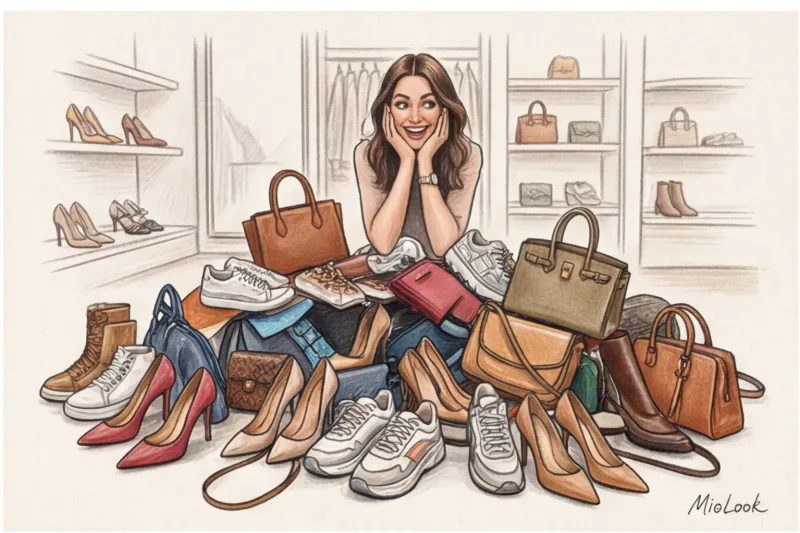
Six months ago, my client Elena came to me in desperation. She was looking for "that one" bag she'd seen in a blurry screenshot from a vintage '90s Vogue editorial. It was the perfect dusty olive tote with an intricate leather weave. We tried searching for "green woven bag," "olive leather shopper," and "khaki weave tote." In response, the marketplace algorithms dumped thousands of nylon string bags, neon green backpacks, and cheap polyurethane knockoffs.
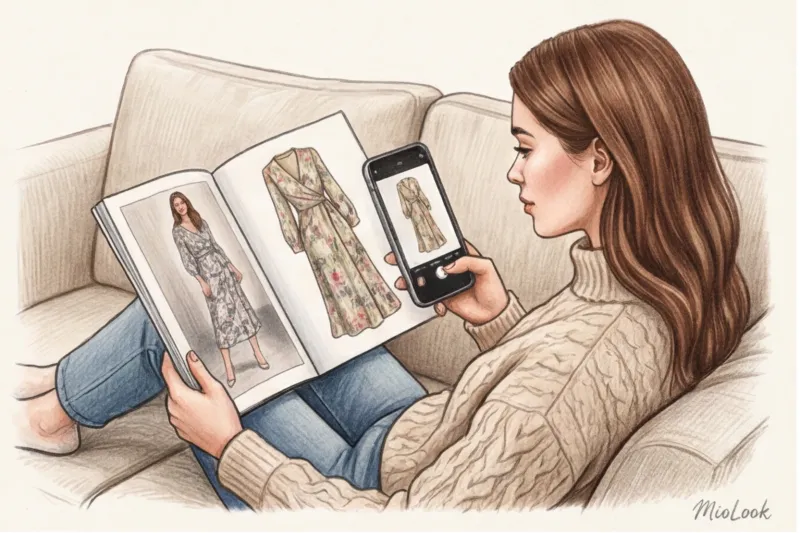
I said, "Stop typing. Let's show them a picture." We uploaded that pixelated screenshot into the visual search system. Exactly three seconds later, a perfect Italian analogue in thick leather appeared on the screen for €240. No logos, with the right handle architecture. We've already discussed the evolution of technology in more detail in our The complete guide to finding clothes by photo , but today I want to look at the most complex and interesting wardrobe category.
As a stylist with twelve years of experience, I can officially say that if you're still trying to find the perfect shoes or a fashionable bag using text queries, you're robbing yourself of time and style.
Anatomy of Style: Why Text Search for Accessories Is Doomed to Fail
Try describing in words an architectural glass heel that curves slightly inward, like a 1950s column. Or the distinctive shade of aged cognac leather with a slight patina. Got it? Now imagine a copywriter describing it in a mass-market product listing. They'll probably just write: "women's brown heeled shoes."
It's precisely because of this gap between a product's actual aesthetics and its verbal description that we spend hours scrolling through catalogs, feeling increasingly frustrated. Retailers' text tags mercilessly limit our choices to primitive categories.
According to a large-scale e-commerce study by the WGSN agency (2024), using visual search increases purchase accuracy in the shoe and bag segment by a phenomenal 37%. The reason is simple: the neural network doesn't read tags; it analyzes the geometry of the item.
The algorithm recognizes the silhouette, the proportions of the hardware, and the depth of color. It understands the difference between the cheap sheen of faux leather and the refined matte sheen of genuine leather. A text search returns thousands of irrelevant options, while image search offers the top 10 exact architectural matches.
Access to MioLook for €0.99 — one-time payment
A smart AI stylist will select the perfect look based on your visual preferences.
Get access — €0.99 onceFind sneakers by photo: from street style to your cart in seconds
Interesting fact: sneakerheads and athletic footwear have become the main catalyst for the development of visual search. When brands release limited collaborations with dozens of micro-shades (colorways), describing them in text becomes impossible.
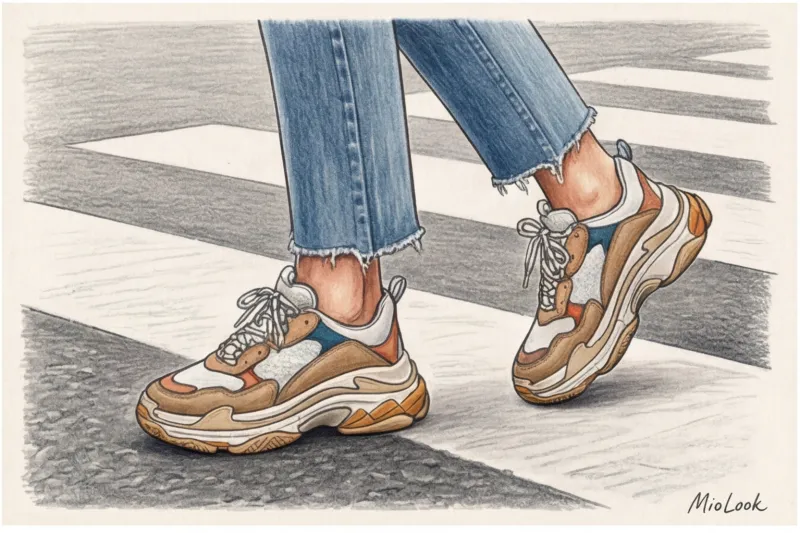
One day, I was scrolling through the street style feed from Copenhagen Fashion Week and spotted a stunning pair of vintage running sneakers on a guest. No logo, no clear name. A smart search query like "find sneakers by photo" instantly identified the chunky ribbed sole and the distinctive geometry of the suede side panels, returning the exact model from the 2010s archives, along with three current models.
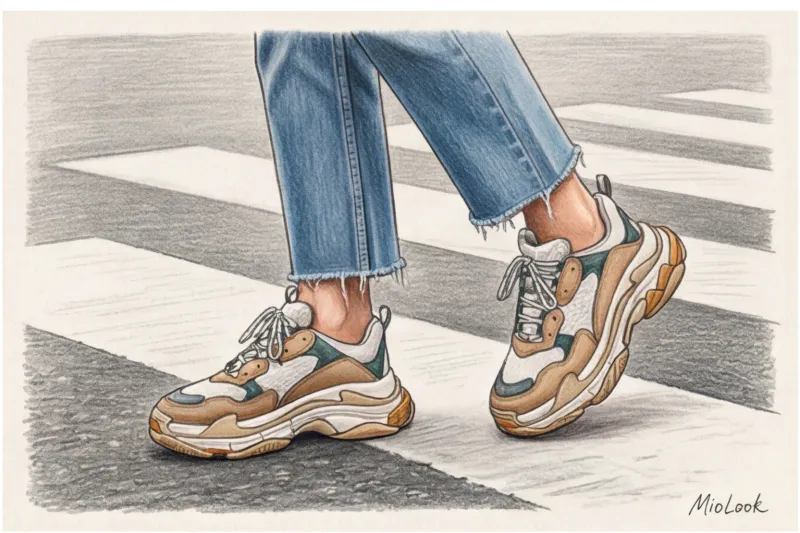
How does it work technically? Neural networks are trained to recognize microdetails: tongue thickness, toe angle, perforations, and even hidden logo textures. You no longer need to know the exact model number.
Putting this discovery into practice couldn't be easier. My favorite formula for the off-season: A basic oversized trench coat + straight-leg jeans in heavy denim (12 oz and up) + those statement sneakers from Pinterest = totally effortless chic..
Hunting for the Dream Bag: How AI Distinguishes Textures and Shapes
While the algorithm looks for panel geometry with sneakers, the real magic of texture recognition begins when searching for bags. Artificial intelligence has learned to brilliantly distinguish cheap reptile-like embossing from expensive smooth nappa or grained calfskin.
For status accessories, form is always more important than brand. The rigid, architectural frame of a tote (when the leather is at least 1.5 mm thick and maintains its shape even when empty) conveys poise and authority. Meanwhile, the soft, relaxed shape of a hobo bag conveys bohemianism and creative freedom.
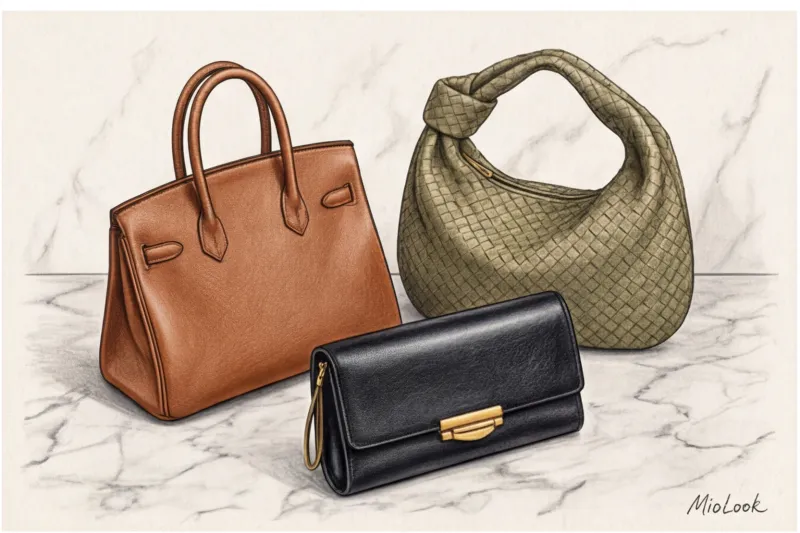
When you upload a photo of your dream bag from The Row or Bottega Veneta for €3,000, smart search analyzes the proportions of the handles relative to the body of the bag and the matte finish of the hardware. As a result, you don't get a Chinese knockoff with crooked seams, but high-quality analogs from local European brands. For more information on which shapes are investment-attractive, I recommend reading our article about essential bags for all times.
Stylist Secrets: How to Prepare Photos for the Perfect Search
The tool only works flawlessly if you know how to provide it with the right input. As a practicing image consultant, I run dozens of references through visual search every day. Here are the key rules that will save you from disappointment.
Framing, Lighting, and Background
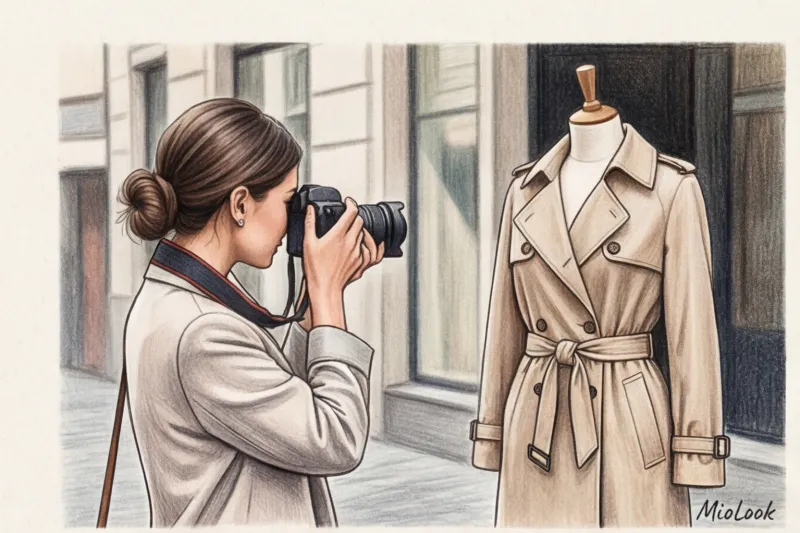
Never upload a full photo of a person if you're only looking for a bag. Be sure to crop the image to include only the desired item. If the background is a colorful coat or a brightly printed dress, the algorithm may try to find something with a similar pattern.
This is where the main thing lies limitation Visual search. It works extremely poorly with glossy patent leather photographed with a flash. The algorithm often interprets reflections of light on patent leather shoes as white accents or metal hardware. Always try to find shots with matte, diffused lighting.
Angle matters: the profile of the shoe and the full face of the bag
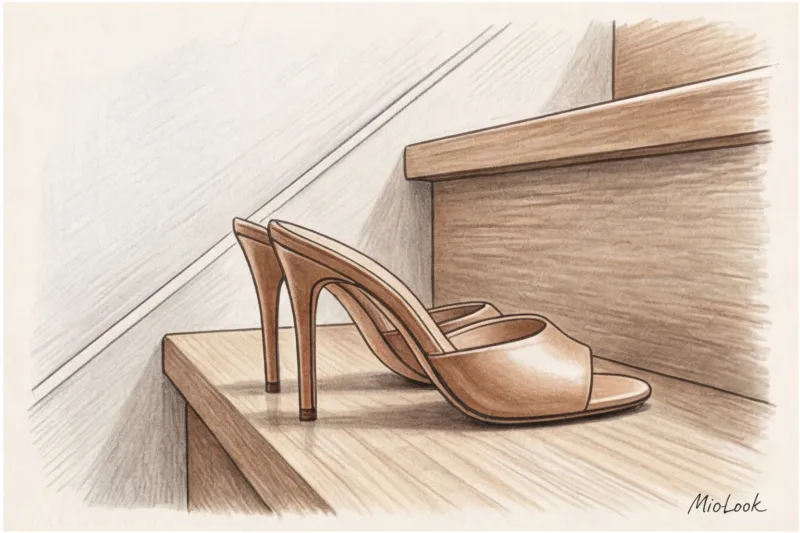
The most common mistake my clients make is trying to find shoes from a photo taken from a top-down perspective (from a "looking at your feet" perspective). In this position, the AI only sees the toe of the shoe.
The architecture of the shoe last, the height and shape of the heel, the curve of the instep - all of this is readable only strictly in profile or at an angle of 45 degrees Bags, on the other hand, are best recognized from a frontal view, so the neural network can assess the proportions of the flap and the placement of the buckles.
Your perfect look starts here
Join thousands of users who look flawless every day with MioLook. Upload photos and find the perfect combination.
Get access — €0.99 onceDebunking the Myth: "Visual Search Is Only for Finding Cheap Copies"
There's a persistent, yet fundamentally incorrect, stereotype in the industry. Many people think image search is only for uploading a photo of a Prada bag to AliExpress and getting a cardboard replica for €15. This is a terrible misconception.
Modern stylists use AI for the opposite purpose—for intelligent hunting. My goal is to find not a fake with a counterfeit logo, but the so-called dupe (high-quality analogue) in the middle segment.
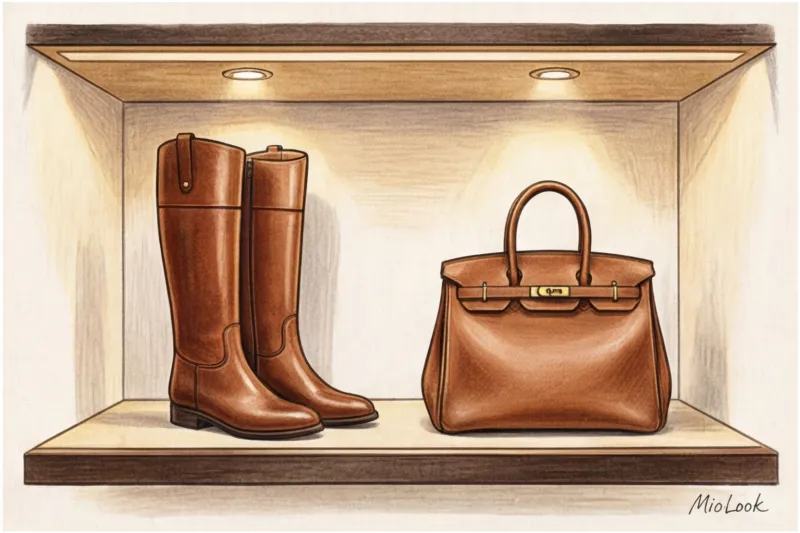
For example, you've fallen in love with minimalist Loro Piana loafers. By conducting a visual search across premium multi-brand platforms, you'll easily find shoes with an identical suede texture and perfectly shaped almond toe from Italian artisan brands in the €150-€250 range. You're paying for the aesthetics and the architecture of the last, not the letters on the insole.
It's also the best tool for vintage shopping. By uploading photos of archived 90s collections to resale platforms, you can find unique pieces that are long out of production.
Smart Shopper's Checklist: A Visual Search Algorithm for Shoes and Bags
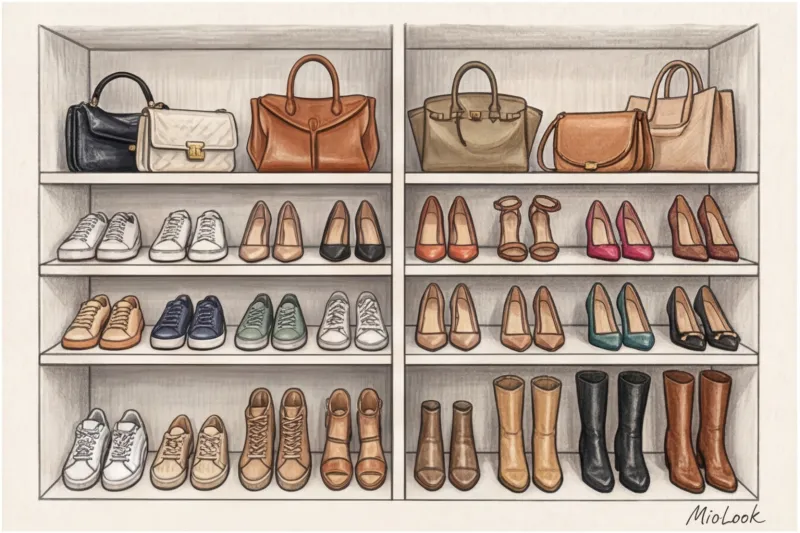
To ensure the process produces real results, not just images for inspiration, I developed a step-by-step algorithm for my clients.
- Step 1: Correct source. Find a photo with the highest resolution possible. If it's a screenshot from an Instagram video, try to capture a frame without motion blur.
- Step 2: Focus on detail. If your shoes have a complex heel or your bag has an unusual clasp, make sure that this particular detail is clearly visible and cropped.
- Step 3: Smart filtering. Once the algorithm returns results, immediately enable text filters. Eliminate faux leather, set a comfortable price range (for example, from €80 to €300), and select the desired brands.
- Step 4: Wardrobe analysis. Don't buy something just because it looks like a reference. Take a screenshot of the pair you find and upload it to the "smart wardrobe" feature of the MioLook app See if this shade of burgundy pairs with your favorite fall coats.
Accessories That Change Everything: Integrating Finds into Your Wardrobe
In the Mediterranean style school I gravitate toward, there's an ironclad rule: your clothes can be as simple as possible, but your shoes and bag must be impeccable. Well-fitting jeans and a crisp white T-shirt made of heavy cotton are a great canvas. But it's the right accessories that transform this canvas into a masterpiece.
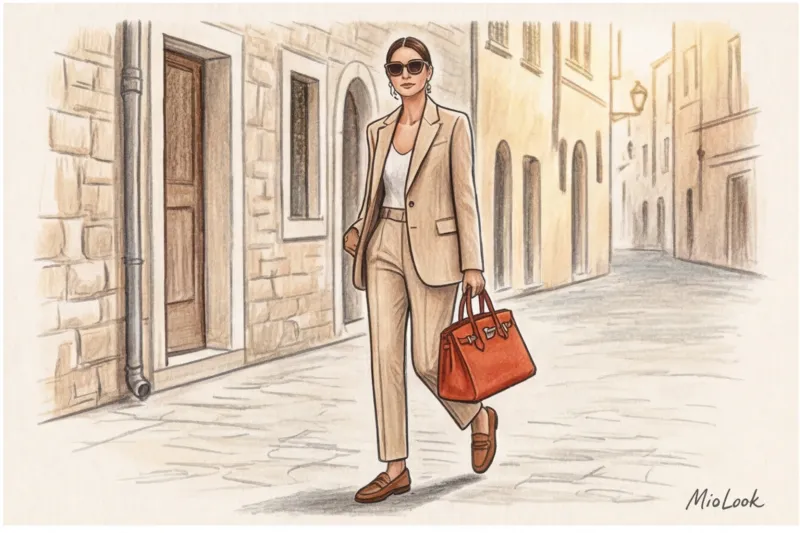
One perfectly chosen pair of structured loafers or a graphic baguette bag can update and elevate 10 of your old looks. You don't need to completely change your wardrobe every season—just introduce the right accents with the right architecture.
Stop endlessly scrolling through catalogs in search of a miracle. Go to your saved folders on Pinterest or Instagram right now. Choose that unattainable bag or pair of shoes you've been dreaming about for months, crop out the excess background in the photo, and upload it to the visual search. Let technology do the routine work, leaving you with the pure joy of perfect style.