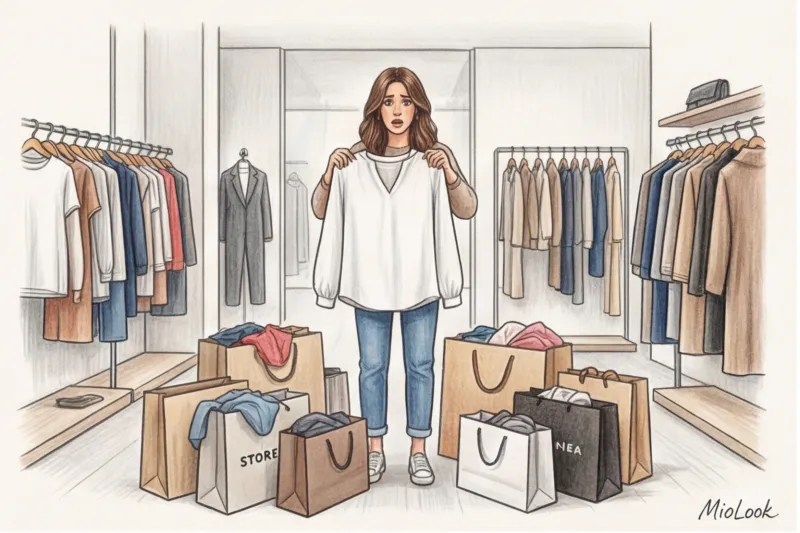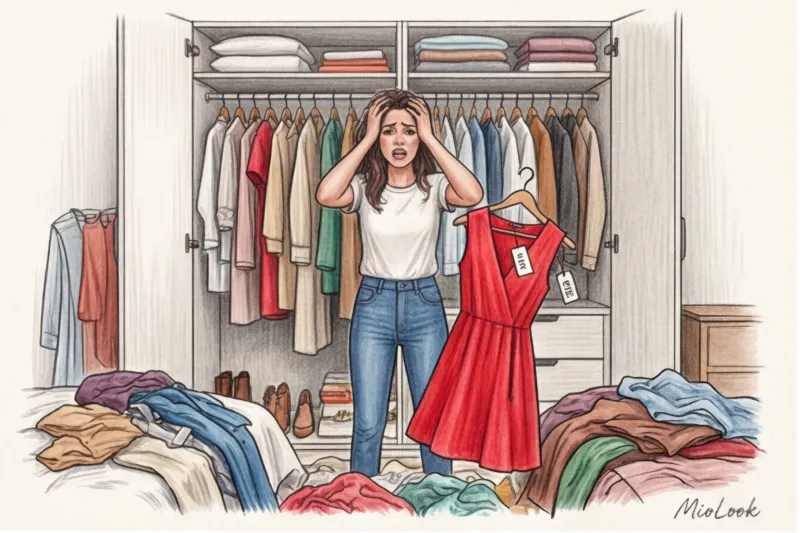
Let's be honest. Have you ever found an item of clothing deep in your closet, still with the tag intact, bought six months ago? That sequined skirt or intricately tailored top that, in the dimly lit fitting room, seemed like a ticket to a new, incredibly stylish life. And then they just sat on the hanger because there were no suitable shoes or occasions to wear them.
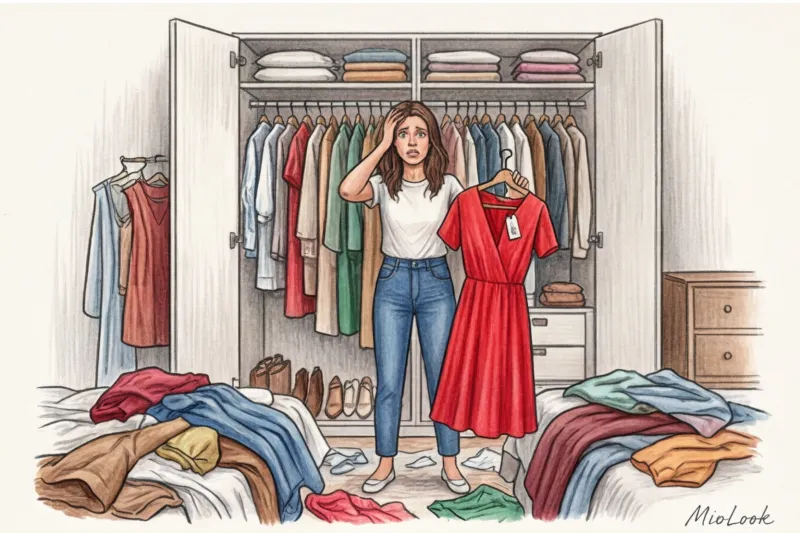
If your answer is "yes," you're not alone. The advice to "just control your spending and make lists" is hopelessly outdated. Emotional shopping can't be overcome with dry, rational budgeting. Over 14 years of working as an image consultant, I've realized that shopaholism isn't cured by iron willpower, but by a more powerful visual argument. This is where the "shopaholism" comes into play. digital wardrobe — shopping with it turns from an impulsive lottery into a targeted investment. We've already discussed the architecture of this process in more detail in our guide. Digital Wardrobe: How to Solve the "Nothing to Wear" Problem , and today we'll talk about how technology is breaking the dopamine loop of thoughtless spending.
The Psychology of Impulse Shopping: Why We Buy Things We Don't Wear
According to the international organization WRAP (Worldwide Responsible Accredited Production), the average woman goes unworn about 70% of her closet contents in a year. Why do we continue to buy clothes while ignoring what we already own?
The answer lies in neuroscience. Behavioral psychology research proves that the brain gives us a generous dose of dopamine (the hormone of anticipation and joy) precisely when at the time of payment at the checkout Or clicking the "Place Order" button. Nature didn't engineer us with a reward mechanism for later ingeniously styling that item with three different pants. The brain has received the reward—the process is complete.
The second trap is shopping for the "fantasy self." We work remotely in cozy joggers, but we continue to buy formal jackets or evening dresses because subconsciously we're buying not the fabric, but a lifestyle.
"We suffer from wardrobe blindness. The human brain is physically incapable of holding 150-200 items of clothing in its working memory. What you can't see right now simply doesn't exist in your consciousness."
This is why the Pareto principle works flawlessly: 80% of the time we wear the 20% of the things that are in plain sight.
Digital Wardrobe: Shopping on a New Level Without the Emotional Breakdowns
"Visual sobriety" is a term I use in my consultations. It's the translation of your intuitive, often chaotic, choices into a systemic one.
In my practice, impulsive spending problems are identical among clients with dramatically different income levels. One of my clients, a top manager at an IT company, complained that she had nothing to wear to a specialized conference. When we began our audit, we discovered five (!) nearly identical basic white T-shirts and a luxurious fuchsia statement jacket in her closet. There wasn't a single matching bottom—no structured trousers, no skirt in the right shade—to go with the jacket. She kept buying T-shirts (because "you always need basics") and bright tops (to set the mood), creating huge "blind spots" in her wardrobe.
Access to MioLook for €0.99 — one-time payment
A smart AI stylist will choose the perfect look for you and help you digitize your closet.
Get access — €0.99 onceA catalog of things as a personal "stop signal"
When you move your things in wardrobe management app , you enable a powerful analytical tool. law of compatibility: If a potential update doesn't fit into 3-4 looks with your current catalog, it remains hanging in the store.
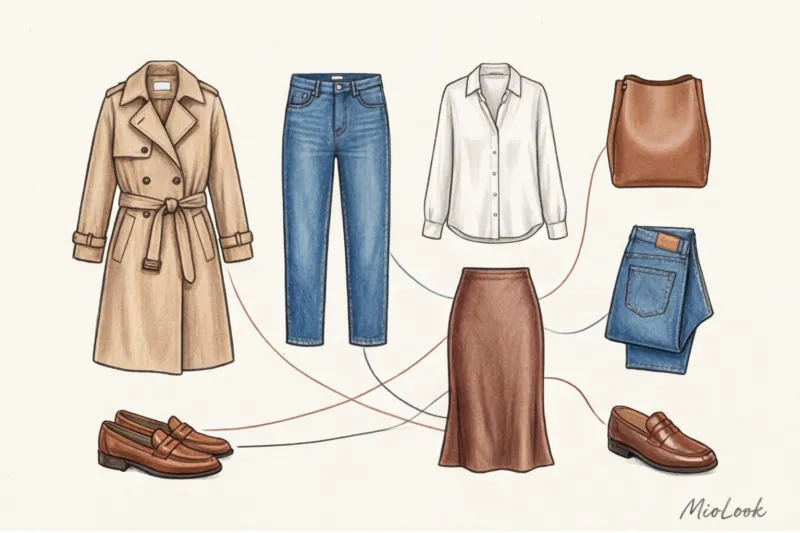
Visual incompatibility is sobering. You look at your phone and see for yourself: that stunning tweed top doesn't go with your favorite wide-leg jeans or your office skirt. The illusion dissipates.
Virtual fitting room: test drive items before paying
As a certified colorist, I always warn my clients about the pitfalls of store lighting. Warm halogen bulbs in boutiques or the harsh, cold light in high-street stores (like Zara or H&M) can dramatically distort undertones.
You might think you're buying the perfect cool taupe sweater. But when you get home, you discover it looks a dirty yellow next to your favorite graphite pants. The virtual fitting room allows you to "match" a photo of the item from the online store with real photos of your belongings.
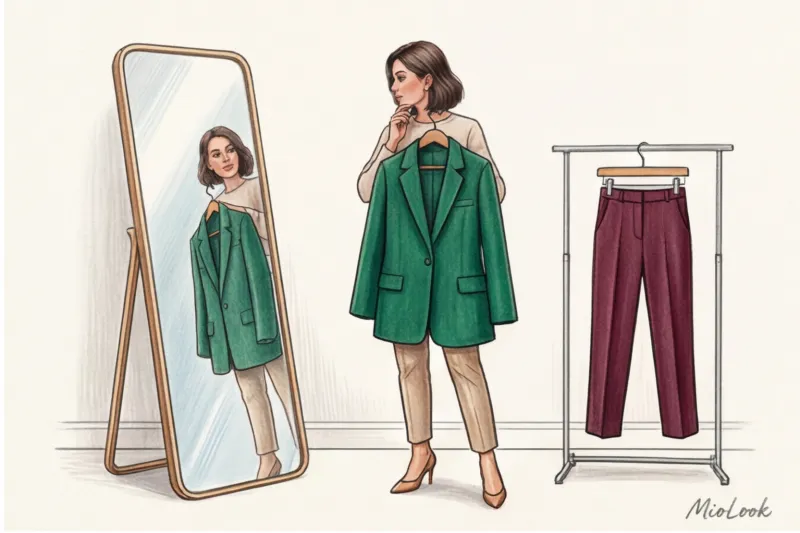
Artificial intelligence helps evaluate not only color but also the clash of textures and proportions. Taking a moment to virtually assemble a collage is critical—it reduces emotion and refocuses your thinking.
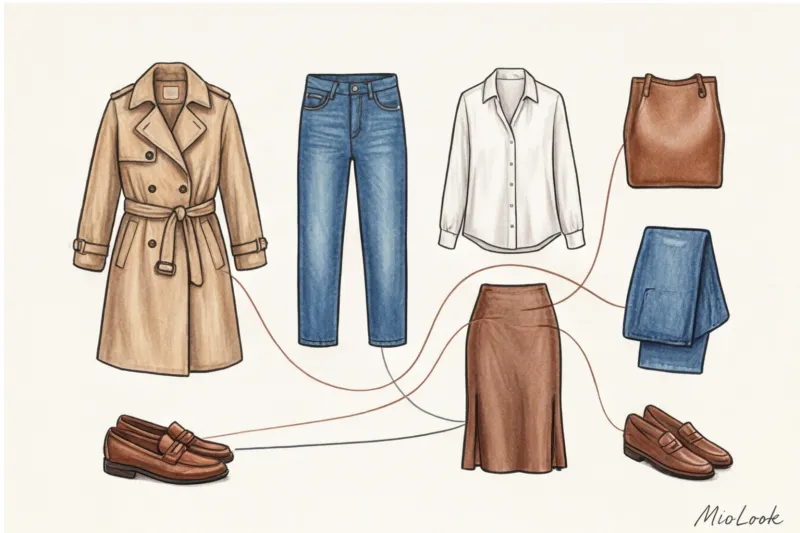
Fair Limit: Should you completely trust a virtual fitting? No. It won't convey tactile sensations. AI won't tell you that that stunning acrylic sweater in the photo will squeak unbearably and become staticky. So, a digital fitting is a filter for stylistic errors, but the quality of the fabric You need to choose in person or by carefully reading the ingredients.
Style Mathematics: Calculating Cost Per Wear in a Digital Catalog
Why might a €200 cashmere sweater be more affordable than a €15 cotton T-shirt? The secret lies in the Cost Per Wear (CPW) formula—the price per garment.
Let me give you a real-life example with calculations from a recent case study. My client bought a striking silk blouse with a vibrant floral print on sale for €150. She wore it exactly once a year, to a corporate event. The CPW was €150. At the same time, she wore basic straight-leg jeans in heavy denim from Agolde for the same €150 at least twice a week for the entire year (about 100 times). The CPW of the jeans was €1.50.
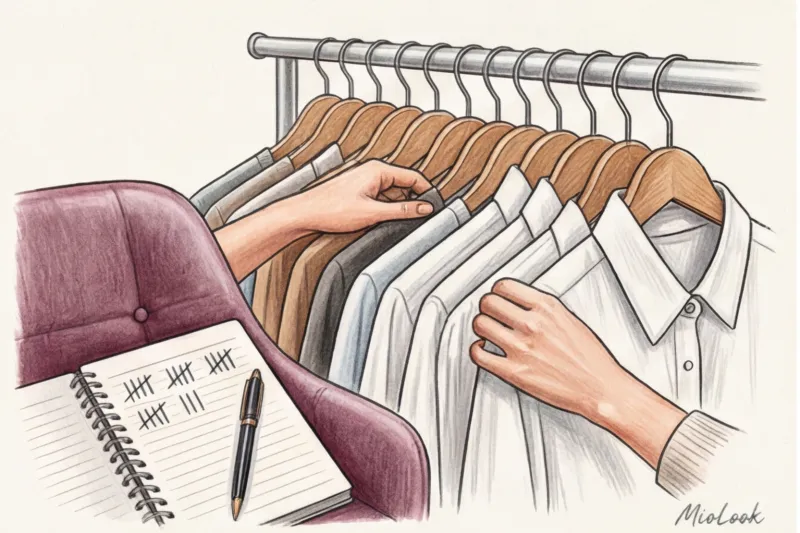
When you track your looks in the app, you stop fooling yourself. The catalog automatically shows the real return on your purchases, shifting the focus from one-time purchases. prices for the long term value.
Your perfect look starts here
Join thousands of users who look flawless every day with MioLook. Digitize your closet today.
Get access — €0.99 onceChecklist: 5 Steps to Mindful Shopping with a Digital Wardrobe
Save this algorithm for your next shopping trip or online surfing trip. These 5 steps take exactly 5 minutes but can save you tens of thousands of euro:
- Step 1: Check your wish list against the digital database. Check if you already have something similar. The gray cardigan from Massimo Dutti is wonderful, but you already have two similar ones from Uniqlo.
- Step 2: Collect virtual images. Can you, right now, standing in the fitting room, create 3 outfits in the app with this item for your REAL life (and not for an imaginary vacation in Portofino)?
- Step 3: Check for weak links. Do you have the right shoes and outerwear? Chunky knit sweaters often remain in the closet simply because they don't fit through the tight sleeves of your favorite coat.
- Step 4: Evaluate color matching. Does the new item fit into your seasonal palette and current wardrobe temperature?
- Step 5: The 24-Hour Rule. Take a photo of the item on yourself, add it to your digital catalog's Wishlist, and leave the store. If you can still justify the purchase the next day, come back. Spoiler: you won't return for 80% of the items.

The myth that digitization is “too long and complicated”
"Dasha, I work 10 hours a day; I don't have time off to photograph my entire closet!" is the most common objection I hear. And it's true: if you try to photograph 300 items in one sitting, you'll burn out on the twentieth T-shirt.
But the reality is: you don't need to digitize everything at once. Start with the current season. Select 15-20 favorite items you're wearing right now. 40 minutes spent on these will save you tens of hours of aimless shopping and mornings spent stumbling in front of your open closet.
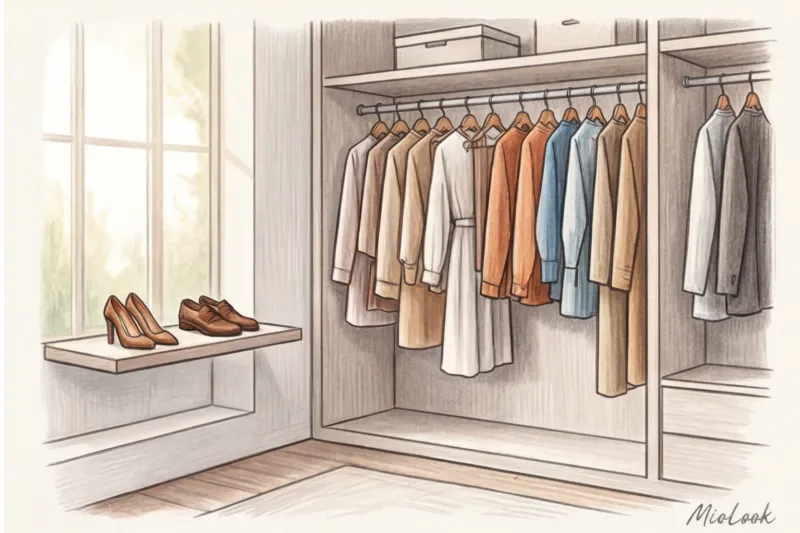
Moreover, this process has a hidden benefit. Sorting and digitizing have a powerful therapeutic effect. You pick up each item, assess its condition (is there pilling here, is the collar stretched there) and honestly admit to yourself: does it reflect the you you are today?
Bottom line: Your wardrobe should work for you, not for the stores.
Modern technologies, be it MioLook virtual fitting room or simply a meticulously curated photo catalog on your phone, they give us back control. Control over our decisions, our style, and our budget.
A crucial paradigm shift occurs. You stop seeking dopamine in the endless pursuit of "something new" at sales. Instead, you begin to enjoy creating complex, layered, stylish combinations from what's already hanging in your closet. Confidence comes not from the number of items with tags, but from a clear understanding of how to manage your image.
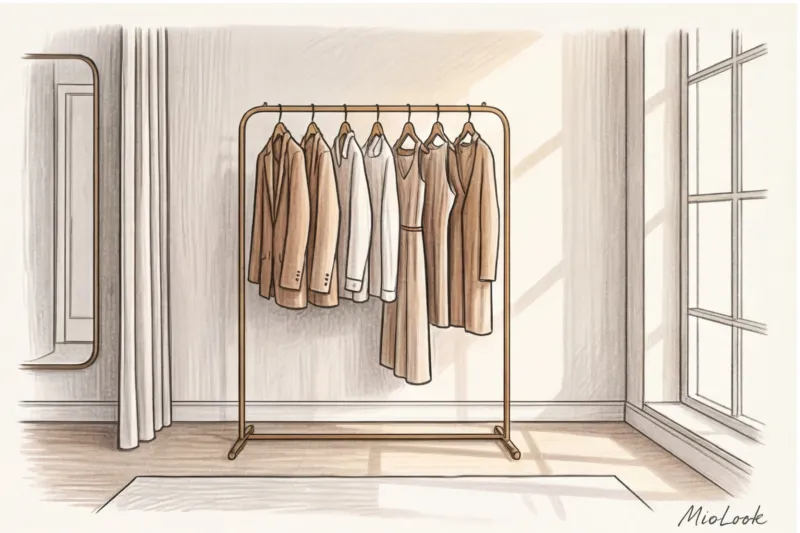
Take the first step today: take photos of 10 of your favorite, most reliable pieces. Upload them to the catalog. And the next time you reach for the "Buy" button, just open that folder. Chances are, you already have something to wear.