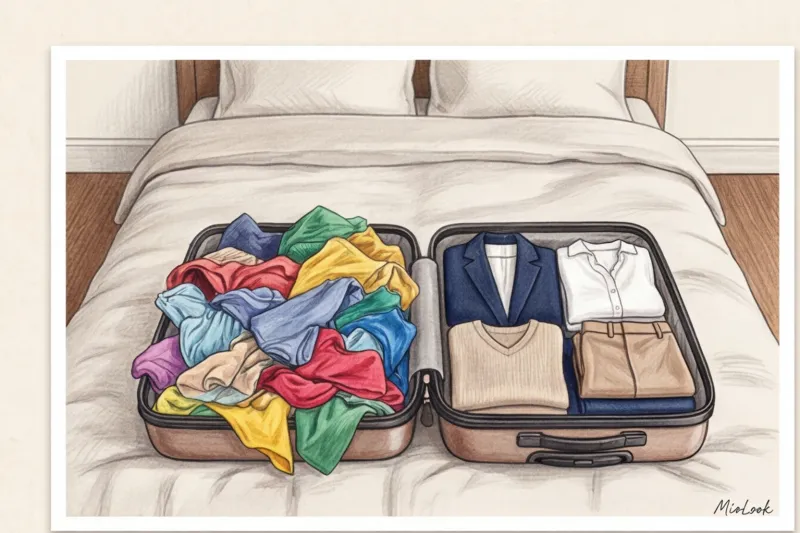
In my 12 years as a personal stylist, I've seen hundreds of luxurious closets overflowing with items. But one case in particular stands out. My client, a top manager at a large company, regularly took 20 kilograms of luggage—five impeccable Massimo Dutti jackets and three pairs of stiletto pumps—on short, three-day business trips to Berlin. Why? Purely out of fear of "what if she needs it?" This chaos, which cost her nerves and excess baggage fees, only ended when we introduced this into her routine. calendar of images We discussed the psychology of endless packing in more detail in our complete guide: Travel wardrobe planning app | MioLook.
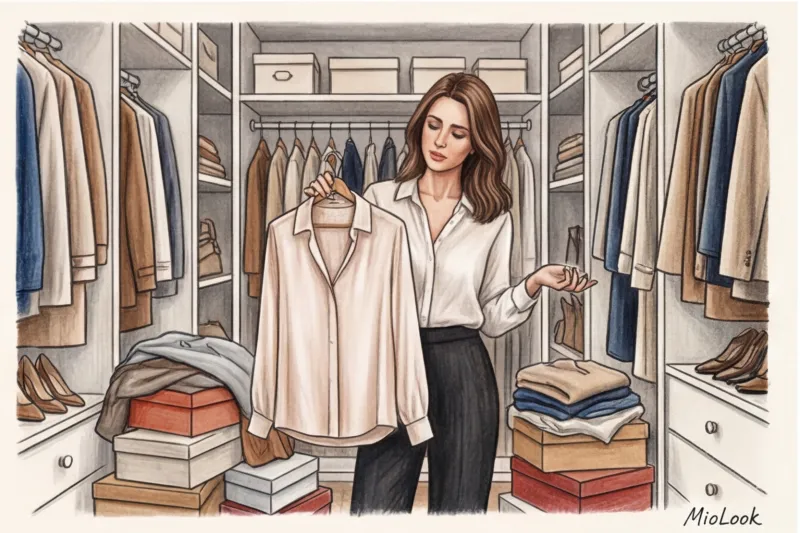
Today, I want to go further and show you why digitizing your closet isn't just a utilitarian organizer. It's a powerful psychological tool and a ruthless financial scanner that shatters illusions, calculates the true value of luxury items, and cures the syndrome of postponed living once and for all.
The Illusion of Choice: Why a Full Closet No Longer Works
In 1998, social psychologist Roy Baumeister coined the term "decision fatigue." His research demonstrated that our brains have a limited amount of volitional decisions per day. The stress of spending 15 minutes in front of your closet choosing between a silk blouse and a heavy cotton shirt literally eats away at your cognitive resources—the very same resources you'll need an hour later at a board meeting.
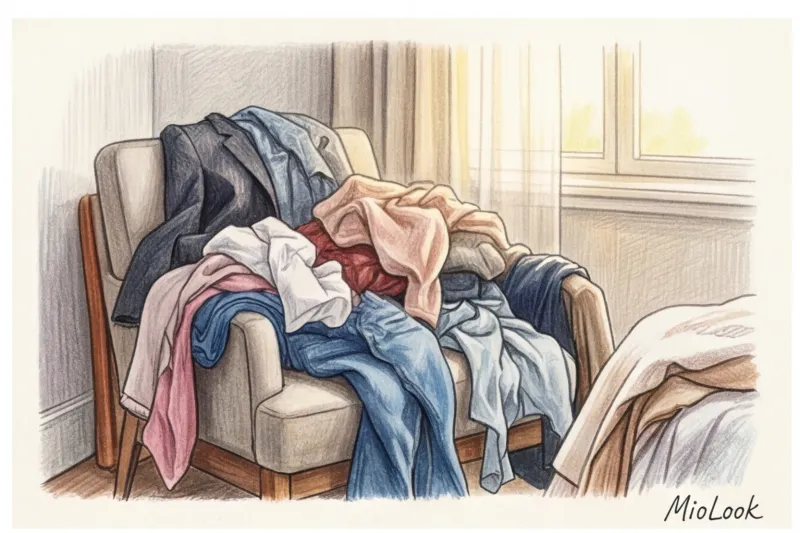
Have you ever noticed a gap between the clothes you wear in your "imaginary life" and your reality? We buy luxurious lingerie-style slip dresses for hypothetical social events, but live a busy schedule of Zoom calls, coffee runs, and business lunches. It's a classic paradox: your wardrobe is bursting with silk and sequins, but you have nothing to wear on a rainy Tuesday.
Without digitizing your habits, it's impossible to beat the Pareto principle in your wardrobe: 80% of the time, we wear only 20% of our favorite items. The remaining 80% of your budget hangs forlornly on hangers, waiting for a "special occasion" that never comes.
Access to MioLook for €0.99 — one-time payment
A smart AI stylist will select the perfect look based on your schedule and weather.
Get access — €0.99 onceWhat is a digital image calendar and how is it a game changer?
A connoisseur's eye glides over individual items: "What a beautiful cashmere turtleneck!" A stylist's eye evaluates strategy: "What from the current capsule will this work with, and where can I wear it?" The transition to a digital calendar is a leap from warehousing to management.
When you use Smart planning features in MioLook , you begin to see the whole picture of the week. The app takes into account your dress code, weather forecast, and meeting schedule. Moreover, the calendar instantly highlights the problem of wardrobe "cloning." One of my clients genuinely believed she had nothing to wear until we uploaded her database to the app and discovered five absolutely identical black turtlenecks from COS and Zara. The calendar makes such blind spots obvious.

The difference between a smart calendar and a simple photo gallery of things
Many people try to simply take photos of things on their phone and create a "Looks" folder. It doesn't work. A smartphone gallery is a warehouse, while a calendar is a streamlined logistics system. Photos aren't tied to your schedule. You can't filter a phone folder by the tag "brunch with friends +15°C." A digital calendar, on the other hand, integrates specific looks for specific events, turning a fabric collection into a personal branding tool.

The Mathematics of Style: How a Style Calendar Reduces the Real Cost of a Wardrobe
There's a golden rule for financial planning an investment wardrobe: the Cost-Per-Wear (CPW) formula. To find the actual price of an item, divide its retail price by the number of times you've worn it.
Let's do the math. One of my clients purchased a luxurious double-breasted cashmere coat from Max Mara for €3,000. Without planning, she would wear it maybe five times a season on "special occasions" (CPW = €600 per outing—a whopping amount!). By implementing a look calendar, we created 12 different outfits with this coat: from formal office outfits with pantsuits to relaxed weekend outfits with jeans and a hoodie. She wore the coat 50 times over the course of the season. The actual cost per wear dropped to €60. That's how an item becomes an investment.

On the other hand, fast fashion often turns out to be a financial black hole. A trendy €50 top, worn once for a photo and then washed to a dull finish, has a CPW of €50. Paradoxically, a classic Hermès bag, worn regularly for decades, is mathematically more profitable than a quick purchase. Tracking your wear in the app is ruthless—it clearly shows which expensive investments are gathering dust and which are worth every penny.
Your perfect look starts here
Join thousands of users who look flawless every day with MioLook. Digitize your wardrobe and start reducing your cost-per-wear.
Get access — €0.99 onceThe "What if" Effect: How a Calendar of Looks Saves You from Carrying on Excess Baggage
Let's return to the client with the 20-kilogram suitcase for three days. According to a 2023 global travel industry study, 62% of travelers never wear half the clothes they pack. The psychology of packing is deceptive: we pack not clothes, but our fears of unforeseen situations.
This fear literally comes at a price. European low-cost airlines' overweight charges are merciless: fines range from €40 to €80 per kilogram. It's a hidden tax on lack of planning.

Modular travel planning is a game-changer. Using the app, you create a mini capsule for four days. You see that the same straight-leg jeans work with a jacket for the plane and a silk top for an evening dinner. You fly with carry-on luggage only, maintaining elegance and class because each outfit is mathematically tailored to your schedule.
The Surprising Truth: The Myth That Planning Kills Creativity
The most persistent stereotype I regularly encounter is: "Rigidly planning my outfits will kill my individuality and spontaneity! I want to dress according to my mood." It sounds great, but in practice, that morning "creative burst" 15 minutes before heading out usually ends with the usual blue jeans and a favorite, but now faded, gray sweater.

Here's a counterintuitive insight from the world of high fashion: the most stylish influencers, Vogue editors, and street style icons are absolute meticulous. They try on and photograph their multi-layered looks in advance.

True creativity (for example, a bold pairing of a vintage lace skirt with a voluminous men's jacket) only emerges within a system. When the basic structure of your wardrobe is already laid out in your calendar, your brain doesn't waste energy searching for a clean, basic T-shirt. This freedom, through discipline, gives you the resources to add a statement belt, chunky jewelry, or bold shoes.
Incorporating a Look Calendar into Your Routine: A Stylist's Checklist
I always give a fair warning: the digital calendar method doesn't work for everyone. If you're a perfectionist and try to take notes on 150 items in your closet in one evening, you're guaranteed to burn out and delete the app. You need to be strategic.
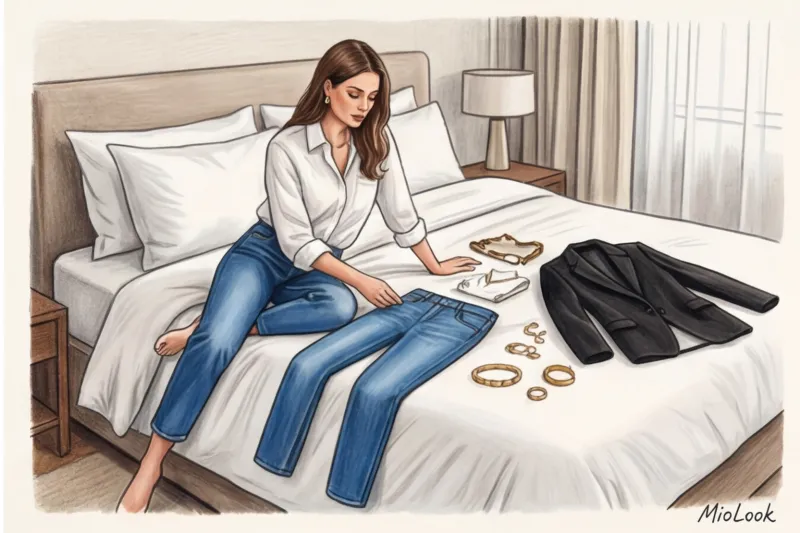
Here's a proven step-by-step algorithm that I give to my clients:
- Step 1: Digitizing the core. Don't take photos of your entire closet. Photograph just 15-20 key basic items that you wear most often (perfectly fitting pants, the right jackets, basic tops).
- Step 2: Planning the Golden Three. In the app, you can create three ideal, 100% effective images for your most common life scenarios (for example: office, walk with children, dinner at a restaurant).
- Step 3: Sunday ritual. Set aside exactly 15 minutes on Sunday evening. Brew some tea, open the app, and organize your looks into the days of the coming week, taking into account your appointment calendar and the weather.
- Step 4: Monthly audit. At the end of the month, check your statistics. If your luxurious pleated skirt hasn't made it onto the calendar within 30 days, it's time to admit your mistake and resell it.
Ready to get started?
Try the free plan—no commitments required. Create your "Golden Trio" of looks today.
Get access — €0.99 onceSummary: Invest in real life, not fantasy
A digital lifestyle calendar is an honest reflection of your real lifestyle. It ruthlessly dispels illusions, showing that you don't need a tenth evening dress if 90% of your time is spent in the office and on business flights. This digital awareness naturally leads you to buy less, but choose things of a fundamentally different, higher quality.
Don't save your style for a "special occasion." Your life is happening right now. Open the app tonight and create one perfect, meticulously planned look for tomorrow morning. You'll be surprised how much confidence and energy those 15 minutes saved will give you.