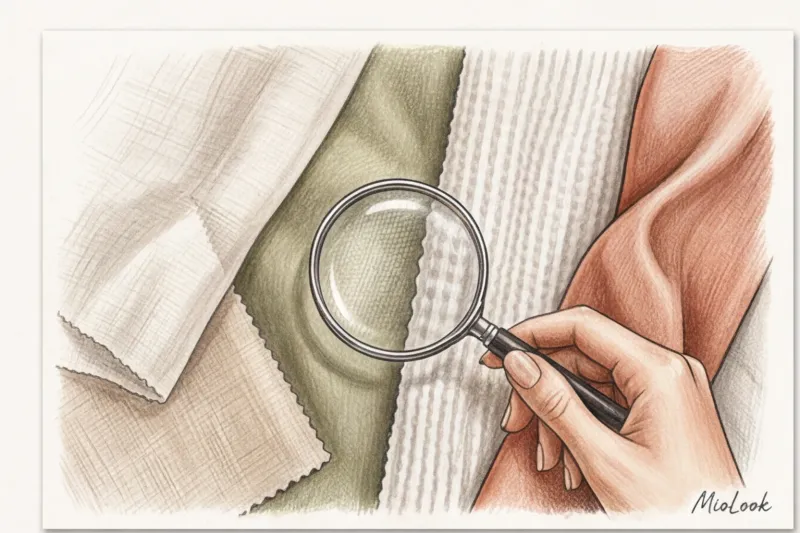
When my client flew to Singapore—a city where the humidity approaches 100% year-round and the temperature rarely drops below 33°C—she made the classic mistake of all temperate climates. Her suitcase consisted of short denim shorts, linen crop tops, and tight tees. Two days later, she texted me from her air-conditioned hotel room with sunburn, heat exhaustion, and chafed thighs. Her instinct was that the hotter it was outside, the more she needed to undress. But in extreme climates, this rule works exactly the opposite.
Over 14 years of working as a stylist, I have put together hundreds of vacation capsules and I can confidently say: the right clothes for a hot climate are not a question of How many what you're wearing, and that one, How This is sewn and what it consists of. I talked in more detail about the universal rules for gathering in our The complete guide to creating a vacation capsule , but today we'll be taking a closer look at a wardrobe for a real fire.
The Anatomy of Cool: Why 'Just Cotton' No Longer Works
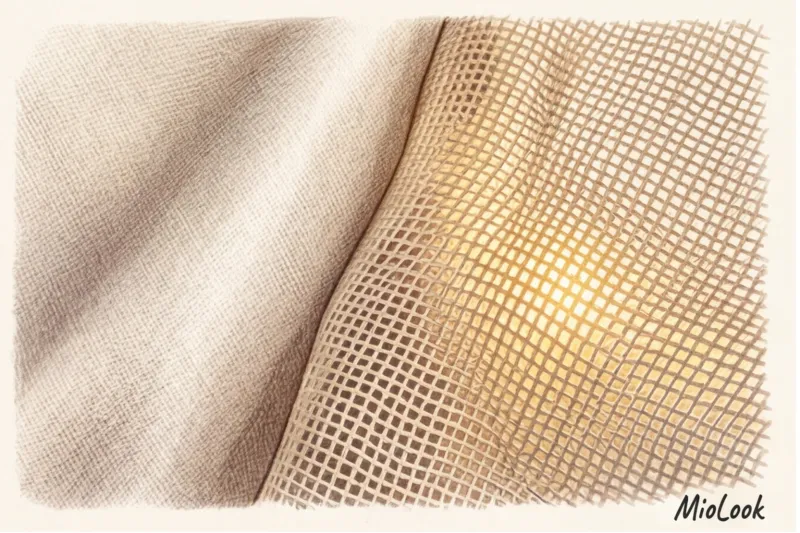
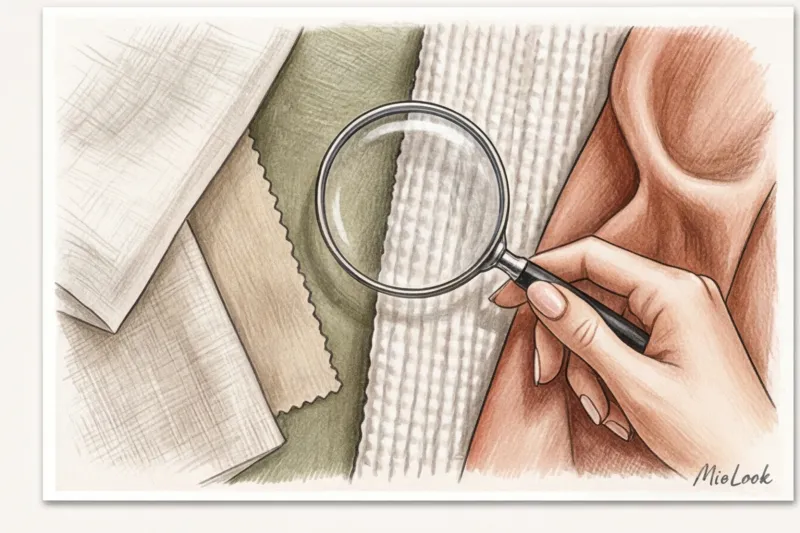
We're used to thinking of cotton as a summer savior. But the problem is, the label might say "100% cotton," but the item might actually turn into a personal sauna. The secret lies not in the composition, but in the density of the weave.
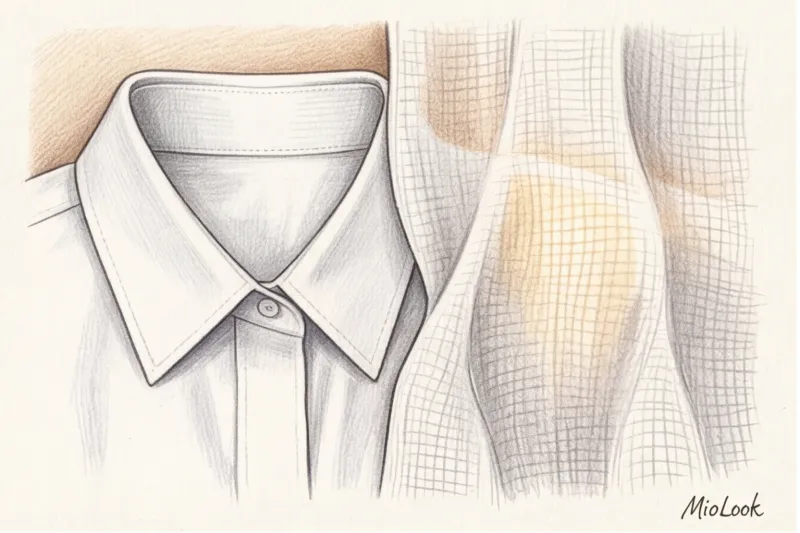
Take cotton poplin, for example. It's often used to make heavy office shirts and shirtdresses. At 40°C (104°F), this fabric acts like a greenhouse: it blocks air circulation, quickly becomes damp with sweat, and takes a long time to dry, clinging to the skin. Meanwhile, cotton cambric or muslin of the same weight (around 80–100 g/m²) act as a portable air conditioner, allowing the slightest breeze to cool the skin.
But science moves on, and today I rarely recommend pure linen or cotton to clients for the humid tropics. They've been replaced by technologically advanced artificial fibers (not to be confused with synthetics!).
- Tencel (lyocell): According to research by the Textile Institute (2023), Tencel fibers have a moisture absorption rate 50% higher than cotton. The fabric literally wicks moisture away from the skin and evaporates it instantly, creating a noticeable "cooling" effect.
- Cupro: This fiber is made from cotton fluff. It looks and flows like silk, but is machine washable and doesn't retain heat. It's an ideal choice for evening dresses in hot weather.
- Viscose Ecovero: A more environmentally friendly and durable version of classic viscose. It doesn't wrinkle as easily as linen, which is critical for a suitcase.
I have a professional test I always perform in stores: the "light test." Hold one layer of fabric up to a lamp or window. If you can't clearly see the light source through the weave, the item is not suitable for temperatures above 28°C (82°F), even if it's 100% natural silk.
Access to MioLook for €0.99 — one-time payment
A smart AI stylist will select the perfect look for any weather and help you organize your vacation suitcase.
Get access — €0.99 onceThe Bedouin Paradox: The Right Clothing for a Hot Climate is Closed
Let's return to the myth that shorts and T-shirts are the best choice for the heat. Now consider the desert dwellers. Bedouins have been wearing long, closed, multi-layered clothing for thousands of years. Why? Because exposed to direct sunlight, bare skin heats up instantly, and ultraviolet radiation causes micro-burns, forcing the body to expend a colossal amount of energy on cooling and regeneration.
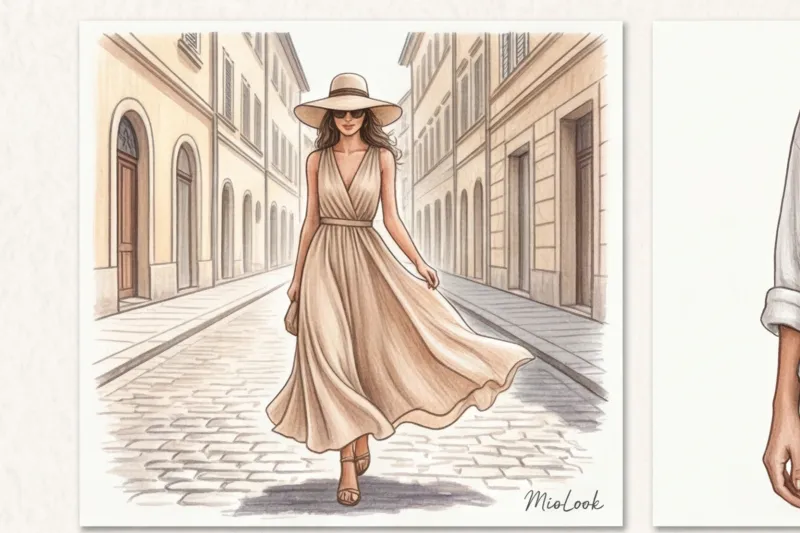
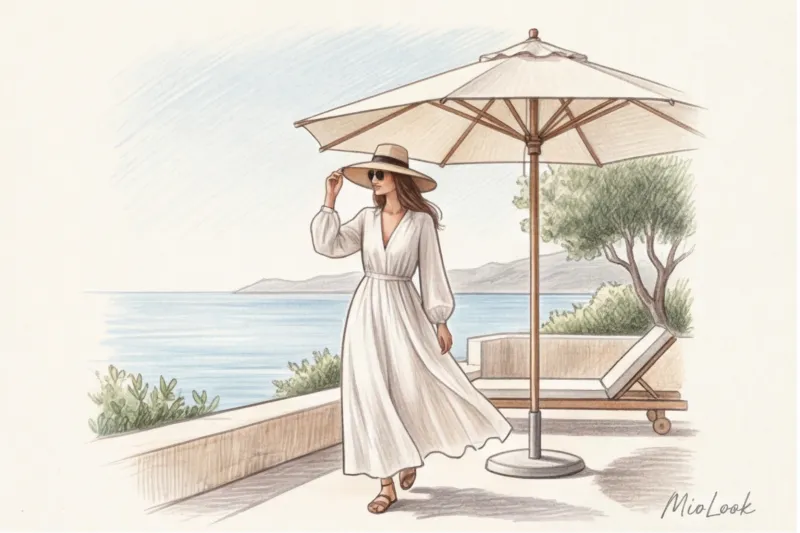
The best clothes for hot climates work microclimate principle A long, loose maxi dress or flowing palazzo pants create a layer of air between the fabric and the body. When you walk, this layer circulates, acting like a bellows. The difference in skin temperature under direct sunlight and under a layer of the right breathable fabric can be as much as 4–5 degrees.
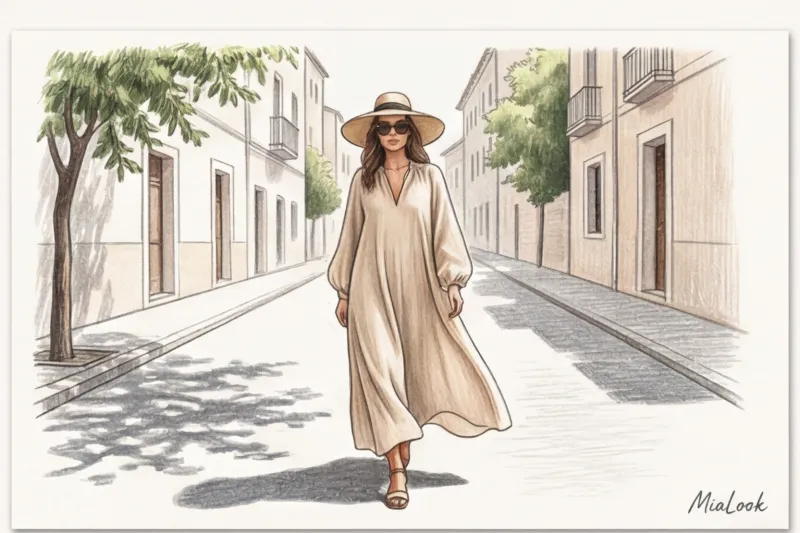
We also often forget about UPF (Ultraviolet Protection Factor), the UV protection factor built into the fabric itself. According to the Skin Cancer Foundation, a typical white cotton T-shirt has a UPF of only about 5, which allows one-fifth of the sun's rays through. Meanwhile, tightly woven linen in dark shades (yes, dark colors absorb UV rays better, preventing them from reaching the skin) or special UPF clothing provide protection of 50+.
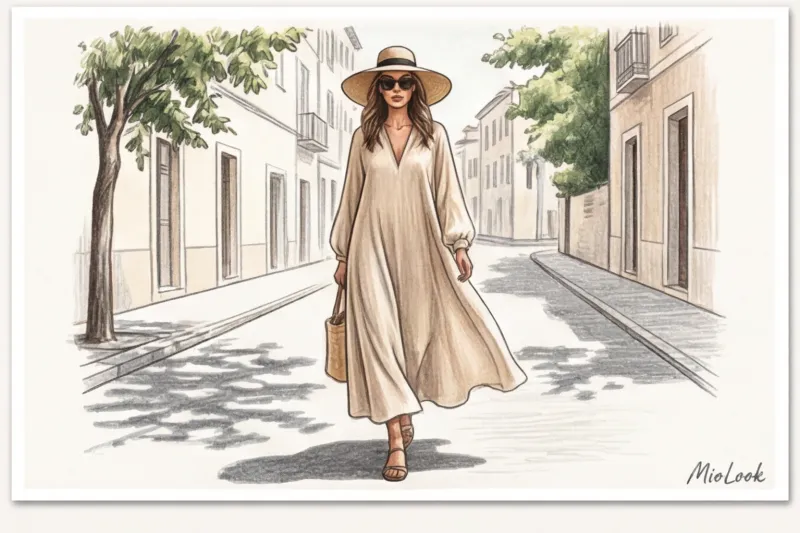
Last year, we put together a capsule collection for a client moving to Dubai. Initially, she asked for "more shorts." I insisted on adding flowy silk-Tensel blend trousers. A month later, she wrote back that the shorts were sitting on the shelf: the long, wide-legged trousers prevented her legs from getting sunburned, didn't stick to taxi seats, and the breeze felt pleasantly cool on her skin.
Resort Elegance: How to Look Expensive When the Asphalt Melts
A huge problem with summer wardrobes is the blurring of boundaries between the beach and the city. Micro shorts, pareos, mesh tops, and flip-flops are appropriate by the pool or on a sun lounger. But if you plan to stroll through Rome, Barcelona, or visit a nice restaurant, you need style. Resort Elegance.
How to look classy when you want to take off everything?
- Relaxed Tailoring: Swap denim shorts for pleated Bermuda shorts made of suiting linen or fine wool (tropical wool is very breathable in summer). Swap your tank top for a structured vest top. Choose brands like COS or Massimo Dutti (they have great options in the €80–€150 range).
- Pajama-style outfits: Sets made of thick cupro or tencel with wide-leg trousers and a short-sleeved shirt look incredibly bohemian and allow for unrestricted movement.
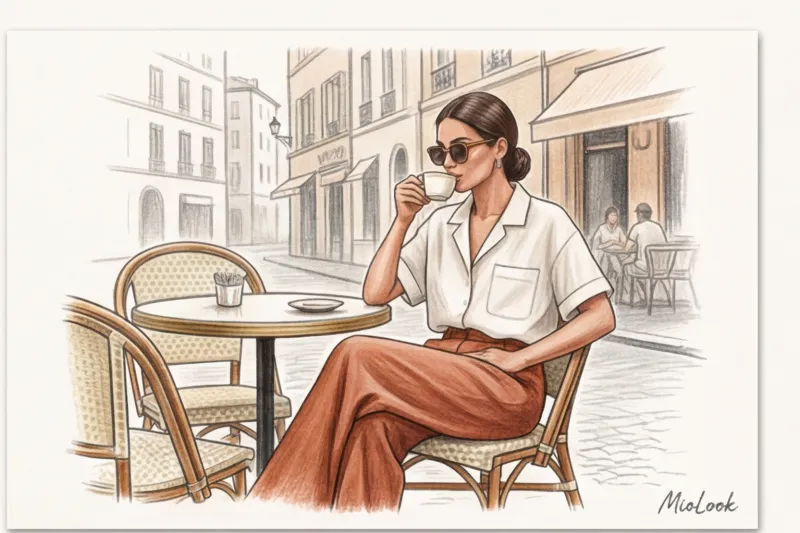
- Avoid loud prints: Poisonous pink flamingos and neon palm trees on clothing are a sure sign of the "typical tourist." A prestigious look is built on a noble natural palette. Ecru, olive, terracotta, deep chocolate, and creamy oyster. These shades look luxurious even on the simplest fabrics.
Your ideal image begins Here
Join thousands of users who look flawless every day with MioLook's AI-powered tips.
Get access — €0.99 onceFrom 18°C to 40°C: The Art of Summer Layering
The hardest thing about southern countries is coping with the contrast. You step out of a scorching street (+40°C) into a mall or restaurant where the air conditioning is set to a chilly +18°C. If you're wearing a thin, strappy top, hello, cold.
This is where summer layering comes in handy. It won't work if your base layer is thick cotton. But if you're wearing a top made of the finest silk or viscose, the following will work great as a top layer:
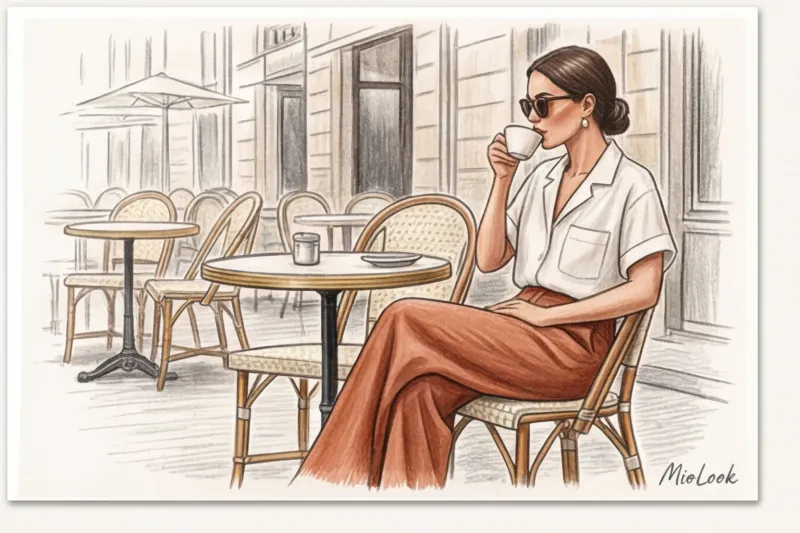
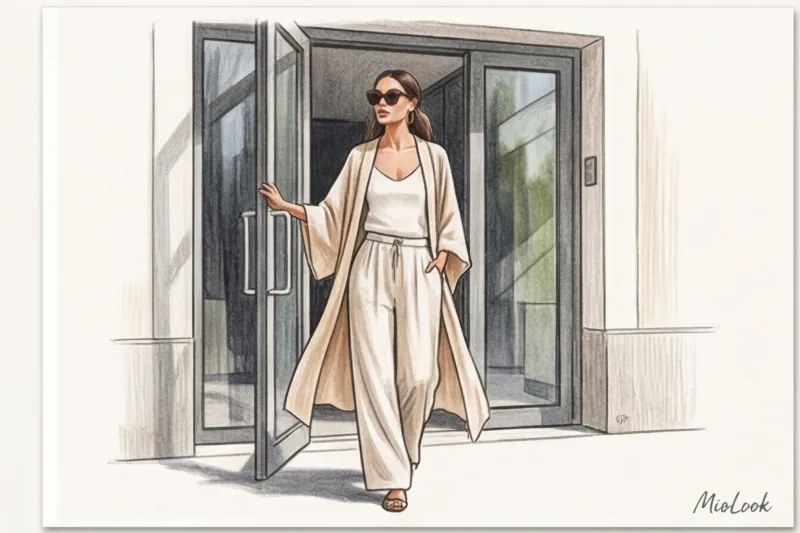
- A flowing silk kimono (takes up zero space in your bag, but instantly warms your shoulders indoors).
- An oversized linen shirt in a men's cut (it can be draped over the shoulders, tied at the waist, or left unbuttoned).
- The finest cashmere cape (cashmere is not just for winter, summer down breathes very well).
Shoes and accessories: saving your feet from swelling
In the heat, blood vessels dilate, and by evening, your feet inevitably swell. If you choose the wrong shoes, you won't be able to take a single step by the end of the day.
I categorically advise against two items for long walks in the heat: sneakers with synthetic mesh (they'll "cook" your feet, despite the holes) and shoes with completely flat, thin soles (thin leather sandals or ballet flats). The asphalt in southern cities heats up to 50–60°C. A thin sole (3–5 mm) transfers this heat directly to the foot, increasing swelling.
What to choose instead?
- Suede loafers with a soft rubber sole (suede breathes 3 times better than smooth leather).
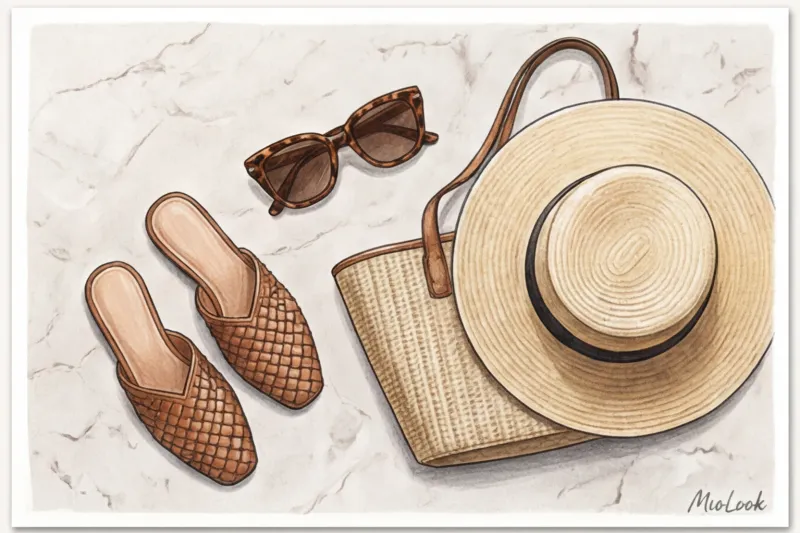
- Leather mules with a small, stable heel (2-3 cm).
- Sandals with an anatomical cork insole (cork is an excellent thermal insulator). High-quality models can be found at Birkenstock (around €100–€130) or in Zara's premium lines (from €60).
Don't forget about accessories. The right sunglasses are not only a style statement but also protection from fine lines and wrinkles. Choose glasses with glass lenses (they reduce image distortion and don't cloud under sunscreen) or high-quality polycarbonate with a UV400 rating. A stiff straw boater hat will not only protect your head from overheating but also instantly pull together your look, adding a touch of class. By the way, if you are sewing summer hats or jackets to order, be sure to pay attention to the composition of the lining fabric. - synthetics inside will kill all the benefits of the natural top.
Ready to get started?
Try MioLook's free plan—upload your items to a virtual wardrobe and let AI create the perfect combinations.
Get access — €0.99 onceA stylist's checklist: putting together a capsule wardrobe for extreme heat
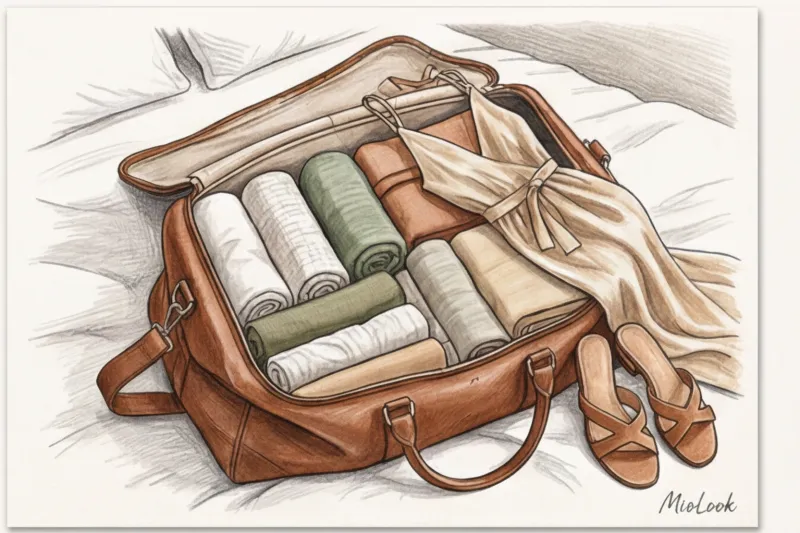
When you're staring at an empty suitcase (especially if it's carry-on), it's easy to panic and throw together 15 t-shirts just to make it last. In practice, I always use a tried-and-true formula with my clients. 3 bottoms + 5 tops + 2 dresses + 1 top layer This gives over 25 combinations!
Here's what a perfect basic capsule might look like (which would also work great as a bases for short women , if you follow the proportions):
- Bottom: Wide-leg Tencel trousers, bias-cut viscose midi skirt, heavy linen Bermuda shorts.
- Tops: A basic silk top, two structured cotton batiste T-shirts, a smart off-the-shoulder blouse, and a classic thin cupro Breton top.
- Dresses: One versatile maxi dress (wear it with sandals during the day, or statement earrings at night) and one shirt dress (wear it as a cape).
- Top layer: Loose oversized linen shirt in a basic shade.
To be fair, I'll point out that closed, multi-layered clothing does NOT work if you're planning jungle trekking or active sports—special synthetic fabrics are king there (we wrote about this in running clothing guide ). But for city tourism, evening promenades and restaurants, this is the gold standard.
Clothing for hot climates isn't just about aesthetics. It's a direct investment in your health, avoiding skin irritation, and feeling confident when the temperature hits 35°C. Save the short shorts for the dacha, invest in meters of flowing, breathable fabrics, and you'll be surprised how comfortable a real summer can be.