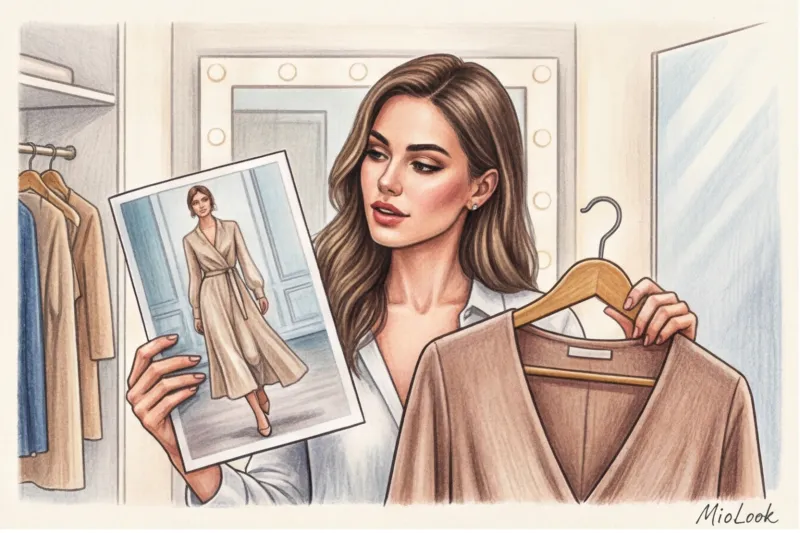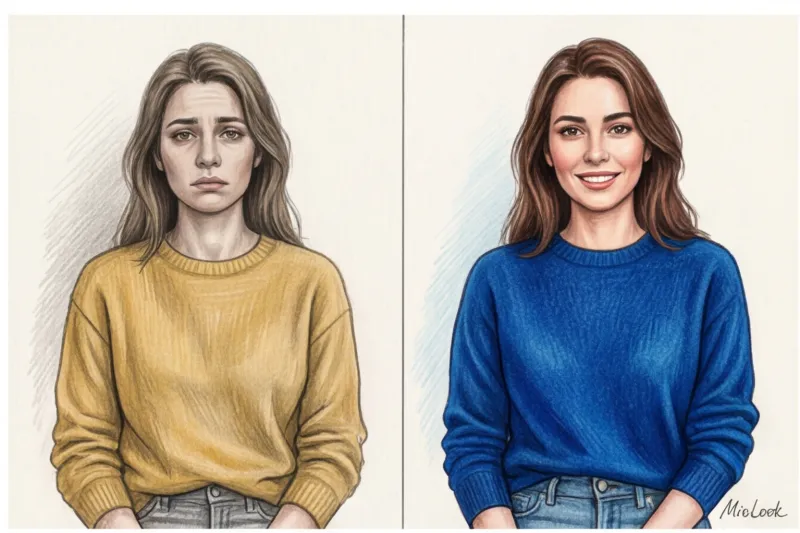
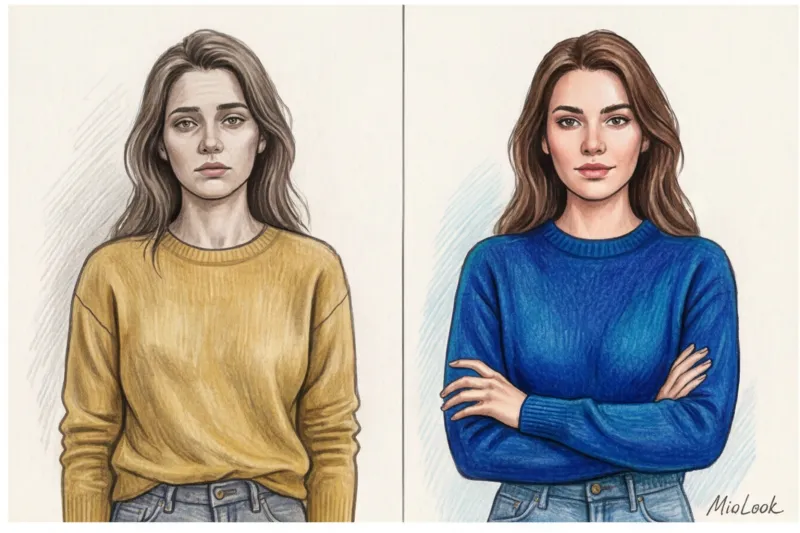
How many times have you breathlessly opened a package from an online store, pulled out a stunning emerald blouse, tried it on in front of the mirror, and suddenly realized your face looks tired, as if you haven't slept in three weeks? You blame yourself, your lack of sleep, or the lighting in the room. But the problem isn't you. The problem is that the color of the fabric clashed with the micro-contrasts of your skin.
In my 12 years as a stylist and fashion journalist, I've seen hundreds of such disappointments. We recently covered this technology in detail in our A complete guide to virtual photo try-ons at MioLook Today, I want to talk about the most insidious aspect of shopping: color. We're no longer in the era of blindly trusting brand studio photos. We now have the ability to turn our own smartphones into a veritable color lab.
Why "by eye" no longer works: the studio lighting trap
I had a classic case in my practice. My client ordered a luxurious mustard sweater made of 100% cashmere. On the model in the catalog of a famous brand, it looked warm, cozy, and elegant. In reality, however, this shade made my client's skin look downright sallow, highlighting even the slightest shadows under her eyes.
Why does this happen? I'll give you a little journalistic insight from the world of fashion e-commerce. The colors in brand catalogs are almost always distorted. Retouchers "adjust" the shades of clothing to the overall brand aesthetic or Instagram's color grid. Add to this powerful studio flashes, which bleach fabric, and the fact that our smartphone screens calibrate color differently.
"According to a 2023 True Fit study, approximately 65% of online clothing returns are not due to size, but rather because the color didn't live up to expectations or didn't 'fit' in daylight."
Choosing a color by eye on a screen is like playing roulette with your budget. Your brain is conjuring up a shade based on a beautiful picture of a professional model, whose skin tone is likely radically different from yours.
Access to MioLook for €0.99 — one-time payment
A smart AI stylist will create the perfect look and help you find your best colors without breaking the bank.
Get access — €0.99 onceIs Color Type Theory Outdated? From "Autumn" to Smart Analytics
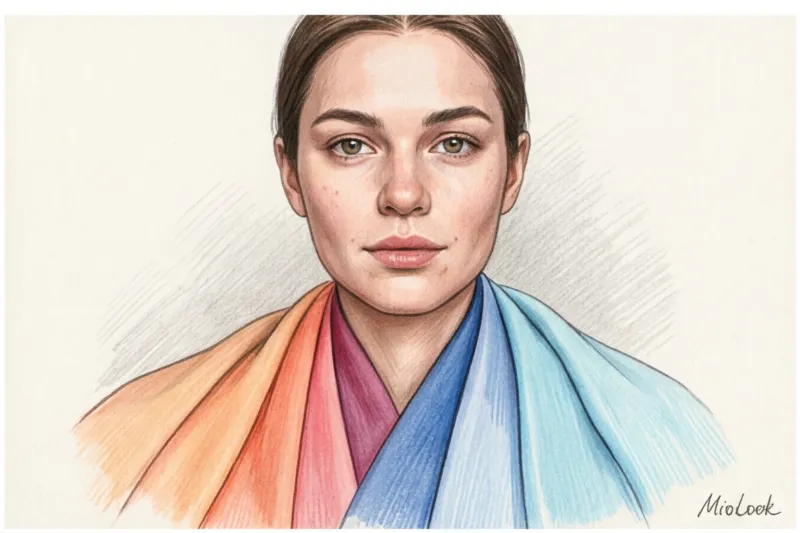
"Camilla, I can't wear fuchsia. My stylist told me I'm a Soft Autumn five years ago!" If I had a salary for every time I heard that phrase, I'd have bought an apartment in Montmartre by now. The theory of 12 color types is hopelessly outdated. It confines women to rigid boundaries, forcing them to wear dull palettes for decades.
Modern coloristics has proven that there are no truly "forbidden" colors. Any color can be adapted if you choose the right temperature (warm/cool), saturation (pure/muted), and depth (light/dark). It's all about the so-called microcontrast of your appearance—the unique combination of flecks in your irises, the undertone of your cheekbones, and the natural pigmentation of your lips.
Of course, there's a limit to this rule. If you have extremely low contrast (light eyes, fair skin, light brown hair), neon yellow near your face will completely overwhelm you. But that doesn't mean yellow is off-limits. It just means you need a buttery or bleached lemon shade, and it's best to tuck bright neon into your shoes or bag.
How to check if a clothing color suits me online: the magic of generative neural networks
Back in 2018, augmented reality (AR) technologies resembled flat paper stickers crudely applied over a photograph. Today, the rules of the game have changed. To accurately Check if a clothing color suits me online You no longer need to have an artist's imagination—generative neural networks will do it for you, taking into account the physics of light.
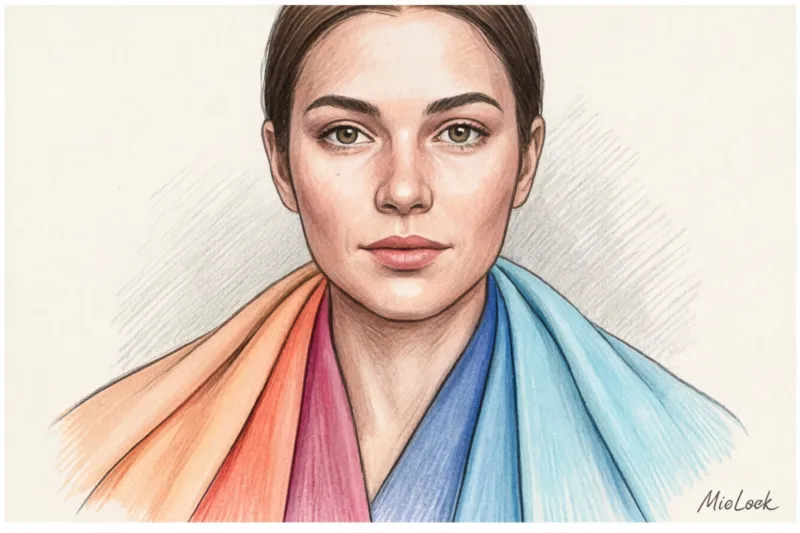
How does this work in practice? Algorithms MioLook smart wardrobe They analyze over 100 points on your face based on your uploaded selfie. The artificial intelligence doesn't just "recolor" pixels. It reads your skin tone and calculates so-called reflections—the colored highlights that real fabric would cast on your neck and chin (shadows and highlights).
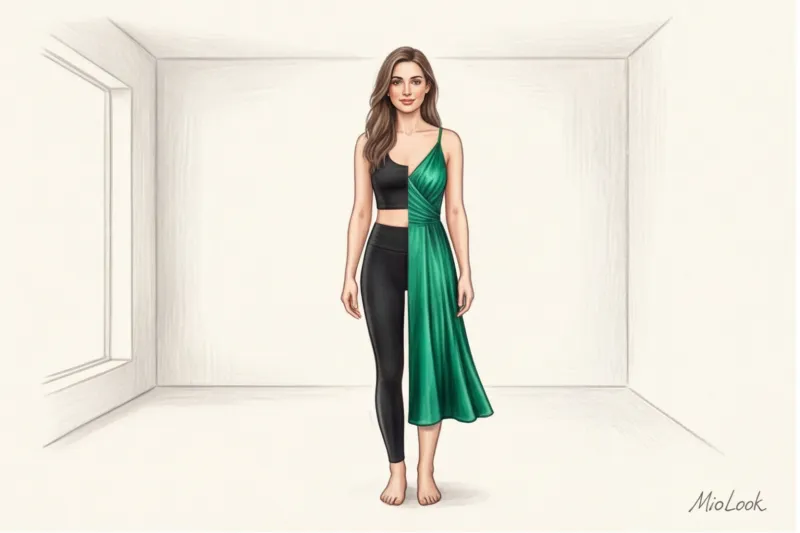
In just two minutes, you can compare borderline shades that you previously doubted. For example, try on a cool emerald and a warm olive. You'll literally see with your own eyes which color makes your nasolabial folds appear deeper and which makes your skin glow from within.
Testing Complex Trends: From Peach Fuzz to Acid Green
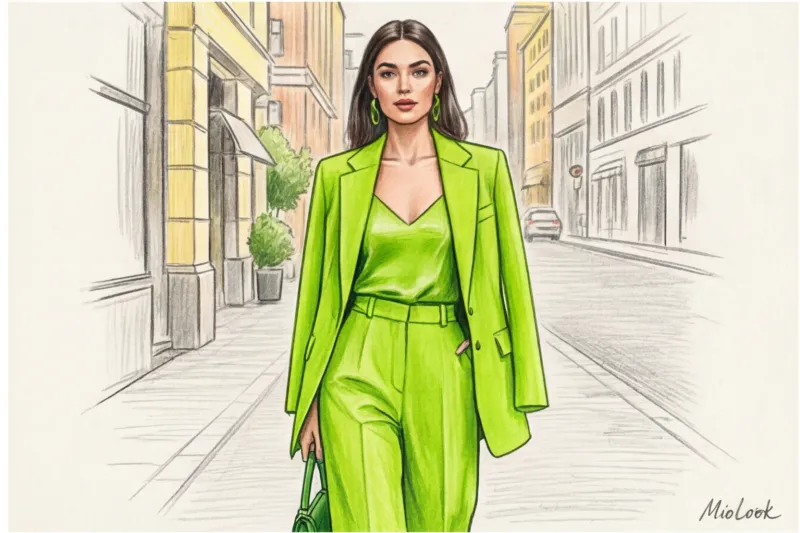
Every year, the Pantone Color Institute announces the top shades that instantly fill store shelves. But let's be honest: they're rarely universally flattering. Take the recent favorite, Peach Fuzz—this delicate shade mercilessly blends into fair skin, turning the face into a pale blur.
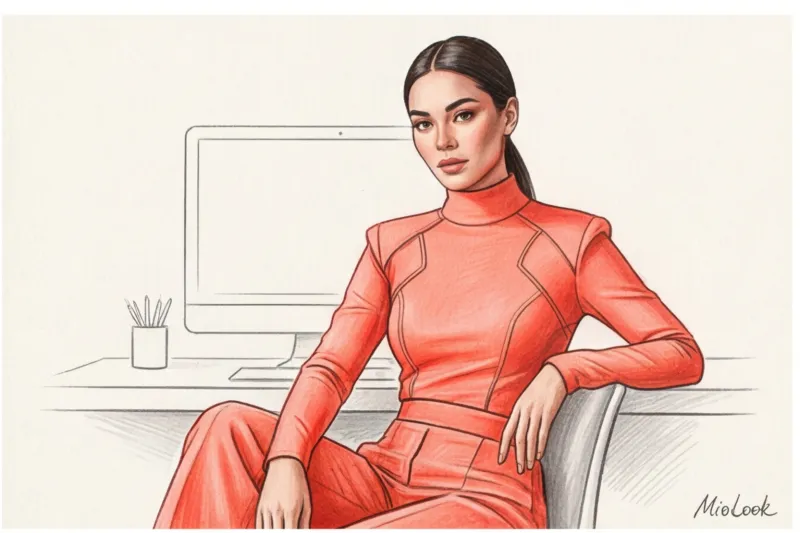
Or consider another street style hit: Acid Green. It's a gorgeous color, but it requires a perfect match with the contrast of your appearance. Virtual try-ons allow you to "test-drive" these aggressive trends without spending money. One of my clients managed to incorporate a sophisticated tomato-red color into her conservative IT wardrobe by choosing the right deep shade of jacket, which we first matched in the app.
Your ideal image begins Here
Join thousands of users who look flawless every day with MioLook. Digitize your appearance and find your colors.
Get access — €0.99 onceExiting the Beige Zone: A Step-by-Step Plan for Introducing New Colors
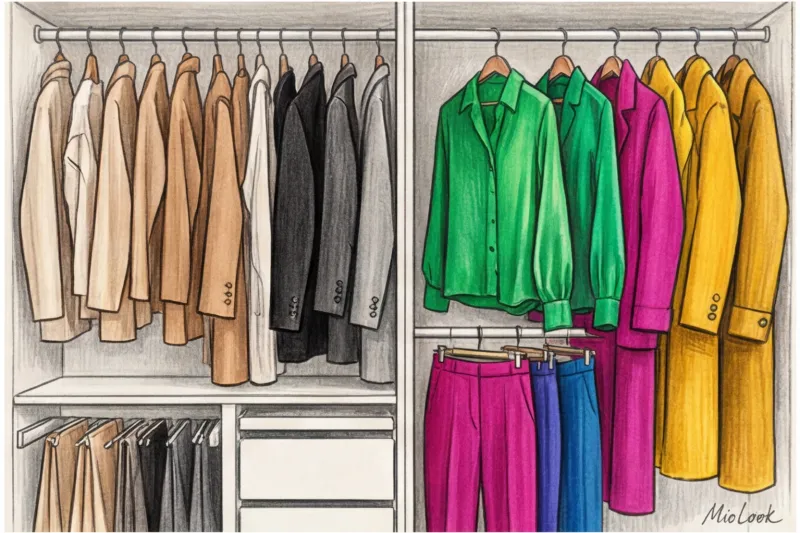
The psychology of color explains why most wardrobes in our latitudes consist of black, gray, and beige. It's the fear of making a mistake. We're afraid of looking ridiculous or wasting money on something that will just hang in the closet with the tag still attached.
I remember a client who wore only camel and beige for 10 years, considering them a "safe base." When I showed her via virtual try-on how her gray eyes lit up against a cobalt blue backdrop, she burst into tears. We lose enormous visual potential by hiding behind neutral tones.
Here's my algorithm for safe experiments for conservatives:
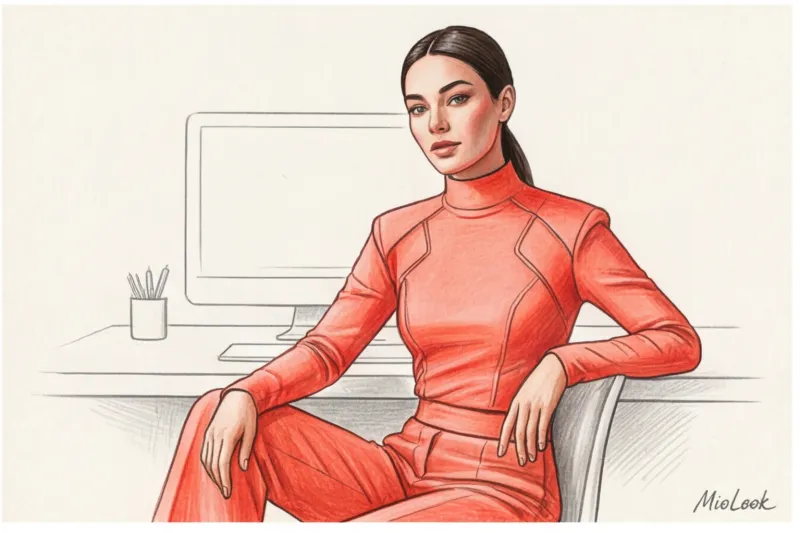
- Level 1: Safe distance. Start introducing color away from the face (the portrait area). Bright shoes, a bag, or statement pants won't clash with your skin tone but will add dynamism to your look.
- Level 2: Gradient method. Use prints that mix your favorite base color (like beige) with a new, vibrant shade (like terracotta).
- Level 3: Digital Test Drive. Before buying a bright blouse or sweater, upload a photo of yourself to the AI fitting room. Compare three saturation levels of the same color. Choose the one that makes you see your face first, not the item itself.
Checklist: How to prepare a photo so AI doesn't get the shade wrong
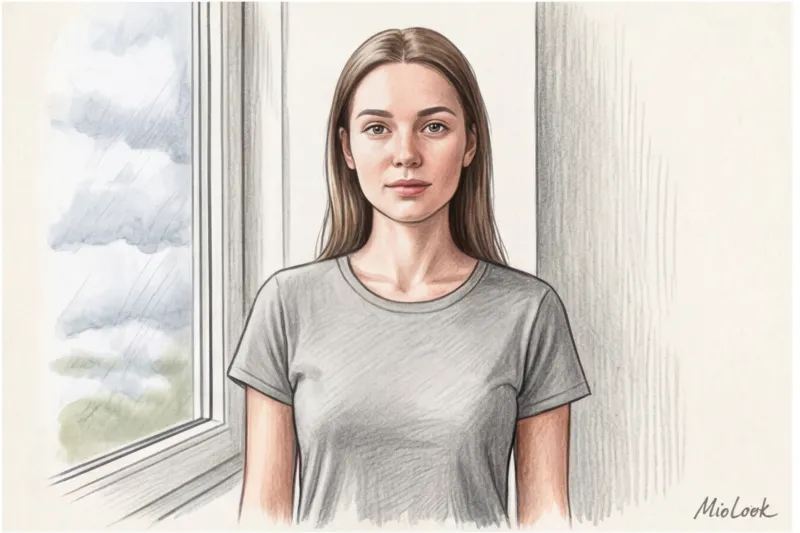
Even the smartest algorithms are powerless if you feed them poor input. Over the years of working with styling apps, I've identified two key user mistakes that ruin the magic of online selection.
The first mistake is taking a selfie in the bathroom. Incandescent bulbs emit yellow light (around 2700K), which instantly makes any skin appear warmer, distorting its true undertone. The second mistake is taking photos with heavy foundation and social media filters. The algorithm needs to see your true shadows, capillaries, and midtones, not a mask of pixels.
To ensure AI works at 100%, do the following:
- Wait for a cloudy day or a time when there is no direct sunlight shining through the window.
- Remove makeup. Absolutely clean skin is the key to an accurate analysis.
- Wear a basic t-shirt in a neutral gray or white (black can cast harsh shadows on your chin).
- Stand facing the window at arm's length. The light should fall evenly on your face, without harsh shadows on one side.
Expert Summary: Color as Your Visual Capital
When attending castings at Milan and Paris Fashion Weeks, I often observe the same process. Designers hold fabric scraps against models' faces under different lights. They know that if the color doesn't match the model's micro-contrasts, a luxurious dress will look cheap on the runway, and the model will be lost in the background.
Clothing color is the fastest and most powerful signal others perceive within the first seven seconds of meeting you. It influences your level of trust, conveys your status, and controls how your energy is perceived. The wrong color can add five to seven years to your appearance or create an unhealthy appearance.
That's why virtual fittings today aren't just a toy for an evening. They're a serious risk management tool for your wardrobe and personal brand. Digitize your appearance, stop hiding behind fictitious color types, and let technology find the very shades that will make you feel flawless.