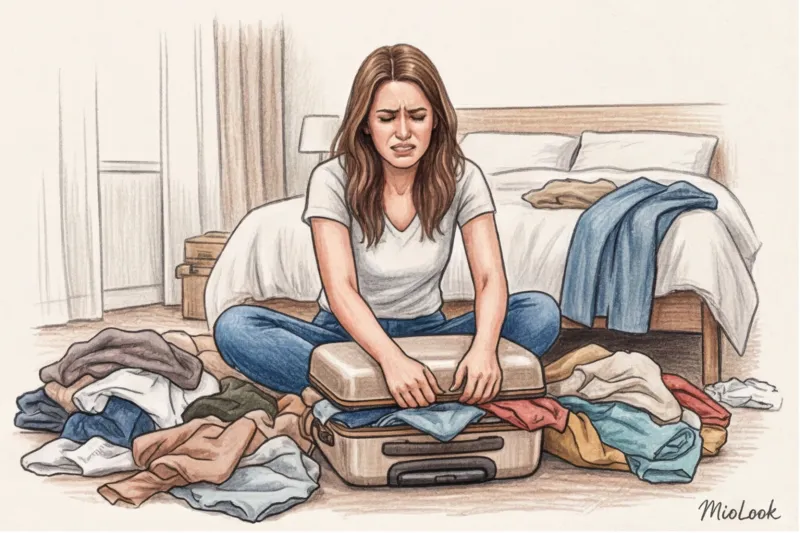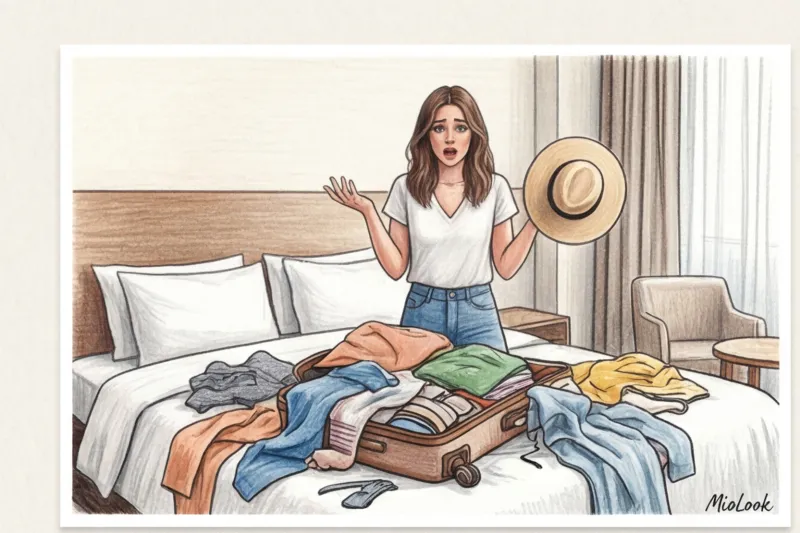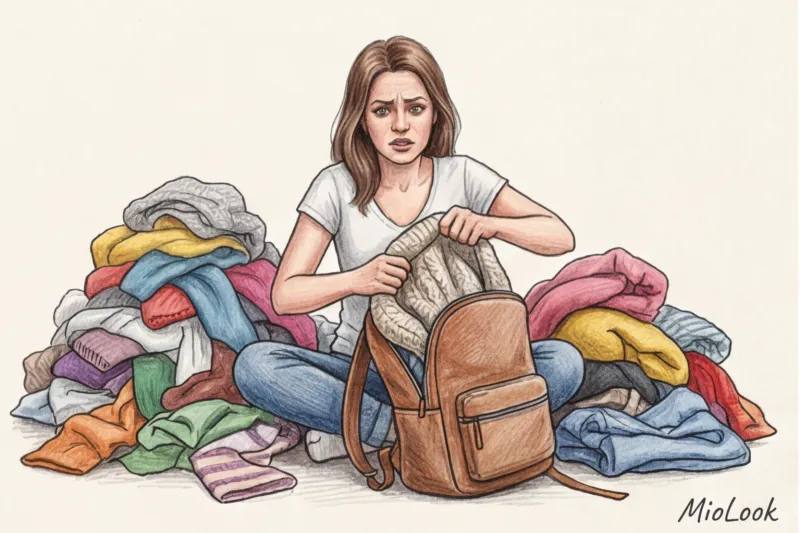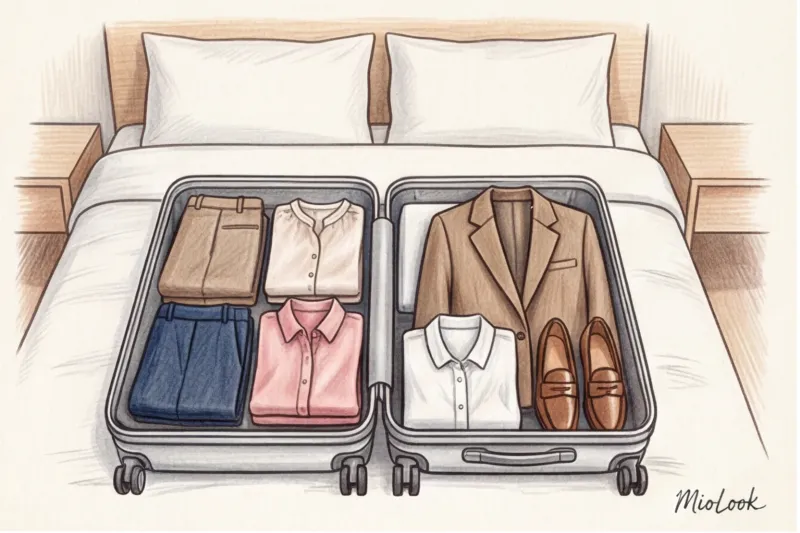
Remember that awkward moment at the check-in counter on a low-cost airline when the scale mercilessly shows 11 kilograms instead of the permitted 8? You frantically open your suitcase in front of the entire line and start putting on a second sweater, simultaneously shoving heavy makeup into your pockets. I witness scenes like this at airports all the time.
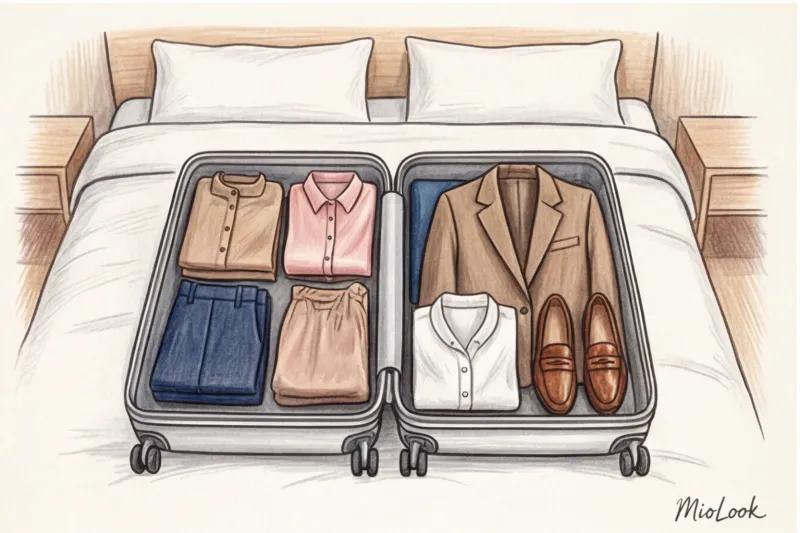
For many women, a well-packed carry-on capsule seems like an unattainable miracle. We're used to thinking that different moods require different suitcases. But after 12 years of working as a personal stylist, I've discovered an ironclad rule: low-cost airline restrictions aren't a Procrustean bed for your style. They're a catalyst for your creativity. We discussed this in more detail in our The complete guide to planning your travel wardrobe , but today I want to share the mathematics of compact collections.
Forget the clichéd internet advice about rolling your T-shirts into tight rolls. We'll approach the matter like architects: using the "bright spot" theory, the right formula for packing, and a Mediterranean approach to detail to look luxurious even with a tiny suitcase.
The Anatomy of the Perfect Trip: What is a Carry-On Capsule?
Let's be honest: 10 random items thrown into a bag is just a hassle you'll have to carry around. But 10 items carefully collected into a capsule collection equals over 30 unique looks. That's the fundamental difference.
The standard IATA (International Air Transport Association) dimensions for carry-on baggage are 55x40x20 cm, and the weight is typically limited to 8-10 kg. Have you ever considered the hidden costs of your baggage? Adding even a small checked suitcase on European low-cost carriers currently costs between €40-€80 each way. Why pay that much to the airline when you could spend it on a sumptuous seafood dinner in Barcelona?
My favorite assembly algorithm is formula 5-4-3-2-1 It works flawlessly and saves you from the agony of choice:
- 5 tops (shirt, silk top, basic T-shirt, lightweight jumper, statement blouse)
- 4 bottoms (palazzo pants, perfect-fitting jeans, midi skirt, shorts or lightweight trousers)
- 3 pairs of shoes (including what you're wearing: comfortable loafers or sneakers, elegant sandals/dressing shoes, flip-flops)
- 2 bags (a roomy tote for travel and a crossbody/clutch for the evening)
- 1 accent accessory (for example, a large piece of jewelry or a bright belt)
If every top goes with every bottom, you already have 20 ready-made outfits. Add a change of shoes and a bag, and the versatility doubles.
Mediterranean Wardrobe Math: Maximizing Your Looks
My signature style is always rooted in Mediterranean aesthetics—relaxed yet infinitely elegant. The secret of Italian and Spanish style isn't the quantity of pieces, but the mastery of the visual canvas.
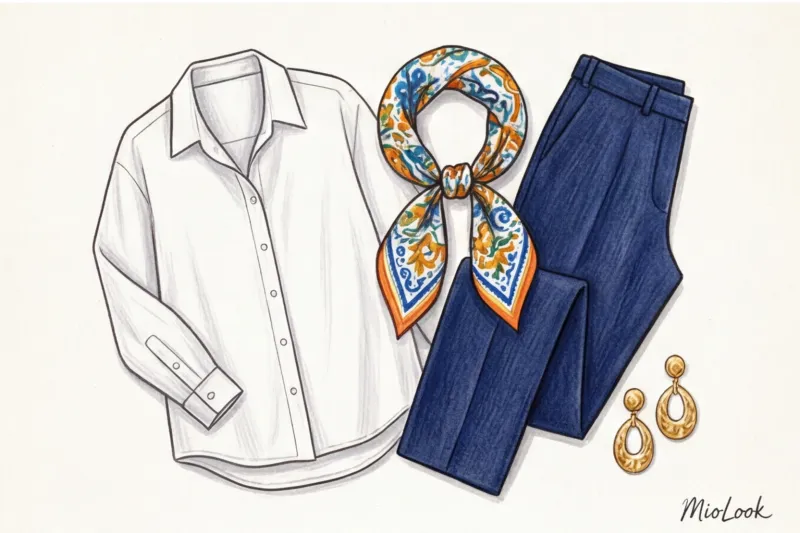
Choose two or three base colors (for example, sand, navy, and off-white) and add one deep accent shade (terracotta, emerald, or rich wine). This will create harmony. But the most important thing when you're on a tight budget is layering and versatility.
"One perfect oversized white shirt made of thick cotton will replace a cardigan on a chilly evening, a formal blouse at a business lunch, and a beach tunic by the pool. It's an investment worth every gram."
One of my favorite formulas that helps clients in any situation: Structured jacket + silk top + flowy palazzo pants + leather loafers = instant effortless status There's nothing heavy about this formula, but it looks like a million bucks.
Accessories: How to Trick the Eye Without Adding Excess Weight
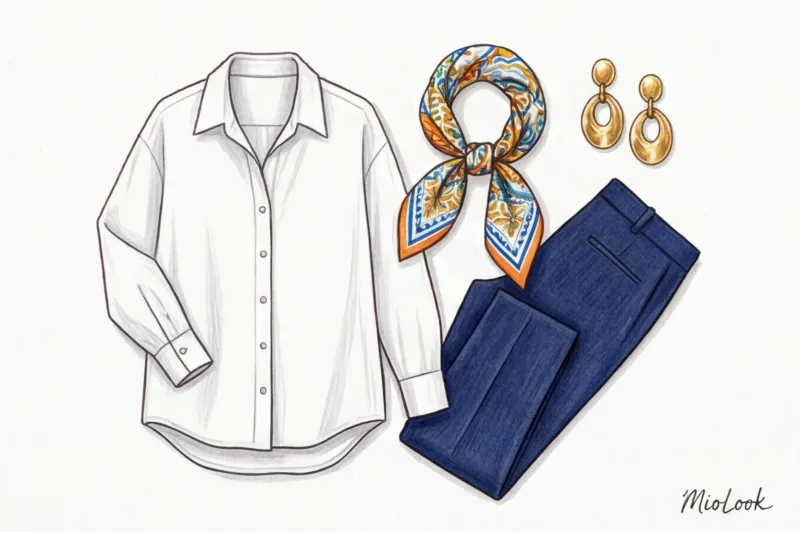
Nothing saves a small travel bag like accessories. Large vintage jewelry, silk bodice, and a tube of the perfect red lipstick weigh just a few grams.
Last year, during a trip to the Amalfi Coast, I traveled with just a backpack. My secret? A large silk scarf, 90x90 cm. During the day, it adorned the handle of a woven bag, in the evening on the veranda it served as a shoulder shawl, and one day I wore it as an asymmetrical halter top. The secret to transforming a daytime look into an evening one (day-to-night) lies solely in changing earrings and shoes.
Access to MioLook for €0.99 — one-time payment
A smart AI stylist will create the perfect look for your next trip, taking into account everything in your wardrobe.
Get access — €0.99 onceThe "What if" Syndrome: The Psychology of Excess Baggage
Every time we pack our suitcase, we're not packing things. We're packing our fantasies of the perfect vacation and our fears. We pack silk dresses for the mountains "in case of a romantic dinner" and three pairs of stilettos for the cobblestones of Old Europe.
The WGSN travel patterns study (2023) confirms my professional pain: Exactly 50% of the things brought on vacation are never worn They simply travel at your expense, taking the place of souvenirs.
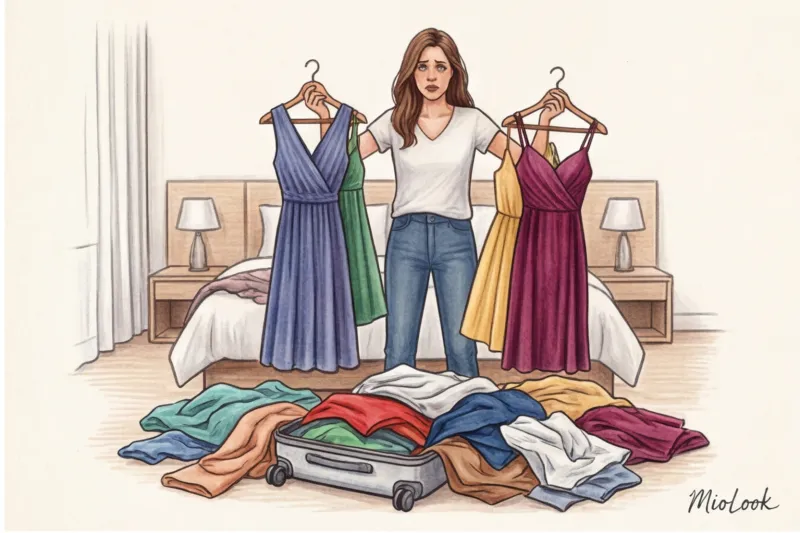
I have a client, Anna, who heads the IT department. She used to fly on three-day business trips with a 20-kg suitcase. When I asked her why, she'd answer, "What if we're invited to the opera? What if it gets really cold?" Today, Anna travels to five-day conferences in London with only carry-on luggage.
What's changed? We've digitized her travels. To get rid of the "What if" syndrome, move your wardrobe from your anxious head to MioLook app When you see a clear digital calendar with a specific outfit assigned to each day and event, your brain stops panicking and throwing up ideas to add a fifth T-shirt.
Packaging Secrets from a Stylist: Debunking the Myths
Now let's bust a couple of myths. Popular travel bloggers insist, "Always use compression cubes for packing!" In my experience as a stylist, for small cabin-size suitcases (as opposed to huge luggage), hard cubes are a disaster.
They create "dead zones" in the corners of the suitcase, preventing items from being distributed evenly and stealing up to 15% of the usable space. Sometimes, good old-fashioned flat packing works much more effectively.
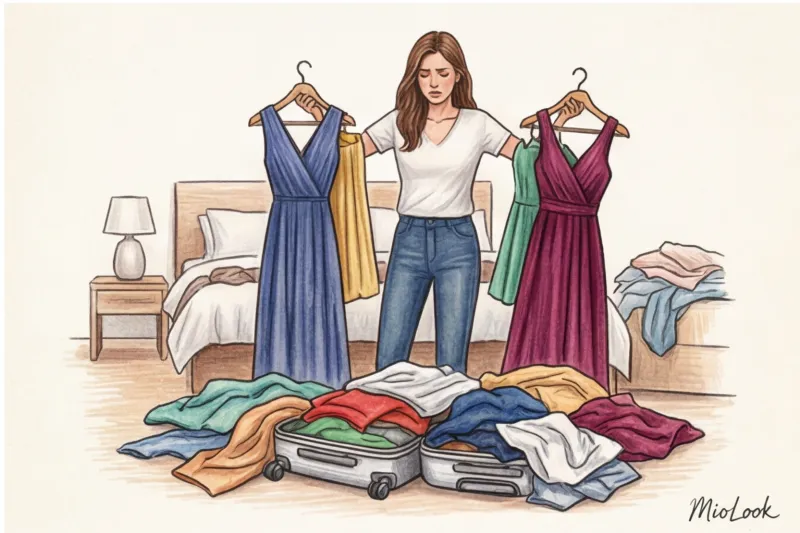
Myth 2: Rolling is good for everything. Wrong! Rolling works great for basic T-shirts, fine knits, and jeans, but it's detrimental to suiting fabrics and structured items.
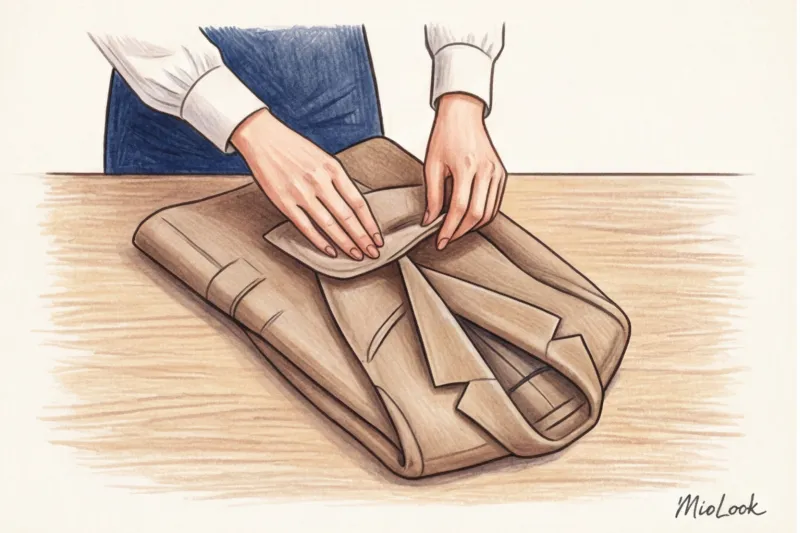
How to pack a jacket correctly without creases (the "shoulder to shoulder" technique):
- Turn one half of the jacket inside out (leave the sleeve as is).
- Insert the non-inverted shoulder into the inverted shoulder so that the shoulder pads meet. The jacket will fold in half along the back line.
- Carefully straighten the lapels so that they do not wrinkle.
- Fold the jacket in half horizontally and place it on top of the rest of the items in your suitcase.
Important disclaimer: This flat laying method does NOT work for chunky knits. If you're carrying a thick sweater, you'll actually have to roll it tightly or even pull it on.
Fabrics made for travel
If you want to look neat straight off the plane, avoid 100% linen. Yes, it's aesthetically pleasing, but after an hour of flight, you'll look like you slept in it. Opt for blended fabrics: linen with 20-30% viscose or Tencel is just as breathable but wrinkles less easily.
My absolute favorite for basics is 120-150 g/m² merino wool (for warm weather) or heavy cotton with 5% elastane. Merino has natural antibacterial properties: it doesn't absorb odors, doesn't wrinkle, and keeps you warm in freezing airport air conditioning.
Ready to get started?
Digitize your belongings once, and packing will be a 10-minute job. Try the free plan—no commitments.
Get access — €0.99 onceBusiness capsule carry-on: travel in style
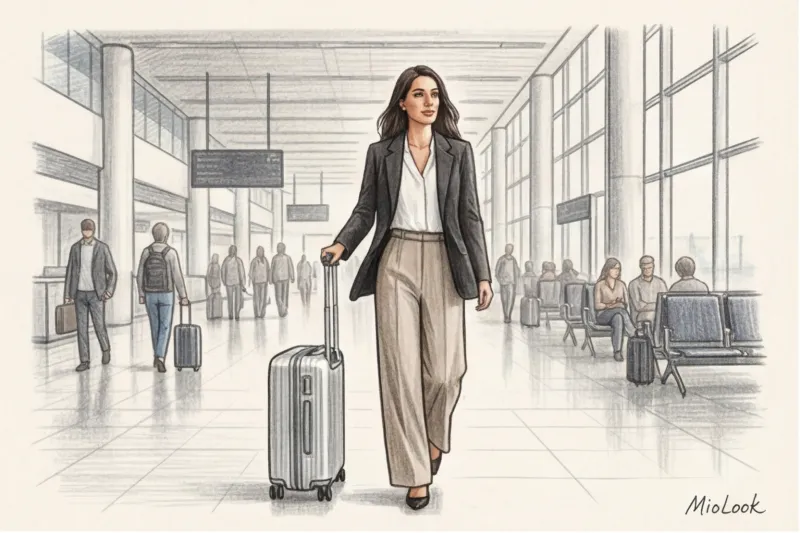
The specifics of a business wardrobe on the road dictate their own rules. A woman's goal on a business trip is to arrive, drop off her bags at the hotel (or even at reception), and immediately head to a meeting looking impeccable.
This is where the concept of Airport Style (airport dress code) comes into play. The main rule for saving space in your suitcase is to put the bulkiest and heaviest items on yourself. Your flight outfit might include thick, wide-leg trousers, a cotton shirt, a cashmere sweater slung over your shoulders, a voluminous trench coat, and chunky loafers.
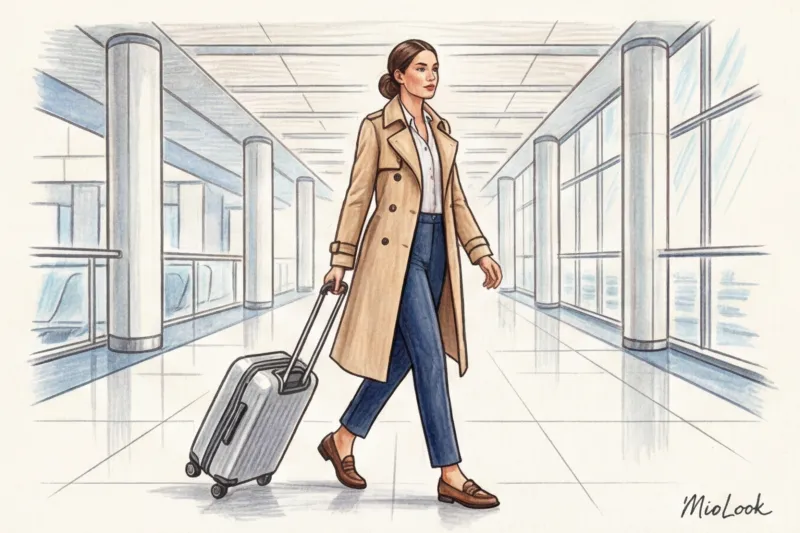
A bag is crucial. Choose a structured leather tote that meets low-cost airline personal item (typically 40x20x25 cm), fits under the seat in front of you, accommodates a 14-inch laptop, and still looks respectable in a boardroom setting.
Checklist: Final check before going out
When finishing packing, I always recommend my clients do a little audit. Use the "24-hour rule": pack your suitcase the day before your flight. Then, the next morning, with a clear head, open it and... take out two things. Trust me, you won't even remember them during your trip.
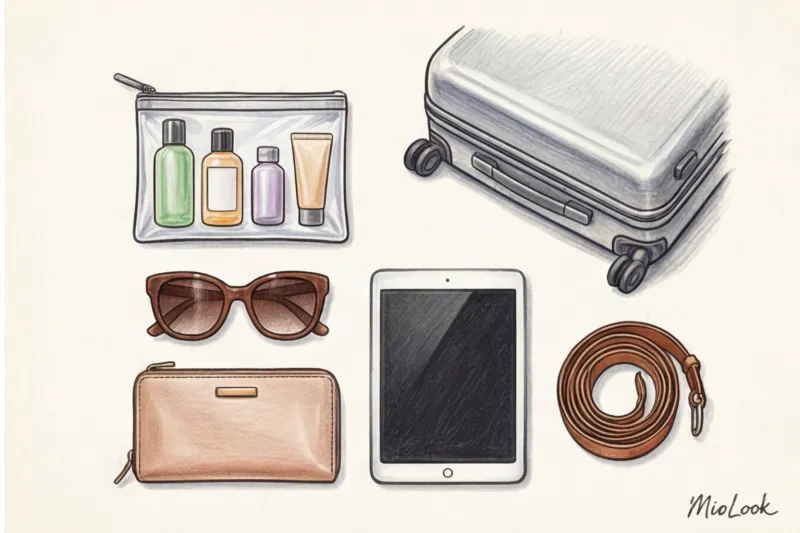
Check yourself with this checklist:
- Pairing: Can every bottom in your suitcase be worn with at least three tops?
- Layering: Do you have a light layer (tank/top), a medium layer (shirt), and a warm layer (jacket/sweater) that you can wear at the same time?
- Shoes: Have you worn this pair for at least a week? (Never take brand new shoes on vacation—they're a guarantee of sore feet.)
- Digitization: Are your images loaded in MioLook smart wardrobe so that every morning at the hotel doesn’t start with the phrase “I have nothing to wear”?
Knowing how to pack the perfect carry-on capsule isn't an innate gift, but a skill that requires just a little practice and consistency. By leaving those extra pounds at home "just in case," you take what matters most: lightness, freedom of movement, and confidence in every look. Fly beautifully and lightly!