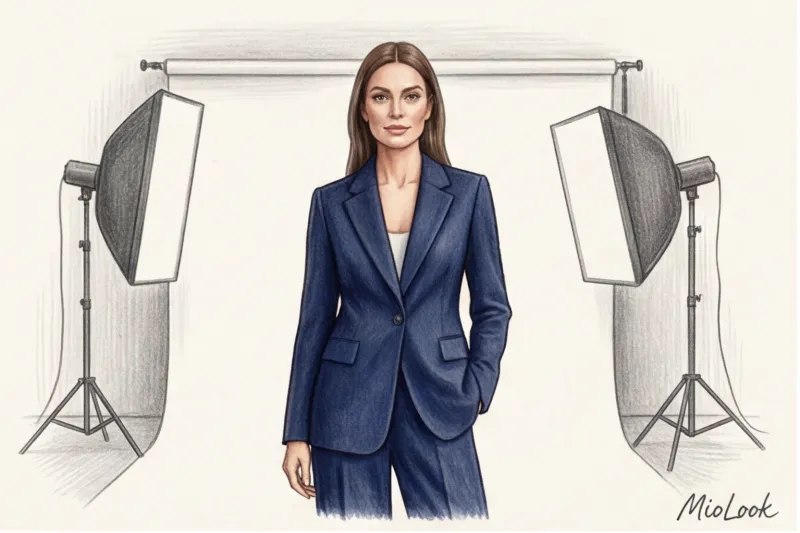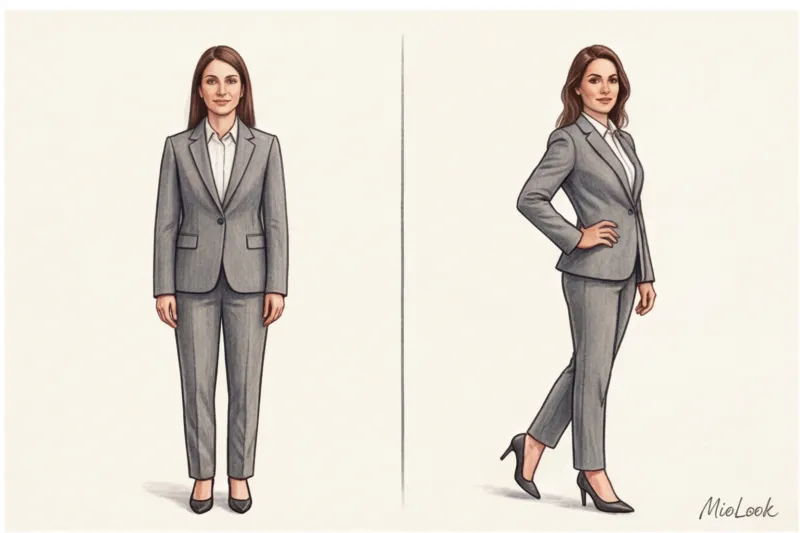
Three years ago, during a shoot in Paris, I nearly brought my client to tears. She was a top executive at a major IT company, wearing an impeccably tailored Saint Laurent jacket worth two thousand euros. In person, she looked stunning. But as soon as the photographer pressed the button, a boxy, neckless silhouette appeared on the monitor. The problem wasn't her figure or the clothes. The problem was that standard female poses for business photoshoots completely ignored the architecture of the suit itself.
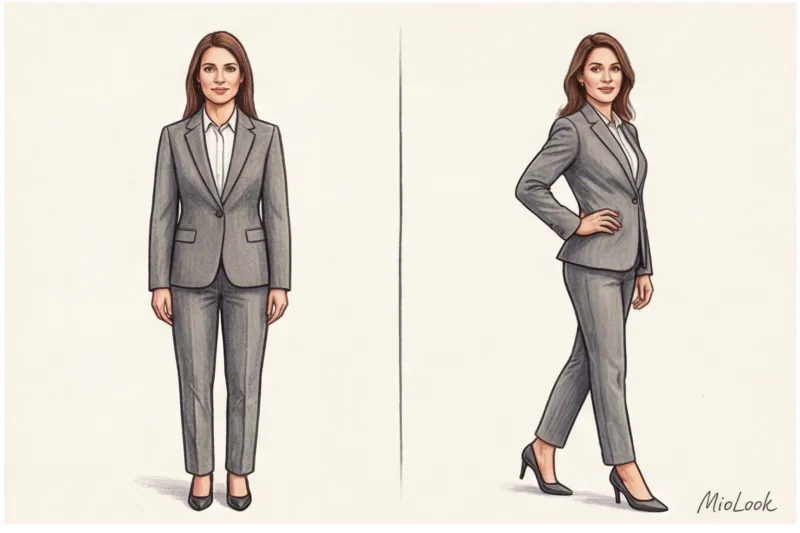
Unlike photographers who often ask you to simply "stand up straight and smile," as a stylist, I approach the shot differently. Posing isn't about body language in a vacuum. It's about how the cut, the density of the fabric, and your movements create a unified geometry. I've already written in more detail about choosing the right clothes in our A complete guide to looks for a business photo shoot , and today we'll talk about how to make these clothes work for you on camera.
Frame Geometry: Why We Look Different in Real Life Than in Photos
Have you ever noticed that your favorite, incredibly comfortable office suit suddenly looks like a shapeless sack in photos? There's a physical explanation for this.
In life, we exist in 3D space. We are constantly moving, fabric flows, light plays on curves. The human eye perceives this dynamic. The camera, however, mercilessly flattens reality into a 2D plane. What seemed like an elegant, free-flowing fit in motion becomes, in static form, unnecessary bulk.
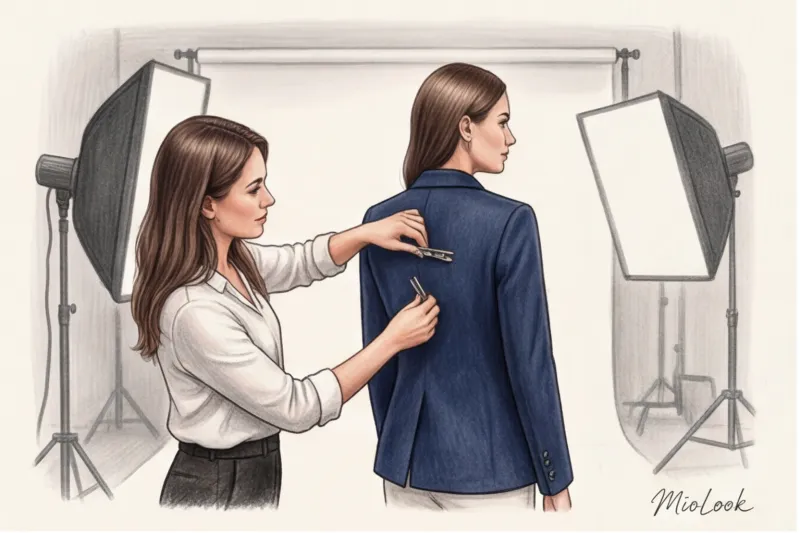
I'll let you in on a professional secret. On set, I constantly use regular clothespins and clamps. We tighten the models' jackets on their backs, creating the perfect silhouette that the camera will perceive correctly. The illusion of photography is this: the pose in which you stand most comfortably often appears slouched and slouched in the photo. Conversely, a body position that makes your muscles cramp up after a minute looks regal and relaxed in the frame.
Access to MioLook for €0.99 — one-time payment
A smart AI stylist will select the perfect look for your next photo shoot, taking into account your body type and goals.
Get access — €0.99 onceBasic female poses for a business photo shoot: building a silhouette
The foundation of any successful business portrait is proper weight distribution and angles. Forget standing at attention—save that for passport photos.
The 45 degree rule. Never stand completely straight to the lens, unless it's a conceptual fashion shoot. A straight-on angle visually broadens the hips and shoulders. Turn your body 45 degrees away from the camera. This simple technique instantly narrows the silhouette, defines the waist (even in a straight jacket), and adds much-needed dynamism to the shot.
Weight transfer. Lean on your back leg (the one furthest from the lens). Your front leg should be slightly bent at the knee and relaxed. This automatically aligns your shoulders, relieves tension from your lower back, and makes your pose stable but not heavy.
The Secret to Perfect Posture and the "Turtle Neck" Technique
My clients' biggest fear is a double chin in photos. It can appear even on women of size XS if they hold their head incorrectly. Photographer Peter Hurley coined the brilliant term "squinch & turtle" in the industry.
How it works: You stretch the crown of your head straight up (lengthening your spine), and then tuck your chin in forward to the camera and literally a millimeter down In real life, this feels completely awkward, as if you're trying to reach your face toward the person you're talking to. But according to studies of portrait photographers, this micro-shift makes the jawline 30% more defined and completely eliminates the shadow under the chin.
The Triangle Rule: Where to Put Your Hands
"Where should I put my hands?" is a question I hear at every shoot. The main rule of composition is to create "air" between your arms and waist. If you press your arms tightly at your sides, the camera will merge them with your torso, adding visual dimension to your figure.
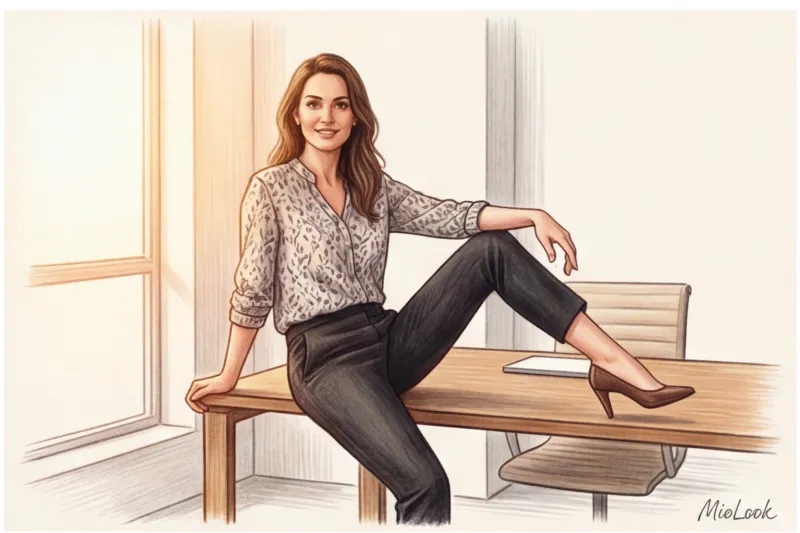
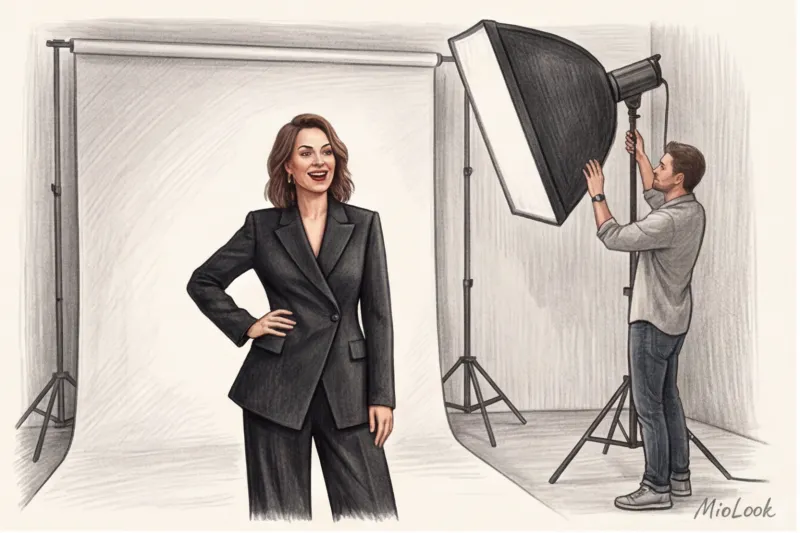
Use asymmetry. Place one hand on your hip (creating a triangle), and let the other rest at your side or support it—for example, by holding a tablet, glasses, or leaning against the back of a chair. Broken lines always look more interesting than straight ones.
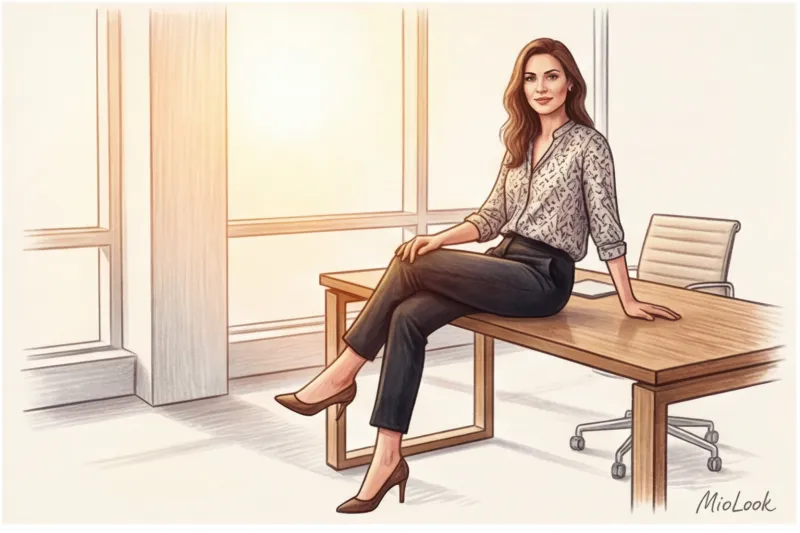
The Crossed Arms Myth: How to Avoid Looking Closed
Here I want to debunk the most popular stereotype. If you Google "women's business photoshoot poses," half the images will show you women with their arms crossed. This is considered a "boss pose." As a stylist, I'm categorically against this cliché 90% of the time.
Firstly, tightly crossed arms distort the fit of any formal attire. They pull at the fabric of the back, pull the jacket shoulders up toward the ears, and visually expand the chest. Secondly, body language research (in particular, an adaptation of Amy Cuddy's "power poses" concept for 2D) shows that if the hands are tucked under the armpits, 80% of the audience perceives such a pose as defensive, distrustful, or arrogant.
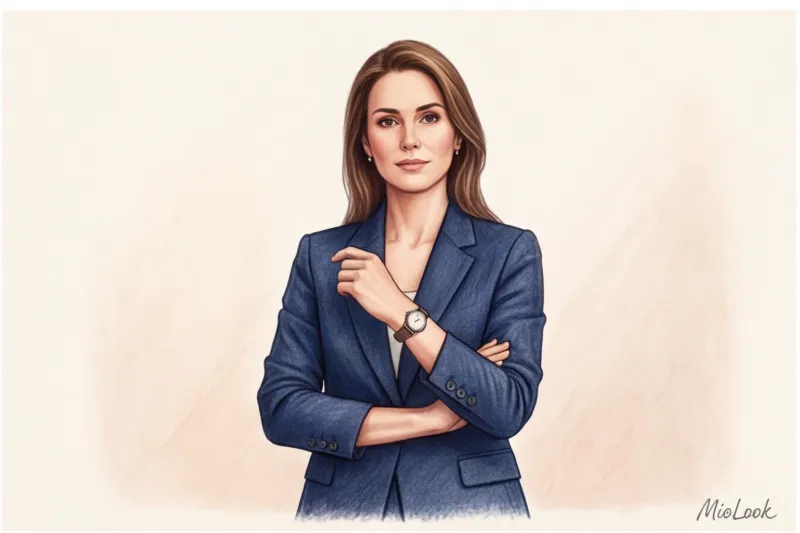
"Crossed arms are a wall between you and your client. In modern business, openness is valued, not defensiveness."
What to do instead? Use a "partial cross." One arm gently hugs your waist, and the other rests on it, with your hands Necessarily should be visible (for example, you're adjusting your watch or holding your cuff). This maintains a confident pose but removes the aggressiveness.
Your perfect look starts here
Join thousands of users who look flawless every day with MioLook. Digitize your wardrobe before your shoot.
Get access — €0.99 oncePosing with Clothes: How Fabric Dictates Your Movements
This is my favorite approach, which I teach to clients. You can't pose in a silk blouse the same way you would in a double-breasted wool suit. The pose must showcase the best features of the cut.
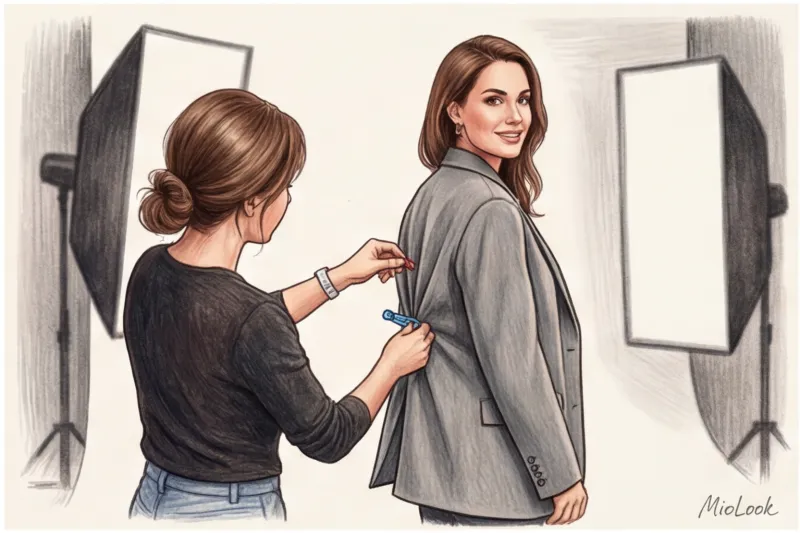
Rigid cut (jackets and suits)
Clothing made of dense fabrics (structured cotton, wool) with shoulder pads requires clear, graphic poses and straight lines. Static is king.
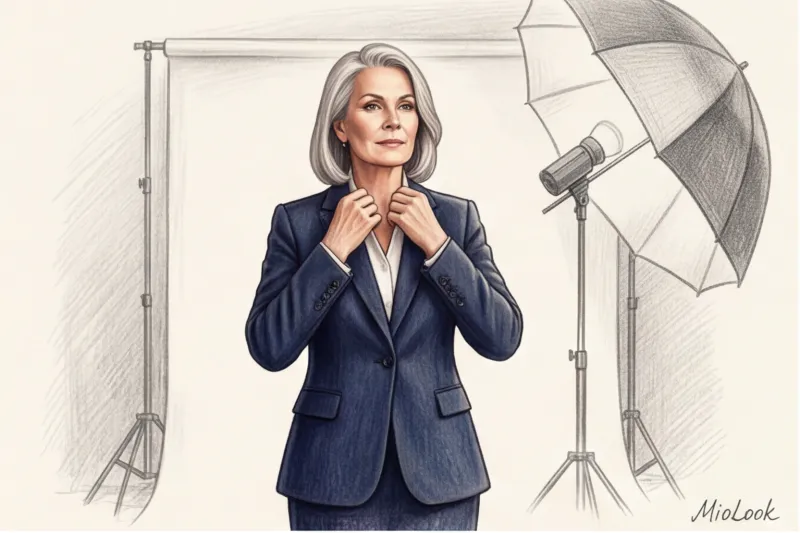
The main danger: raising your arms. If you wear a classic jacket from Zara or Massimo Dutti and raise your arm to your face, the shoulder pad will inevitably rise, distorting the line of your neck. In a tailored jacket, your arms should be working below chest level. The most you can do is adjust the lapel.
Soft textures (blouses, silk and knitwear)
If you're wearing a flowing silk blouse or cashmere cardigan, sharp, choppy poses will create a dissonant look. Soft textures call for a smoother look.
Here, slight tilts of the head, arches of the body, and sitting in a chair with one leg tucked in work great. The drape of the fabric should "play." If you use MioLook app To create your look, pay attention to the texture analysis function—it will tell you how much dynamism your top requires in the frame.
The Psychology of Posture: Conveying Status or Empathy
There's no universally "good" pose. What might sell a crisis manager's services perfectly might turn off a family psychologist's clients.
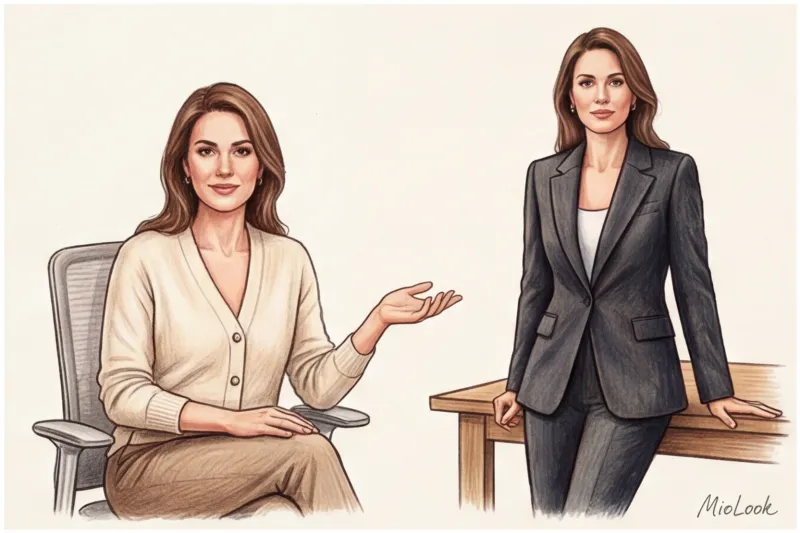
Leadership Poses (for Executives, Lawyers, and Finance Professionals)
Your task is to convey stability, authority, and boundaries. Use symmetry in your legs (supporting both feet, a confident stance) and asymmetry in your arms. The "owner of the space" pose works well: don't just stand next to the table; lean lightly on it with your hip or hand, claiming this territory. Keep your gaze direct, and your gestures minimalist.
Trust Poses (for psychologists, coaches, and HR)
Here we eliminate distance. The main marker of empathy in body language is a slight forward lean. If you're sitting in a chair, don't lean back (that's the observer's position). Sit on the edge, leaning your body 10-15 degrees toward the camera. Your shoulders should be soft, and your palms should be open or gently folded in your lap. A half-turned seat also reduces formality.
Ready to get started?
Try the MioLook free plan—no commitments required. Plan your photo capsule in 15 minutes.
Get access — €0.99 onceOn the Move: How to Create a Lively Shot in the Studio
"Standstill syndrome" is when you freeze in front of the camera, stop breathing, and your smile turns into a grimace. Static poses can kill naturalness, especially if you're not a professional model.
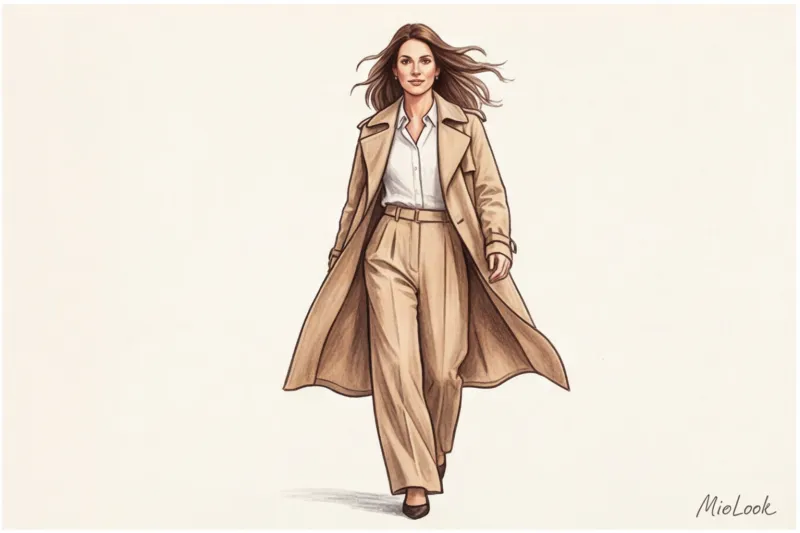
My favorite life hack for "unfreezing" my clients is the "step forward, step back" technique. I ask the woman to take a real step toward the camera, shift her weight, pause for a second, and then step back. At this moment, the photographer captures micro-phases of movement. The clothes come to life, the hair flutters slightly, and a meaningful look appears in the eyes.
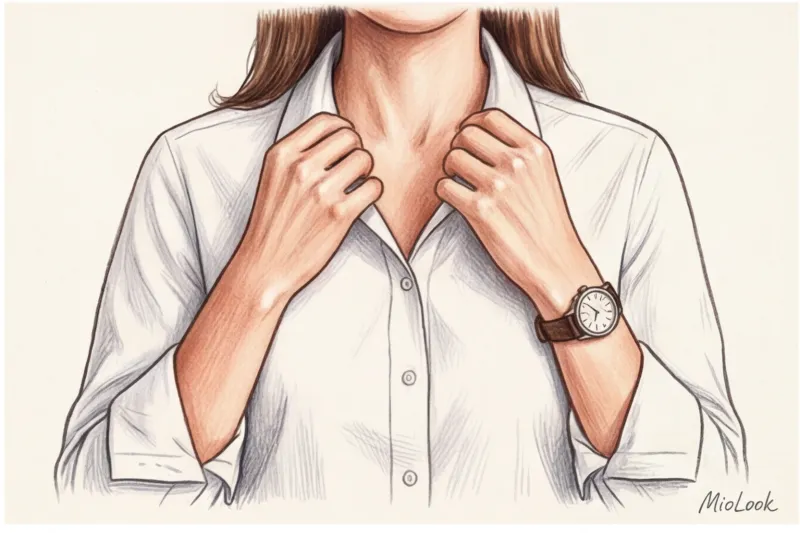
If there is no place to walk, use micro-movements Give your hands something logical to do. Adjust your shirt cuff, fiddle with the temples of your glasses, slowly button your jacket, or flip through the pages of your notebook. The camera loves these unfinished actions—they create a reportage effect, as if you were accidentally caught at work.
Before-the-Shutter Checklist: 5 Seconds to the Perfect Shot
Keep this algorithm in mind. When the photographer says, "Ready, shoot," you have exactly 5 seconds to check your body:
- Inhale-exhale. Take a deep breath through your mouth. Your shoulders will automatically drop a couple of centimeters, releasing tension in your neck.
- Checking the "air". Make sure your hands aren't glued to your ribs. Leave some space between your elbows and your waist.
- Chin control. Let's remember the "turtle neck": the crown of the head up, the chin slightly forward towards the lens.
- Focus in the gaze. Don't look at the lens glass. Look through It's as if your most important client is standing behind the photographer. This will give the look depth and awareness.
A business photo shoot isn't a posing exam. It's a tool for solving your business problems. Remember, confidence in the frame begins long before the studio—it begins in the fitting room. When your clothes fit perfectly and reflect your inner status, proper posture and elegant gestures will follow naturally.