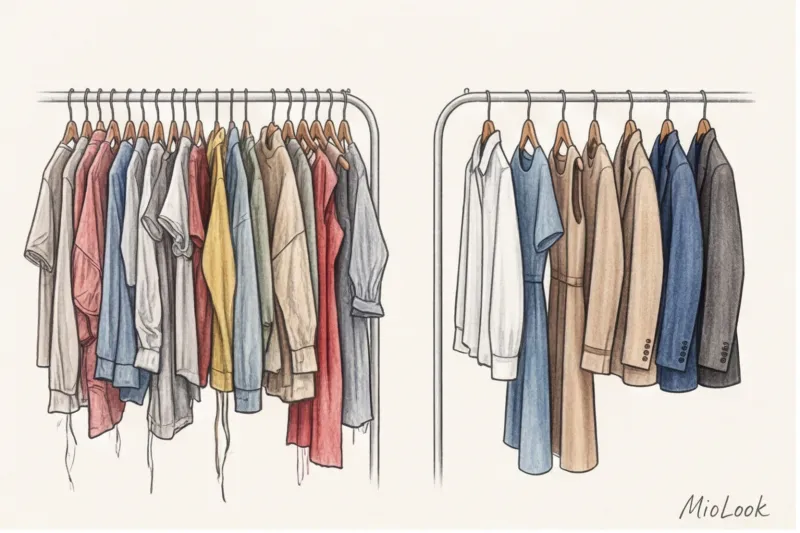

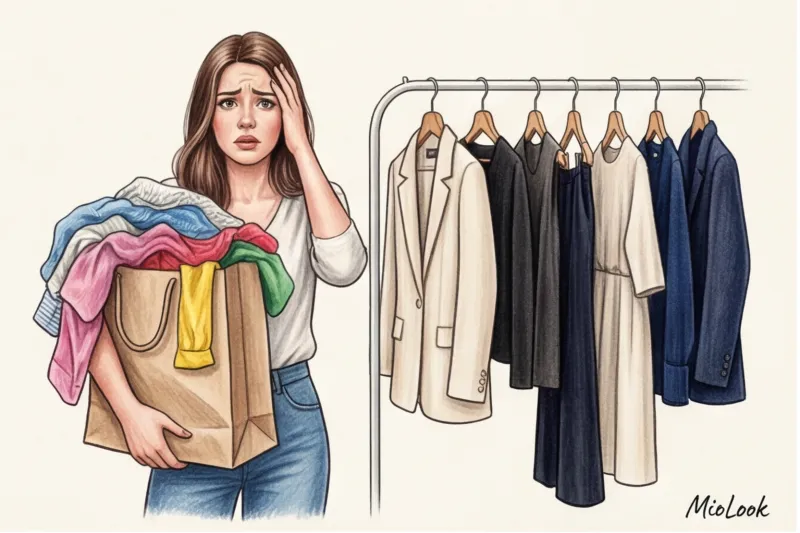
I remember one of my clients, Anna, throwing up her hands in despair at her enormous, literally bursting at the seams, closet during her first consultation. By the most conservative estimates, she was spending around 30,000 € a month on "bargain" purchases at mass-market stores. Her shelves were overflowing with sale T-shirts and ultra-fashionable skirts for the season, yet every morning she uttered that same proverbial phrase: "I have absolutely nothing to wear."
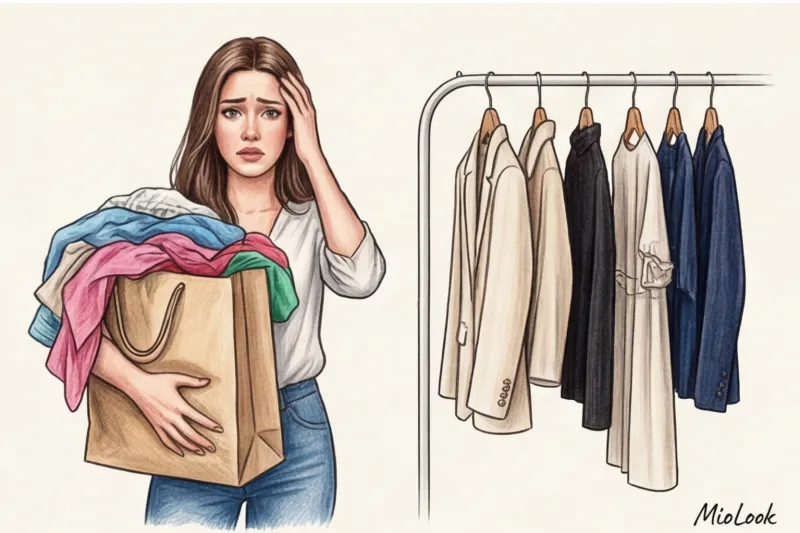
That's when we sat down at the table, got out the calculator, and I clearly showed her that buying cheap things is the biggest mistake when you're on a budget. budget capsule wardrobe It's not based on the ability to find the cheapest synthetic sweaters on sale, but on pure mathematics and an understanding of textures.
We have already discussed in more detail the basic principles of creating such a wardrobe in our the complete guide to creating a capsule Today, I'll share some insider stylist techniques: how to create the perfect foundation without breaking the bank, and why expensive items ultimately save you money.
Budget Capsule Wardrobe: Why the "Cheap and Plenty" Rule No Longer Works
The main trap of the modern fast-fashion industry is the illusion of affordability. You buy a T-shirt for 500 € and rejoice at the savings. But after the third wash, the side seams are crooked, the collar stretches out, and the item is consigned to the dacha (or the trash). You go buy a new one.
In styling we use the formula Cost Per Wear (CPW) — the price per exit. Let's calculate it together.
- Scenario A: You buy an acrylic sweater at a mass-market store for 2,500 €. After 10 wears, it's covered in unremovable pilling. Your cost per wear: 250 €.
- Scenario B: You find a basic 100% merino wool jumper (possibly on a resale site) for 12,000 €. With proper care, you'll wear it at least 100 times over the next five years. Your cost per wear: 120 €.
The math is relentless: a high-quality wool jumper costs you half as much as a cheap acrylic one. Moreover, according to a study published in The Wall Street Journal (2023), most women wear only 20% of their wardrobe 80% of the time. A well-designed capsule wardrobe changes this ratio to 100/100: every item in the closet earns its value down to the last penny.
To be fair, this mathematical approach doesn't always work. completely unsuitable If you use shopping as your weekly psychotherapy and buy things for a momentary dopamine rush, this capsule requires mindfulness and discipline.
Smart Color: How Color Can Help You Create a Budget-Friendly Capsule Wardrobe
As a certified colorist, I often see how chaotic color choices can ruin a budget. If you buy a complicated mustard-colored skirt that only matches one blouse in your closet, you've wasted your money. A capsule wardrobe only works when items can be easily mixed and matched.
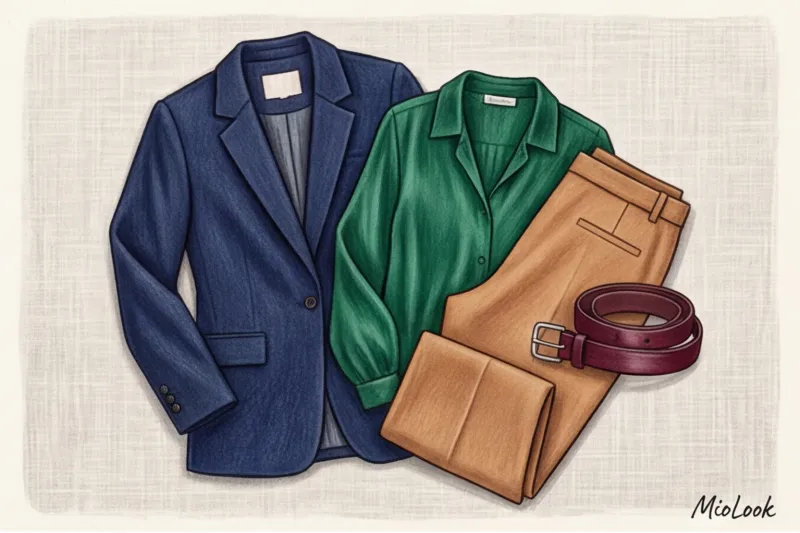
The secret to wardrobes that look "expensive" lies in the rule of Johannes Itten (the creator of the famous color wheel). The ideal color palette is built on a formula of three colors: base, nuance, and accent. But there's one nuance that the glossy magazines don't mention.
"Black is the worst base for a budget wardrobe. The black pigment on cheap polyester or viscose quickly washes out, and the fabric begins to shine or collect all the dust in the world, instantly revealing its low cost."
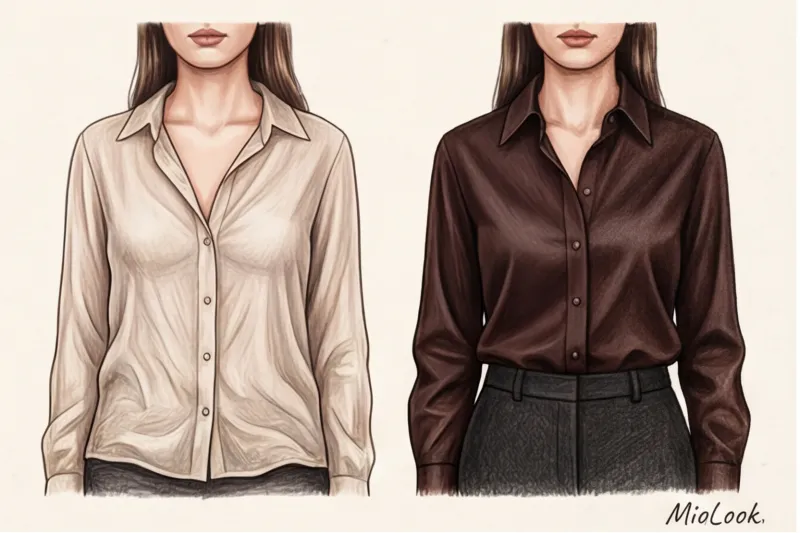
If your budget is limited, replace all-black with complex, deep shades. Rich navy, bitter chocolate, deep emerald, or warm camel can visually enhance even an inexpensive blended fabric. They create that signature "quiet luxury" aesthetic (old money) without the premium price tags.
Basic and accent shades without the extra expense
Choose two or three neutral colors as a base. For example, navy blue, beige, and graphite. You'll use these as a base for your most expensive items: outerwear, shoes, trousers, and jackets.
Instead, incorporate one or two accent colors (such as fuchsia or scarlet) through less expensive items: silk scarves, belts, basic tops, or socks. This will allow you to refresh your looks each season without having to rebuild your wardrobe from scratch.
Access to MioLook for €0.99 — one-time payment
A smart AI stylist will analyze your palette and select the perfect color combinations from your items.
Get access — €0.99 onceWhat you absolutely mustn't skimp on in a capsule
In styling, there's a golden rule: "frame." Shoes, bags, and outerwear are the frame of a painting. If the frame is cheap and shabby, even an original Picasso inside will look like a reproduction from a subway station.
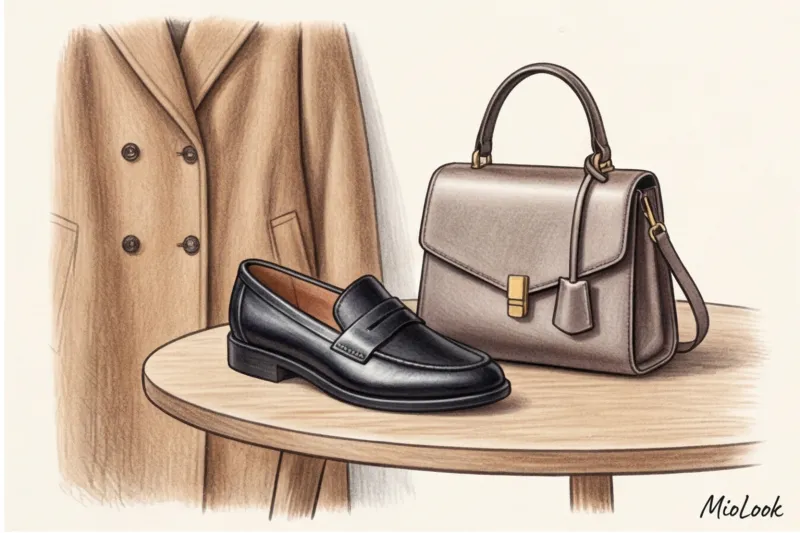
An expensive, structured leather bag with a rigid shape can elevate the simplest knit dress from H&M to Fashion Week street style. Conversely, a shapeless plastic bag will ruin a luxurious cashmere suit.
It's better to have just one pair of impeccable leather loafers in a versatile color than five pairs of cheap faux leather ballet flats that make your feet sweat. How can you visually identify a cheap item if you're shopping at a high-street store? Look at the hardware. Cheap, yellow, shiny metal zippers and buckles scream price. If your budget is tight, look for shoes and bags with matte or hidden hardware, or none at all.
Where to Buy Clothes: Building a Budget Capsule Wardrobe Like a Pro
Building a budget-friendly base means moving from mindless fast fashion to smart shopping. And here, international and local resale platforms (like Vestiaire Collective or local equivalents like Oskelly/Avito) become your best friends.
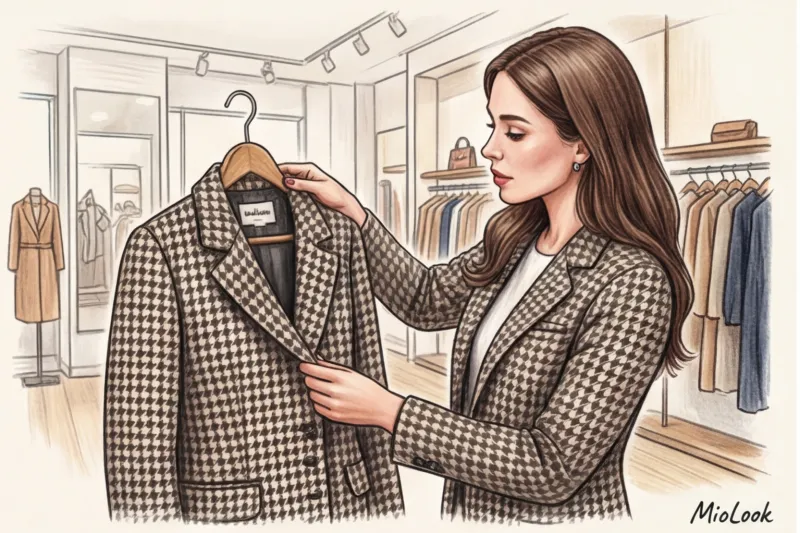
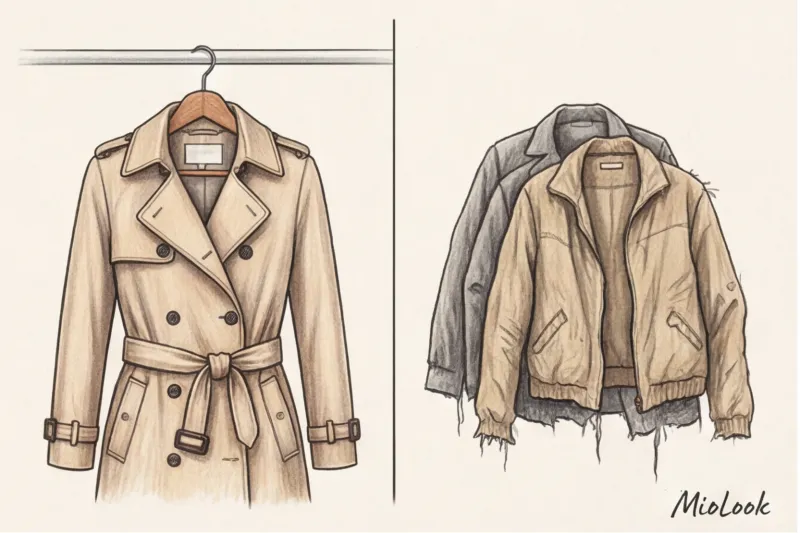
From personal experience: last month, I found a client the perfect double-breasted 100% wool jacket from a premium Scandinavian brand for just 15% of its original boutique price. It was in like-new condition. For the same price, the only thing we could buy at a mass-market store would be a thin polyester jacket, which is too hot in the summer and too cold in the winter.
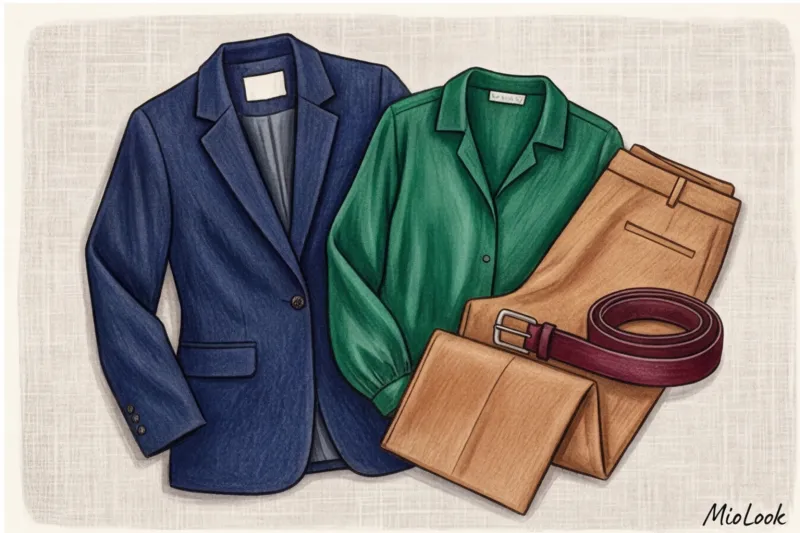
A stylist's checklist for finding diamonds at resale:
- Don't look for brands, look for ingredients. Search for: "100% wool jacket" , Massimo Dutti silk , COS cashmere.
- Set your filters to "new with tags" or "excellent condition."
- Always ask the seller for photos of the tags with the composition and the item's measurements in centimeters to avoid surprises.
Fabric Testing: How to Choose Quality in the Mass Market
If you do buy a basic item at a mass-market store, use my favorite life hack: the "fabric-in-a-fist" technique. Right in the store, squeeze the edge of the item tightly in your fist for 10 seconds, then release. If the fabric is very wrinkled, don't buy it. You'll spend half your life ironing, and by the middle of the workday, you'll look unkempt.
Read the labels. The textile industry is unforgiving: 100% acrylic will shrink within a week. Blended fabrics are ideal for a budget-friendly and durable base layer. For example, viscose with 20-30% polyester (which will prevent the fabric from stretching out too quickly) or heavy cotton with 5% elastane.
Your perfect look starts here
Join thousands of users who look flawless every day without spending hours getting ready with MioLook.
Get access — €0.99 onceThe Mathematics of Style: A 15-Piece Budget Capsule Checklist
Theory is great, but let's get down to the numbers. A true budget capsule wardrobe doesn't require 50 items. Just 15 well-chosen items (excluding underwear and outerwear) are enough to create around 40 different looks.
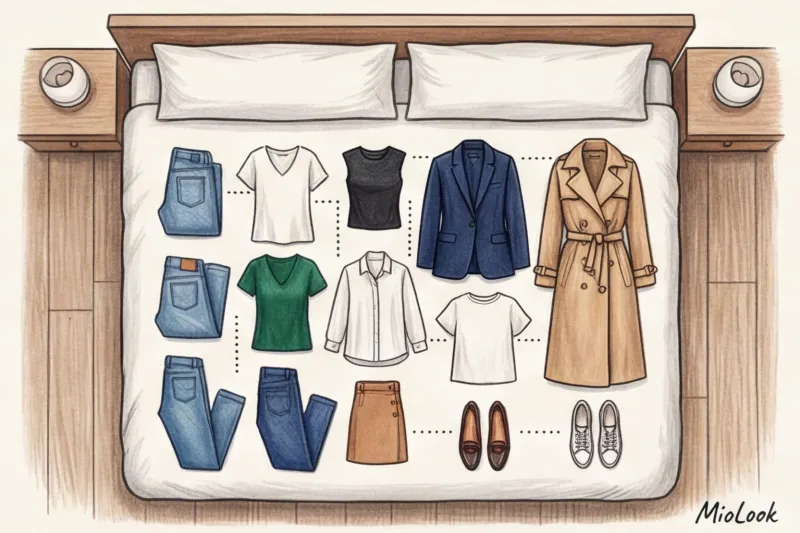
Here is a basic matrix that has been tested on dozens of clients:
- 3 "bottoms": Straight-leg jeans, creased palazzo suit trousers, midi skirt (straight or A-line).
- 5 "tops": A white structured t-shirt, a basic shirt (one size up), a thin turtleneck, a high-quality oversized jumper, a silk or satin top.
- 2 dresses: A slip dress (can be worn under a jumper as a skirt) and a casual, thick knit dress.
- 1 jacket: Voluminous, straight cut, covering the hips.
- 2 pairs of shoes: Basic white or off-white sneakers, classic leather loafers or ankle boots (depending on the season).
- 2 bags: A roomy tote bag for work and a small structured crossbody.
The budget for such a smart wardrobe is distributed as follows: 50% of the budget goes to the "framework" (jacket, shoes, bags), 30% - on the base (jeans, trousers, jumpers), and only 20% remains for accent tops and accessories.
Top 3 Myths About Affordable Capsule Wardrobes
Over the years of working as an image consultant, I've heard hundreds of objections. Let's dispel the most common myths that are holding you back.

Myth 1: “A capsule is boring, only grey and beige.”
Absolutely not true. From a color theory perspective, you can create a capsule collection with anything from fuchsia to neon green and purple. The key is to match the shades in temperature and saturation. If you adore bright colors, consider a deep burgundy or rich cobalt as your base.
Myth 2: “A budget wardrobe can be assembled in one day at a shopping center.”
The reality is this: building a proper capsule wardrobe takes months. It's a gradual, targeted process of replacing worn-out items with quality alternatives. Don't try to buy everything at once—you'll inevitably make mistakes and end up spending more.
Myth 3: “I’ll have to throw away all my favorite things.”
The most paradoxical insight I've learned from my practice: a boring wardrobe consisting only of "correct" basics is the most expensive. Why? Because you quickly get tired of it. Your brain starts demanding emotions, and you break out and buy downright weird things. You need to build a capsule wardrobe. around something you already love. Do you have a favorite red skirt? Great, let's make it the centerpiece of the composition.
How to start building your budget capsule wardrobe today
The first step to a perfect closet isn't a trip to the mall with a credit card in hand. It's a complete audit of what you already own. Lay out absolutely everything you have on your bed. You'll be surprised, but you probably already have three or four great basics, they're just buried under piles of "loungewear" and "things for when I lose weight."
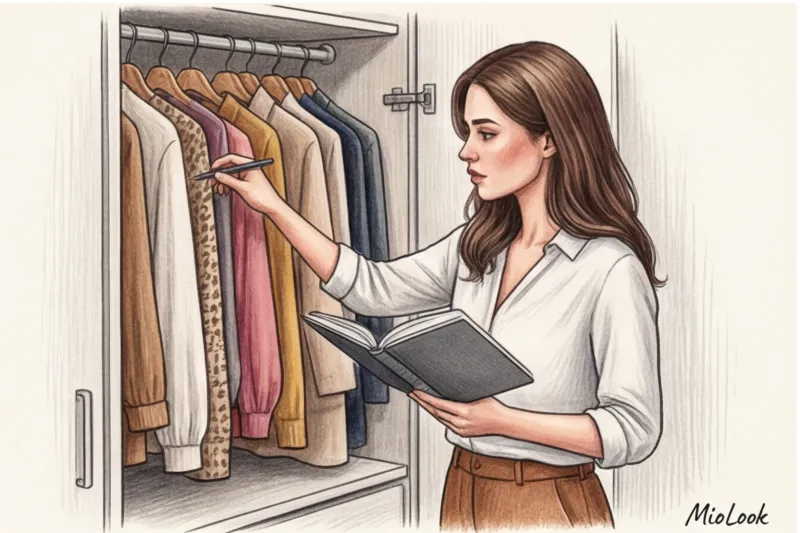
After your audit, create a "deficiency list"—a list of two or three items you need to complete your look (for example, a high-quality beige jacket or thick, unworn jeans). With this list in hand, set out on your search, tracking the ingredients and checking the hardware.
To prevent this process from turning into chaos, I highly recommend digitizing your closet. By installing an app MioLook , you can upload photos of your items and let artificial intelligence show you dozens of new combinations based on what you already own. You'll clearly see exactly what you're missing and stop buying duplicates.
Remember this: the most stylish women on the streets of Milan or Paris aren't those with unlimited credit cards. They're the ones who know their colors, understand textures, and know how to calculate the cost of every appearance.