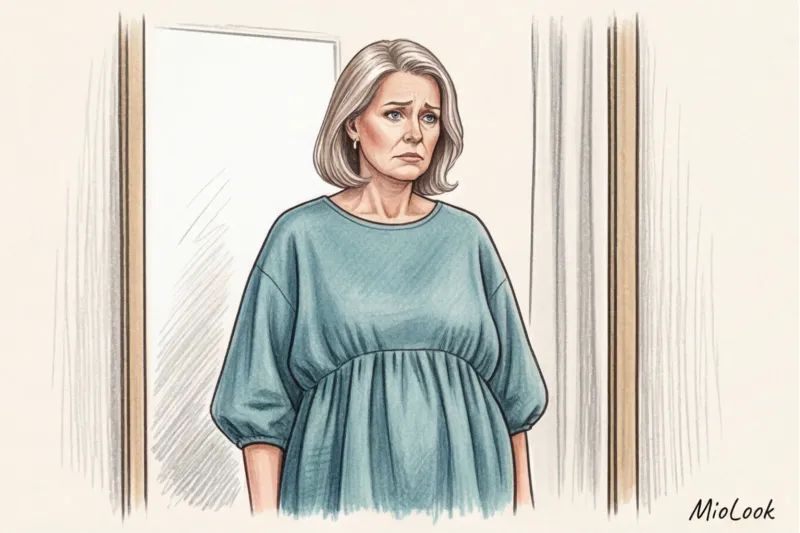
Introduction: The "Balakhon" Illusion
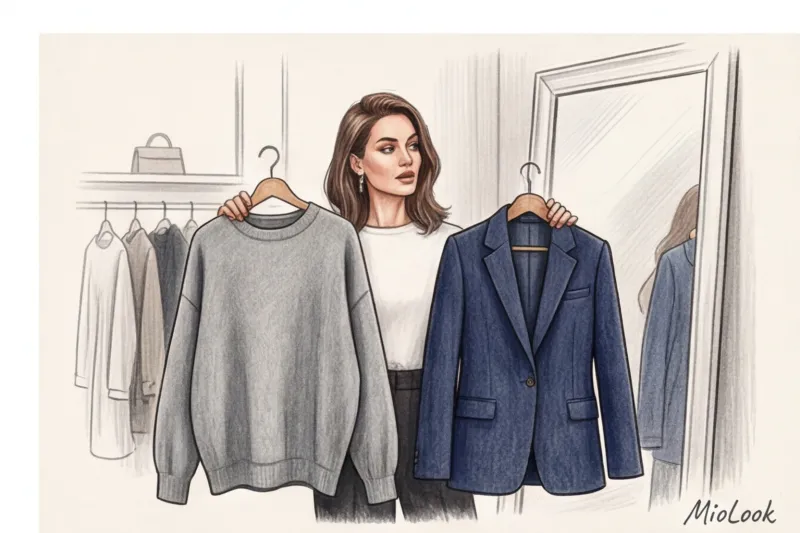
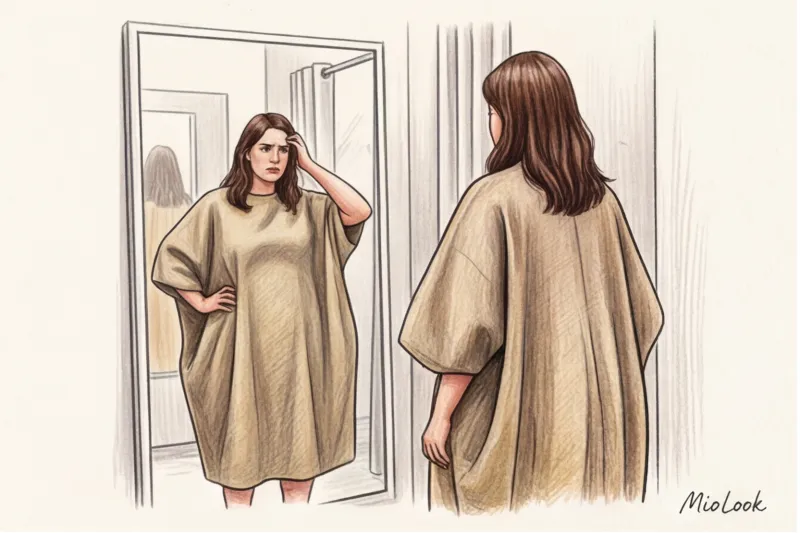
It's a familiar situation: you grab five loose blouses from the fitting room, hoping to hide your budding belly, only to see in the mirror a monumental figure that's visually grown two sizes too big. You sigh in disappointment and buy another shapeless black sweater.
As a practicing stylist, I see this scenario every week. We're used to thinking that volume hides volume. But the truth is, cut architecture and fabric density (that same GSM metric) work much more effectively than meters of flowing fabric. We've covered the physiology of these changes in more detail in our complete guide to... How to hide a belly and love handles with clothing after 40 , and today we’ll talk exclusively about the top.
Let's figure out which ones blouses that hide the belly which ones really work, and which ones should be left on store shelves without regret.
The Biggest Mistakes: Why Our Traditional Tops Stop Working for Us
After 40, your figure changes, even if your weight remains stable. Declining estrogen levels lead to a redistribution of body volume: the waist becomes smaller, creating a so-called "life preserver." And the first thing 90% of women do is start hiding in oversized clothes.
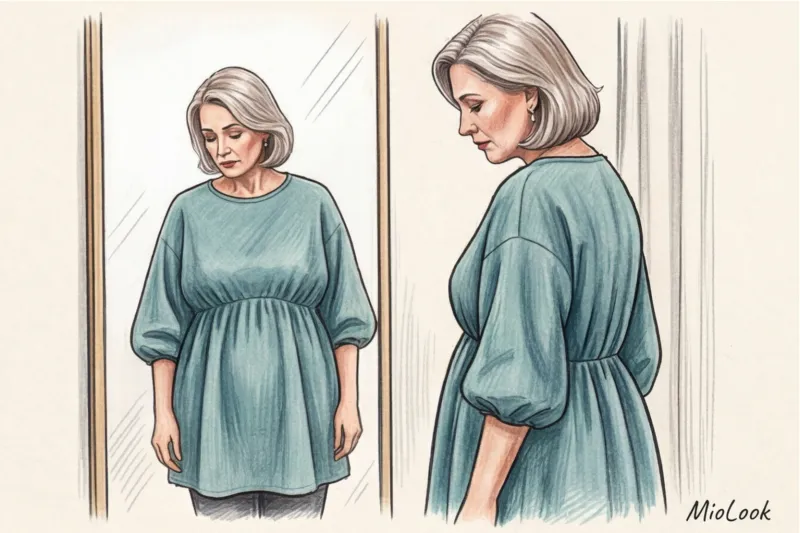
Last week, a client brought in a stack of empire-waist tunics and babydoll blouses from H&M for a wardrobe review. She was convinced they were her savior. I photographed her in them and showed the result: the gathers under the bust created a classic "expecting-to-be" silhouette, adding about 22 pounds to her figure.
- The Oversized Myth: A shapeless robe won't hide your belly; it will simply expand your entire figure to fit that belly. You'll become a square.
- The "pregnancy" effect: The empire waist (cut just below the bust) is your worst enemy. The fabric falls from the widest point of the bust, creating a sail-like appearance.
- The Trap of Fine Knitwear: According to fitting room statistics, 80% of thin viscose (kulirka) items from the mass market are tight-fitting and emphasize even the body contours that are not actually there.
Access to MioLook for €0.99 — one-time payment
A smart AI stylist will select the perfect look based on your individual characteristics.
Get access — €0.99 onceCut architecture: ideal blouses that conceal the belly
The main rule for waist contouring is to eliminate horizontal lines and create verticals with diagonals. The more defined the lines of the blouse, the more composed the silhouette will appear.
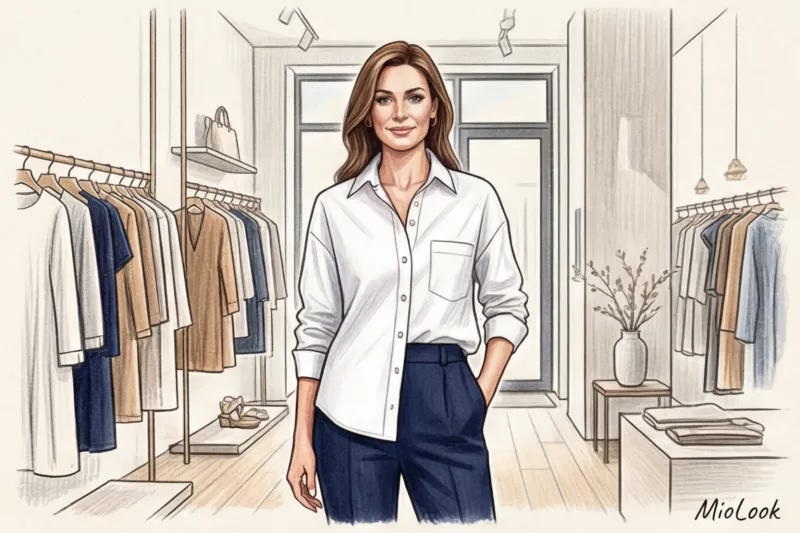
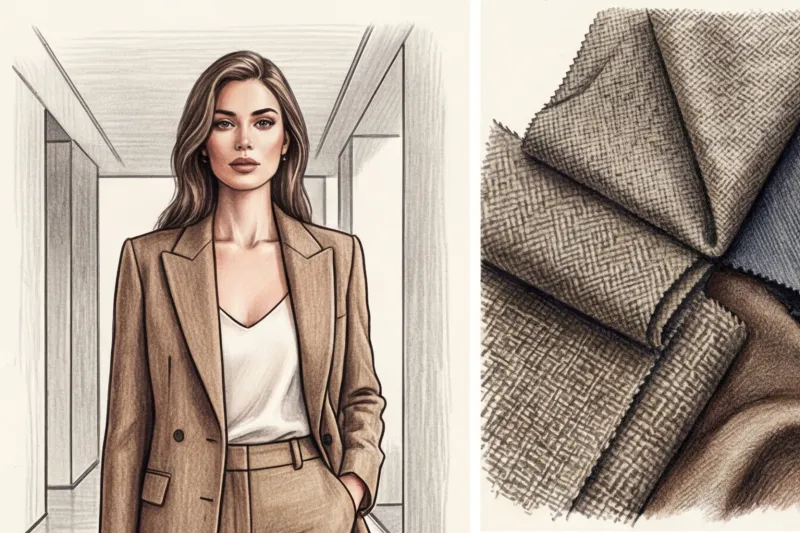
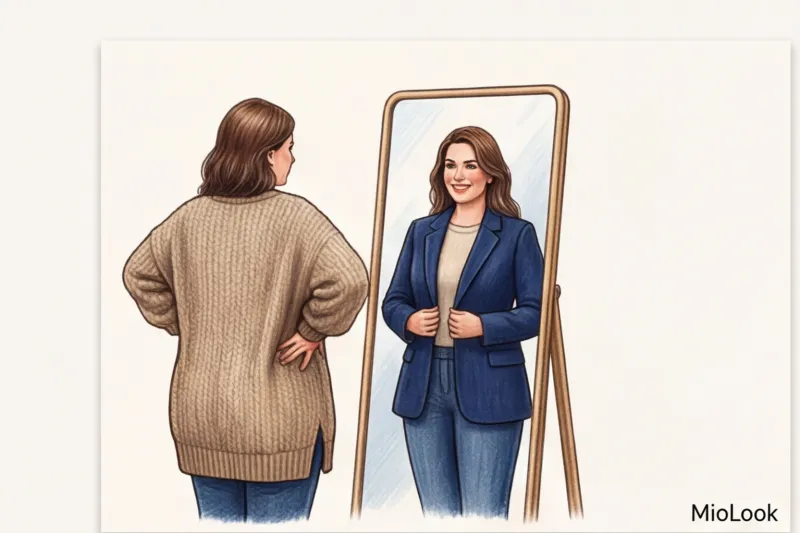
A real-life example: I went into COS with a client, and I suggested she try on a thick, straight-cut shirt instead of her usual flowy blouse. The difference was dramatic. The straight shoulders and thick fabric created a frame within which her belly simply "disappeared."
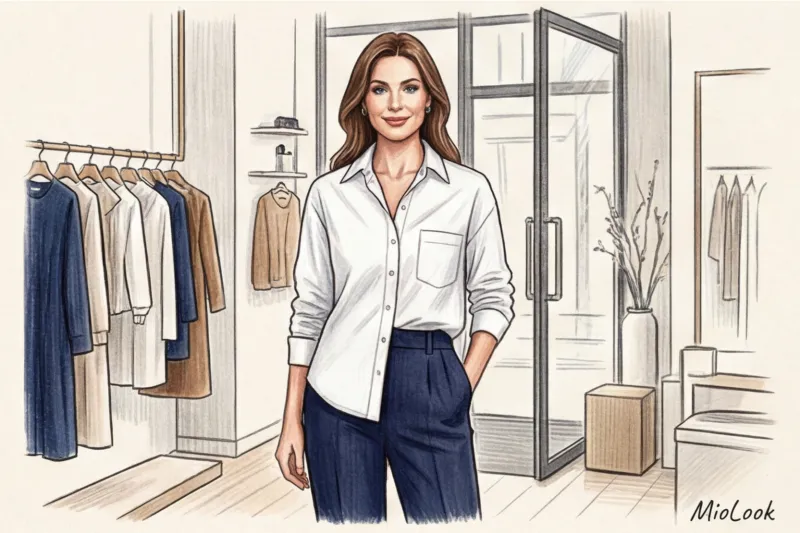
What to look for in stores:
- Men's cut shirts: Women's blouses often have darts at the waist that dig into the sides. A men's (or straight) cut falls in a straight line from the armpit to the hip. Check out Zara's men's department—you'll be surprised at how much better basics fit there.
- Wrap tops: But there's a catch! The wrap should be pinned slightly to the side or draped asymmetrically. If it's tied right down the center of your stomach, you'll create an unnecessary accent.
- Asymmetry: An uneven hem, an extended back, or a diagonal seam work as an optical illusion, causing the eye to move up and down rather than outward.
Saving details: collars, V-necks, and sleeves
To draw attention away from the center of the body, you need to shift the focus to the portrait area and graceful limbs. Learn more about How to visually lengthen your neck , we wrote earlier, but the main rule for the top is to expose the collarbones.
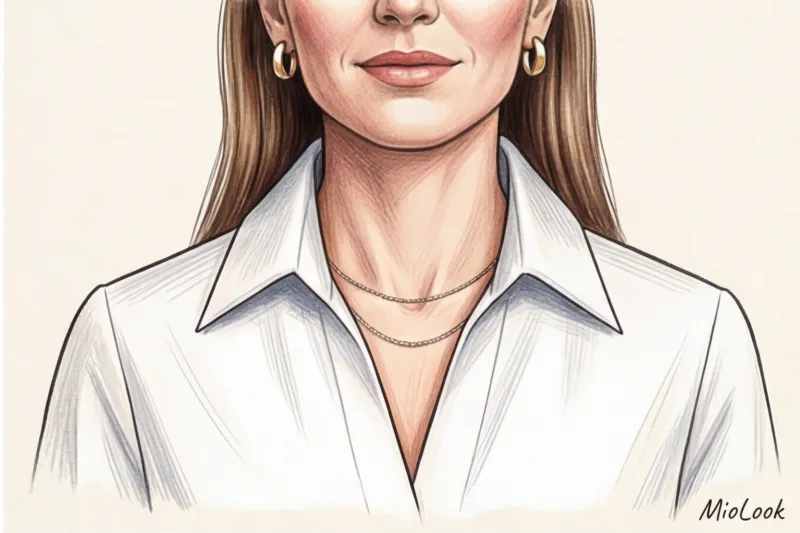
A deep V-neckline elongates the silhouette better than any diet. Add a crisp, well-starched collar, and the look instantly becomes a statement piece. 3/4 sleeves or rolled-up cuffs reveal slender wrists, subconsciously making the entire figure appear more fragile.
Fabric is everything: density versus treacherous shine
Remember the stylist's golden rule: the fabric of your clothes should always be thicker than your body If the fabric is softer (thin knitwear, cheap polyester), it will inevitably cling to every fold.
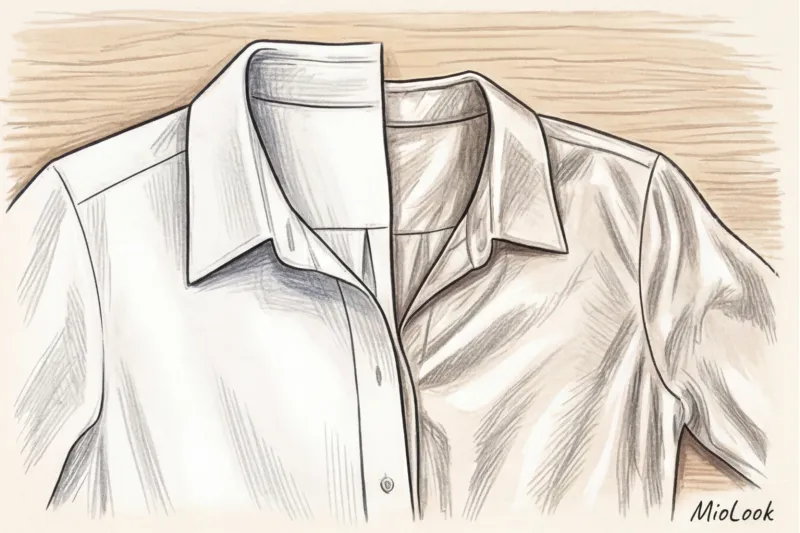
In the textile industry, there's a metric called GSM (grams per square meter). Mass-market blouses often have a density of 90-100 g/m²—that's too thin. You need a density of 130 g/m² or higher. How can you check this without going to a lab? A simple test in the store: put your hand under the blouse. If you can clearly see the outline of your fingers or the lace of your underwear, the garment will accentuate your stomach.
"The danger of shine: satin, silk, and sateen reflect light. Any bulge on your stomach in a satin blouse will catch the glare and appear 1.5 times larger. Choose matte textures: heavy poplin, linen with viscose, tencel (lyocell)."
Let's do the math. Investing in one high-quality, heavy cotton shirt from Massimo Dutti or COS will cost around €70. It will survive dozens of washes and always retain its shape. The alternative is to buy three flimsy viscose blouses for €25 each, which will lose their shape after the first wash and end up sitting in your closet like dead weight. The economics of a conscious wardrobe are clear, especially when we're collecting basic capsule wardrobe.
Your perfect look starts here
Join thousands of users who look flawless every day with the MioLook app. Digitize your wardrobe and get ready-made outfits.
Get access — €0.99 onceThe Art of Tucking: How to Wear Tops and Shirts
The most common mistake is tucking your blouse into your pants. This creates a sharp horizontal line right at the midsection of your stomach.
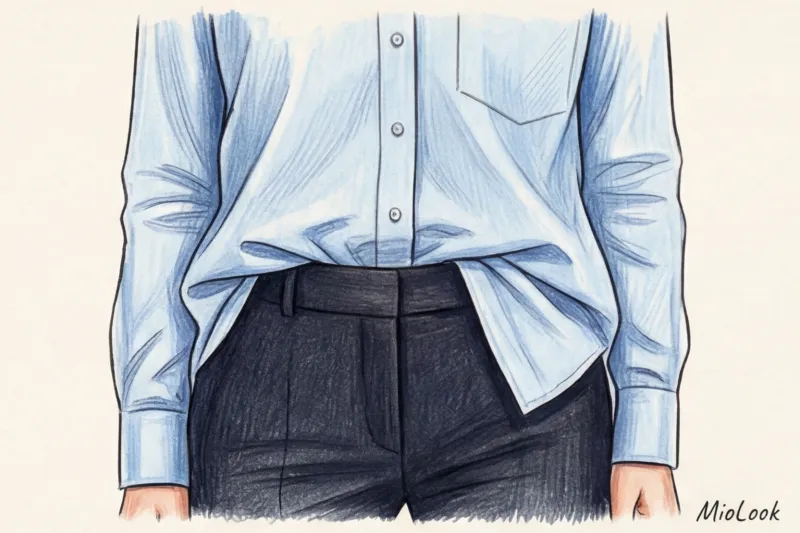
Instead, use the French tuck technique. Here's how to do it in front of a mirror:
- Take the edge of the shirt only from the front (literally 5-7 centimeters wide).
- Tuck this small section into the waistband of your jeans or trousers, slightly shifting it from the center towards your hip.
- Pull the fabric back slightly to create an overlap.
- Leave the sides and back exposed.
This technique creates diagonal folds that skillfully disguise volume while still showing off your waist. If you prefer to wear blouses loose, be mindful of the length: the hem should end 2-3 fingers below the most prominent point of your stomach, but strictly higher the widest part of your hips. If your shirt ends at the widest part of your hips, you'll add volume there too.
Prints and Colors: Optical Illusions for the Waistline
Forget the "black is slimming" rule. Yes, black absorbs light, but if you wear a black blouse with white pants, you'll cut your figure in half with a contrasting line. This is disastrous for the abdominal area.
A monochrome look (color column) works much better. A beige blouse with beige pants (even if in slightly different shades) will create a continuous vertical line. This will visually add height and flatten your stomach. You can easily create such combinations by uploading your items to the app's "smart wardrobe" feature. MioLook.
Speaking of prints:
- Avoid large flowers: A huge peony placed right on the belly will act as a target.
- Choose small geometry: Ripples, abstractions, crow's feet, or thin stripes cause the eye to lose focus. Against such a chaotic background, the brain simply cannot calculate the true volume of the body.
When it does NOT work: A horizontal striped vest made of thin cotton. The stripes should be either vertical or diagonal. Horizontal stripes are only acceptable on very dense, shape-retaining fabrics (such as a chunky knit jumper).
Checklist: How to Test Blouses in the Fitting Room
I teach this algorithm to all my clients, and it reduces the percentage of impulsive and unsuccessful purchases to almost zero. Ideal office blouses for plus-size women or casual Friday tops are tested the same way.
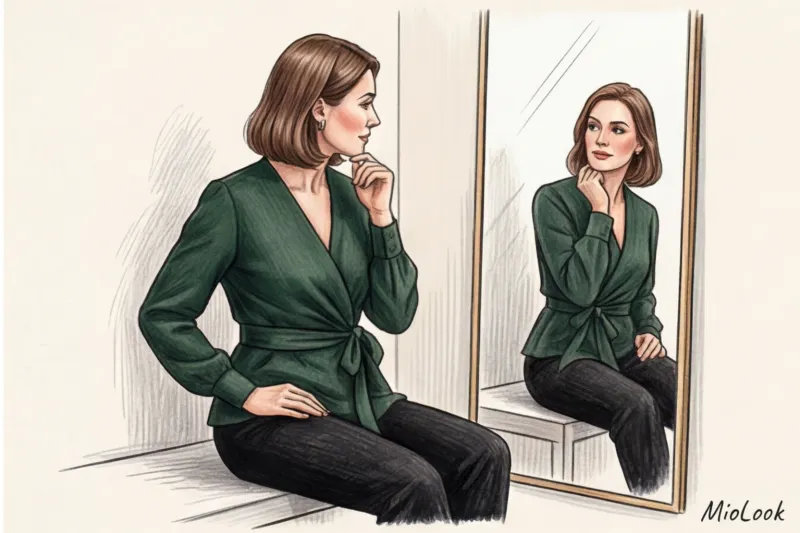
Before you go to the checkout, do three tests:
- "Sitting Test": Stand up, and then be sure to sit on the fitting room bench. Your belly always gets bigger when you sit. Are the buttons coming apart at the chest and waist? Is the fabric digging in? If so, leave the item in the store. It will betray you at your first work meeting or dinner.
- Profile Test: Turn sideways. The blouse should fall loosely across your stomach and back. If it's pulled tight between your shoulder blades and stomach, creating a drum-like effect, you need a different cut or size.
- Shoulder seam assessment: Even if you're wearing a loose shirt, the shoulder seam should be perfectly in place (unless it's a deliberately dropped raglan shoulder). A crisp shoulder line is the framework that holds the entire silhouette together.
Let's sum it up
Blouses that conceal the belly aren't magical blouses made of thin fabric. They're pieces with a clear design, crafted from thick, matte materials, and featuring straight or diagonal lines. Ditch the empire waist for a classic men's shirt, master the French half-hitch, and you'll see how your reflection in the mirror changes. The main secret of style isn't hiding the body, but rather correctly directing the focus.