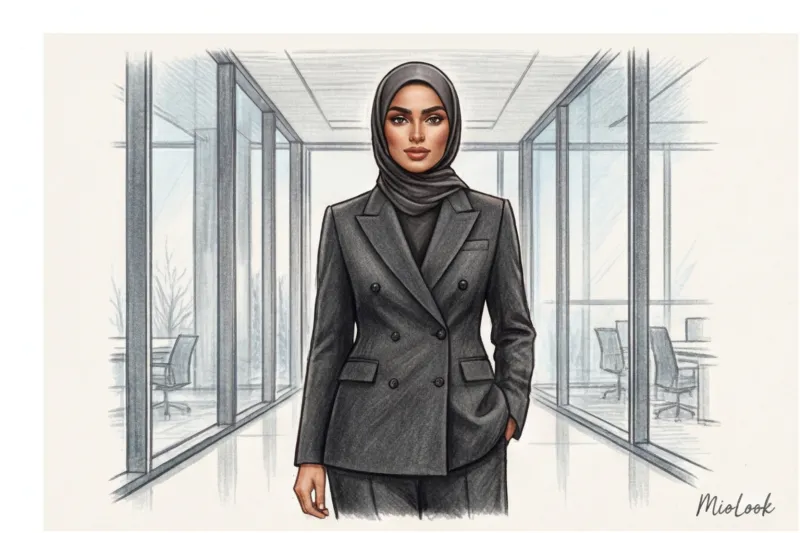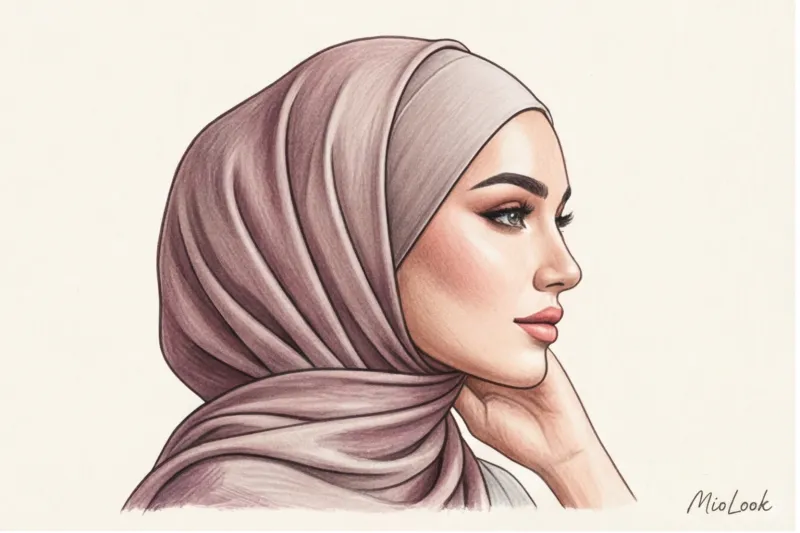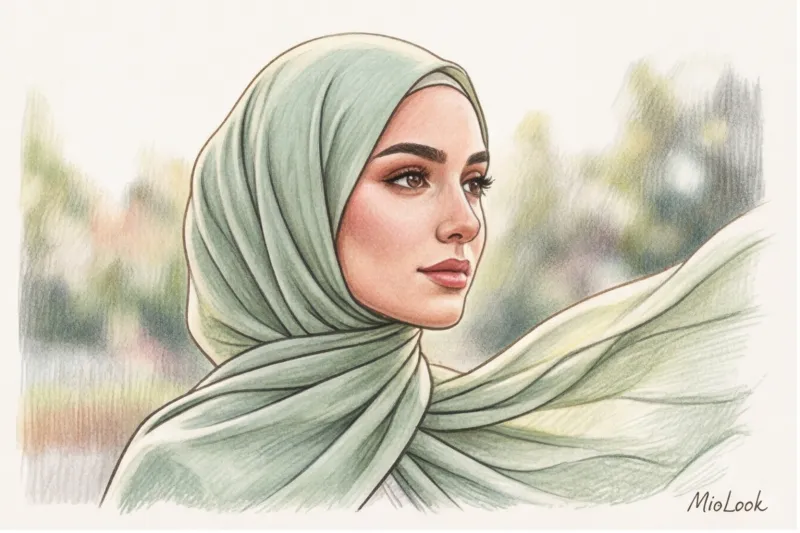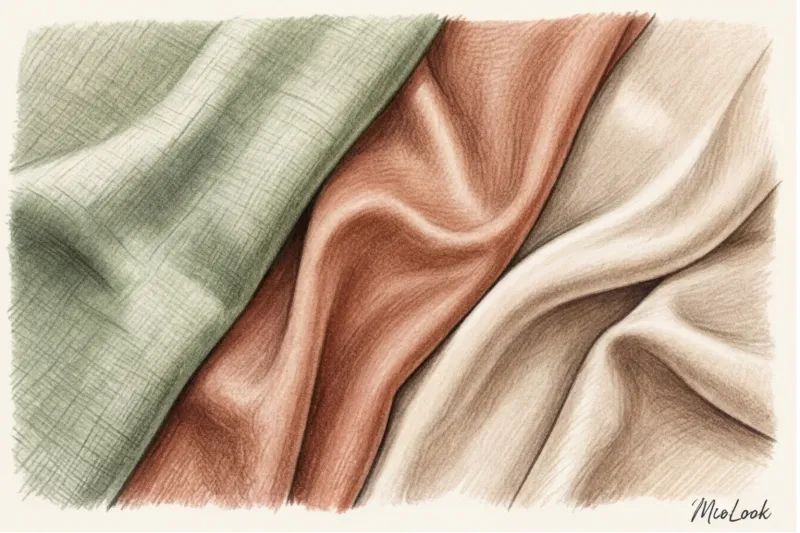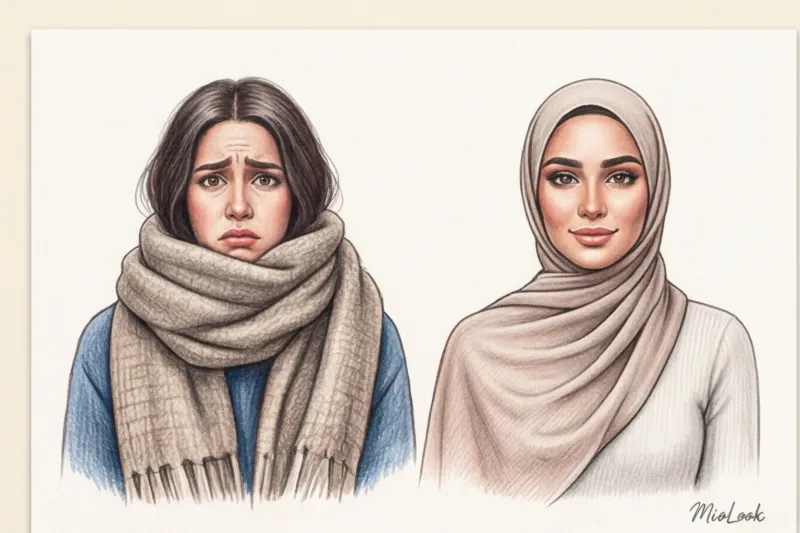
Have you ever noticed how the cold outside in winter penetrates your bones, and the moment you take the subway or enter a café, you physically urge to rip off your scarf due to the unbearable greenhouse effect? Many women endure this discomfort for years, mistakenly believing that the key to warding off the cold lies in the thickness of the fabric. As a stylist and textile researcher, I'm ready to challenge this stereotype: the thickest fabric is almost never the warmest.
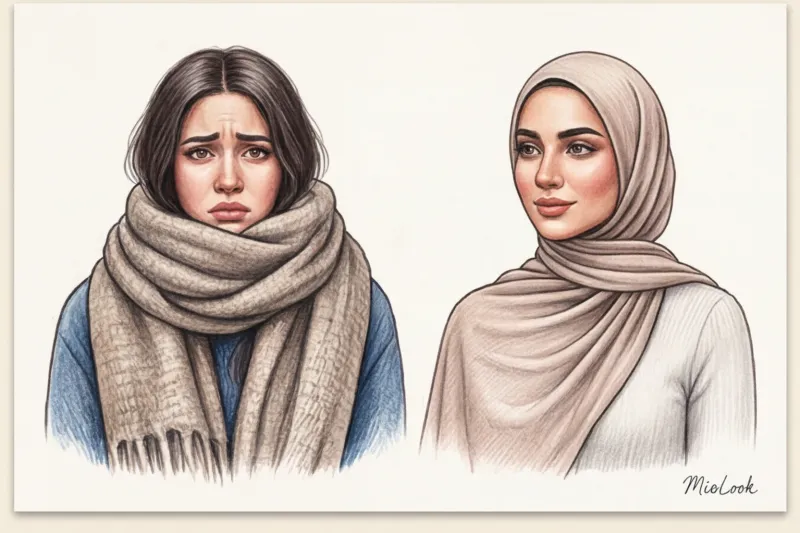
Before we move on to the physics of fibers, it's important to cover the basic question of coloristics. We covered this in more detail in our A complete guide to choosing the right hijab color But in winter, the ideal shade is only a visual layer. Physical comfort depends on what winter fabrics for hijab you choose for your base.
The Anatomy of a Winter Hijab: Why Fabric Thickness Is a Trap
The biggest enemy in winter isn't the cold, but your own moisture. When you step into a heated room from outside wearing a thick acrylic scarf, your scalp inevitably begins to sweat. Cheap synthetics can't wick away moisture, creating a greenhouse effect. And when you step back out into the cold, that moisture trapped under the scarf instantly cools. The result? You're much colder than if you were wearing a thin, but properly constructed material.
In textile physics there is an indicator clo (thermal resistance of clothing). Research shows that the thinnest layer of merino wool has a higher clo index per gram of weight than a thick layer of acrylic. It's not the fabric itself that retains heat, but the microscopic air pockets between its fibers.
Over 12 years of working as a stylist, I've noticed another side effect of "snowman scarves." A bulky stole, wrapped in three layers, makes women slouch. It restricts the neck's mobility, distorts the proportions of the portrait area, and visually adds 5-7 kilograms to the silhouette. Elegance requires flexibility, and warmth requires intelligent thermoregulation.
Access to MioLook for €0.99 — one-time payment
A smart AI stylist will select the perfect look for any weather, taking into account your color type and preferences.
Get access — €0.99 onceTop 4 Natural Winter Hijab Fabrics That Actually Keep You Warm
According to the WGSN global textile agency's 2024 report, demand for functional natural fabrics has grown by 40%. Consumers are tired of "plastic" clothing. This is critical for the hijab: the fabric is in contact with the sensitive skin of the face and neck for up to 12 hours straight. Here are four favorites that I personally test and recommend to my clients.
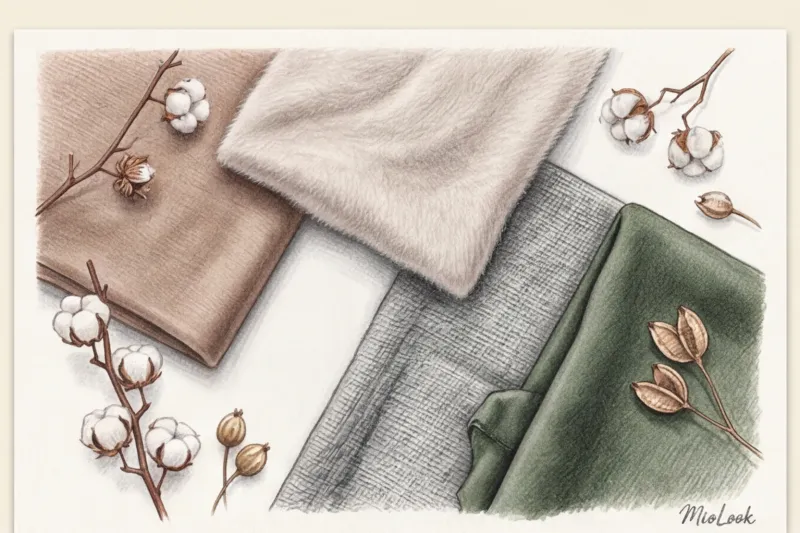
Merino wool: the gold of your winter wardrobe
If you think wool is necessarily itchy, you simply haven't tried quality merino. Merino fiber is three times finer than human hair (approximately 17-19 microns). When in contact with the skin, it bends gently rather than digging into it.
Merino wool is unique in its hygroscopic properties: it can absorb up to 30% of its own weight in moisture while remaining completely dry to the touch. This is the ideal winter hijab fabric For city dwellers who constantly commute between the street, the car, and the office.
Cashmere and modal-cashmere blends
100% cashmere is luxurious, but let's be honest: it's difficult to care for and quickly loses its shape when draped with pins every day. My insider tip: look for blends. The ideal proportions are: 70% modal (or viscose) and 30% cashmere.
Modal gives the fabric fluidity, a beautiful, heavy drape, and durability, while 30% cashmere creates that weightless downy layer that retains body heat. This scarf is easy to style into complex folds without creating excess bulk around the neck.
Premium Jersey (wool blend)
For lovers of casual style and sporty chic, jersey is an indispensable option. But for winter, regular cotton knitwear isn't enough. Look for blends that contain 10-15% angora or fine-wool wool in addition to cotton and elastane.
Thanks to its dense, interlocking knit, this winter jersey blocks wind perfectly. It fits snugly against the face without requiring a million pins, which is especially valuable in severe frosts when you don't want to fiddle with needles outside.
Thick cotton with brushed lining (fleece)
This is a unique yet stylish choice for pairing with oversized down jackets and parkas. The front of this scarf is smooth, while the back has a soft pile that creates a barrier against cold air. Cotton is hypoallergenic, so if your skin is prone to winter dermatitis or reacts to any animal fibers with redness, this is your savior.
Your perfect look starts here
Join thousands of users who look flawless every day with MioLook. Upload your items and receive ready-made capsules.
Get access — €0.99 onceThe Hidden Threat: Synthetics in Winter and Hair Health
Recently, a client named Amina came to me. She complained of sudden dandruff, severe static, and breakouts along her hairline. We analyzed her skincare routine, but the cause turned out to be her wardrobe. All winter, she'd been wearing a beautiful, voluminous, but 100% acrylic stole.
According to dermatological studies on the effects of microclimate on the scalp, synthetic fibers (polyester, acrylic) disrupt the natural microbiome. Not only do they create the aforementioned "greenhouse," but they also generate powerful static electricity. The constant friction of synthetic fibers against the hair under the scarf lifts the cuticle. Moisture evaporates from the hair shaft, causing the hair to become brittle, dull, and prone to breakage.
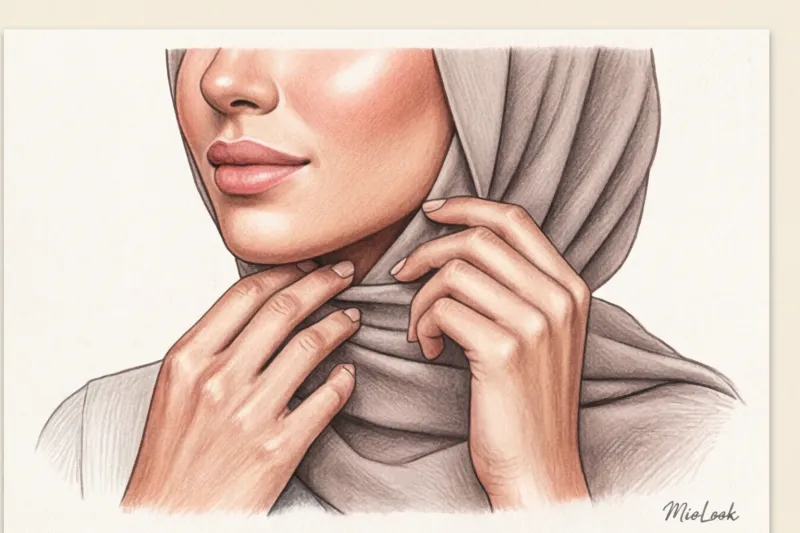
I'm not advocating completely eliminating polyester—a small amount (up to 20%) in blended fabrics increases the lifespan of a garment. However, the base layer that comes into contact with the head should be strictly natural.
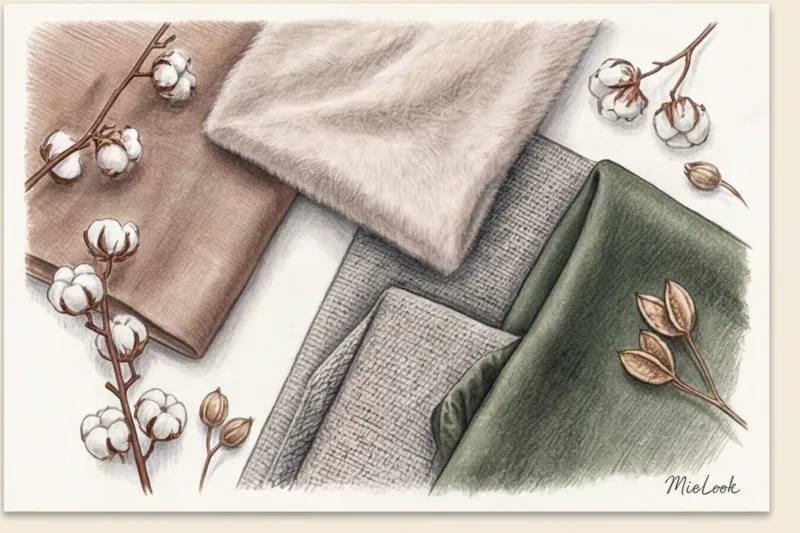
The Art of Layering: Bonnets as a Thermal Foundation
If you wear a hijab, you know the rule of layering. But in winter, it's not for volume, but for insulation. The air trapped between the inner cap (bonnet) and the outer scarf is your main heater. Just like professional mountaineering gear.
Most girls buy cotton bonnets out of habit. In winter, this is a mistake. Cotton absorbs sweat quickly but dries very slowly. If you're sweaty, the damp cotton will keep your head cool all day. My personal styling trick: switch to bamboo knit bonnets (they have antibacterial properties) or invest in silk-lined undercaps - hats with silk lining.
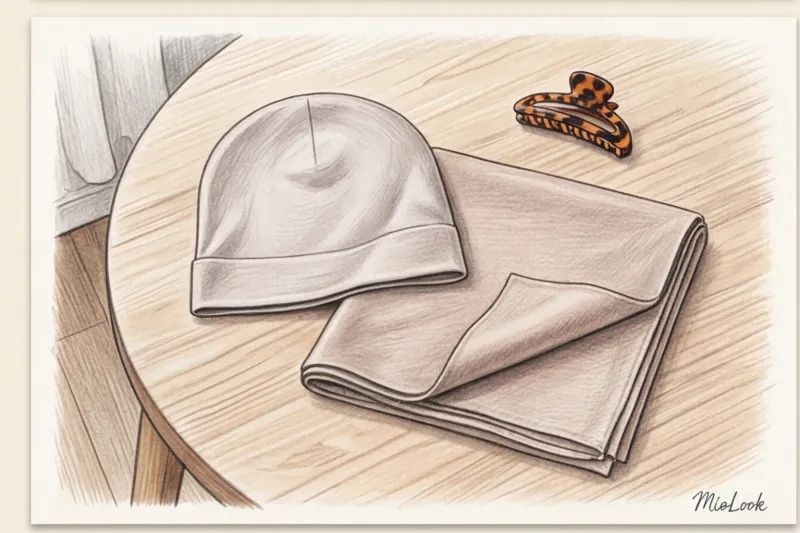
The silk inside the cap protects hair from friction, prevents tangling, and retains its natural moisture. And the outer layer of bonnet provides the necessary grip to prevent the wool scarf from slipping off.
How the volume and texture of the fabric around the face influences style and proportions
Fabric texture directly influences color. We discussed the optics of shades in detail in the article "Style Foundation: How to Match Your Hijab Color to Your Skin Tone and Undertone" , but in winter, the rules of the game change slightly. Fleecy, matte fabrics (cashmere, wool) absorb light. Because of this, the same color on a silk scarf will appear bright and vibrant, while on a cashmere one, it will appear deep, muted, and dark.
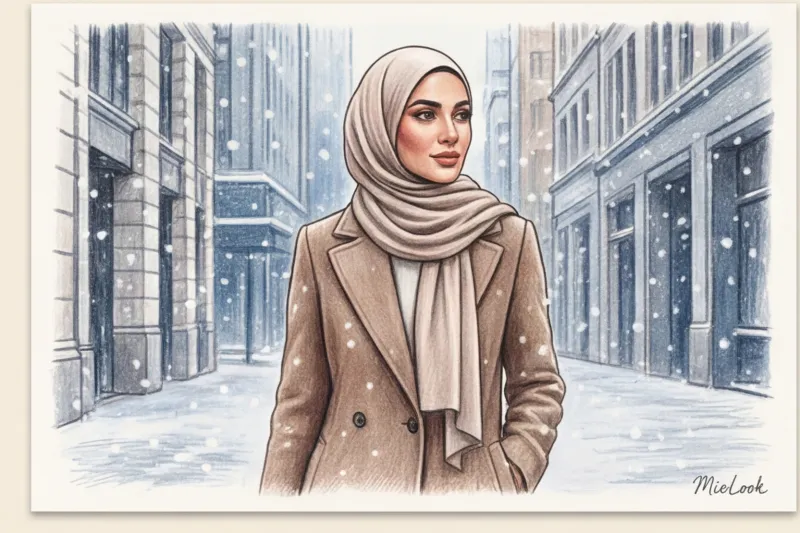
The most common winter styling mistake is clashing collars. When you put on a double-breasted wool coat with an English collar and try to wrap a thick stole over it, your neck visually disappears. Your head appears "squashed" into your shoulders.
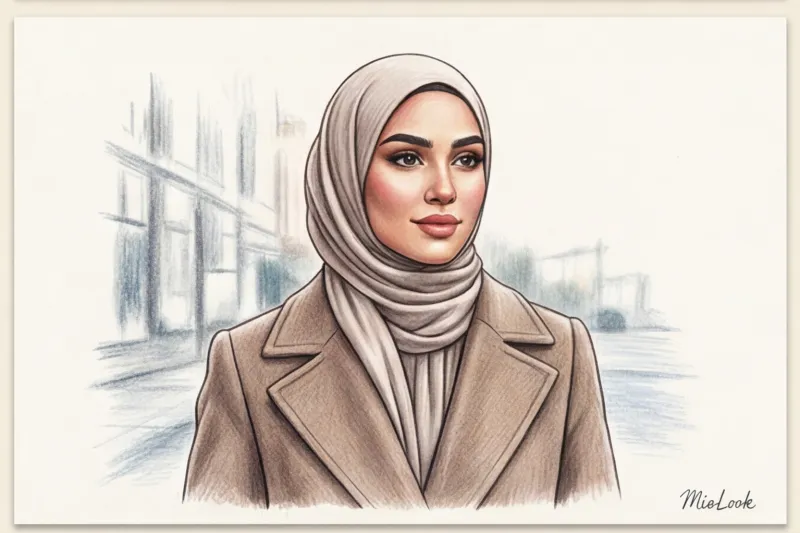
How to avoid this?
- Use the V-line principle. If the coat collar is thick, the ends of the scarf should be tucked in, creating a smooth layer on the chest, rather than creating rings around the neck.
- Maintain stylistic unity. A matte raincoat jacket pairs perfectly with winter jersey or fleece. A classic coat pairs perfectly with fine merino wool or modal cashmere. Avoid mixing glossy summer satin with heavy winter wool—this clash will cheapen the look.
Ready to get started?
Try a free plan—no commitments. Digitize your wardrobe with MioLook and get daily outfit recommendations.
Get access — €0.99 onceA Stylist's Checklist: How to Choose and Care for Winter Hijab Fabrics
You can determine the quality of the fabric right in the store using the "wrinkle test." Firmly squeeze the edge of the scarf in your fist for 10 seconds and then release. If the fabric feels like paper, it contains too much cheap viscose or poor processing. If the creases smooth out quickly, you have a high-quality, elastic thread.
Caring for natural winter fabrics is a ritual. But it's worth it to ensure they last for years:
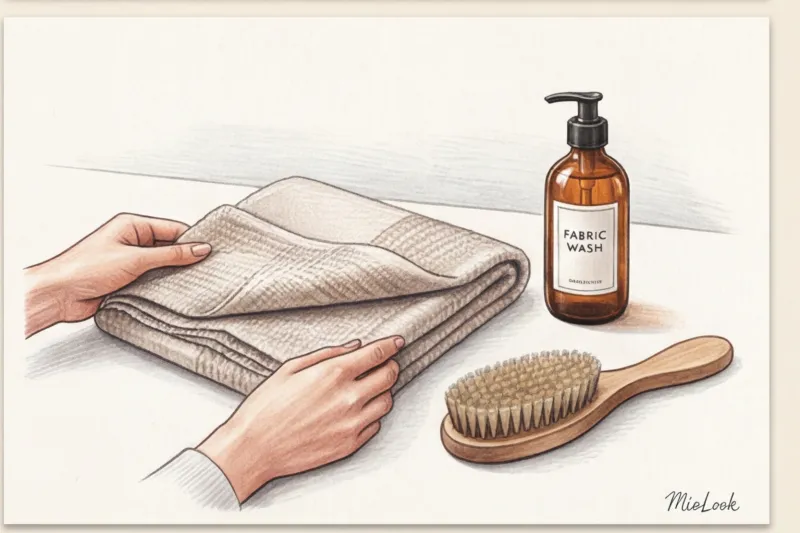
- Washing without shock. Wool and cashmere are sensitive to temperature fluctuations. Wash and rinse them in water at a consistent temperature (no higher than 30°C). Use liquid eco-friendly detergents containing lanolin, which restores the fiber's natural softness.
- Proper drying. Never hang wool hijabs on a line. Dry them horizontally on a towel only, otherwise the fabric will deform under its own weight.
- Fighting pilling. The appearance of pilling where it rubs against the coat collar is normal for 100% natural wool. But be careful: pilling machines are only suitable for densely knitted fabrics. Never "shave" a thin pashmina or modal cashmere stole with a machine—you'll just cut a hole. For such delicate fabrics, use a special cashmere comb.
Summary: Warmth without compromising on style
Investing in high-quality winter hijab fabrics isn't just a fashion statement. It's about the health of your hair, the condition of your skin, and your everyday comfort. It's much more cost-effective to have three high-quality scarves in your wardrobe (for example, black merino, beige modal cashmere, and graphite jersey) than ten cheap acrylic scarves that will leave you both sweaty and cold.
Sort out your winter accessories today. Put away the overtly synthetics, check the ingredients in your basics, and make sure your wardrobe is working for you, not against you.
If you want to cleverly integrate new scarves into your existing wardrobe, try add them to your digital closet in the MioLook app The neural network will help you create dozens of stylish and warm combinations with your outerwear, saving you from the morning hassle of pondering in front of the mirror.