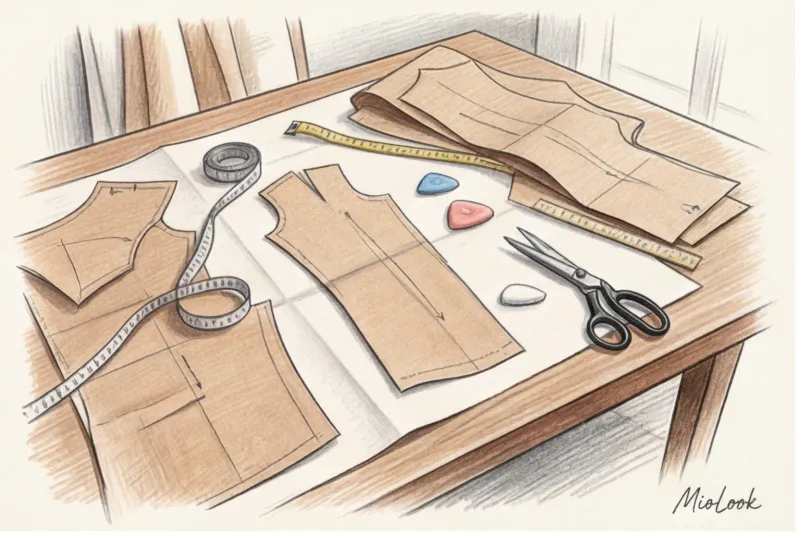
The Illusion of a "Standard" Size: Why Specialized Rulers Are a Necessity
Over 12 years of working as a personal stylist, I've conducted hundreds of wardrobe reviews. And every time I see the same picture: approximately 80% of the items that clients label as "wrong fit," "fat," or "make me look boxy" are not a problem with their figure at all. They are the result of a desperate attempt to stretch standard cut patterns to fit an atypical frame. When we begin reassembling the basics, many are surprised to learn that specialized plus size clothing brands , as well as lines for petite and tall girls - this is not a marketing ploy by brands, but a strict technological necessity.
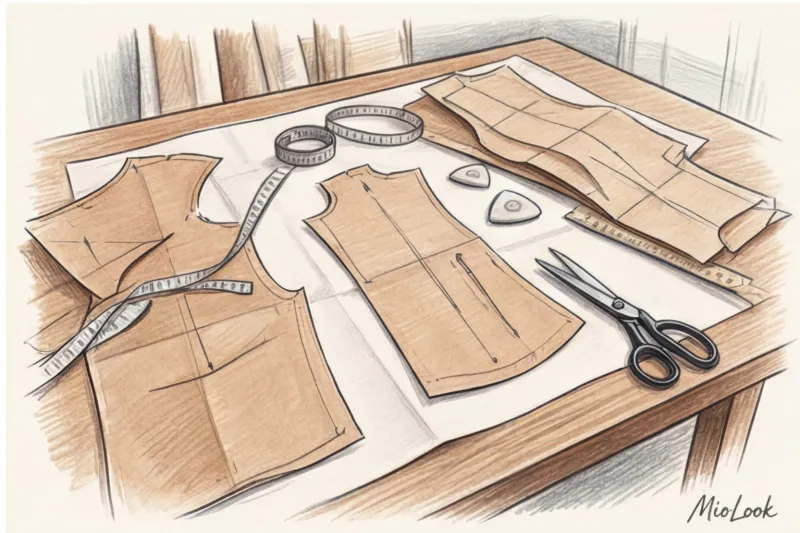
Why have we struggled with poor fit for so long? The answer lies in the rigid economics of production. According to a 2023 McKinsey analytical report, the fashion market has historically been plagued by a colossal paradox: for decades, the industry has blatantly ignored the needs of the nearly 70% of women whose measurements fall outside the runway standard. Basic patterns in mass-market factories are created for a single, standardized mannequin (usually a rigid size M for a height of 168–170 cm). Developing entirely new patterns for different body types was considered too expensive for corporations.
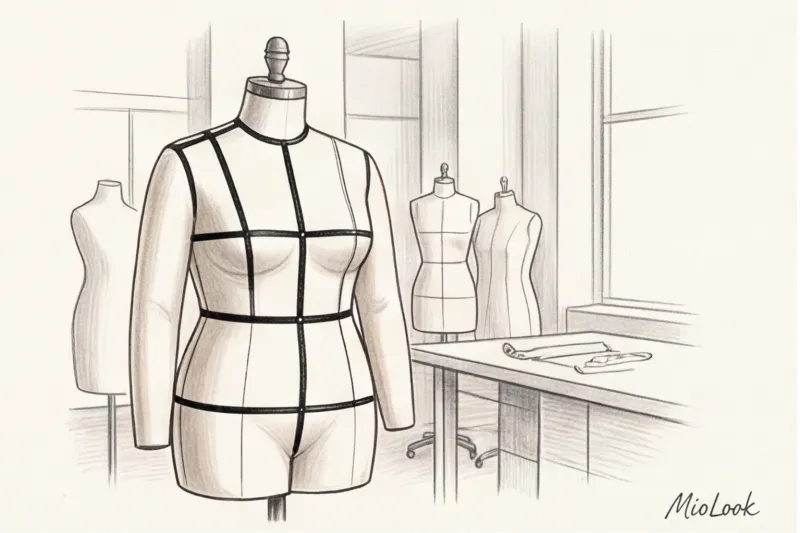
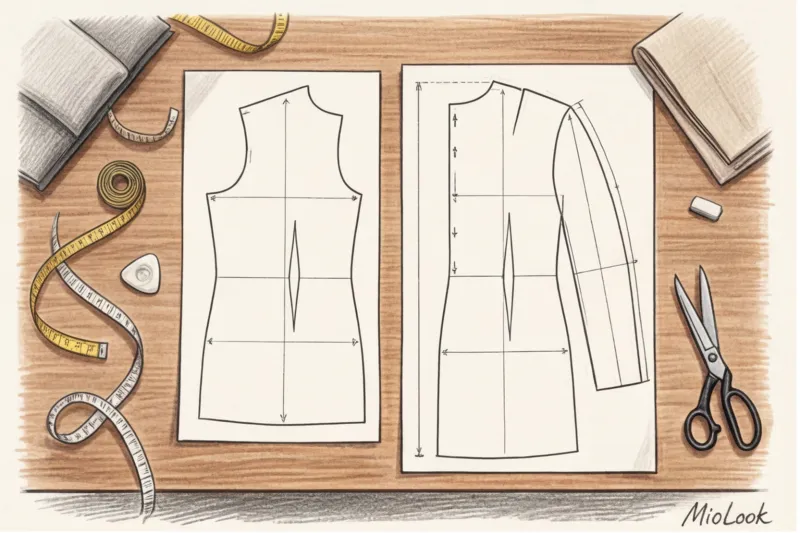
Instead of creating new designs, manufacturers use a lazy method—linear "pattern grading." To turn a size M into an XXL, the factory simply adds a couple of centimeters uniformly along all edges of the pattern. But a woman's body doesn't expand proportionally in all directions like a balloon! As a result of this mechanical scaling, the fit is completely ruined: the armholes become enormous and bunch up unattractively at the armpits, the bust darts "move" somewhere toward the collarbones, and the shoulder seam treacherously slides down. For petite or tall women, this grading is also fatal—the waistline is always out of place. About How to choose a quality basic T-shirt We've talked about this before, but it's important to understand: even premium cotton won't save a garment if its cut is initially calculated mathematically incorrectly.
"Clothing should adapt to your body's anatomy, not your body compressing or deforming for the sake of clothing. This is the basic rule of comfort that mass-market fashion has made us forget."
In an attempt to somehow compensate for manufacturing flaws, we constantly make compromises. One of my clients regularly spent €100 to €150 a month on tailoring services: taking in the waist of her jeans, shortening the sleeves of her jacket that were too long, and altering buttons. But constant trips to the tailor not only mercilessly eat into your budget. By tampering with the finished product, you inevitably ruin the original design. For example, if you shorten standard-fit trousers too much to fit a petite rise, the anatomical knee level shifts, causing the flare to begin in the wrong place. And taking in the saddle seam of jeans so they don't pull in the front is practically impossible—a point worth remembering for anyone studying... How to choose quality jeans without stretched knees.
Abandoning the illusion of a "standard" size and switching to specialized lines radically changes the quality of life. And this is confirmed by the raw data: the internal analytics of the smart app. MioLook Studies show that users who build a capsule wardrobe primarily from specialized lines spend an average of 15 minutes less on their morning routine. They don't have to constantly fidget in front of the mirror, adjusting their hem, pinning their neckline, or trying to conceal a bulging waistband with a belt. A properly designed garment simply fits like a glove and works for you from the very first moment.
The Best Plus-Size Clothing Brands: Where to Find the Perfect Fit
Now that you understand how standard factory grading ruins your fit, it's time to stop wasting money on clothes that simply aren't designed for your body. Many women spend years blaming their bodies for ill-fitting pants, when the problem lies solely with the manufacturer's laziness.
I constantly test patterns on my clients and can confidently say: jeans made from the right, dense denim with a well-designed fit visually elongate the silhouette a hundred times better than any aggressively shaping fabric or shapewear. When we look for reliable plus size clothing brands We demand not compromise, but engineering precision and an understanding of anatomy. Let's take a look at the brands that revolutionized this niche.
"The golden rule of a stylist: clothes should adapt to your curves, and you shouldn't shrink to fit the flat, two-dimensional patterns of the mass market."
Universal Standard: The Gold Standard of Industry
This brand isn't just a clothing label, it's a true manifesto of inclusivity. Their approach has changed the entire market. Most classic brands take size S patterns and mathematically scale them up using a computer program. This scaling results in armholes moving toward the waist, and the chest opening revealing half the torso. Universal Standard took a fundamentally different approach: they use real fit models for each size in its line.
Moreover, they've turned the traditional sizing chart upside down. Their size M is equivalent to a US 18, because that's the size the average woman wears, according to independent data. A basic T-shirt made of thick Peruvian cotton will cost around €50, while a perfectly tailored dress will cost between €120 and €150. These are items that retain their shape after a dozen washes.
Denim without compromise: Good American and Levi's Plus
One of the most common complaints I hear in my consultations is, "My jeans fit perfectly on the hips, but they bulge so much at the waist you could fit two fists in there." This is due to the anatomical difference between the waist and buttocks, which standard fits simply ignore.
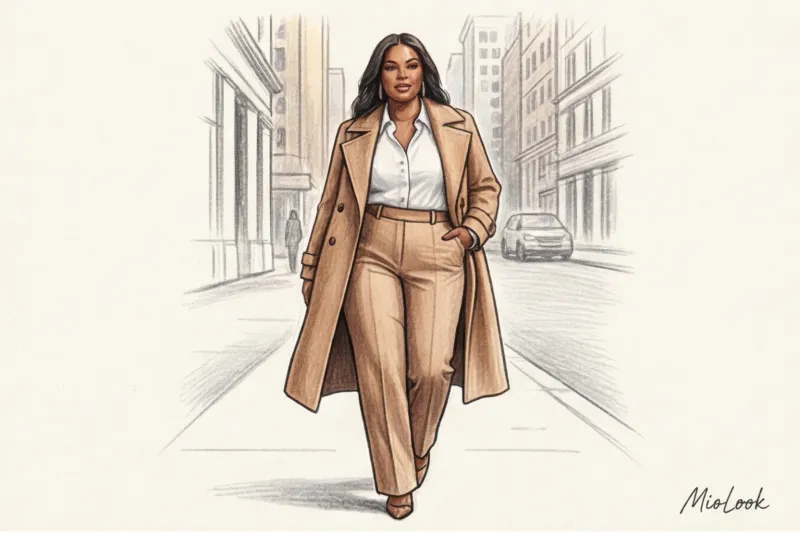
Here the undisputed leaders are Good American and a specialized line Levi's Plus Good American (jeans cost around €140–180) has introduced a special contour waistband that's cut along an anatomical curve rather than a straight line. It fits snugly around the back, eliminating the gapping effect. Levi's Plus, meanwhile, uses innovative fabrics with a high recovery rate—they don't stretch out at the knees by the end of the day and have a proper rise that supports the stomach rather than digs into it.
Office Capsules and Elegance: 11 Honoré and Violeta by Mango
Assembling a business wardrobe is the most challenging part, as strict dress codes require perfect garment design. If you're looking for premium and investment-grade pieces, consider 11 Honoré This platform has made a breakthrough, forcing luxury brands to make their runway collections up to size 24. Prices here start at €300 for silk blouses and go up to €1,000 for impeccable suits.
For a more affordable, but no less stylish business base, the line is ideal Violeta by Mango (which is now integrated into the collection Mango Curve ). They offer excellent double-breasted jackets, pleated trousers, and shirt dresses for €60–€120. Their main advantage is the correct sleeve width at the forearm. This is the very detail where 90% of inexpensive brands fail, making the sleeves critically tight.
Trends and Essentials: ASOS Curve and Eloquii
For a long time, it was believed that the lot of curvy women was shapeless dark tunics, which the industry maliciously called "tank covers." Brands like Eloquii have eradicated this stigma forever. They create fashion without limits: sequins, faux leather, complex asymmetry, bold cutouts—all the runway trends adapted to luxurious figures. The average order here is €80–130 per item. ASOS Curve (from €30) remains an absolute lifesaver when searching for trendy knitwear, trendy slip dresses and swimsuits that really support the bust.
Digitize your wardrobe
Try MioLook for free: Our smart AI stylist will create the perfect look from your clothes and suggest key elements to add for a flawless fit.
Get access — €0.99 onceInvesting in a Plus-Size Wardrobe: What You Shouldn't Skimp On
Even if the majority of your capsule collection is made up of budget-friendly brands, there are two categories where trying to save money directly harms your visual appeal.
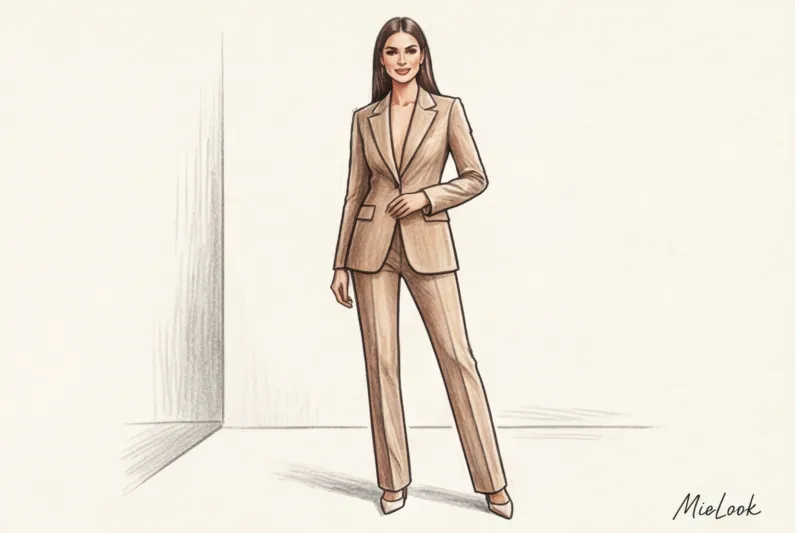
First of all, it is structured jackets A sharp shoulder line is your main stylistic ally. Many women mistakenly choose soft cardigans or knit blazers without shoulder pads, thinking they look "cozier" and don't add bulk. In practice, the opposite happens: shapeless, loose knits cling to every fold and visually blur the body's contours, making the silhouette appear bulky.
A crisp, architectural jacket with a defined shoulder line (ideally made from suiting wool with added elastane) creates a powerful vertical line and pulls the entire look together. It acts as a visual framework: the shoulders establish the correct proportions, and everything below appears slimmer in contrast to the straight, crisp lines of the lapels. Budget between €150 and €350 for a quality blazer—it's an investment that instantly elevates the status of any outfit.
Secondly, shoes and correct proportions When working with expressive volumes, the visual weight must be balanced. The worst thing you can do to a plus-size figure is to wear shoes with tiny kitten heels or ultra-thin stilettos with a weightless sole. This creates an "inverted triangle" or ice cream cone effect: a massive upper rests on a disproportionately thin base. Subconsciously, the eye perceives this as precariousness and instability.
Heavy boots (like Chelsea boots with chunky soles), classic loafers with a wide welt, or boots with a sturdy, thick block heel perfectly balance the look. They add visual weight to the bottom, balancing out wide hips or a voluminous top, and create a confident gait.
Petite Girls: Brands and cutting secrets for petite women (up to 160 cm)
One of my clients, a 32-year-old IT analyst standing 156 cm tall, had always believed she had disproportionately short arms and a "complicated" figure. We met during a wardrobe review, when she was mechanically rolling up the sleeves of an expensive basic shirt. "I'm just used to everything being too big in the shoulders and my waist always creeping down to my hips." " she sighed. The first time I brought her a structured jacket from the specialized Petite line into the fitting room, it was a true catharsis. The shoulder seam was perfectly in place, the darts lined up perfectly with the bustline, and the sleeves ended right at the wristbone. For the first time in 32 years, she didn't have to hem anything or create an artificially sloppy look with rolled-up sleeves.
Clothes should be designed according to your own design, not by adapting to the average mannequin. The Petite line isn't a limitation; it's a celebration of proper proportions.
Many people still think in terms of length, believing that petite girls can simply shorten the hem or leg at the nearest tailor's. But Petite anatomy — this is a completely different cutting geometry, requiring a thorough revision of basic patterns. According to data from the analytical agency Alvanon (2023), which creates 3D mannequins for fashion houses, the proportions of figures up to 160 cm differ radically from the standard. The armhole height is reduced (otherwise, unsightly excess fabric will form under the arms), the waist is structurally raised by 3-5 centimeters, and the anatomical taper at the knee is shifted upward. If you simply cut off the hem of a standard midi dress, the bust darts will still remain below your actual bust, creating the effect of a bulky, "tired" silhouette.
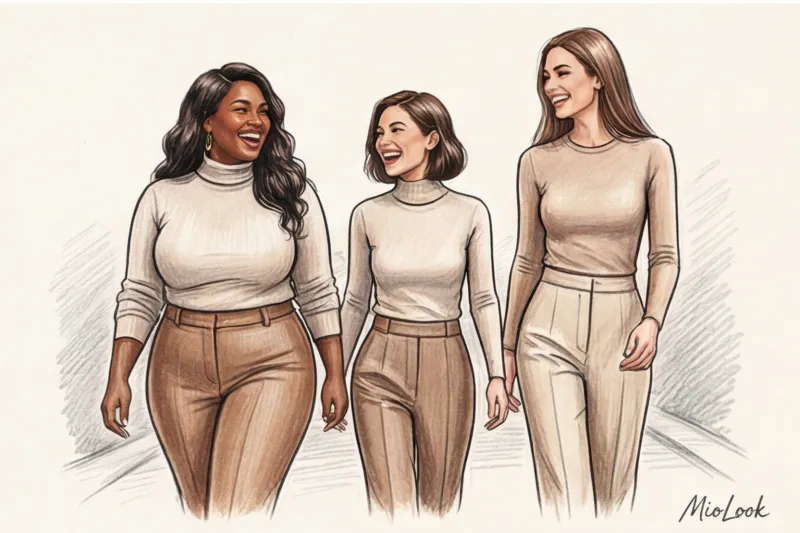
And here we come to the main mistake of petite girls: Regularly buying cropped or 7/8-length trousers in a standard size, hoping they'll fit like the perfect full-length palazzo or straight-leg jeans on someone who's 158 cm tall. Spoiler alert: they won't. The design of these trousers is tightly tied to the crotch drop and knee articulation. The crotch drop on standard trousers is designed for a height of 168 cm and above, so the crotch area will treacherously sag. And where the fabric should anatomically taper at the knee will end up at your calf. You'll end up with a baggy silhouette that will visually "snack" off a couple more centimeters of your height.
Where can you find the perfect fit? When it comes to feminine silhouettes, my absolute favorite is the Californian brand Reformation and their Petite line. These are the perfect dresses for petite figures, where the waist is truly in place. When you buy a dress with a complex cut or a corset bodice (the brand's average price range is €200–€280), even the slightest shift in the waistline makes the torso appear square and massive. Reformation designs the bodice so it ends just under the ribs, and the V-neckline doesn't reveal underwear, as the straps are proportionally shorter.
When it comes to basics and casual, the perfect jeans that don't require a tailor's attention are worth looking for at Madewell Petite And ASOS Design Petite Madewell (an investment of around €130–€150) has fantastically designed hips: their thick denim doesn't flatten the buttocks, which often happens when a petite woman tries to fit into a standard size designed for a more elongated pelvis.
ASOS Design Petite (budget segment, €35-€60) is a surefire way to rock trendy silhouettes. Imagine buying a pair of trendy bootcut or flare jeans in a standard length. You go to a tailor, cut off 10-12 centimeters from the bottom, and end up with boring, straight-leg jeans because all the dramatic flare is left on the floor. By purchasing the Petite version, you preserve the designer's original vision.
In my styling practice, I always recommend digitizing successful finds. When adding new trousers or a jacket to MioLook app , use landing tags (eg "Madewell Petite is the perfect Inseam" ). Over time, a smart algorithm will help you clearly see which brands form the basis of your most successful looks, saving you from unnecessary expenses on alterations. Invest in brands that respect your anatomy from the start.
Tall Capsule: Where to Find Stylish Clothes for Tall Women (175cm and Up)
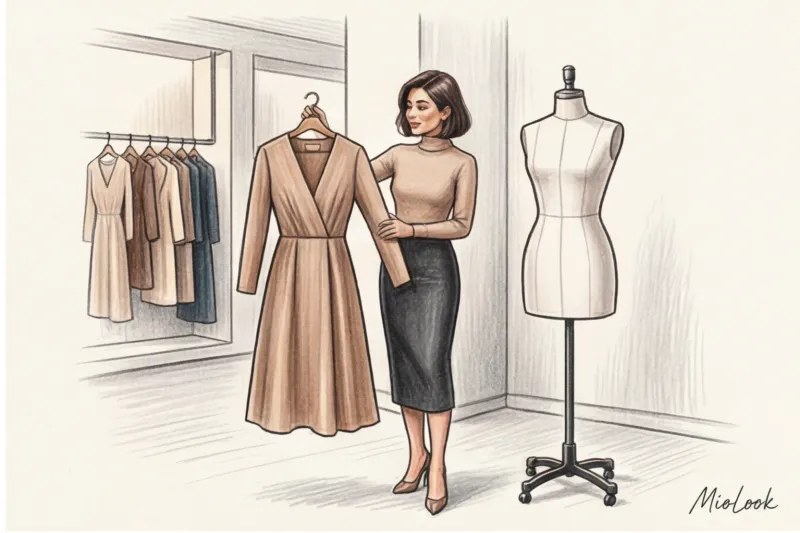
The statistics are relentless: according to research group WGSN (2023), only 14% of mass-market brands offer full lines for women over 175 cm tall. While the main problem for petite women is excess fabric, for taller women, shopping often becomes an endless search for those missing centimeters.
I know the drama of tall women down to the last detail. It's the eternal compromise, when full-length shirt sleeves magically transform into 3/4 sleeves upon first trying them on. It's stylish wide-leg trousers that look like luxurious palazzos on the model but fit you like awkward "underpants." And perhaps most annoyingly, the waist of dresses invariably slides right under the bust, creating the unnecessary illusion of pregnancy and ruining the proportions of the silhouette. If you buy standard trousers, the anatomical curves intended for the knee end up at mid-thigh. As a result, the crease breaks, and the fabric deforms as you walk.
Many people despair and head to the men's department for jackets, hoodies, and shirts. Spoiler alert: it doesn't work.
The architecture of the female body requires mathematically precise contours. Trying to hide behind oversized men's clothing won't conceal your height, but will only erase your natural grace and distort your proportions.
Why can't the men's section save tall women? The answer lies in the pattern design. Clothing designers know that men's jackets and shirts lack bust darts. Because of this, the fabric on a woman's figure either stretches uncomfortably in the front, flattening the chest, or bunches up in hard bubbles at the armholes. Furthermore, men's tailoring completely ignores the female hip curve. Men's trousers will bulge unattractively in the groin area and visually flatten the buttocks, depriving the figure of feminine contours.
Fortunately, the industry is gradually waking up. Just as we carefully select plus size clothing brands To ensure a perfect fit, the Tall segment has its own shortlist of wardrobe-saving brands.
- Long Tall Sally: an absolute legend in the market. They design garments from scratch for heights over 173 cm, taking into account the torso length and correct armhole placement. Basic suit trousers cost between €60 and €90.
- Madewell Tall: Phenomenal denim. They have styles with inseam lengths up to 37 inches (approximately 94 cm). This means you can finally wear jeans with heels without looking like you've outgrown them.
- ASOS Tall: the best choice for finding trendy pieces and dresses where the waist will be firmly in place and the maxi skirt will really cover the ankles.
- Zara Tall: A hidden gem. These are the brand's online exclusives—you won't find these longer jeans in physical stores, but they're available on the website and are a lifesaver for many a basic capsule collection.
To make the shopping process easier and avoid returns, I always recommend that customers enter their exact measurements in MioLook Digitalizing your wardrobe helps you plan ahead to incorporate new long pieces into your everyday looks.
Try MioLook for free
Start creating perfect images with the help of artificial intelligence
Get access — €0.99 onceYou can't complete a Tall capsule look without the right footwear. This requires a lot of psychological work: we're erasing the toxic stereotype of "I can't wear heels." Heels don't make you look bulky—they create verticality, elongate your silhouette, and elevate your look. At 175 cm, Catherine Middleton regularly wears stilettos, and she looks flawless.
Choose trendy shapes: architectural kitten heels (3-5 cm), sturdy block heels, or trendy pointed-toe ankle boots. The main rule for tall women: shoes should be proportionate to your height. If you're 180 cm tall, the soles of ballet flats that are too thin, almost papery, will visually "heavier" your foot. Meanwhile, structured shoes with a distinct shape—whether loafers with a thick sole or elegant slingbacks—will harmoniously pull the entire look together.
The Oversized Myth: Why Buying Clothes "Too Big" Ruins Your Figure
"Go two sizes up for a looser fit"—if you've ever heard this advice from old-school Instagram stylists, delete it from your memory right now. It's lazy styling that ruins your body's structure.
In my experience, it's attempts to artificially create a relaxed silhouette by simply going bigger that lead to the most disappointing fashion failures. Buying clothes "to fit" instead of finding your perfect fit doesn't work, and here's why.
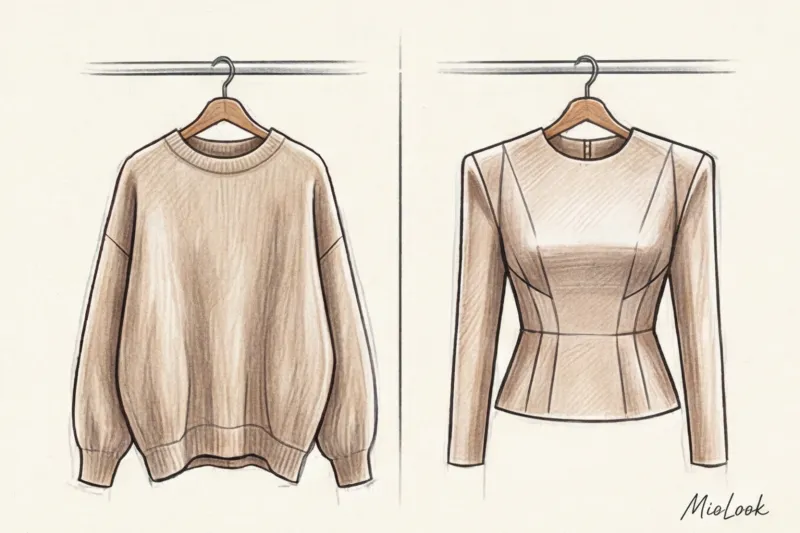
Let's look at the physics of fabric. When we choose plus size clothing brands Sometimes it's tempting to give up on searching and simply buy a men's hoodie or women's sweatshirt in size XXXL at the nearest high-street store. It seems like a ton of thick cotton or fleece will reliably conceal your belly. However, hard practice in front of the mirror proves otherwise. Baggy clothes without darts or structured seams drape over the widest point of your figure and fall perpendicular to the floor. As a result, your silhouette becomes one monolithic square. You're not disguising your weight—you're creating visual bulk where none was ever there, adding an extra 10-15 kilograms.
For petite women, blindly pursuing oversized clothing can result in a comical "daddy jacket" effect. Imagine: at 157 cm tall, you put on a fashionable jacket from a standard line, bought a couple of sizes too big. The shoulder line drops almost to the elbow, the armholes drop to the waist, and the hem ends at the widest part of the hip. In professional clothing design circles, this is called a distortion of vertical proportions. Instead of relaxed chic, you get the look of a little girl secretly wearing an adult relative's clothes. You instantly lose your status.
Does this mean a complete rejection of comfortable, loose silhouettes? Absolutely not. The key to stylish volume is to apply the rules. smart oversized (smart oversize):
- Correct shoulder: A voluminous garment is designed to be loose from the start, within your actual size. It features an anatomically correct dropped shoulder, not just a wide back.
- Armhole secret: If you buy a garment three sizes too big, the armhole will become enormous. You won't be able to lift your arms without pulling the entire hem with you. A properly oversized garment keeps the armhole comfortable, but not bottomless.
- Fixation points: To make a hyper-voluminous shirt look expensive (especially if the basic shirt cost you €100–€150), the collar and cuffs should be your size. The collar fits snugly around the neck, and the cuffs are firmly secured at the wrists, creating a beautiful gather on the sleeve.
Knowing the line between "stylishly relaxed" and "just too big" can be difficult in a fitting room due to poor lighting and emotions. That's why I always recommend clients digitalize the selection process. Take photos and upload your looks to MioLook The built-in "smart wardrobe" feature lets you evaluate your outfits in a convenient gallery format. On your smartphone screen, when you look at yourself from the side among other outfits, a distorted proportion due to a slipped shoulder immediately catches your eye. This will save you from making purchases that then hang in your closet for years with the tags still attached.
Technology Protects Style: How AI and MioLook Are Changing Online Shopping
According to statistics from the National Retail Federation (NRF, 2023), over 60% of online clothing returns are not due to manufacturing defects or color issues, but rather to simple sizing and poor fit. Imagine this: you order a gorgeous wool jacket for €200, wait for it to be delivered, and when you try it on, you discover that the bust darts are stuck somewhere near your collarbone, and your shoulders are too tight to move your arms. For women with nonstandard proportions, blind shopping has been a grueling gamble for decades. But today, machine learning algorithms are radically changing the rules of the game.
Modern fit recommendation algorithms have revolutionized their use of flat, two-dimensional circumference measurements from size charts. Neural networks have learned to understand the three-dimensional distribution of human body volumes. Artificial intelligence today accurately recognizes the fundamental difference between an hourglass figure in the plus-size segment and an apple-shaped figure. In the former case, the smart system will automatically filter the selection and suggest options for you. plus size clothing brands with patterns curve , which mathematically calculates the difference between a narrow waist and fuller hips. In the second, the algorithm recommends mid- or high-waist styles, where the extra volume is technically built into the stomach area, but the legs remain semi-fitted. You no longer need to choose a shapeless oversized fit to compensate for one dimension, sacrificing the overall silhouette.
Virtual fitting rooms and smart measurements work like your own personal digital designer. AI-powered tools match your individual curves with digital patterns for a specific garment before you even hit the "pay" button. This reduces the risk of getting the wrong size to virtually zero, as modern algorithms even take into account fabric density and elastane percentage.
However, the real magic of technology begins after the package is delivered. For those with non-standard figures, it's crucial to see their wardrobe as a cohesive, functioning ecosystem. The digital capsule and visualization of items in the app are especially important, as they allow you to plan online purchases strategically, rather than relying on a pretty picture in a catalog. You're not just buying an abstract blouse—you're pairing it with those perfect tall jeans or petite trousers right on your smartphone screen, checking the proportions and texture compatibility.
In my practice I use MioLook As a powerful analytical tool. When we begin the process of digitizing our clients' current wardrobes, we always make the same astounding discovery. The app helps instantly identify "dead weight"—those €50-€100 items that are just sitting on the shelves, wasted capital. Why are they there? In 90% of cases, it's because of a compromised fit: a tight armhole here, a bulging collar there. By digitizing your clothes, you get crystal-clear statistics: which styles you wear regularly and which ones are just taking up space. Understanding this data is your most reliable filter against impulse purchases in the future.
Your perfect look starts here
Join thousands of users who look flawless every day with MioLook.
Get access — €0.99 onceA Stylist's Checklist: How to Evaluate Cut and Fit When Buying Online
We often blame our own figures when unpacking yet another package containing a poorly received item, although the real problem lies in our inability to read the product's "technical data sheet." Whether you choose specialized lines for petites or study plus size clothing brands I always ask my clients to ignore styling and focus solely on the technical parameters. Here's my rigorous process for assessing any item before you hit the checkout button.
Anatomy of Photography: Model Height and the Shoulder Seam Rule
Start with the most boring part: scroll to the very bottom of the product description, to the line "Model Measurements." If the woman in the photo is 178 cm tall and the dress hem ends just a hand's breadth above her knee, then if you're 162 cm tall, the same garment would be a vague midi length, visually cutting into your calves at their widest point.
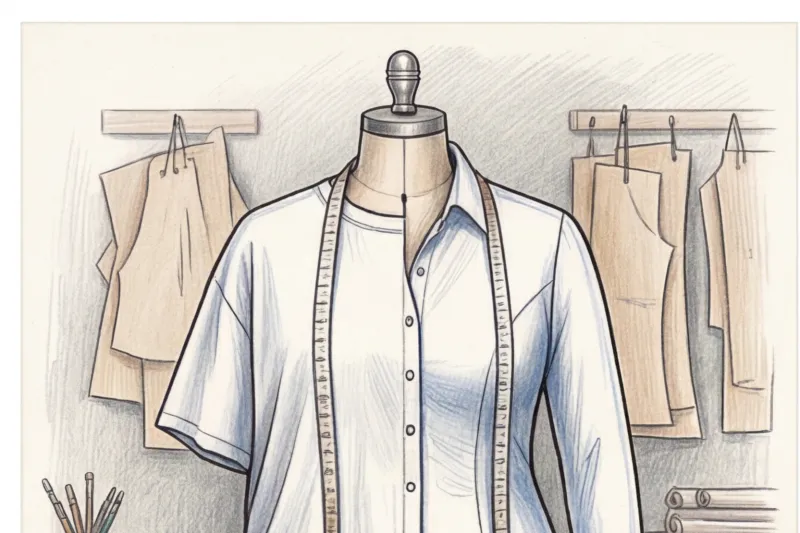
The second step is to zoom in to the maximum on the model’s shoulder girdle. Mass-market manufacturers love to pin clothes at the back for the perfect shot, but the armhole area always reveals the true geometry of the cut. Apply the "shoulder seam rule": if you see diagonal creases running from the center of the chest to the armpit, or the sleeve seam itself extends even half a centimeter toward the neck, the armhole is too narrow and will tug uncontrollably with any arm movement.
Texture and Density: Why Composition Matters
For those with a non-standard figure, fabric is the foundation of the fit. Carefully check the percentage of elastane. The ideal balance for structured clothing that needs to hold its shape is 2–4%. Less elastane will restrict movement (especially in the hips). If it exceeds 5%, the fabric becomes a flimsy knit, which will instantly highlight even the slightest imperfections.
"Pay attention to the fabric's density if the brand specifies it. For quality plus-size or tall trousers, look for values between 280 and 320 g/m². Thin, unlined viscose will never create the right look."
Measurements You Can't Ignore: Rise and Inseam
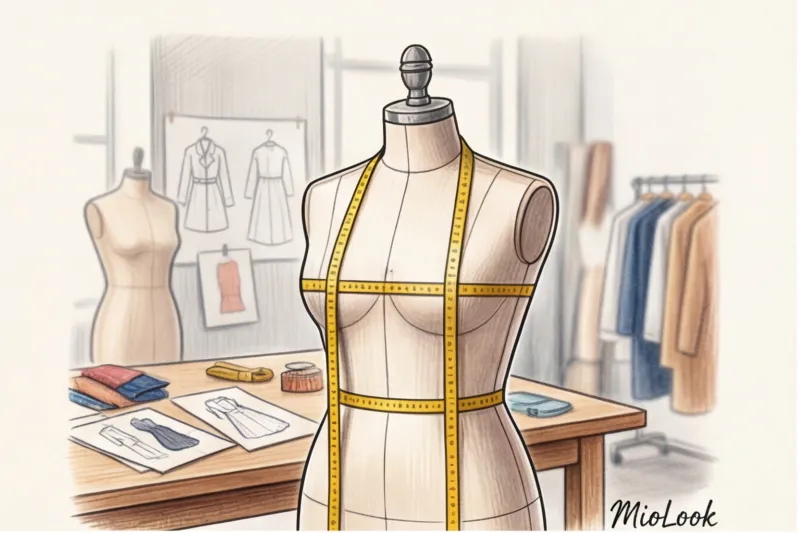
Buying trousers based on an abstract size of "46" or "L" is a surefire way to return them. Your main guidelines should be rise (the height of the waist from the inguinal seam to the top edge of the waistband) and inseam (length along the inner seam).
- For the Petite line: comfortable inseam usually 65–70 cm.
- For tall girls (Tall): look for inseam from 86 cm and above.
- General planting rule: height rise about 28–30 cm (High-Rise) will securely fix the stomach and will not allow the belt to treacherously stick out on the back when bending over.
Knowing these two parameters saves at least €50–100 per season on unnecessary shipping and tailoring services.
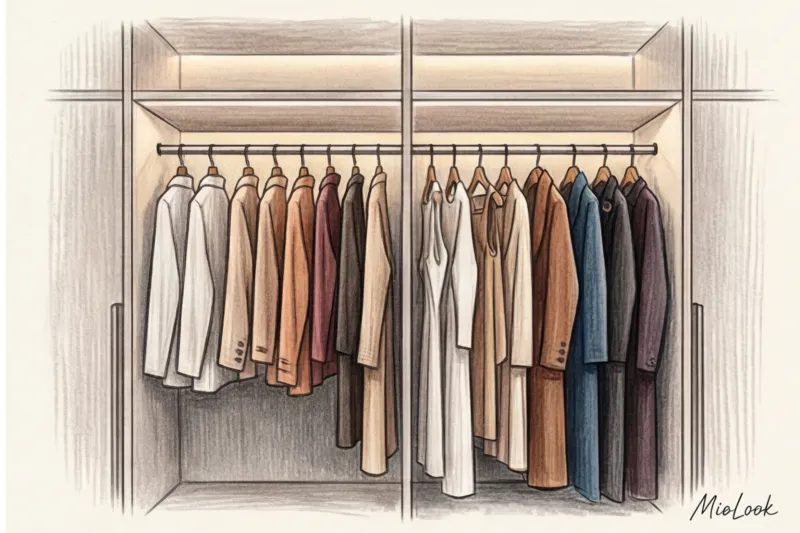
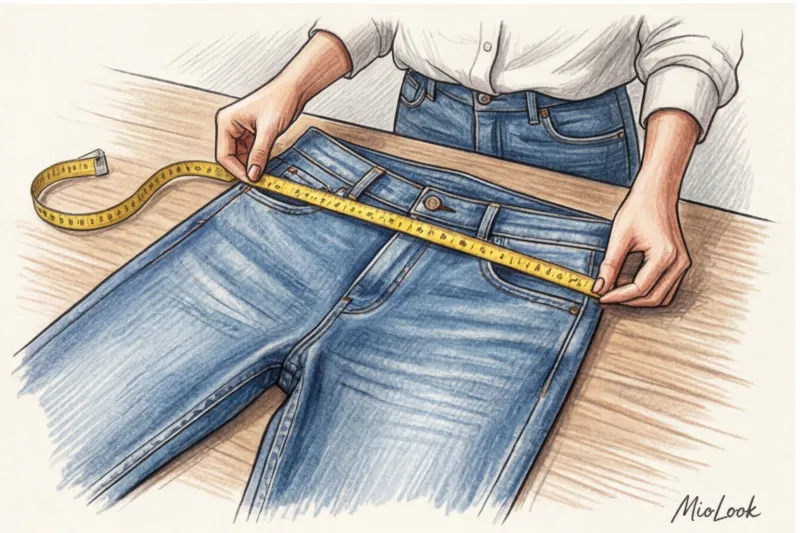
To avoid having to keep all these numbers in your head, transfer them to a digital environment. I recommend taking precise measurements once. rise And inseam from your favorite, perfectly fitting jeans and bring them into MioLook When your measurements, digital capsule, and best-fit data are all at your fingertips on your smartphone, shopping transforms from a lottery into a clear and predictable system.
Smart Shopping Strategy: Building a Database Without Compromise
According to a 2023 study by the Sustainable Fashion Institute, the average woman regularly wears only 20% of her closet. The remaining 80% is a kind of museum of unfulfilled hopes. As a capsule wardrobe evangelist, I constantly encounter the phenomenon of "waiting pieces." These are expensive dresses bought with the thought "when I lose ten pounds," or trousers that sit on a shelf for years, marked "someday I'll find time to take them to a perfect tailor."
Let's be honest: this kind of wardrobe is toxic. Every morning, when you open your closet, you waste precious cognitive resources scanning for items that physically don't fit you. You try them on, feel discomfort, take them off, and end up slipping into your familiar, yet shapeless, outfit. Your body deserves clothes that fit perfectly right now. By studying plus size clothing brands Whether it's a petite line or a collection for tall women, we're primarily looking for respect for our current anatomy, rather than buying a compromise for the future.
If you want to start a smart closet transformation, don't throw out everything at once. Focus on five key elements where architectural alignment is critical:
- Structured Jacket: creates a rigid frame, elongates the silhouette and requires a perfect match of the shoulder line.
- Classic trousers and thick jeans: are responsible for the proportions of the legs and comfort in the waist area (no one needs a belt that digs in after a long day of work at the laptop).
- Button-down shirt: The main indicator of a quality cut. If the buttons on the chest are coming apart, the pattern is incorrect—period.
- Autumn coat: sets the geometry of the entire top layer and requires the correct armhole depth for comfortable pairing with sweaters.
A basic T-shirt or knit jumper will forgive you a few centimeters of inaccuracy in the fit, but if the shoulder line on a blazer is off, the entire look instantly loses its status. That's why you need to invest in these five items. Well-tailored trousers from a specialized line can cost between €150 and €250, but their Cost Per Wear (CPOW) will approach zero. This is the math of smart style: it's better to have just 30 items in your closet that are 100% wearable than 150 spontaneous purchases on sale.
My personal algorithm for managing such a database is strict digitalization. MioLook app I track how often I wear these structural elements. If smart statistics show that seemingly perfect jeans have been hanging around for a month, it's a sign that the context of my life may have changed, or the fabric has become too rigid.
As I conclude this guide to shopping without boundaries, I want to give you one practical task for today. Right now, after you close this article, open your closet and put in a ziplock bag three items that make you feel "wrong." Your body shape can't be wrong. Only factory-made patterns can be wrong. Make room for brands that understand that personal style is a matter of mathematically precise design, not an attempt to fit the average mannequin.
Guide Chapters
Affordable Plus Size Women's Clothing: A Brand Guide
A stylist's tips for budget-friendly plus-size shopping. Learn how to find quality mass-market clothing and create stylish looks without breaking the bank.
The Best Dressy Dresses for Plus Size Women: Brands
Plus-size eveningwear isn't about shapeless robes, but precision engineering. We'll tell you about the best brands that will make you feel like a luxurious diva.
Plus-Size Lingerie and Swimwear: Brands with the Best Support
The secret to a flawless fit starts with the base layer. We'll break down the engineering behind lingerie and swimwear for a curvy figure.
Outerwear for plus-size women: stylish coats
The right outerwear is the architectural framework that accentuates the best features of a plus-size figure. Let's learn how to choose stylish coats and jackets that truly slim you down.
Ideal jeans for tall women: brands from 175 cm
Tired of short pants and poor fit? We'll explore which brands create the perfect trousers and jeans for those over 175 cm, taking into account body types.
Try on clothes virtually online: how AI will select the right size
Forget about disappointments when shopping online. We'll explain how neural networks break the illusion of a standard size and help you choose the perfect fit.
The perfect petite jeans for petite girls: where to buy
Hemming standard trousers completely ruins their silhouette. We'll explore where to find the perfect jeans for those up to 160 cm tall that will fit perfectly without a trip to the tailor.
Plus-size jeans for women: how to choose the perfect fit
Tired of jeans that dig into your stomach and bulge at the waist? We'll tell you how to find the perfect denim for a curvier figure.
How to Determine Your Clothing Size When Shopping Online: A Guide
70% of women wear the wrong size, relying on old tags. Discover a stylist's secret to help you choose the perfect item and reduce returns by 85%.
Clothes for tall women: brands and best stores
We're exploring the main problem facing tall women: short sleeves and out-of-proportion clothing. Find out which brands offer ideal fits for heights over 175 cm.
The Best Clothing Brands for Short Girls: A Guide
Fashion for those under 160 cm: A guide to mass-market fashion. A stylist shares a selection of brands with the perfect fit for petites.
Russian plus-size clothing brands: where to buy
Forget ill-fitting mass-market clothes. We'll tell you which local brands make perfect plus-size clothing that truly flatters your figure.