Over 12 years of working as a stylist and regularly visiting showrooms from Paris to New York, I've heard the same phrase hundreds of times from clients: "The mass market only makes tank covers for my figure." Finding the perfect fit is always a quest, and when you need it Inexpensive plus size women's clothing , the task seems downright impossible. But I hasten to please you: this is merely an optical illusion created by the fast fashion industry.
We have already discussed in more detail how the global inclusive fashion market works in our The complete guide to the best plus-size, petite, and tall brands In this article, we'll focus on pure practicality. Instead of simply listing cheap brands, I propose an engineering-style approach: we'll explore how to find high-quality patterns in the budget segment, which inexpensive fabrics visually elevate the silhouette, and how to transform a €30 garment into a designer exclusive with a little tailoring.
Affordable Plus Size Women's Clothing: The "Extended Standard" Trap
Let's start with the fundamental problem. You try on a size XXL blouse, put it on, and notice something odd: it's hanging loosely at the shoulders, the armholes seem to disappear somewhere down to your waist, and you can't fit your arms through the sleeves. Why is this happening?
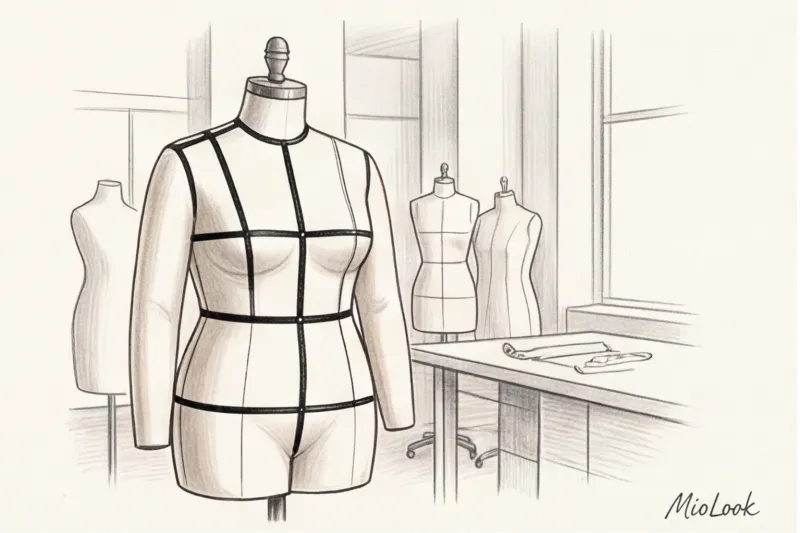
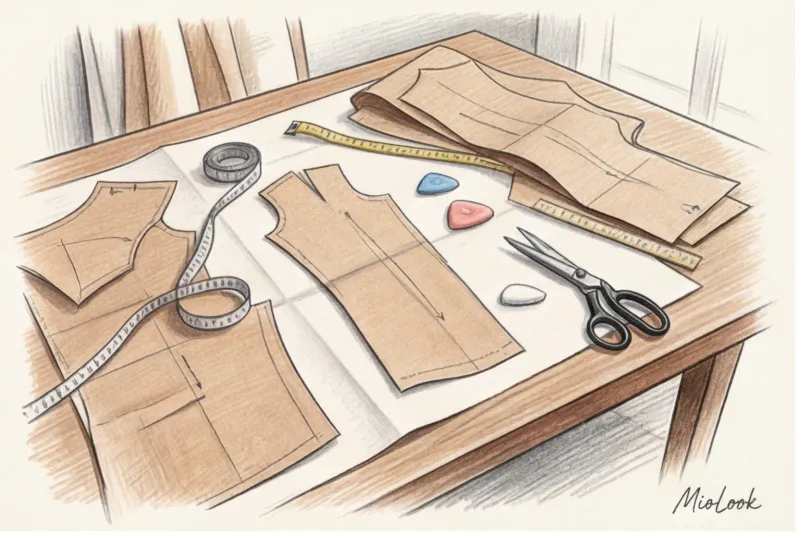
The answer lies in manufacturing technology standards. Most budget brands use the so-called grading (grading) is the mechanical enlargement of a basic pattern. They take a size M pattern and simply add 2-4 centimeters around the edges for each subsequent size. But the human body doesn't expand evenly in all directions, like a balloon!
In professional circles this is called a violation. product balance A WGSN study (2023) found that developing specialized patterns for mesh in sizes XL to 4XL costs factories 30-40% more than grading. Naturally, fast-fashion brands cut corners on this. This is why inexpensive plus-size women's clothing often features enormous cutouts (because grading causes the neckline to flare out) and sleeves that are critically tight in the bicep area.
"A stylist's golden rule: if a brand's size chart simply ends at XXL (S, M, L, XL, XXL), that's a red flag. Look for brands that have a separate Plus line, starting at XL (or 48-50) and going up. This is a guarantee that the brand has invested in developing new patterns that take into account different size groups."
Access to MioLook for €0.99 — one-time payment
A smart AI stylist will select the perfect look based on your individual parameters and save your successful finds.
Get access — €0.99 onceAn honest audit of brands: where the right fit is hidden
According to the McKinsey Fashion Report (2024), mass-market fashion is actively shifting toward inclusive sizes, but the quality of execution varies greatly. Let's take a look at what the market currently offers.
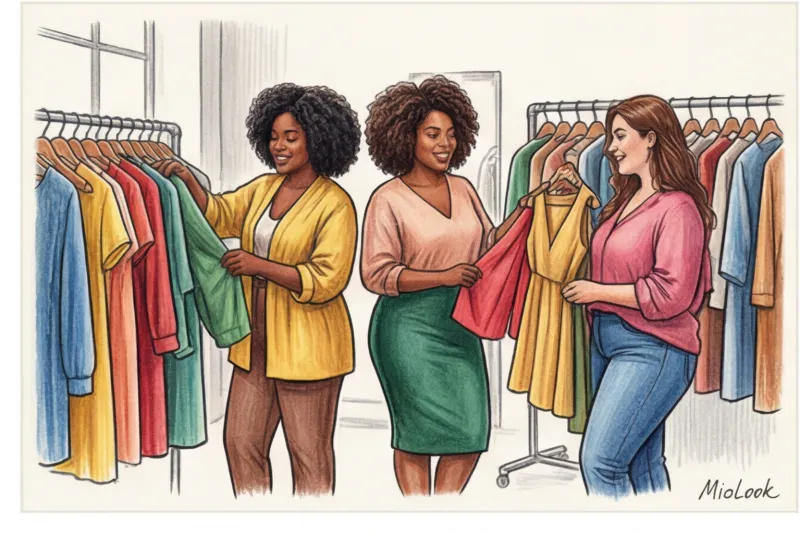
In recent years, we've seen a trend that's unpleasant for consumers: some industry giants are merging their specialized Plus lines with their core collections. For example, this happened with the legendary Violeta by Mango line. The brands' official position sounds elegant—"inclusivity and non-segregation." But in practice, this often means a return to that same cheap, mechanical grading.
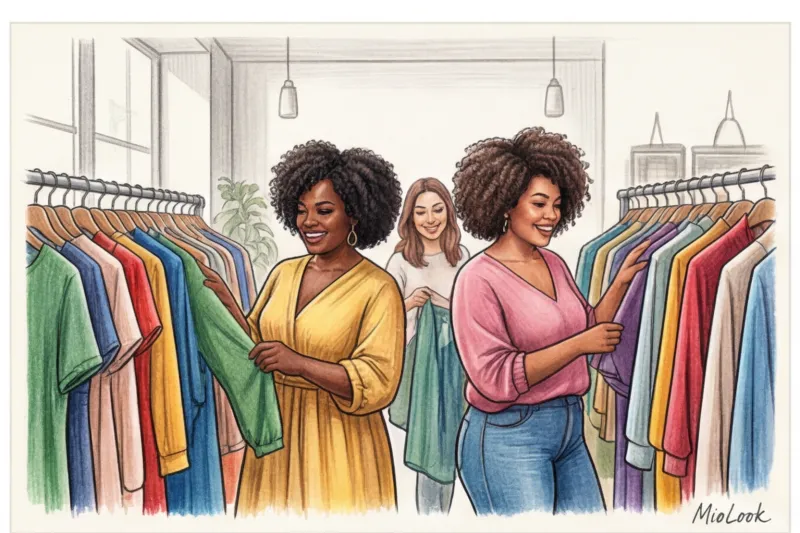
Specialized lines (Curve, Plus)
If we are talking about online shopping, it is worth paying attention to ASOS Curve And H&M+ ASOS has a great expertise in youthful, trendy pieces (draped dresses, crop tops, and bright suits). They have the right fit for pear- and hourglass-shaped figures—with ample hip room and a nipped waist. H&M+ is the perfect place to shop for basic matte T-shirts and straight denim.
When searching on marketplaces, use filters. Ignore no-name brands with suspiciously low prices (less than €15–€20 per dress). Look for factory-owned brands that specialize in exclusively Available in sizes 48 and up. Their patterns are designed for a curvy figure, taking into account the bust's shape and volume distribution.
Fabric Code: What Budget-Friendly Fabrics Don't Make Plus-Size Clothes Cheaper?
Here we come to my favorite counterintuitive rule. A myth has taken root in society: "A budget oversized outfit will hide all the flaws." In practice, cheap oversized fabrics create a harsh "tent" effect. The fabric simply falls vertically from the widest point of your figure (for example, your chest), visually adding 2-3 sizes to your figure.
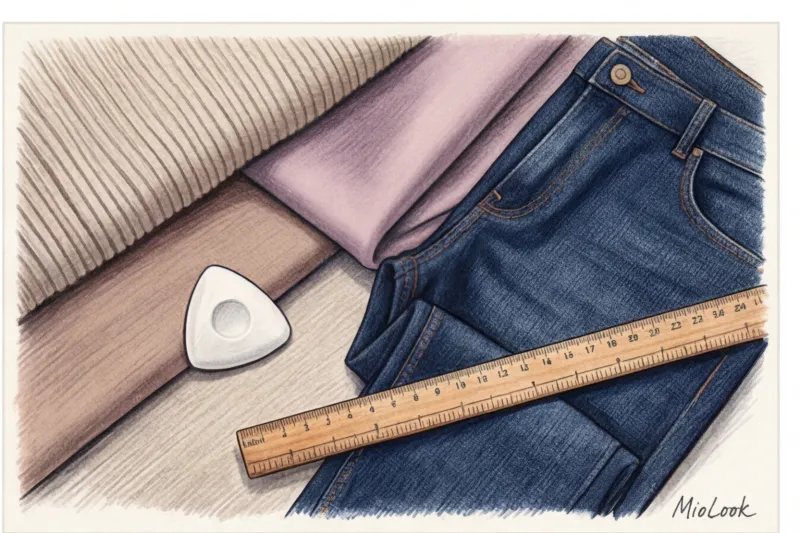
The main rule of texture in mass-market: density is more important than composition Even 100% natural linen or cotton will look terrible if they're as thin as gauze. Thin knits are the worst offender: they treacherously highlight the texture of your underwear and the slightest folds of skin, creating shadows where there aren't any.
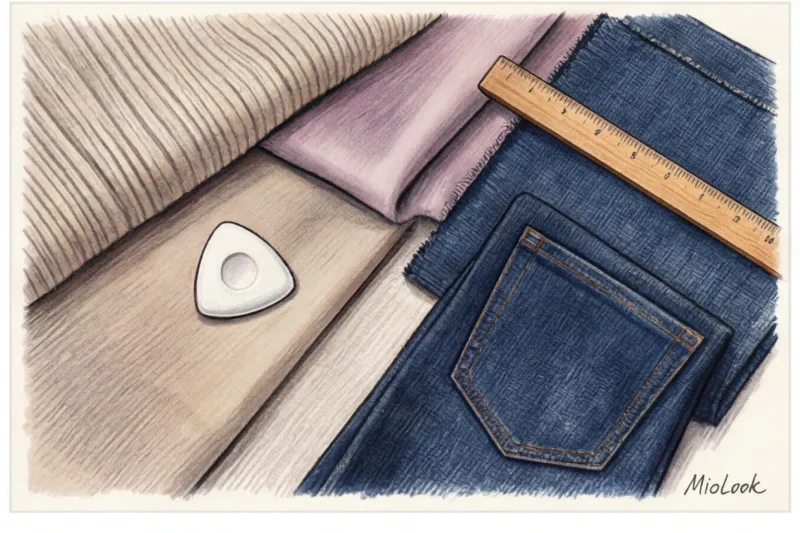
- Budget-Friendly Fabrics: Thick cotton with 2-3% elastane added (keeps its shape but allows freedom of movement), Roman knit (ponte is a heavy, elastic material that fantastically lifts the silhouette), high-quality denim without strong artificial abrasions.
- Traitorous fabrics: thin, shiny viscose (besides the cheap shine, it shrinks up to 7-10% after the first wash—your perfect top will simply no longer fit), flimsy polyester chiffon, loose acrylic jersey that starts to pill even on the hanger in the store.
A stylist's lifehack: do the "shine" and "squeeze" tests right in the fitting room. Squeeze the fabric in your fist for 10 seconds. If it's too wrinkled, don't buy it. Hold it up to a lamp through the fabric. If the light source is clearly visible, the garment won't create a beautiful frame for your figure.
Your perfect look starts here
Join thousands of users who look flawless every day with the help of MioLook's smart algorithms.
Get access — €0.99 onceInvestment strategy: what to buy cheap and where to save
With one of my clients (we worked with a size 54), we put together a luxurious autumn capsule collection exclusively in the mass-market segment. We saved about €400 simply by clearly dividing items into "Smart Budget" and "Risk Zone" categories.
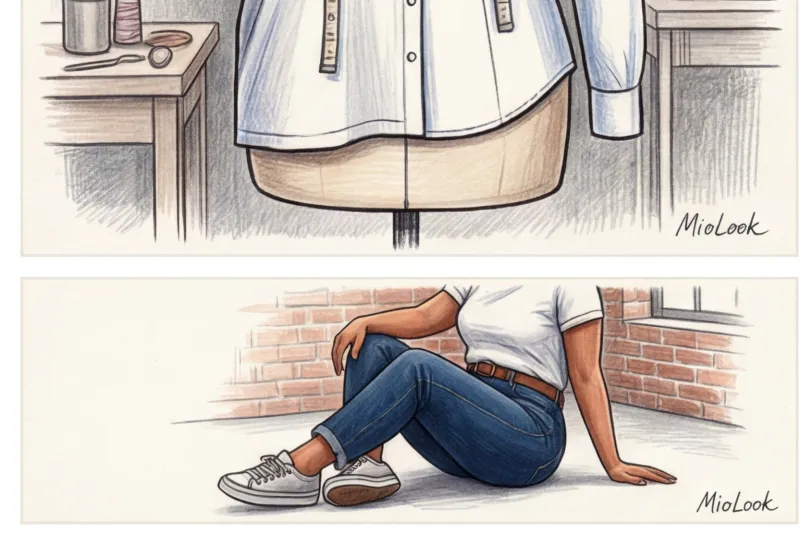
Smart-budget categories (can be taken in a budget of 20-50 €):
- Basic T-shirts. Forget the women's department with its fitted, cropped styles. Head to the men's department! Men's T-shirts in sizes L and XL are made of thicker, heavier cotton. They support the shoulders and don't cling to the stomach.
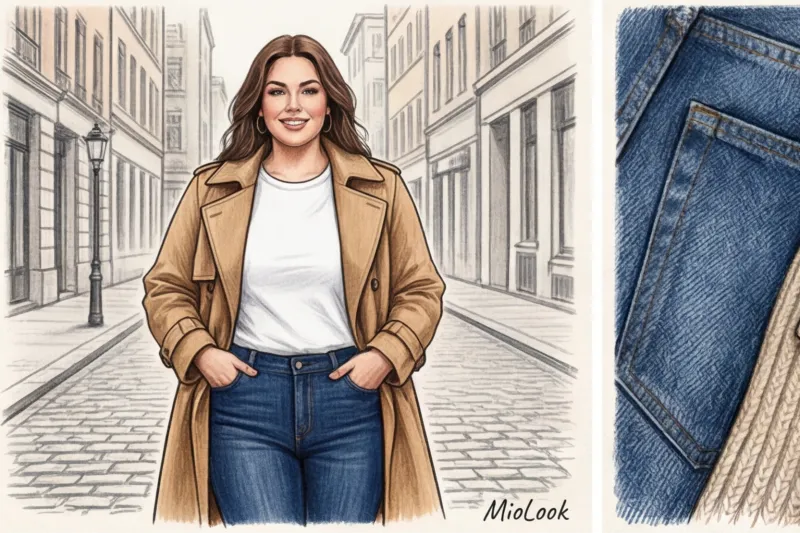
- Jeans. Denim washing and dyeing technologies have advanced so much that €40 jeans from, say, Mango often fit just as well as premium €250 pairs. The key is to choose deep indigo, black, or pure blue without contrasting "whiskers" (light stripes on the hips), which visually widen the pelvis.
Risk zones (best avoided in the low-cost segment):
- Complex tailored jackets. When budgeting up to €50-70, manufacturers skimp on the inner interlining (the material that seals the lapels and collar). After the first dry cleaning, such a jacket will bubble and lose its stiffness.
- Trousers with creases made of thin fabric. They will gather in an accordion-like pattern in the groin area with every step.
Of course, there are exceptions to this rule. Sometimes, even cheap mass-market stores offer excellent jackets made of dense fabric, but this is more of an error in the matrix than a consistent pattern.
Stylists' secret: how inexpensive plus-size women's clothing fits like custom tailoring
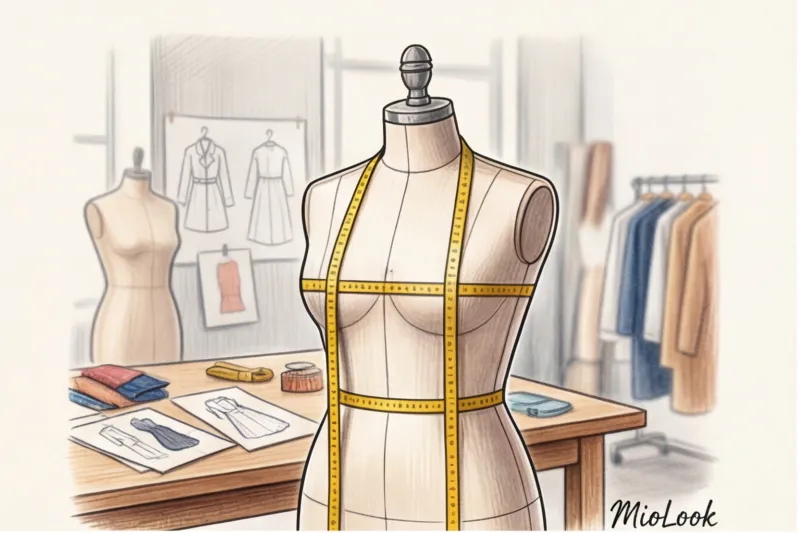
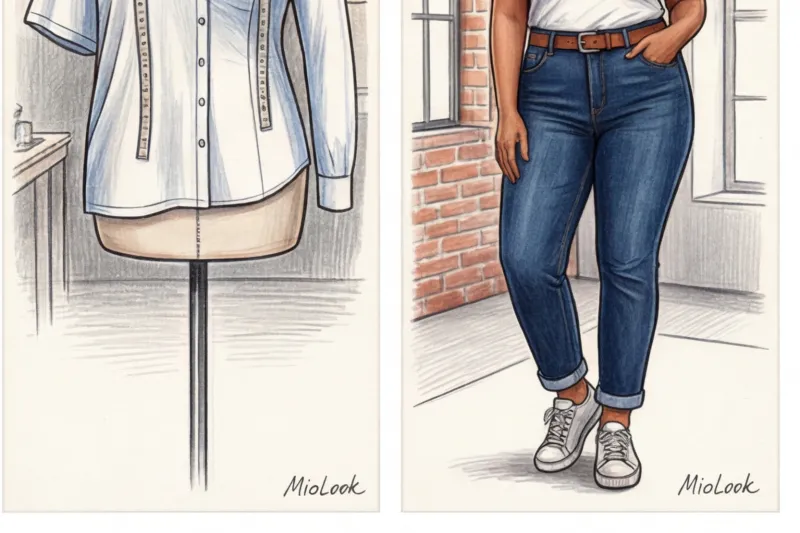
Let's get to the most important insight. How can you make a €40 item look like it costs €400? The answer: find a good tailor. No factory pattern in the world will take into account your exact waist curve or individual chest height.
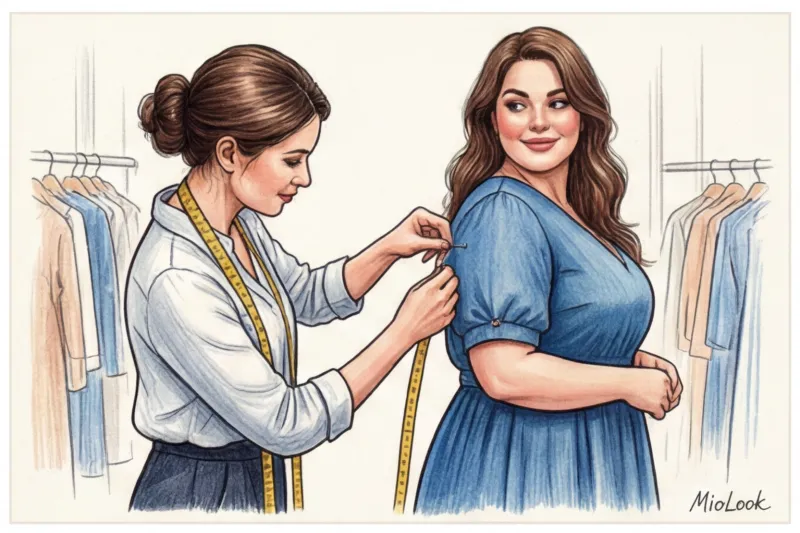
Counterintuitive approach to shopping: Buy a garment so that it fits perfectly only at the widest point of your figure Ignore everything else. If you have wide hips and a narrow waist, buy pants that fit loosely around the hips, even if they stick out 10 centimeters at the waist. Taking in the waist is a piece of cake, but easing out the hips with factory-made allowance (which is simply not available in mass-market clothing) is impossible.
Top 3 cheap alterations that radically change the status of an item:
- Shortening sleeves (approx. 10–15 €). Sleeves that are too long (below the wrist bone) create a heavy and untidy silhouette. The right sleeve length on a jacket or coat instantly brings the look together.
- Darts at the back waist (approx. 15–20 €). Eliminates that "tent" effect. Your dress or shirt begins to follow the curve of your spine.
- Replacement of fittings (5–10 € per buttons + labor). Cut cheap plastic buttons off an inexpensive cardigan or trench coat. Buy metal, horn, or mother-of-pearl buttons at a fabric store. This is the fastest way to deceive the viewer's eye.
Let's do some budget math. You find a basic jacket made of good, thick fabric at a mass-market store for €50. You take it to a tailor: they shorten the sleeves (€15) and replace the buttons (€10). The total cost: €75. But visually, you get a perfectly fitting garment with expensive fittings that looks premium.
Shopping for a luxurious figure isn't about compromising on price and appearance. It's simply about understanding the laws of geometry and the properties of fabrics. Don't be afraid of mass-market fashion, but approach it with the cold, calculating judgment of a technologist: check the density, perform compression tests, and always allow a small budget for the final touches at a tailor's. It's this final step that separates simply good clothes from personal style.