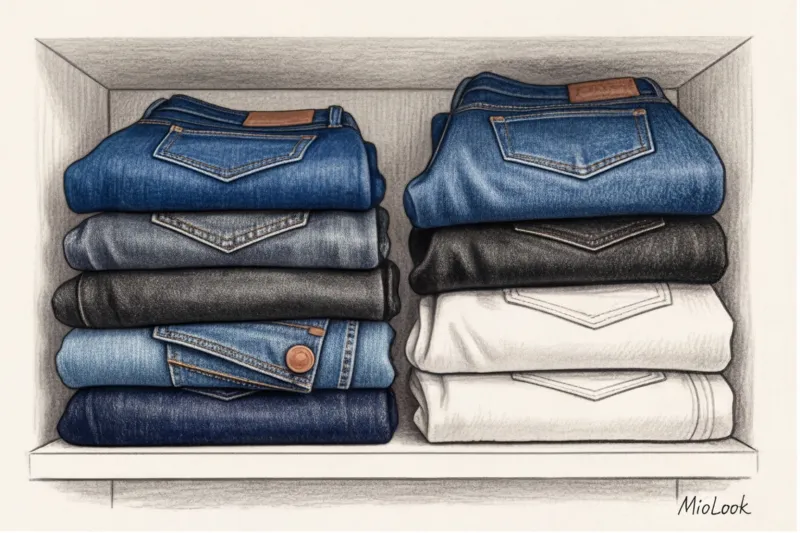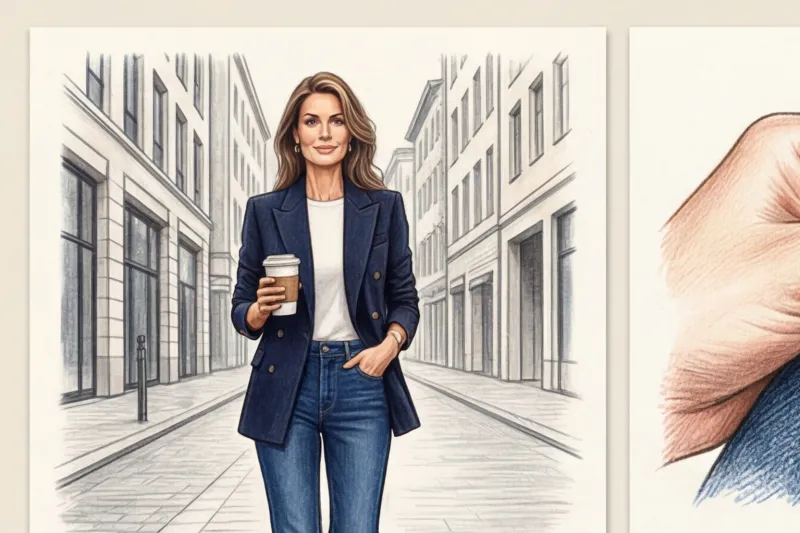
In 12 years of working as a personal stylist, I've read hundreds of articles with the same lazy advice: "Just buy high-waisted black jeans and add some spandex." You know what happens in practice? This advice works exactly the opposite. The thin fabric stretches, shines in the light, and treacherously highlights every crease, while the waistband, pulled up to the ribs, turns the figure into a rectangle.
Hi, I'm Isabella Garcia. Today we're going to forget about clichéd advice and talk about the "architecture" of things. I'll tell you, What jeans hide the belly? In fact, why a bolt-on closure works better than a corset, and how a 98/2 cotton to elastane ratio will save your silhouette. If you've already read our A detailed guide on how to hide your belly and love handles with clothing after 40. , then you know: it’s not about your figure, it’s about the wrong patterns.
Why Your Old Jeans Don't Fit Anymore (And Why You're Alright)
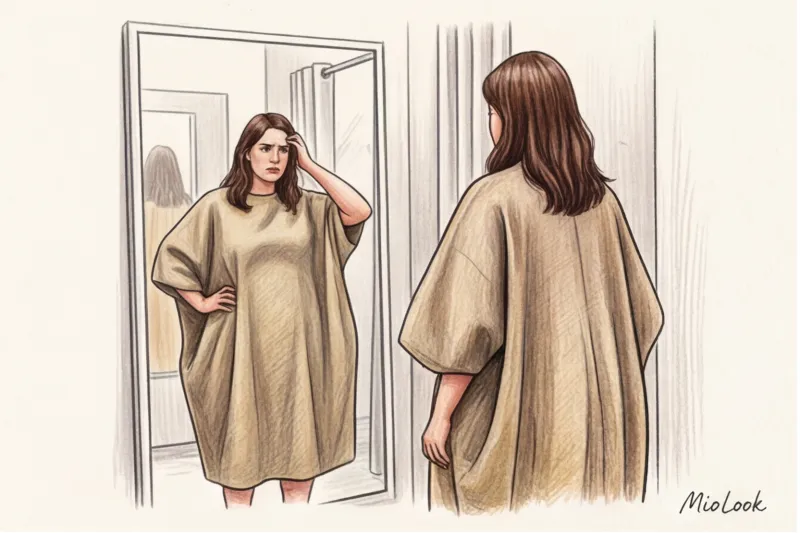
In almost every consultation with clients over forty, I hear the same phrase: "Isabella, I'm eating as usual, exercising as usual, but a life preserver has appeared out of nowhere. My favorite jeans are now digging into my waist." One of my pear-shaped clients was completely distraught when her usual trousers began to create a roll above the waistband.
Let's get this guilt out of the way right away. According to the International Menopause Society (IMS, 2023), during perimenopause and menopause, a natural, genetically determined redistribution of fat tissue occurs. Due to declining estrogen levels, weight "migrates" from the hips to the waist. This is normal physiology, not the result of laziness.
Your body shape simply transforms—for example, from a pronounced pear shape, you gradually transition to an apple or rectangle shape. Old styling formulas are breaking down because they were created for a different body shape. Our main task now is to understand that clothes should adapt to you, not you to your clothes.
Access to MioLook for €0.99 — one-time payment
A smart AI stylist will select the perfect look based on your body shape.
Get access — €0.99 onceThe Anatomy of a Proper Fit: Which Jeans Really Hide Your Belly
In the world of professional styling, we use the term "denim architecture." The cut of a garment (straight or flared) is only 30% of the success. The remaining 70% is the fabric, the cut, and the hidden construction details. To find the perfect pair of trousers, you need to understand three parameters: rise, inseam, and yoke.
Rise: Finding Your Sweet Spot
There's a pernicious myth that an ultra-high rise, almost reaching the bra, will save the day. In reality, it's your worst enemy. When the belt is pulled all the way to the ribs, it visually "sucks" the length of your torso. The end result is a short, square torso and long legs—a proportion that makes your figure look heavy.
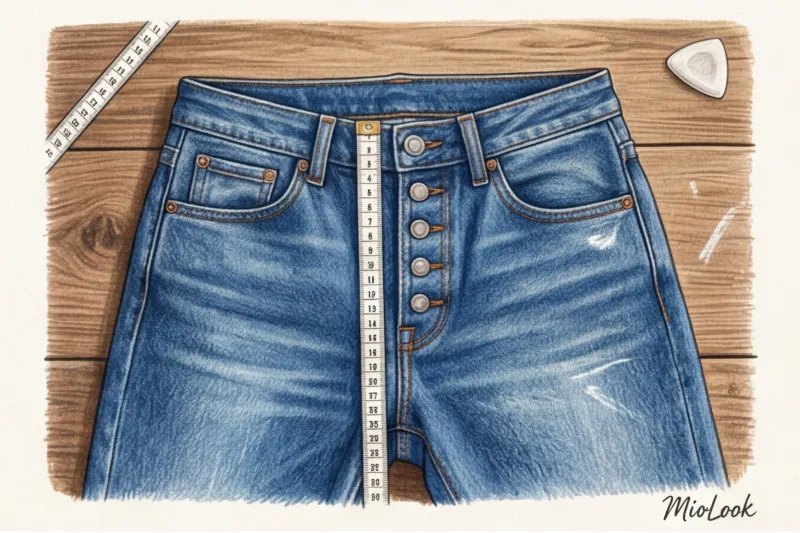
Stylist's secret: the ideal mid-high rise should be exactly 1–2 cm below your belly button. This is where the balance point is, framing the lower abdomen without cutting your torso in half.
How to measure your perfect rise before going shopping? Take a tape measure and measure the distance from your crotch seam (between your legs) to a point 2 cm below your belly button. Memorize this number (usually 24–27 cm) and simply hold the tape measure to your jeans right in the store. This saves hours in the fitting room!
Fabric Composition and Density: Why Stretch Is Your Enemy
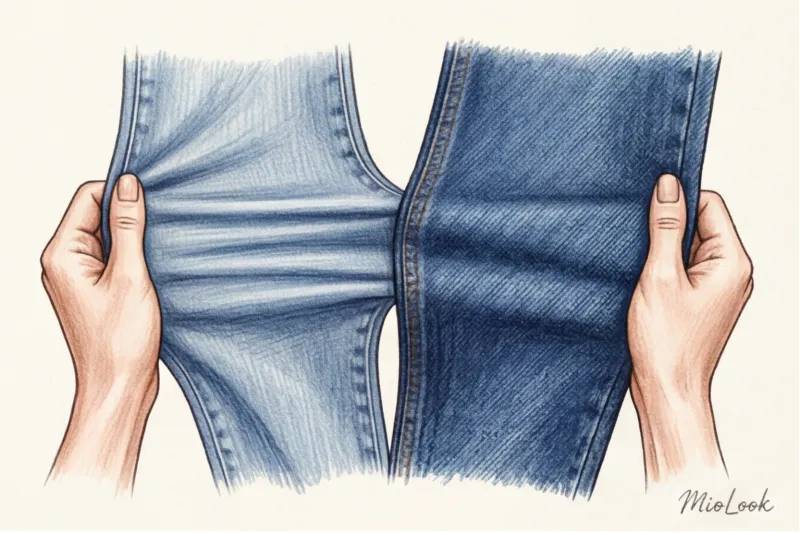
Forget jeggings and thin denim with a high elastane content. Thin, stretchy fabric stretches across your stomach like a balloon, clinging to every fold, creating the telltale "caterpillar" effect. For jeans to work as a lightweight, shaping corset, they need to be firm.
Ideal fabric formula: 98–99% cotton and only 1–2% elastane.
Denim production standards measure density in ounces (oz). For tummy shaping, you need denim with a density of 11–13 oz. This is a dense, slightly dry fabric that holds its shape. Yes, it may feel unusually stiff for the first 10 minutes, but then it molds to your body and maintains your silhouette. High-quality jeans made from this denim from brands like COS, Massimo Dutti, or Levi's typically cost between €80–€130—an investment in your perfect silhouette.
Details that make all the difference: fasteners, pockets, and yokes
If you're trying to hide your tummy, pay attention to the zippers. Zippers tend to bulge when you sit down, adding visual bulk where it's completely unnecessary. Look for jeans with a button-fly closure. A row of metal buttons creates a rigid mesh that acts like a real binder.
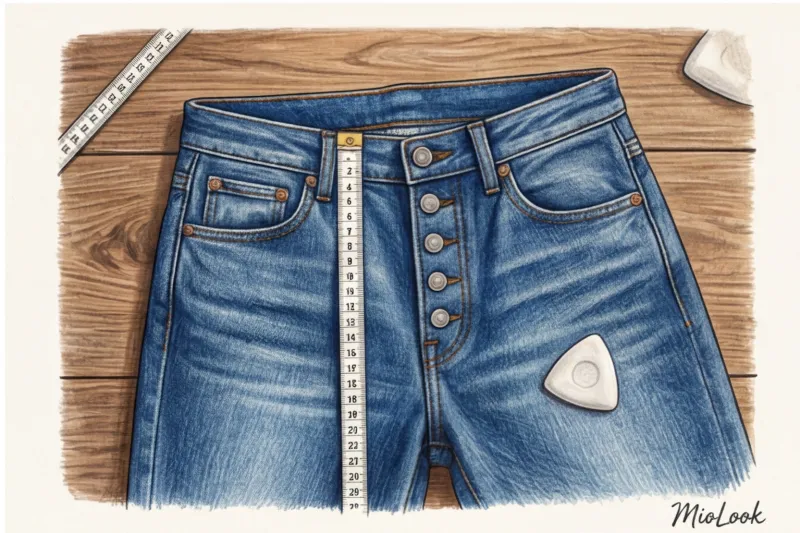
Pockets are also important. The right front pockets should be deep and sewn directly into the side seam of the trousers—they create an extra layer of fabric inside, gently cinching the lower abdomen. And at the back, look for a deep V-shaped yoke, which visually lifts the buttocks and draws attention away from the waist.
Busting the Myth: Why Black Skinny Jeans Don't Make You Look Slimmer
"Black is slimming" is perhaps the most popular fashion rule. And it's true, but only when it comes to the right fit. Black skinny jeans paired with a protruding tummy create the optical illusion of an "ice cream cone." Skinny, slender legs and ankles accentuate a chunky top.
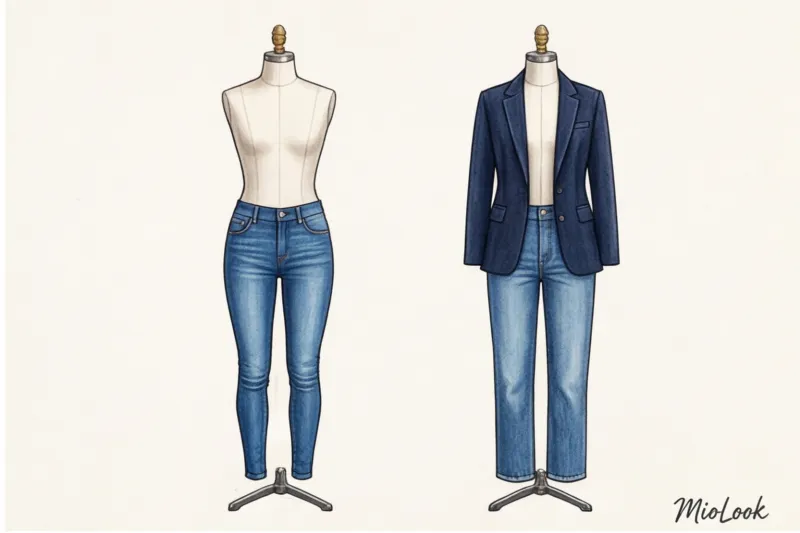
Styling is all about balance. If there's volume in the center of the figure (the stomach), we need to add a little width at the bottom to balance the silhouette. That's why a straight or slightly flared waistline is 10 times more effective than any slimming skinny fit.
Access to MioLook for €0.99 — one-time payment
Start creating your perfect looks with artificial intelligence and the smart wardrobe feature.
Get access — €0.99 onceTop 4 styles of trousers and jeans that work as a lightweight corset
Now let's move on to specific models that I always recommend to my clients to create a toned silhouette.
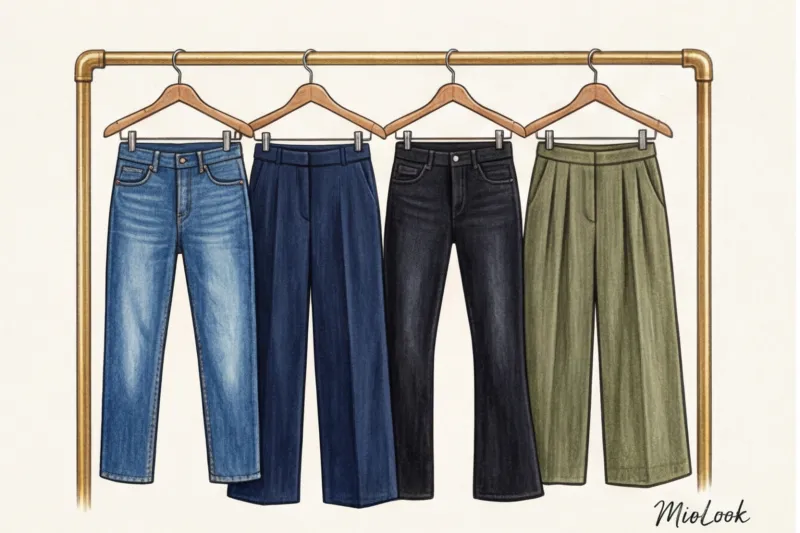
- Straight jeans made from hard denim. This is an absolute basic. The legs should fall straight from the hip, not tapering toward the ankle. They create two distinct vertical lines that visually elongate the height and make the waist appear smaller.
- Wide-leg and Bootcut jeans. Wide-leg styles, either from the hip or knee, perfectly balance a heavy top. They look especially striking with shoes with a small, stable heel, concealing it under the length of the pant legs.
- Palazzo trousers with the right pleats. Many people are wary of pleats, believing they add bulk. But here's a secret: look for pants with pleats that point inward (toward the center of the stomach) rather than outward, and are stitched for the first 3-5 cm from the waistband. These pleats open only at the hips, leaving the stomach area completely flat.
- Carrot-fit trousers (bananas) with a tight waistband. This style features a slightly high waist, fuller hips, and a tapered fit. It perfectly camouflages the lower belly.
When it does NOT work: Honestly, if you have a massive upper body, a large bust, and very thin calves, bananas will turn you into an inverted triangle. In that case, go back to option #2.
Isabella's Stylistic Formulas: What to Wear with "Those" Jeans
Finding the right jeans is half the battle. The other half is incorporating them into your look. I've developed several formulas that work flawlessly for my clients.
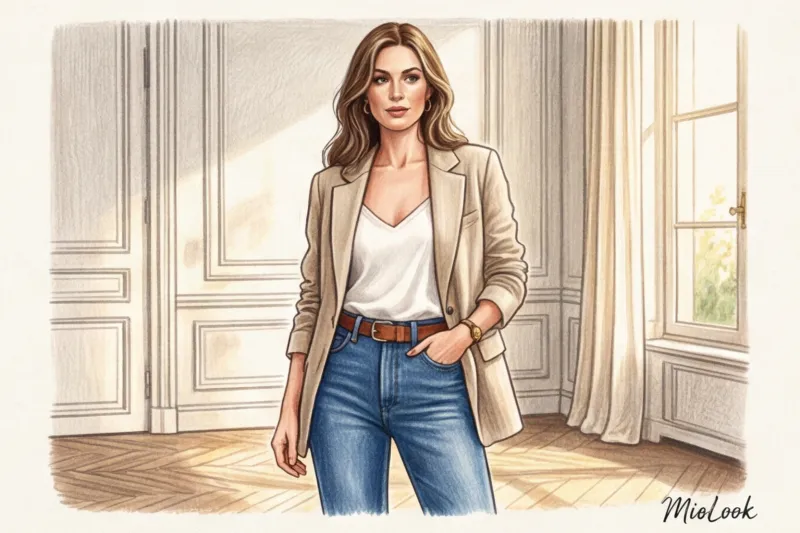
Formula 1: Straight-leg jeans + structured jacket + silk top
We're going for geometric shapes. A soft, flowing V-neck top accentuates the décolleté and neck. Layer a blazer with defined shoulders over the top. Wear the jacket unbuttoned! The two flaps of the jacket create a perfect vertical line down the center of your body, visually cutting off your sides and concealing your belly.
Formula 2: Wide-leg trousers + a thick shirt worn untucked
Take a cotton shirt (important: the fabric should hold its shape, not hang like a rag). Put it on untucked, but use a clever trick: unbutton the bottom two or three buttons. The shirt flares out into a triangle at the stomach. This inverted triangle breaks the horizontal waistline and brilliantly disguises the bulk of the lower abdomen.
French Tuck Rule and Straps
Never tuck your top in completely. Use the "French Tuck" rule: tuck in only 5-7 cm of the front edge of the top or sweater, centered above the belt buckle, leaving the sides and back loose. This defines the waistline and elongates the legs, but the fabric fits slightly loosely, hiding any unevenness.
Choose a medium-width belt (3–4 cm) made of matte leather that matches your trousers. Avoid contrasting belts (for example, a white belt on black jeans) – they will cut your figure in half and draw attention to your midsection.
Your perfect look starts here
Join thousands of users who look flawless every day with the help of MioLook's stylish algorithms.
Get access — €0.99 onceFitting Room Checklist: 5 Steps Before Buying
Shopping accompaniment has taught me one thing: a piece can look gorgeous while you're standing in front of the mirror, but become unbearable the moment you take a step. Before you take your jeans to the checkout, conduct five insider tests.
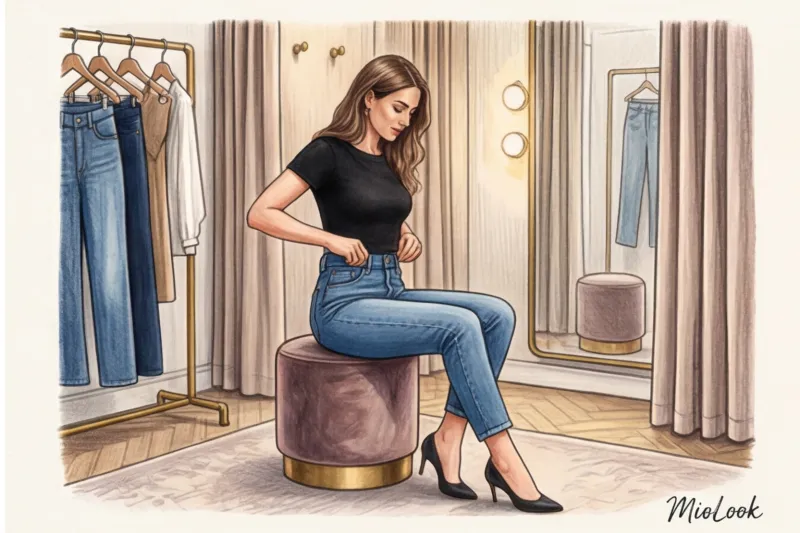
- "Sit test". Be sure to sit on the ottoman in the fitting room. If the belt is painfully digging into your ribs, interfering with deep breathing, or the clasp is dangerously tight, it's not your size or the right rise.
- Back-gap test. Try squatting. If your jeans are too loose at the waist, creating a "pocket," they will constantly slip down and will not properly support your stomach at the front. Look for styles marked Curvy Fit - they have a larger difference between the waist and hips.
- Groin assembly test. Stand up straight. If deep horizontal folds (stylists call them "cat whiskers") have formed in the groin area, your jeans are too tight in the hips, even if the waistband is fastened.
- Checking pockets. Place your hands in the front pockets, straighten the inner pocket flaps, and pull your hands out. The pockets should lie completely flat, without bulging.
- Stretchability test (two-finger rule). Pinch the fabric at your hip and pull. The denim should stretch a maximum of 1.5–2 cm. If it feels like elastic, return it to the hanger; it won't hold your silhouette.
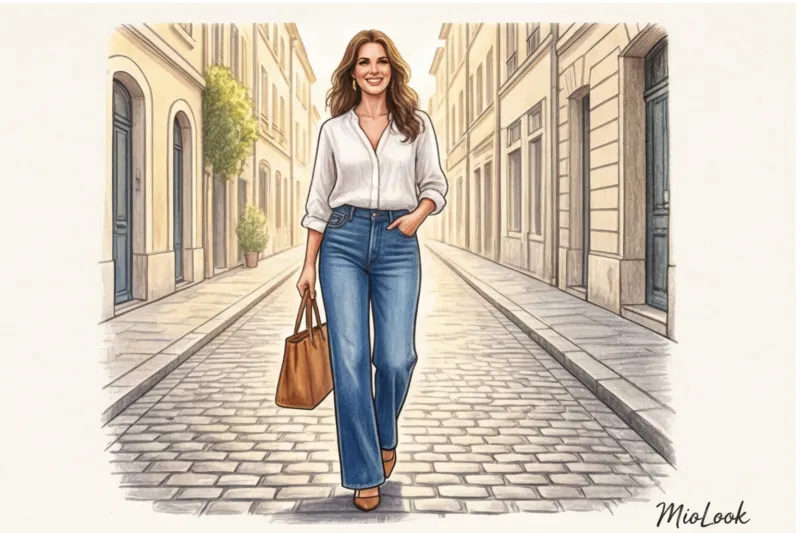
Summary: Your new wardrobe without stress and compromise
Remember: a protruding belly isn't a figure issue that needs to be urgently addressed with diets before heading to the store. It's simply a reason to rethink your approach to cut and construction. High-quality, thick denim, a proper rise of 2 cm below the navel, and silhouette-balancing styles can work their magic.
Tonight, I suggest you open your closet and ruthlessly put away all the thin, shiny stretch fabric that's made you doubt yourself. Make a shopping list with the right measurements (11-13 oz, straight piping, bolt-on closure) and go shopping for the piece that will work for you. After all, true style is a tool for your personal confidence.
Ready to get started?
Try MioLook's free plan—upload photos of your items and let AI create the perfect capsules for every day.
Get access — €0.99 once