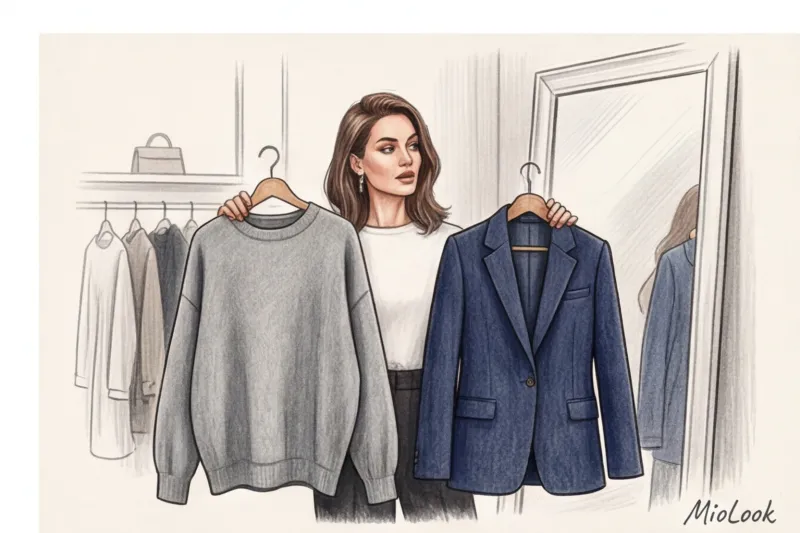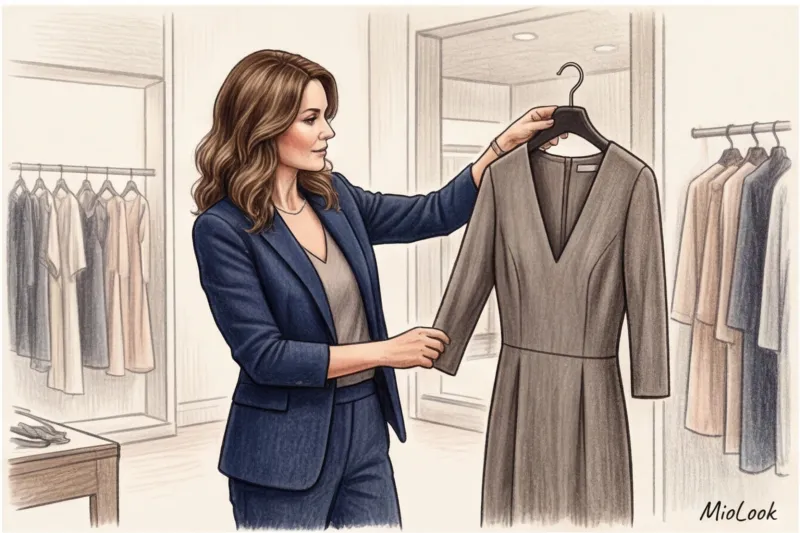
Last week, my client Elena, a top manager at an international company, brought in three huge bags for a wardrobe cleanout. Inside were shapeless, baggy dresses, oversized cardigans, and poorly cut tunics. "I just want to hide my belly," she sighed. "With age, my waist has disappeared, and now I buy clothes two sizes too big to feel secure."
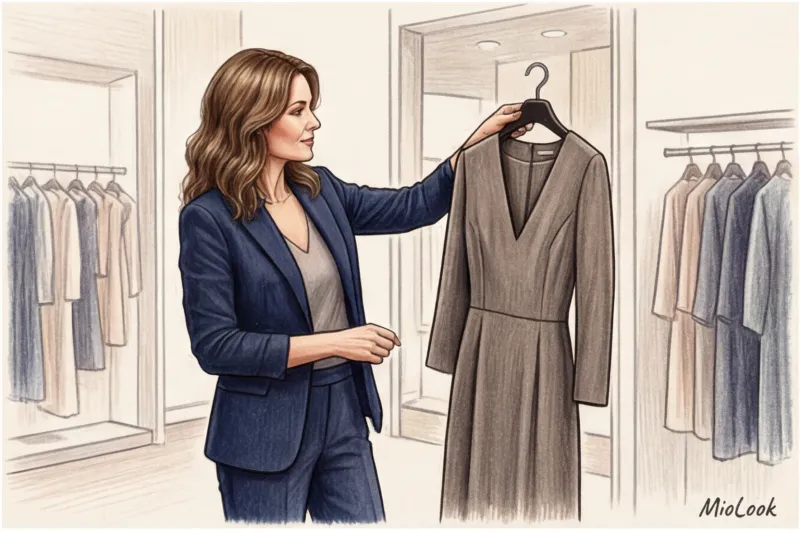
This is the most common and most style-defeating mistake I see in my practice. We're used to thinking that volume hides volume. But the truth is, dresses that hide the stomach and sides These aren't tank covers. They're complex architecture, the right fabric density, and mathematically precise proportions. We've already discussed the physiology of age-related changes in more detail in our A complete guide to body shaping after 40 , and today I want to share with you the secrets of luxury tailoring. We won't hide your figure, but rather re-sculpt it.
Silhouette Migration: Why Old Style Formulas No Longer Work
Let's be honest: what fit you perfectly in your thirties may now be bunching up in treacherous folds. And it's not because you've let yourself go. According to a large-scale study by the International Menopause Society (IMS) in 2023, the natural decline in estrogen levels inevitably leads to a redistribution of fat tissue. Fat deposits shift from the hips to the abdominal area.
This is why standard mass-market sheath dresses, cut to standard sizes, suddenly start to tug at the waist, creating an unflattering horizontal fold. They simply aren't designed to accommodate a new body contour. The luxury segment takes a different approach. Designers understand that after forty, the focus should shift from attempts to "tighten imperfections" to the art of creating new proportions.
The Main Secret of Luxury: How Fabric Density Decides Everything
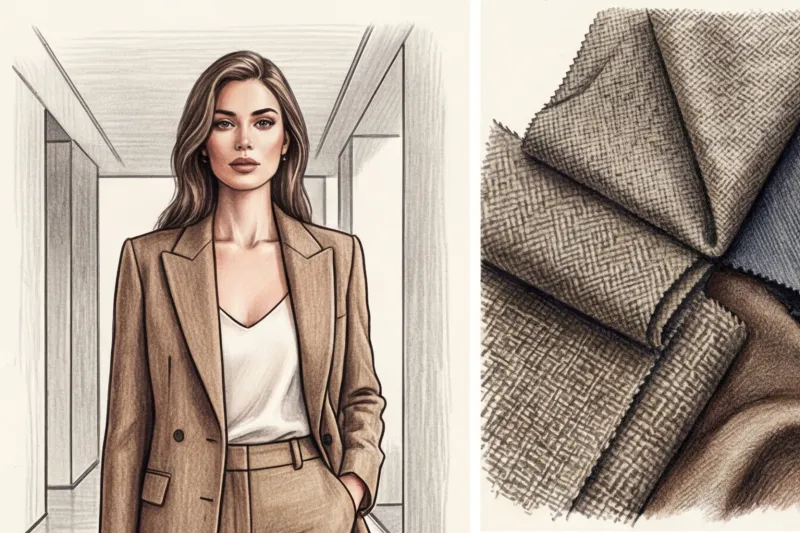
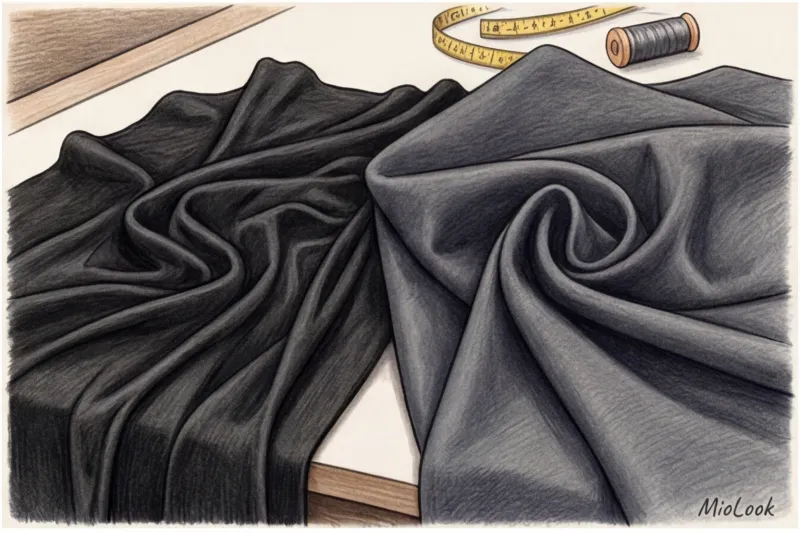
If you remember only one rule from this article, let it be this: It's not the style that's important, but the texture of the material A wrap dress made of thin viscose will highlight every roll of the hips, while a dress made of thick crepe will create the illusion of a chiseled silhouette.
When working with VIP wardrobes, I always use the "stretch test." Grip the dress fabric around the stomach with two fingers. If it stretches easily, is see-through, or flows like water, keep the item in the store. We're looking for so-called "sculptural fabrics." According to textile technologists, fabrics with a density of 250 g/m² or more can visually smooth out up to 80% of silhouette irregularities. Such materials include heavy cady silk, dense crepe, virgin wool, and taffeta.
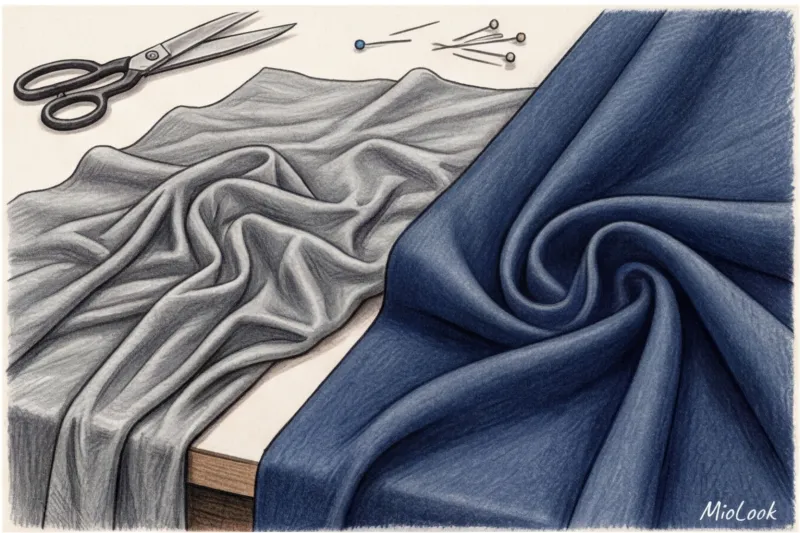
And another insider secret: the "air gap" rule. There should always be 1-2 centimeters of air between your body and the fabric of your dress, no matter the circumstances. As soon as the fabric digs into your body, it ceases to be clothing and becomes a magnifying glass for your size.
Your perfect look starts here
Join thousands of users who look flawless every day with MioLook. Upload your wardrobe and get ready-made look formulas.
Get access — €0.99 onceTop 5: Dresses that conceal the belly and sides with architectural precision
When building a timeless wardrobe, I always ask my clients to consider the cost-per-wear. One perfectly tailored dress in a dense fabric for €300 will pay for itself faster and bring you more joy than five cheap, compromised €60 options that you'll be reluctant to wear. Below are five investment styles that work without fail.
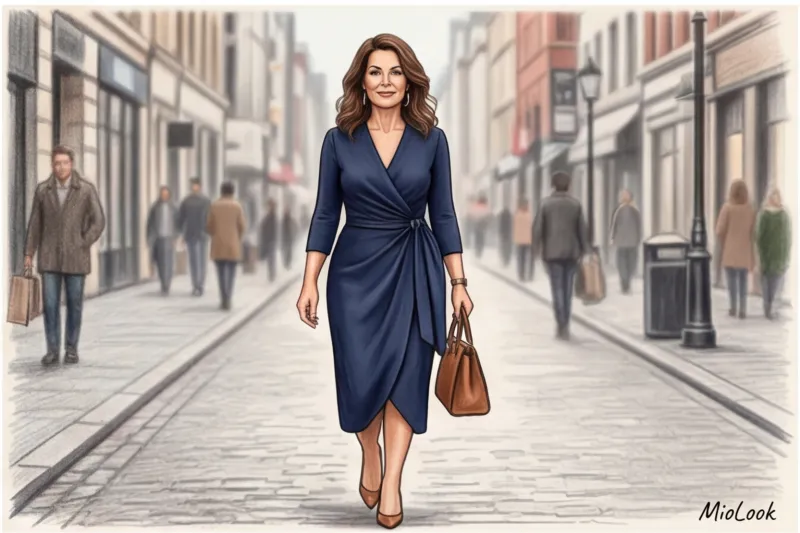
Structured Wrap Dress
Diane von Furstenberg made this style iconic, but the principle of the diagonal cut itself is credited to the great Madeleine Vionnet, who experimented with the bias cut back in the 1920s. The diagonal is the most powerful optical illusionist in clothing. It literally cuts the monolithic volume of the stomach in half.
But there is a nuance: This only works if the dress is made of a thick fabric (remember the rule above?). A soft wrap-over jersey will turn into a robe. The V-neckline will elongate the neck, and the wrap line should end right at the side, not down the center of the stomach.
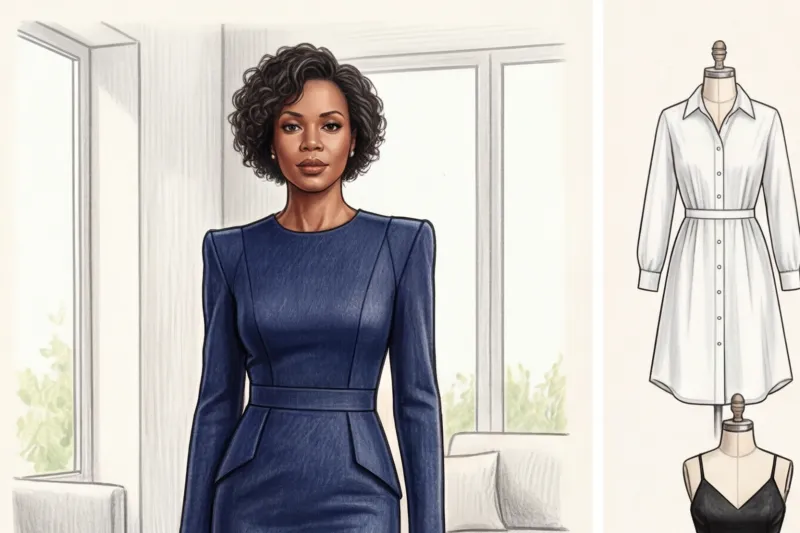
Shirt dress made of thick cotton or silk
The genius of the shirt dress lies in the vertical placement of the buttons. This continuous line draws the eye from top to bottom, visually elongating the silhouette and making it appear slimmer. Choose styles made of thick poplin or heavy silk.
How to wear a belt without constricting your belly? Forget thin belts that cut into your body. Use a wide, medium-stiff belt and wear it just below your natural waistline, or, conversely, wear it up under your bust, creating a slight drape at the belt itself.
A-line dress with a high waistline (Empire)
For an apple-shaped figure, this is the safest and most elegant solution. Christian Dior's principles of architectural tailoring teach us: if you don't have a waist where you want it, draw one where you want it. In an empire-line dress, the cut line falls directly under the bust—the narrowest part of a woman's torso.
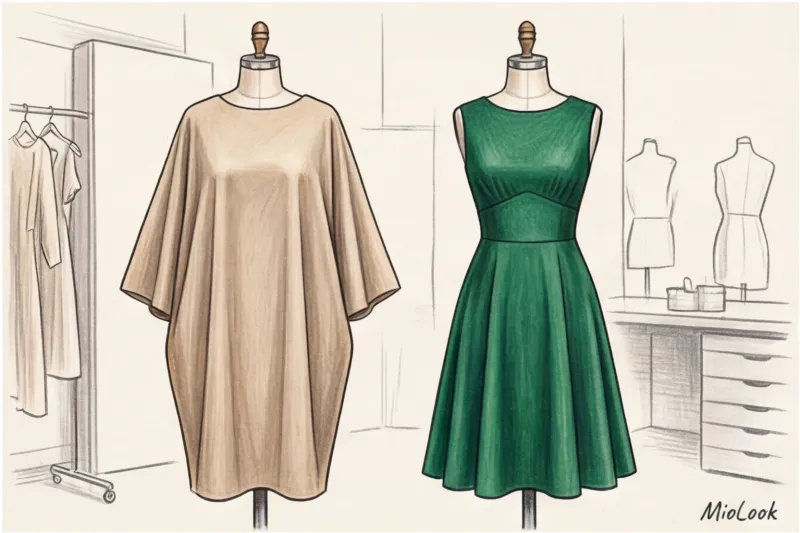
The main limitation of this style is the skirt. It shouldn't be gathered into small folds or pleats right from the seam, otherwise you'll create an undesirable "maternity dress" effect. The hem should flow softly and smoothly down the A-line.
Shift dress
The '60s aesthetic gave us stunning minimalism. The shift dress doesn't emphasize the waist at all. It sits on the shoulders and falls in straight lines. It's a very classy, "expensive" choice for the office or an evening out.
To prevent a dress like this from looking baggy, the right length is crucial. We want to de-emphasize the stomach, but we must also show off the most graceful part of the legs—slender ankles or knees. For more information on how to work with leg proportions, read our article about visual correction of leg shape with clothing.
Ruched Dresses
Don't confuse cheap gathered elastic with expensive architectural draping like Bottega Veneta or Tom Ford. Proper draping at the waist or sides works as camouflage—the folds of fabric create shadows and the optical illusion of a perfectly flat stomach.
An intricate side knot or soft diagonal pleats sweeping toward the hip will steal the show. The fabric should be matte, as a sheen will only highlight curves.
Access to MioLook for €0.99 — one-time payment
A smart AI stylist will select the perfect look for your figure, taking into account your cut and color type.
Get access — €0.99 onceDangerous Illusions: Dress Styles That Visually Add Pounds
It's time to dispel the main myth that ruins the lives of millions of women. Shapeless oversize does not hide fullness. By wearing a tent dress, you convey to others the sheer size of the tent itself. Broad shoulders, a lack of waist, and a wide hem transform your figure into a massive square.
What else should you absolutely avoid if your goal is to correct your abdominal area:
- Thin ribbed knitwear (noodles). It stretches across the stomach, the stripes become deformed, and it acts like a neon sign indicating the problem area.
- Glossy fabrics. Satin, cheap silk, and satin reflect light. Any bulge, even the most microscopic, will appear twice as large in such a dress.
- Dresses with elastic waist. That "caterpillar" effect, where your full breasts hang over the band, revealing your belly's fullness right below. It's the worst thing you can do to your proportions.
The Art of Distraction: Details That Change Focus
Over 12 years of working as a stylist, I've developed a golden rule for visual weight distribution: if we don't want to accentuate the waist, we must shift the focus to its best features. You can't simply "hide" a body part; you must offer the eye an alternative.
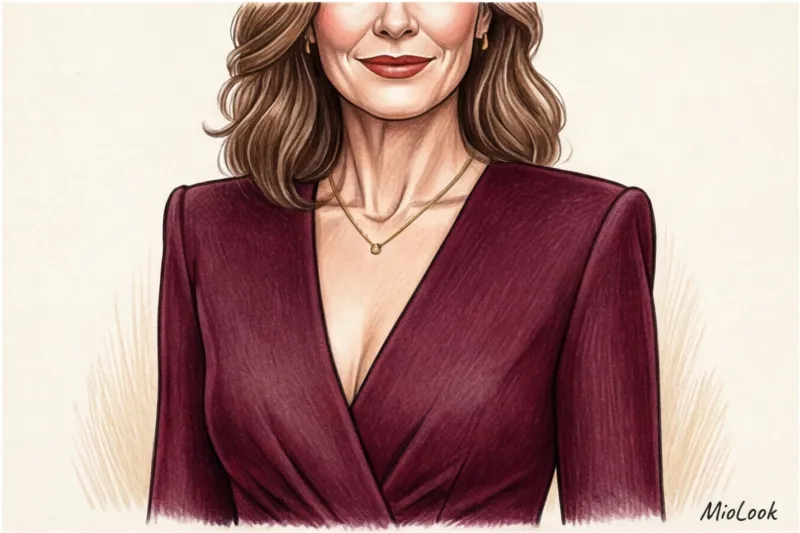
The first point of attraction is the portrait area. Use deep V-necklines, elegant bobs, and accentuated geometric collars. Add statement earrings or a necklace. The face and décolleté are where people should look.
The second point is the wrists and ankles (the narrowest parts of the female body). Choose dresses with 3/4 or bishop sleeves, which gather at a narrow cuff. An asymmetrical hem or a deep side slit also breaks up the horizontal hemline, adding movement and lightness to the figure.
Pre-Shopping Checklist: How to Choose the Perfect Investment Dress
Next time you go shopping, use this professional checklist. This is how stylists select items for photo shoots and high-end clients.
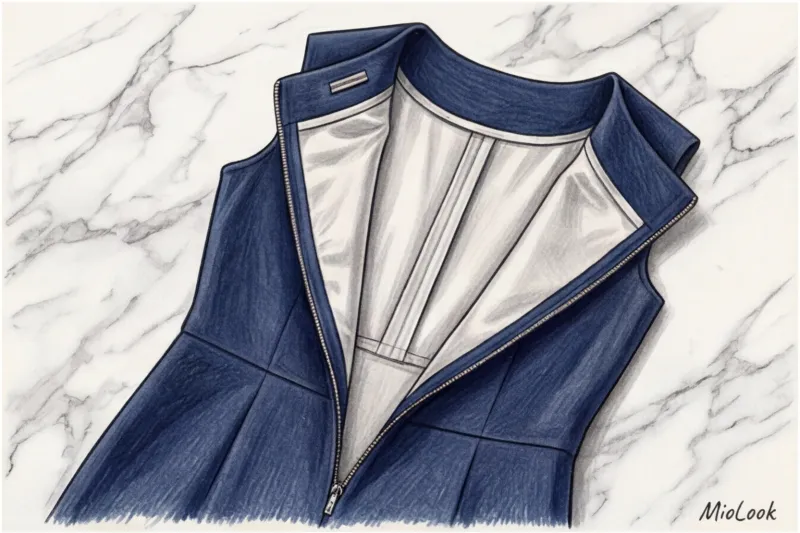
- Check the back. Having a high-quality, smooth lining (viscose or cupro) is critical. The lining allows the dress to glide over the body without catching on tights, underwear, or uneven skin.
- Evaluate the architecture of the seams. Darts, darts, and more darts! A dress should have shape even when it's just hanging on a hanger. If it's just two pieces of fabric sewn together, it won't flatter your figure.
- Conduct a stress test in the fitting room. Don't stand there in front of the mirror. Sit on a ottoman (your stomach always expands a little when you sit—the dress shouldn't cut in). Raise your arms. Take a few long steps. If the dress is riding up and you constantly want to tug it down, it's not for you.
By the way, to avoid buying another dress that you have nothing to wear with, I always recommend digitizing your closet in advance. You can use smart wardrobe feature in the MioLook app , so you can check right in the store whether the new item matches your shoes and jackets.
Stylist's Take: Finding Confidence in a New Silhouette
I always tell my clients: a small belly after forty is a testament to your feminine physiology and life experience, not a reason to deny yourself the luxury of elegance. There's no need to wait until you lose ten pounds to buy a beautiful dress. You deserve to look flawless right now.
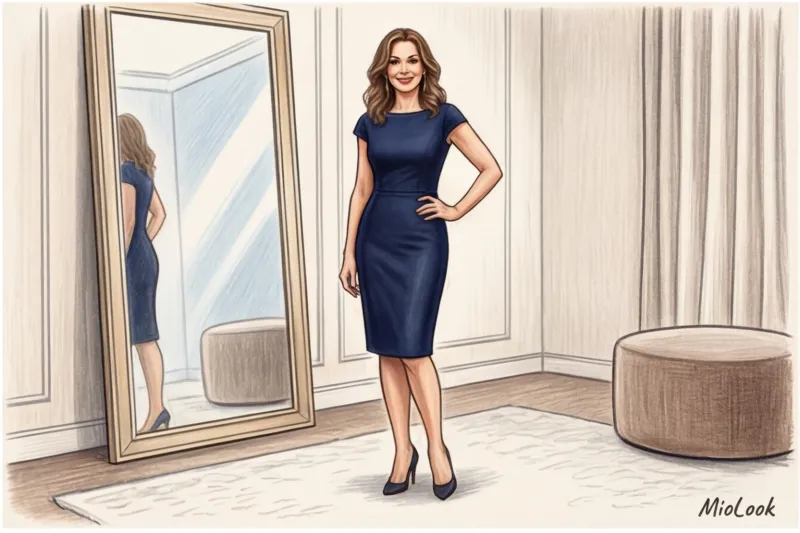
A well-chosen dress with an architectural cut and a dense texture is your soft armor. It gives you tremendous self-confidence. The main conclusion I want you to take today is to take stock of your closet. Get rid of the shapeless knits that make you slouch and suck in your stomach. Keep only those pieces that hold their shape and respect your body.