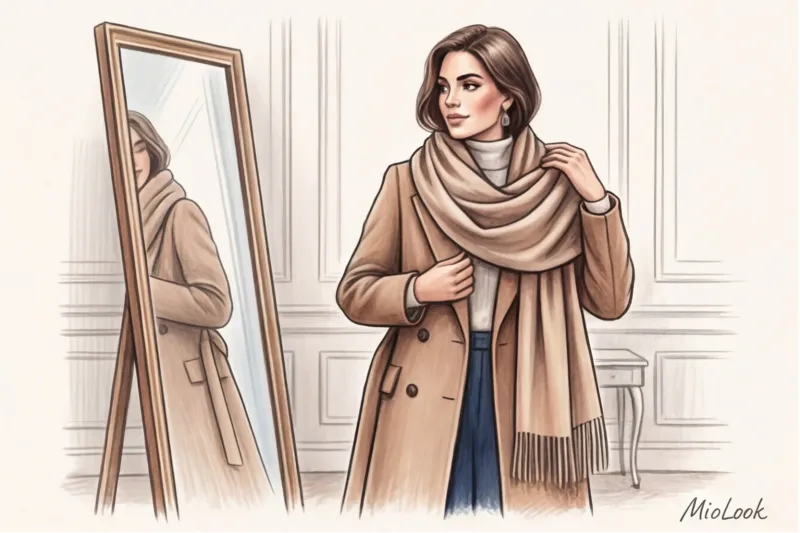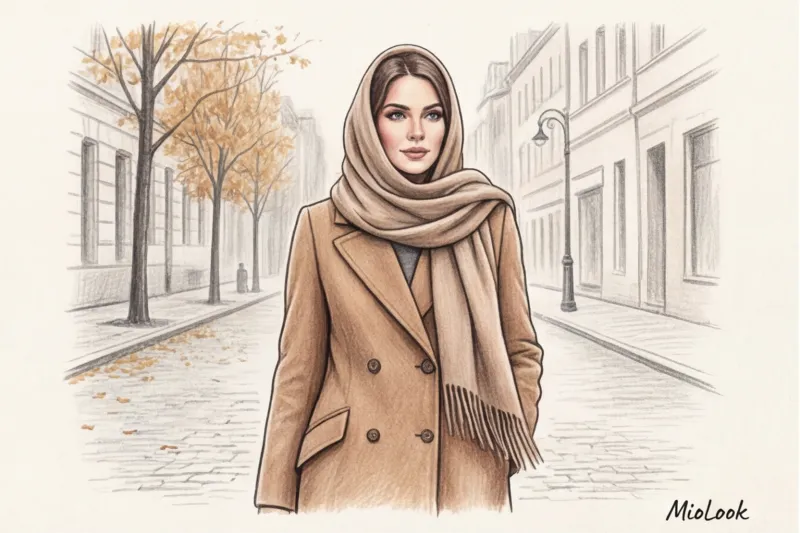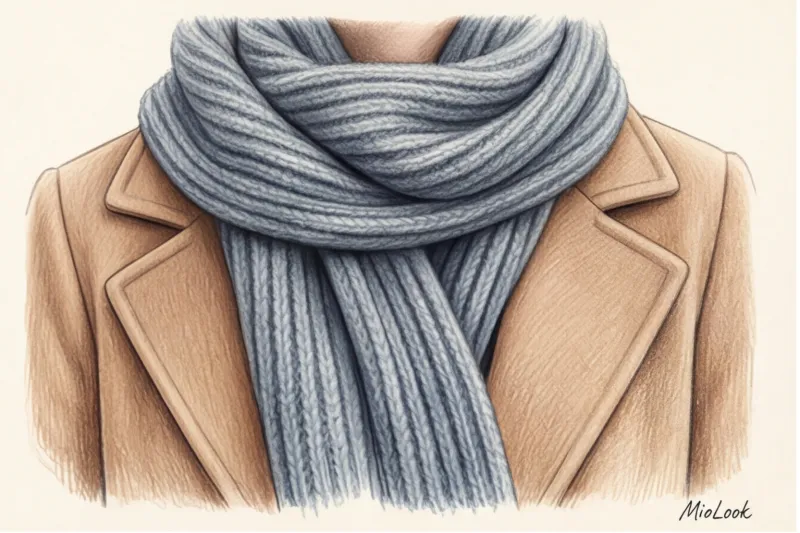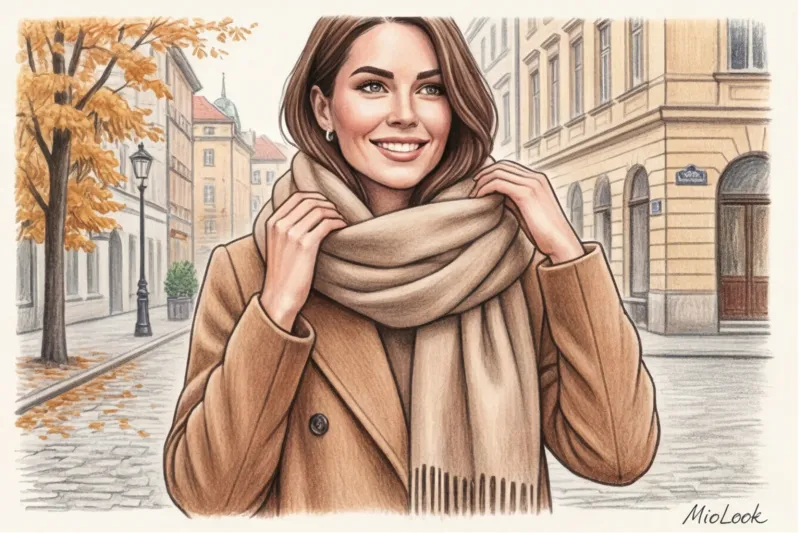
If you have a black acrylic scarf hanging on a coat rack in your hallway right now, I strongly recommend putting it away from your nice wool coats. As a stylist and textile expert, I often see the same fatal mistake: women invest tens of thousands of euro in high-quality outerwear, only to ruin its nap with a cheap synthetic accessory.
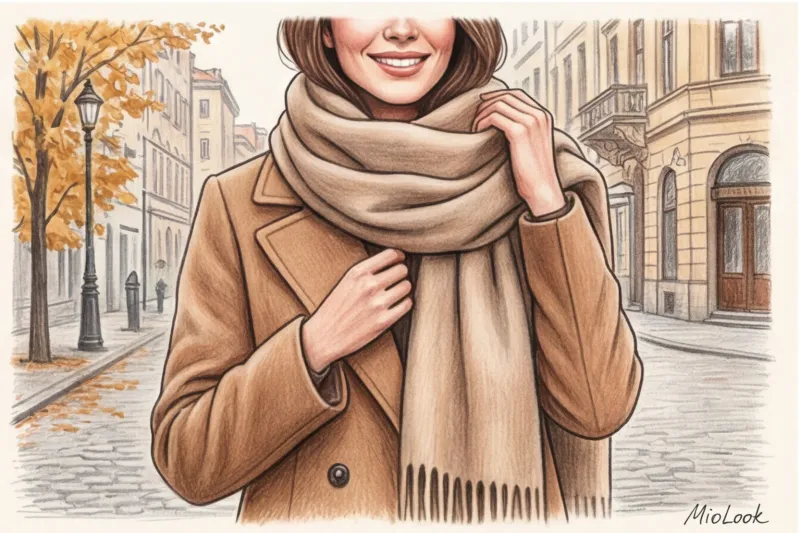
Instead of clichéd advice about buying a "universal black scarf," today we'll examine this accessory from the perspective of textile engineering and color. I've already discussed a more systematic approach to wardrobe in our The complete guide to essential accessories for women , but the neck and décolleté require a separate, detailed discussion. After all, it is through this exposed area that we lose up to 30% of our body heat in winter.
The Anatomy of the Ideal Accessory: What a Basic Women's Scarf Should Be
Let's dispel the biggest mass-market myth right away: a skinny, short scarf doesn't keep you warm or add style. The right one basic women's scarf It starts with math. Its width should be at least 50 centimeters, and its length should be between 180 and 200 centimeters. Only these dimensions provide that "expensive" drape, when the fabric falls in soft folds rather than standing stiffly against the face.
Drapability is the physical property of a fabric to form soft, rounded folds. If you tie a scarf and it bulges like cardboard (a common problem with polyester-blend fabrics), it will visually "swallow" your neck and make your silhouette look bulky.
"There's an important caveat here. The visual volume of a scarf should always be proportionate to your build. If you're petite (under 160 cm), hyper-oversized scarves like Lenny Kravitz will create a "head on a saucer" effect. In this case, look for a happy medium—a width of about 40-45 cm, but made from a very flexible yarn."
Textile Literacy: Compositions that Keep You Warm and Don't Pill
A flashy brand name on the label won't save you from pilling. Only the fiber composition and length matter. The pilling index (the tendency to form pills) can be predicted in the store. The shorter and fluffier the thread, the faster the scarf will lose its appearance.
According to the report Textile Exchange (2023), cheap cashmere production causes colossal damage to Mongolia's ecosystems due to overgrazing. Therefore, the industry is now actively switching to recycled wool or wool certified to the RWS (Responsible Wool Standard). Look for this abbreviation on labels—it guarantees that the wool is ethically sourced and the fiber itself has passed strict quality controls.
Wool, Cashmere, and Alpaca: Where to Invest
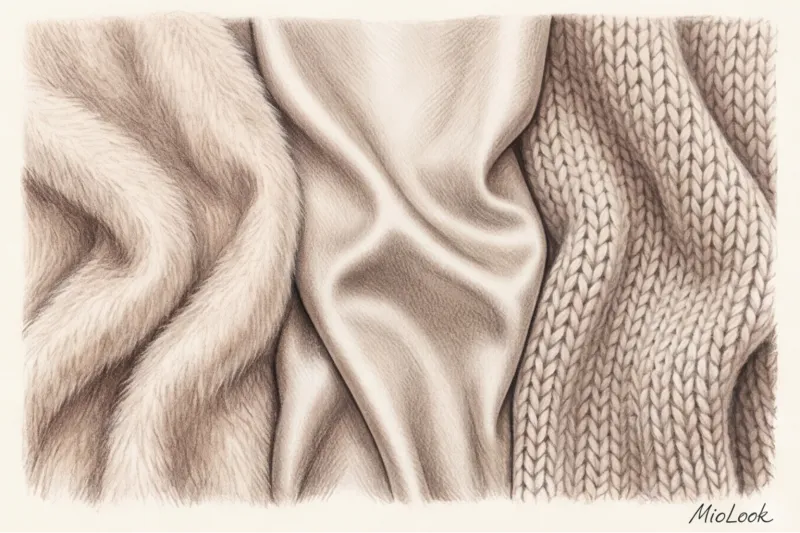
If your budget is limited, always choose 100% merino wool. Merino fiber is 18 to 24 microns thick, making it completely non-itchy for 90% of people. It provides ideal temperature regulation without the "greenhouse effect."
Regarding cashmere: cheap cashmere (the kind sold in mass-market stores for $30-50) is a waste of money. It's made using short, residual fibers that will begin to pill at the collar after just a week of wear. Dense, mid-priced sheep's wool will always last longer than cheap cashmere goat wool.
My personal favorite for clients with sensitive skin is baby alpaca. This fiber is lanolin-free, completely hypoallergenic, weighs half as much as sheep's wool, but is three times warmer.
Why Acrylic Ruins Your Expensive Coats
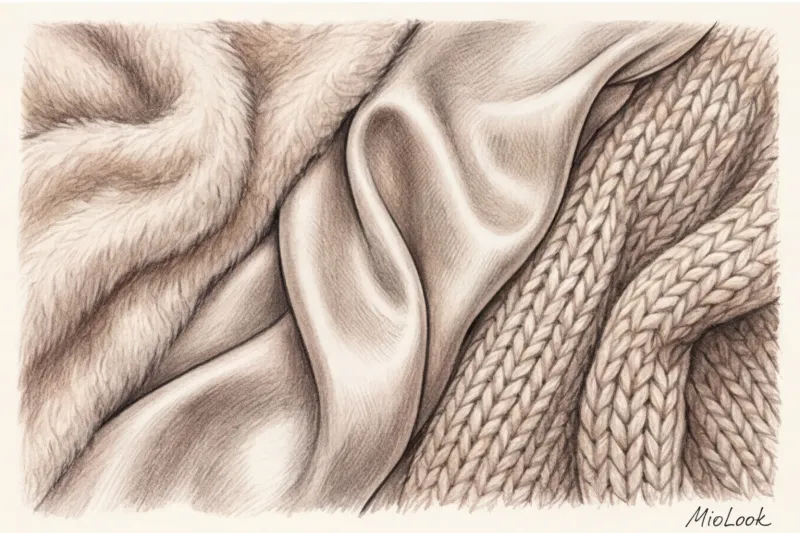
Let's get back to the physics of the process. A year ago, a client came to me in tears: the collar of her new Max Mara coat (made of pure virgin wool) had turned into a felted boot within a month. The reason? She'd worn it with a voluminous scarf from Zara, made of 100% acrylic.
Acrylic has a high ability to accumulate static electricity. Constant friction against the natural nap of a coat creates a micro-charge that literally tears, tangles, and breaks the wool fibers. You're physically ruining an expensive item with a cheap accessory. Furthermore, acrylic releases microplastics when washed, and creates a plastic bag-like effect on your neck—you sweat, and the slightest breeze can lead to a cold. An ideal warm scarf should contain a maximum of 10-15% synthetic fiber (nylon or polyamide) solely for reinforcement.
Create your perfect capsule
Try MioLook for free: A smart AI stylist will find the perfect combinations of accessories and outerwear from your closet.
Get access — €0.99 onceColor Types and Contrast: How to Choose the Right Shade for Your Face
A black scarf is the worst investment in a basic wardrobe. I say this at every consultation. Black near the face acts as a harsh filter: it accentuates shadows, under-eye circles, and nasolabial folds, and visually ages the face in the cold. Plus, it collects all the visible dust from light-colored clothing.
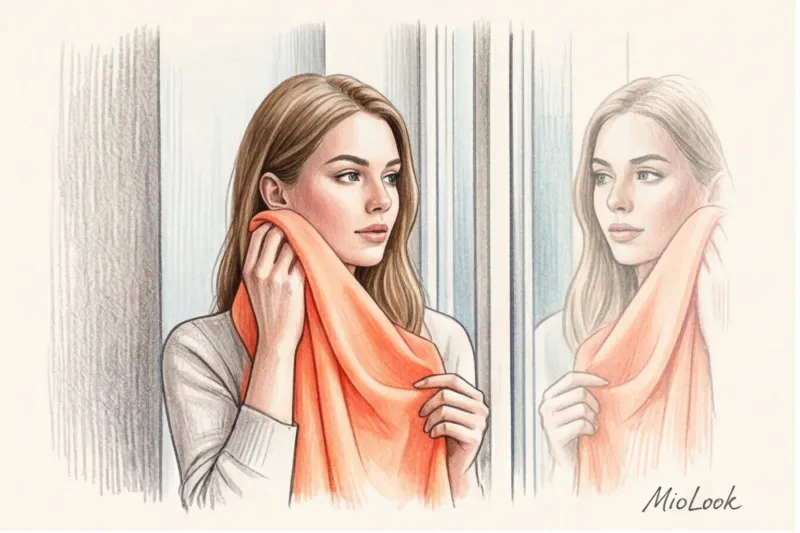
A scarf is your personal photo reflector, notes Leatrice Eiseman, executive director of the Color Institute. Pantone , shades placed directly on the face can optically correct skin tone, neutralizing redness or sallowness.
- What to replace black with: Shades of dark chocolate, deep navy, graphite gray, or pine green. They offer the same status quo, but without the tired look.
- For freshness: Choose complementary colors. If you have blue eyes, a dusty terracotta or caramel scarf will make them pop.
- Be careful with prints: Contrasting checks (especially black and white) break up the look and are only suitable for women with naturally high contrast in their appearance. For others, they'll simply drown out the image.
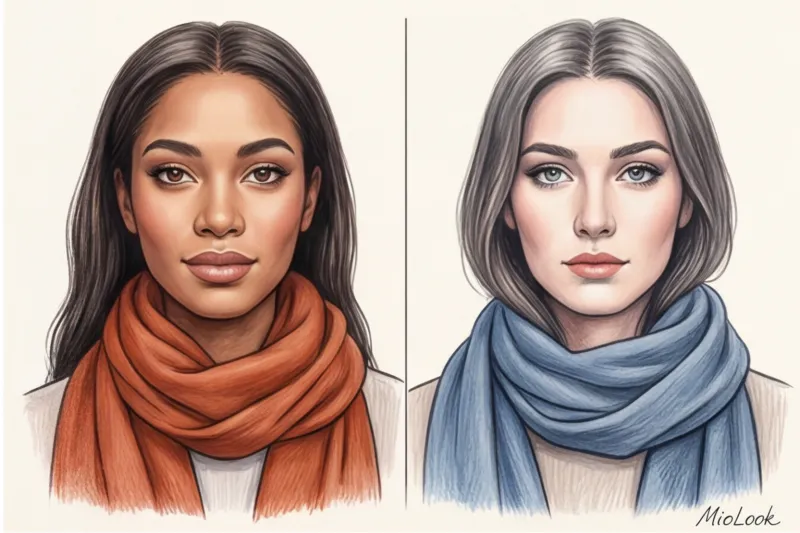
To avoid making a mistake with the palette, I recommend studying A guide to the 12 color types of appearance — this is a base that will save you tens of thousands of euro on unsuccessful purchases.
Shawls vs. Scarves: Creating a Smart Indoor and Outdoor Essential
It's a mistake to think that one accessory can be used everywhere. A smart wardrobe requires a functional division between outdoor essentials (to keep you warm) and indoor essentials (to create a style statement).
A silk scarf (a 90x90 cm scarf) is a brilliant substitute for stiff jewelry in a business dress code. But it also has a purely practical function. Over 12 years of working as a stylist, I've taught all my business clients a simple life hack: a silk scarf tied under the collar of an expensive wool jacket or white shirt absorbs foundation and sebum. Washing a scarf in the sink in three minutes is much easier and cheaper than taking the jacket to the dry cleaner every month.
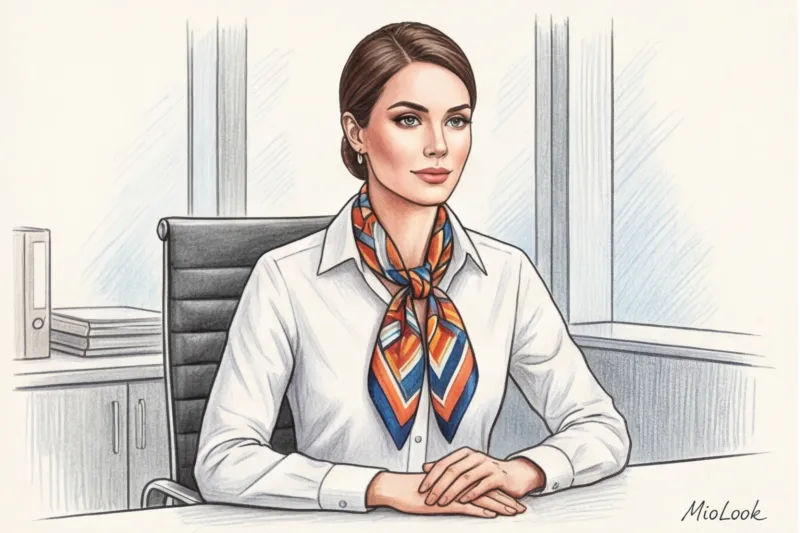
For the spring-fall transition, stoles made of dense modal or viscose are ideal. They breathe like cotton but drape as luxuriously as silk. Read on to learn how to incorporate these accessories into your workday. about a silk scarf in business style.
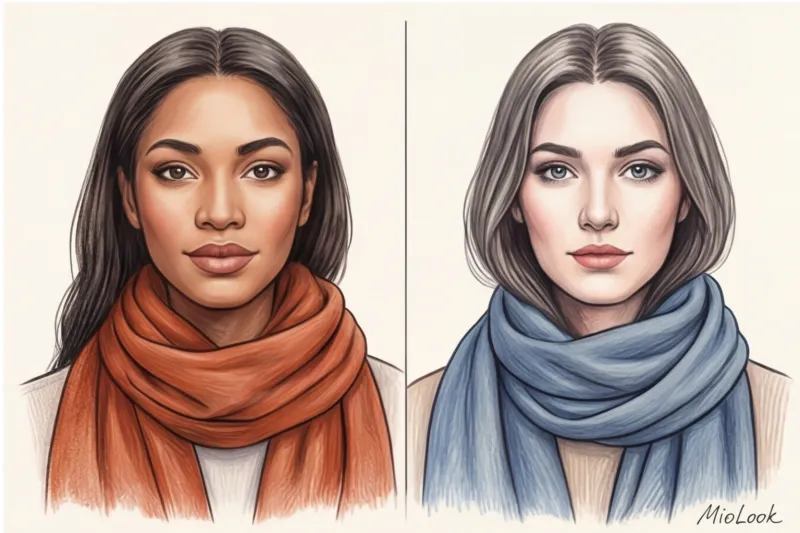
Modern Ways to Tie a Scarf Stylishly (Without the Granny Knots)
Forget tight braids, multi-layered pretzel knots, and complex weaves from tutorials from the 2000s. The main rule of modern accessory styling is effortless chic (casual chic) It should look like you threw on the scarf a second before leaving.
The tying method is dictated not by your imagination, but by the density of the fabric. Trying to tie a thick wool scarf with a Parisian knot means creating a stiff roll across your chest that will prevent you from buttoning your coat. A stylist's secret: we don't tie bulky scarves at all; we secure them with hidden safety pins on the inside.
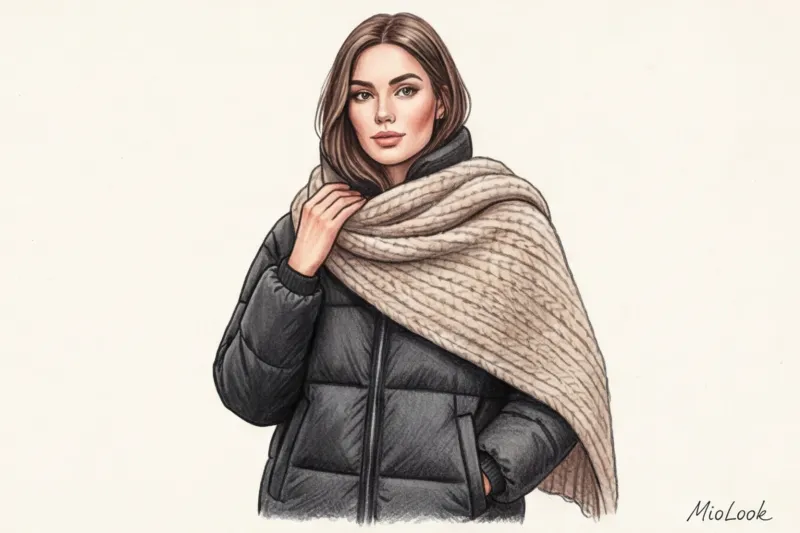
Voluminous draping for down jackets and oversized coats
The "One Turn with Asymmetry" method works with voluminous outerwear:
- Place the scarf around your neck so that one end is twice as long as the other.
- Wrap the long end around your neck once (loosely, leaving air).
- Pull the ends out so they are different lengths - this creates a vertical line that makes you look slimmer.
- One end can be thrown behind the back.
2.0 knot for a classic fitted cut
If you have a tailored coat with a button-down collar, a bulky wrap will throw off the proportions. A "Relaxed Loop" is needed here:
- Fold a thin cashmere stole in half and drape it around your neck.
- Pass only one end through the loop, not both at once (as in the classic Parisian knot).
- Twist the loop into a figure eight and thread the other end through.
- Loosen the knot slightly with your hands so it doesn't look like a tight tie.
Your perfect look starts here
Join thousands of users who look flawless every day with MioLook. AI-powered wardrobe analysis on your smartphone.
Get access — €0.99 onceMioLook Checklist: Test Drive a Scarf in Store Before Buying
Never buy a scarf based solely on your eyes. It's a tactile accessory that requires a physical test drive. I teach my clients to conduct this mini-test right at the display stand.
- Crush test: Squeeze the fabric tightly in your fist and hold for 10 seconds. Release. High-quality wool or silk will straighten out almost instantly thanks to the natural springiness of the fiber. If the fabric remains wrinkled, it will look just as untidy on your neck.
- Static test: Rub the two ends of the scarf together. If you hear a slight crackling sound or the fabric sticks to your hands, return it to the shelf.
- Visual edge test: Cheap production is always betrayed by the edge finish. Premium scarves have hand-rolled edges or a natural fringe of warp threads. A rough machine overlock is a sign of the brand's extreme cost-cutting.
- Light test: Hold the scarf up to a lamp in the store. The weave should be uniform. If you see gaps, thickened threads, or bare spots, the fabric will quickly wear out in these areas.
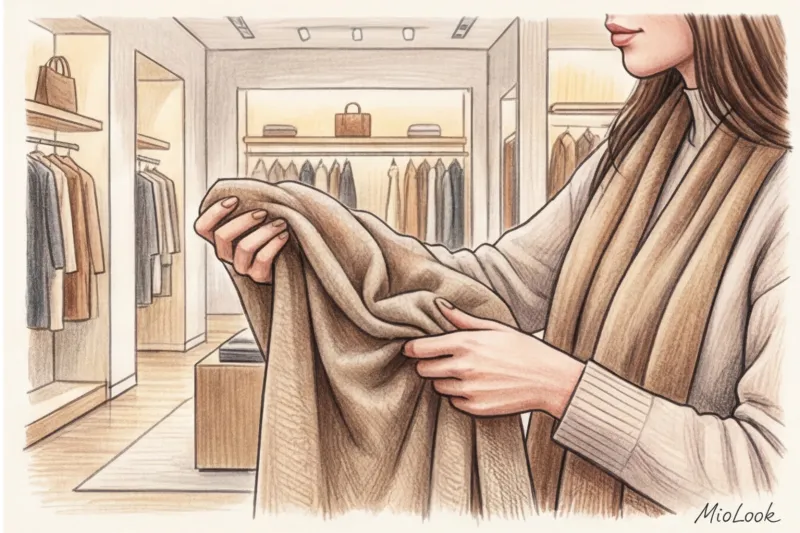
And one last piece of advice: don't try to remember every color combination. While you're in the fitting room, just take a photo of the scarf you like and upload it to MioLook smart wardrobe feature The neural network will show you in a second which coats, down jackets, and jumpers from your real closet this accessory will pair perfectly with. A basic scarf should work for you every day, not sit on a shelf waiting for a "special occasion."