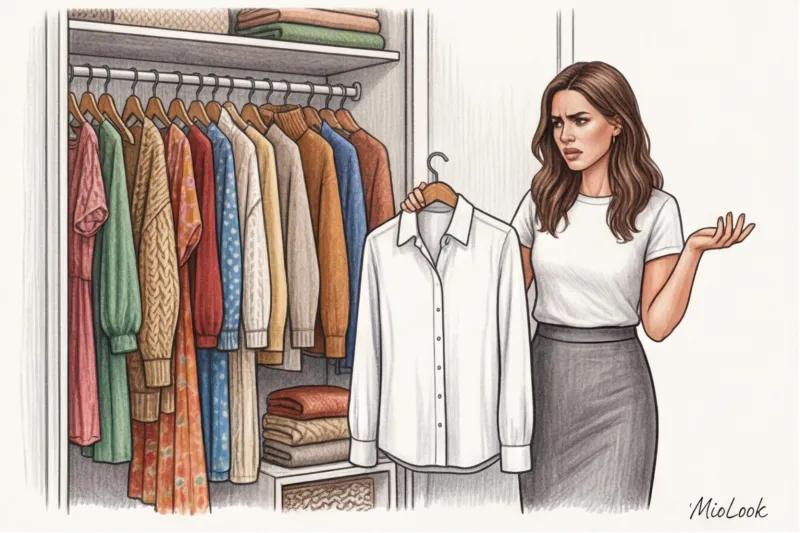
Do you know how many classic white shirts one of my last clients had in her closet? Seven. And she hated all seven. In 12 years of working as a stylist and colorist, I've seen the same scene hundreds of times: a woman decides to "get her style fix," Googles a universal list of items, buys up tailored trench coats and pencil skirts, and then... continues wearing jeans and a stretched-out sweater because she "has nowhere to wear it."
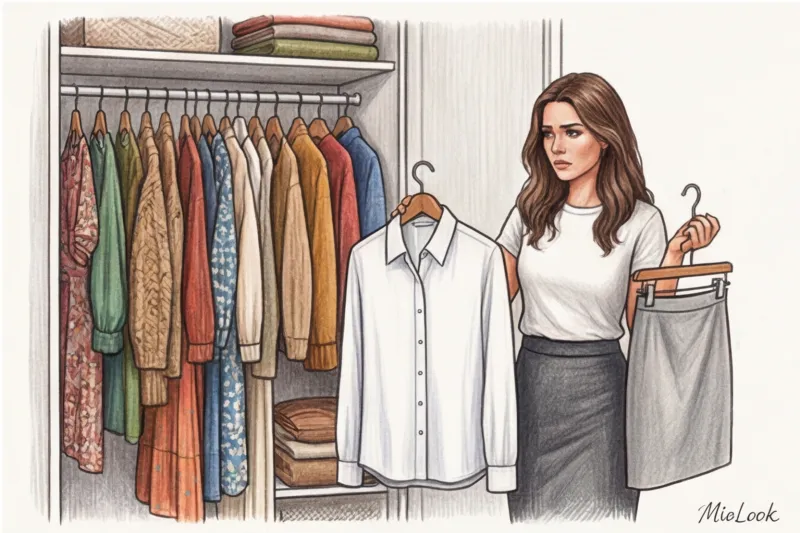
Typical mistakes when creating a basic wardrobe come down to one thing: we're trying to fit someone else's template onto our own unique life. The ideal foundation isn't built on blindly copying glossy magazines, but on the laws of color, cut architecture, and pure mathematics. We discussed this in more detail in our The complete guide to the perfect basic wardrobe for a woman , and today I propose to analyze the main mistakes that steal your money and self-confidence every day.
Mistake #1: Blindly copying "universal lists" from the internet
"Every girl needs a beige trench coat, black pumps, and a smart suit." Sound familiar? It's the most damaging myth in the fashion industry.
I had a revealing case in my practice. Marina, a successful freelance illustrator, approached me. She had honestly bought the entire "basic set" from a glossy magazine article. The problem was that Marina worked from home, got around town exclusively by bike, and spent weekends in the mountains. Her expensive beige trench coat had been hanging with the tag on for two years because it was physically impossible to pedal in it.
A basic wardrobe isn't a uniform. It's the "stylistic cement" that ties together your statement pieces. If you're a stay-at-home mom, your base will be thick microfiber leggings, a high-quality fleece hoodie, and a cashmere jumper. If you're a corporate lawyer, consider structured jackets and palazzo pants.
A "universal" basic item only works for a universal person. And such people don't exist in nature. If something doesn't fit into your daily routine, it's not a basic item—it's random.
To avoid this mistake, I always recommend that clients first analyze their lifestyle. If you find it difficult to do this on your own, MioLook electronic wardrobe It's a great way to visualize which items you actually wear and which ones are just taking up space on hangers.
Mistake #2: Using Black and White as the Only Base Colors
This is my favorite topic as a certified colorist. Black is slimming and flattering—the biggest lie of the mass market. For most Slavic skin types, with their soft, muted contrast, black near the face acts as a merciless anti-aging filter.
According to Johannes Itten's principles of color contrast, if your natural coloring is soft (light brown hair, light eyes, translucent skin), then harsh black will simply "eat up" your face. It will highlight all the shadows, under-eye circles, and nasolabial folds. The same goes for pure white: against it, skin often appears gray or yellowish.
How to choose your base shades
The replacement rule works without fail:
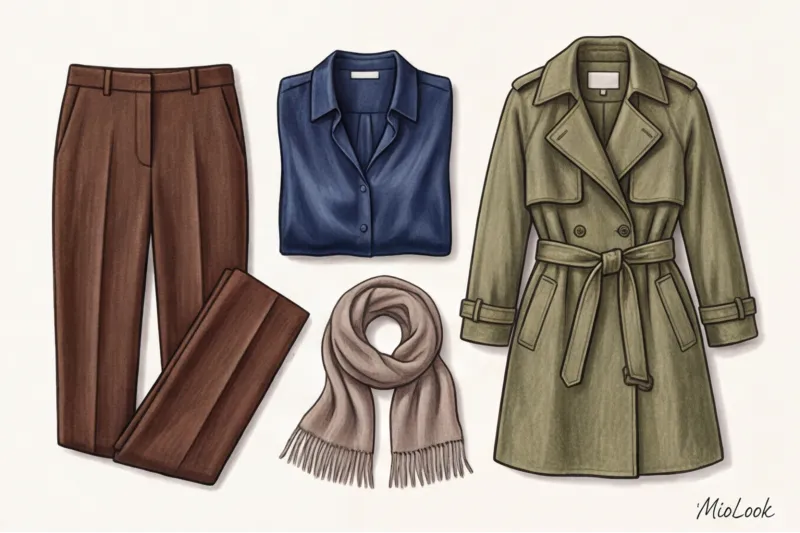
- Instead of black: Choose from deep navy, dark chocolate, rich emerald, or dark graphite.
- Instead of white: ecru (milky), ivory, light taupe or pearl gray.
Of course, there are exceptions. If you're a vibrant "Winter" (black hair, porcelain skin, bright eyes), black is your color. But for 80% of women, swapping black for navy instantly makes their look more luxurious, fresh, and rested.
Access to MioLook for €0.99 — one-time payment
A smart AI stylist will analyze your appearance and select the perfect look.
Get access — €0.99 onceMistake #3: Ignoring the Cost Per Wear rule and skimping on the base
According to a large-scale WGSN study (2024), women regularly wear only 20% of their wardrobe. And it's precisely this 20%—the base—that most women try to save on, squandering their budget on statement corporate dresses that are worn only once.
Let's turn on math and do the math. Cost Per Wear (CPW):
Option A: You buy an acrylic sweater at a mass market for €30. After three washes, it pills and loses its shape. You wear it twice. CPW = 15 €.
Option B: You invest in a heavy cashmere or merino sweater for €200. You wear it for two seasons, at least 100 times. CPW = 2 €.
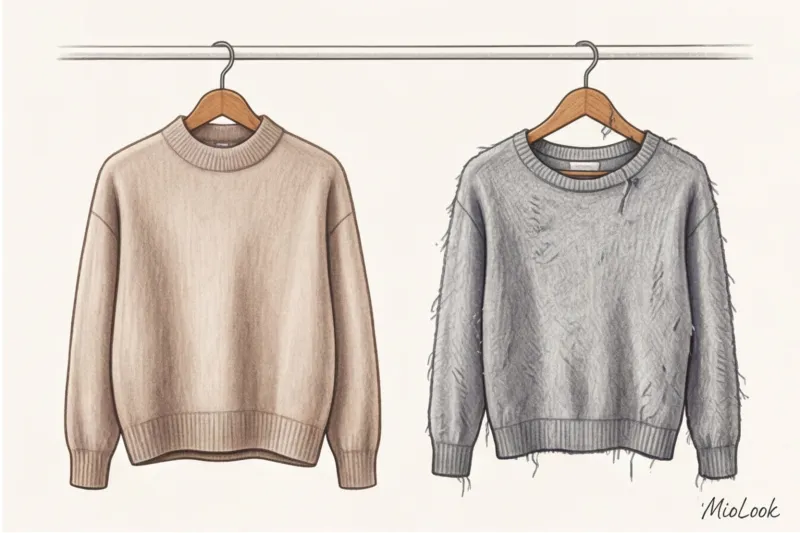
A cheap basic always costs more. Basics are the workhorse. A cotton T-shirt weighing less than 160 g/m² will become a rag within a month. Look for heavyweight cotton (180 g/m² and above), viscose with 5% elastane, or wool blends. You can save on short-lived trends, but never on basics.
Mistake #4: Basic items = boring and bland
My background in interior design taught me one rule: perfectly flat, matte walls of a single color look like cheap plastic. The room needs texture. Same goes for the wardrobe.
A sleek black turtleneck + sleek black suit pants + sleek black boots = a flat, dull, and cheap look. Simple doesn't equal boring.
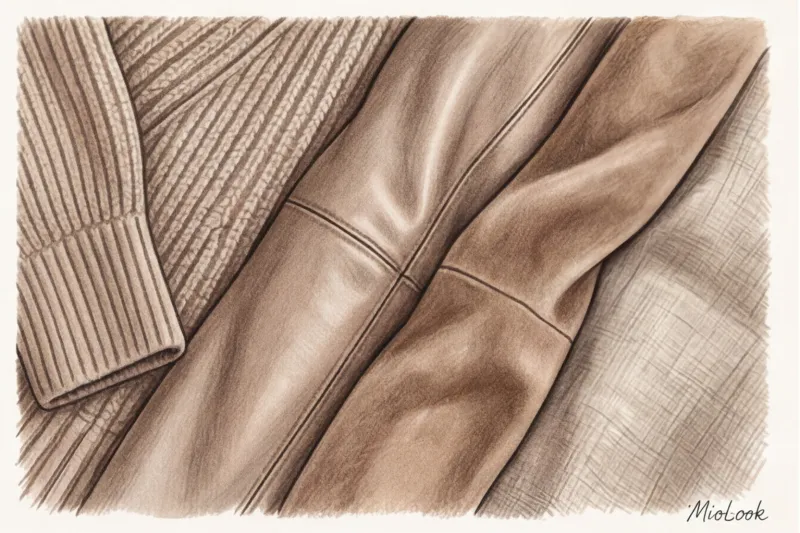
The power of texture in a basic wardrobe
If you're putting together a monochromatic basic look (for example, all beige), the only thing that can save it is a difference in texture. Mix rough with soft, matte with shiny:
- Smooth silk top + chunky knit cardigan;
- Thick, stand-up denim + soft suede shoes;
- Structured leather jacket + flowing viscose.
The second secret to a "not boring" basic is an architectural cut. A basic T-shirt shouldn't hang like a sack. A perfect shoulder line, the correct fit of trousers (for example, a high waist and pleats), and sufficient sleeve length are all important. It's the cut that distinguishes a €500 item from a €15 one.
Your perfect look starts here
Join thousands of users who look flawless every day with an AI stylist.
Get access — €0.99 onceMistake #5: Mismatch between your base and your "real self"
This is a problem in the realm of style psychology. Take a look at your closet. How many items are bought for the "Ideal Self"? For the woman who will lose weight by summer, start going to fashion shows on Fridays, and wear pumps.
Now look at your smartwatch. If you walk 10,000 steps a day, walk your dog, and work in a coworking space with a relaxed dress code, why do you need three formal three-piece suits?
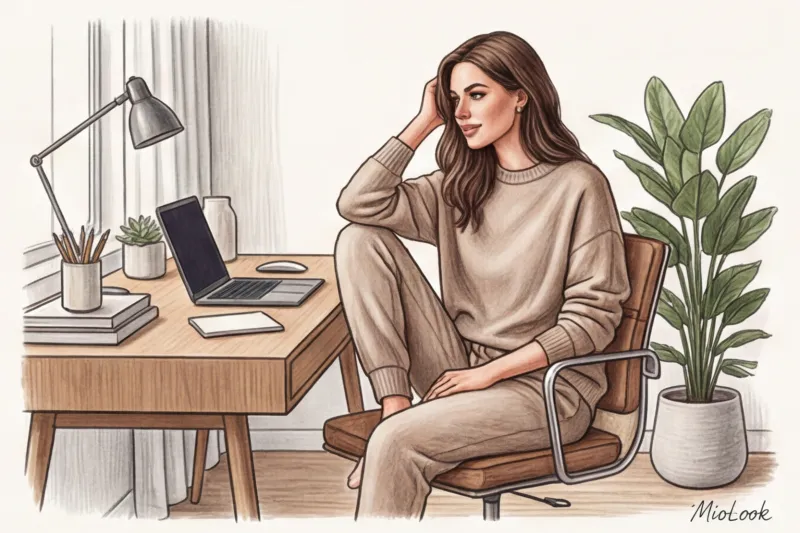
Step one in creating the perfect wardrobe is an honest audit of your real life. Draw a diagram: what percentage of time do you spend at home, in the office, out and about, and on dates? If 60% of your life is Casual Friday, then 60% of your wardrobe should consist of perfect jeans, quality T-shirts, loafers, and relaxed jackets.
Mistake #6: Buying "single-player" items instead of "team players"
You know the situation: you buy a stunning skirt with a complex print, bring it home, and realize you need a new blouse to go with it, some special tights, and shoes in a certain shade. It's a selfish item.
The main rule of a basic item is that it must be a "team player".
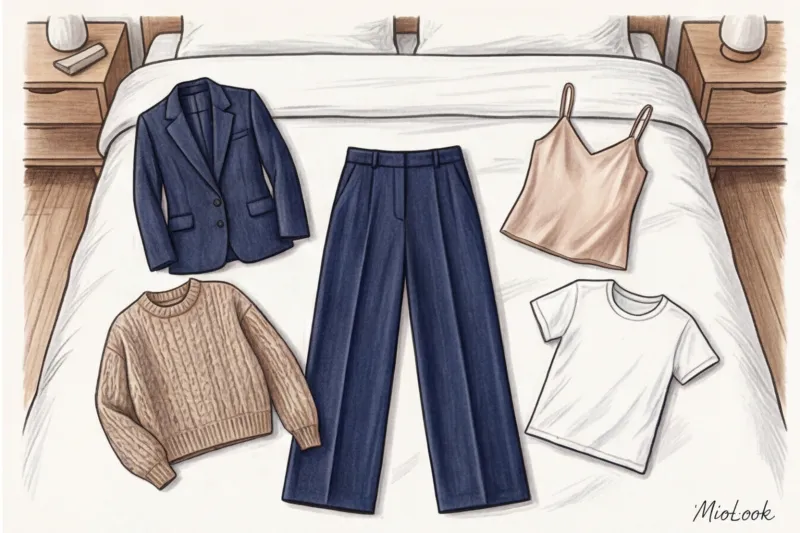
I have an ironclad rule for the fitting room: The rule of three images If I pick up an item and can't mentally create at least three outfits with it within 10 seconds from what's ALREADY hanging in my closet, I leave it at the store. No "I'll buy more tops later."
Basics don't tolerate overly bold embellishments, rhinestones, torn edges, or loud prints. This is why many people confuse a basic wardrobe with a capsule wardrobe. A capsule wardrobe can feature trends, but a basic wardrobe is a foundation that must be compatible with 80% of your items. And yes, to avoid having to keep track of your entire closet, MioLook app allows you to check what your new purchase will go with in a couple of clicks.
Ready to get started?
Try MioLook's free plan to manage your wardrobe—no commitments.
Get access — €0.99 onceMistake #7: Forgetting about shoes, bags, and belts as part of your basic wardrobe
Even a perfectly tailored trench coat and luxurious cashmere sweater will fall apart like a house of cards if you wear them with outdated, worn-out shoes or a shapeless bucket bag.
Accessories are what pull an outfit together. A basic bag should hold its shape (have a rigid frame), be made of high-quality leather, and have minimal shiny hardware. Investing in a structured bag in the €200–€350 range can visually elevate a simple jeans-and-T-shirt look (even from Zara for €40) to a level of old-money aesthetic.
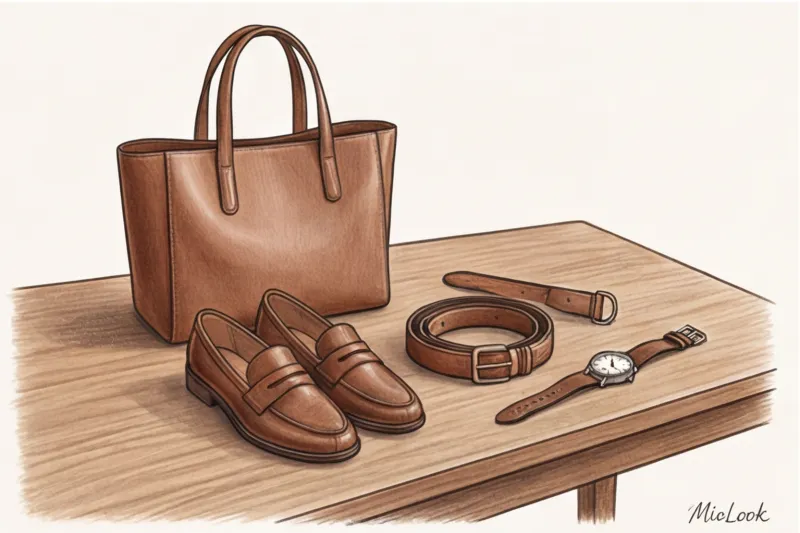
And don't forget the belt! It's the most underrated silhouette-shaping tool. A basic, medium-width leather belt with a simple metal buckle instantly completes your look and defines your waist, even with a bulky sweater.
Checklist: Finding Mistakes When Building a Basic Wardrobe
Now let's move from theory to practice. Conduct a mini-closet audit today with inverted hanger method.
- Hang all the clothes in the closet so that the hooks of the hangers are facing "at you" (non-standard).
- Every time you wear something, wash it and return it to the closet, hang it correctly (with the hook facing away from you).
- Look at the results in a month.
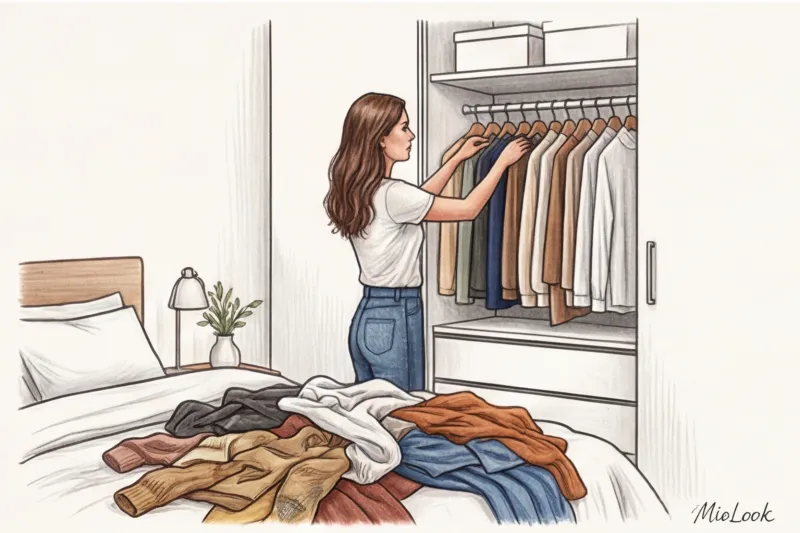
Those items whose hangers are left upside down are your ballast. And those that you turned correctly are yours. real base. Analyze them: what condition are they in? What colors predominate? Are they of sufficient quality?
Make a plan to gradually replace tired pieces with quality investment pieces. Don't buy everything at once. Start by replacing your black close-to-your-face look with a classy navy, add a few structured pieces, and buy a good belt.
And remember the main thing: the best basic wardrobe is one that you don’t even think about in the morning, because everything in it works for you, not against you.