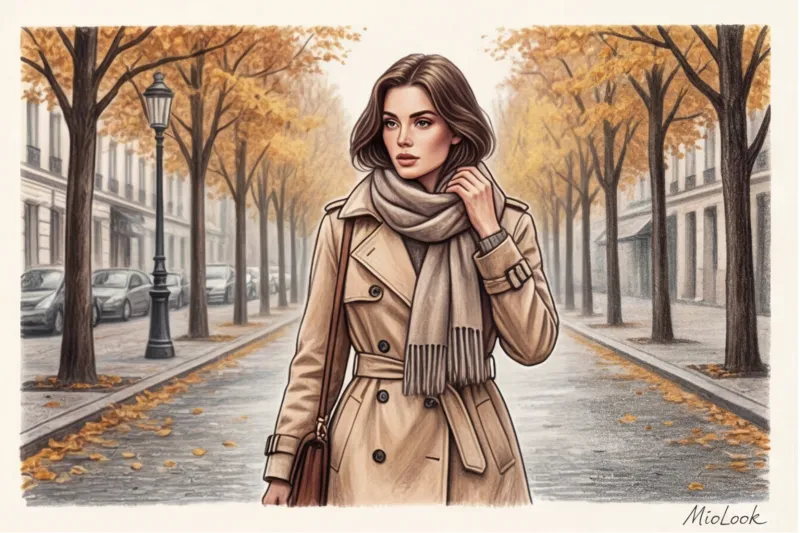
Paris, late September. I'm standing outside the Dries Van Noten show, wrapped in a thin wool jacket. The temperature has plummeted to 12°C, and it's drizzling. And it's at that moment that I notice a stunning metamorphosis: the perfume trails emanating from the editors and buyers smell completely different than they did a couple of days ago in sunny Milan. Gone are the frivolous citruses and sea breezes. The air is filled with a thick, almost tangible scent of damp wood, bitter moss, and warm amber.
Perfume isn't just a cosmetic product. It's the invisible, yet most influential, layer of your fall wardrobe. And if you're still wearing the same perfume in November as you did in July, you're missing out on a powerful styling tool. We discussed the physiology of olfaction in more detail in our A complete guide on how to choose perfume according to the season , and today I suggest looking at autumn fragrances for women through the prism of physics, fabric textures, and image architecture.
The Physics of Cold: Why Your Summer Perfume Disappears in November
Have you ever noticed that your favorite summer bottle seems to "break" when the cold weather sets in? The scent becomes flat, prickly, or disappears from your skin within an hour. This isn't counterfeiting or anosmia (nose adaptation). It's pure thermodynamics.
According to the Fragrance Foundation, the rate of evaporation of ethyl alcohol—the base of any perfume—is critically dependent on ambient temperature. At 25°C, molecules of light citrus and aquatic notes (lemon, bergamot, ozone) actively detach from the skin, creating a voluminous cloud. At 10°C and below, this process slows dramatically. Light molecules simply "shrink" on cool skin, leaving no trail.
The great perfumer Jean-Claude Ellena often emphasizes the importance of the molecular weight of ingredients. In autumn, we need "heavyweights": resins, woods, musk, and patchouli. These have large molecules that don't require intense heat to unfold slowly and beautifully.
The second factor is skin chemistry. With the start of the heating season, indoor humidity drops to 20-30%. Dry skin literally "eats" perfume, trying to extract even a drop of moisture. This is why in the fall, it's essential to switch to compositions with a high concentration of oils (Eau de Parfum or Extrait), where the ratio of base to top notes is approximately 60/40, favoring the base.
Olfactory Wardrobe: How to Match Women's Autumn Fragrances to Fabric Textures
One of my clients, a top manager at an IT company, once complained that her look looked "disorganized," despite wearing a flawless Max Mara camel coat. The problem was in the details: she'd generously applied a light, almost sheer, cologne with notes of green tea and cucumber. It created a profound cognitive dissonance. The subtle, ringing scent clashed completely with the heavy, dense texture of the drape.
Over 12 years of working as a stylist, I have come up with an ironclad rule: the density of the perfume should be directly proportional to the density of the fabric.
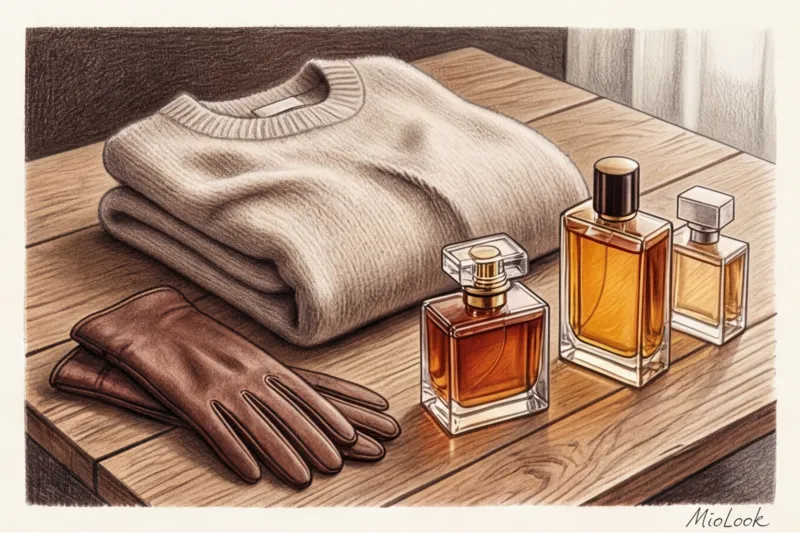
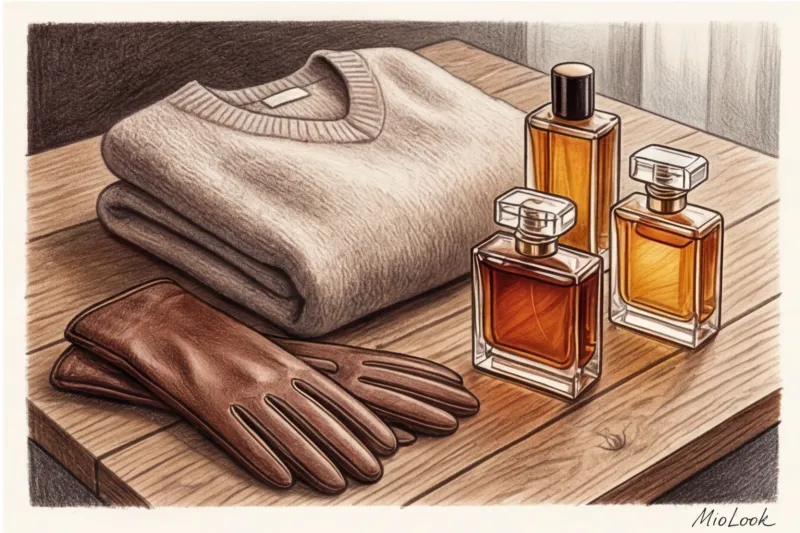
Cashmere and wool: amber, tonka bean and sandalwood
Natural wool fibers have a porous structure with microscopic scales. They act as ideal traps for perfume oils, able to retain base notes for weeks. When you put on a voluminous cashmere sweater, you want a scent that creates a "cocooning" effect.
- Ideal notes: sandalwood, madagascar vanilla, tonka bean, benzoin.
- How to wear: Never spray perfume directly on light-colored cashmere—it will leave oil stains. Apply the fragrance to the inside seams of the garment or mist it into the air and step into it.
Smooth leather and suede: chypre, tobacco and spices
Historically, perfumery and leatherworking are inseparable. In 16th-century Grasse, glovers (gantiers parfumeurs) soaked leather in essential oils of animal musk and flowers to counteract the odor of tannins. Today, a leather biker jacket or a heavy trench coat literally begs for sharper, more structured scents.
Play with contrasts: the rugged texture of leather pairs beautifully with complex chypres. Remember the story: François Coty's first famous Chypre was created in 1917 specifically with the idea that it would be worn in cool, damp climates, where oakmoss and labdanum are at their most aristocratic.
Your perfect look starts here
Join thousands of users who look flawless every day with MioLook. This smart AI stylist will not only help you choose the right outfit but also suggest the perfect accents.
Get access — €0.99 onceThe Biggest Myth: Why Autumn Isn't Just Vanilla and Pumpkin Lattes
Open any glossy magazine, and you'll read that the best fall fragrances for women must smell like a candy store: praline, cinnamon, burnt sugar, and caramel. This is a huge misconception.
Sure, gourmand scents are warming. But if you're heading to a serious meeting or simply prefer minimalist attire (like The Row or COS), the scent of vanilla cupcake will ruin the entire intellectual aesthetic of your look.
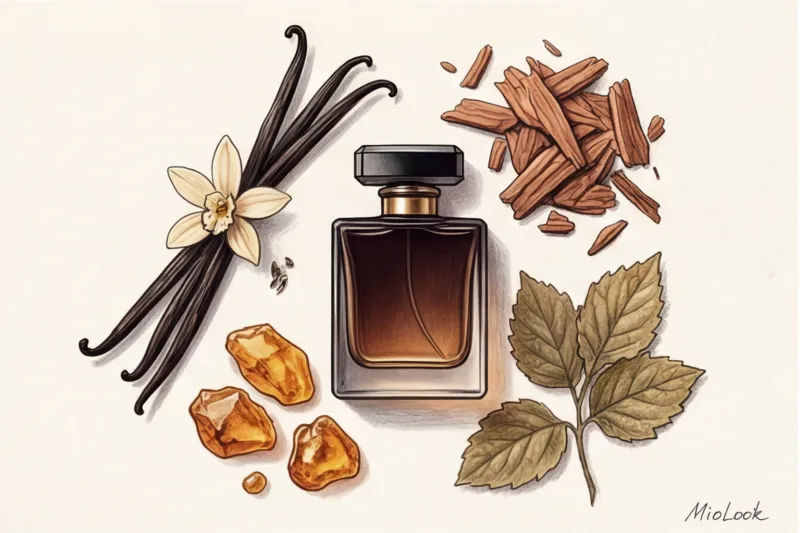
Autumn is the only time of year when the sounds are perfect "cold" Perfumes. Humid air with a temperature of around +10°C is the ideal environment for the development of:
- Vetiver: It stops being simply "earthy" and takes on an elegant smokiness.
- Patchouli: The excess basement dampness disappears, leaving behind the noble aroma of rotten autumn leaves and dark chocolate.
- Black tea and figs: create an aura of calm and distance.
"Cool autumnal chypres act like a perfectly tailored jacket. They don't play with the surrounding sweet notes; they force you to stand up straight"—this is an observation I often repeat to clients who are afraid to stray from their usual floral-fruity compositions.
The Art of Layering in Layer Season
The layering trend in clothing (shirt + vest + jacket + trench coat) can and should be carried over to perfume. Backstage at fashion shows, stylists often use this technique to create a unique, undeniable scent trail.
The key to layering during the cold season is creating a lipid base. As we've already established, dry skin doesn't hold fragrance. Therefore, moisturizing is always the first layer.
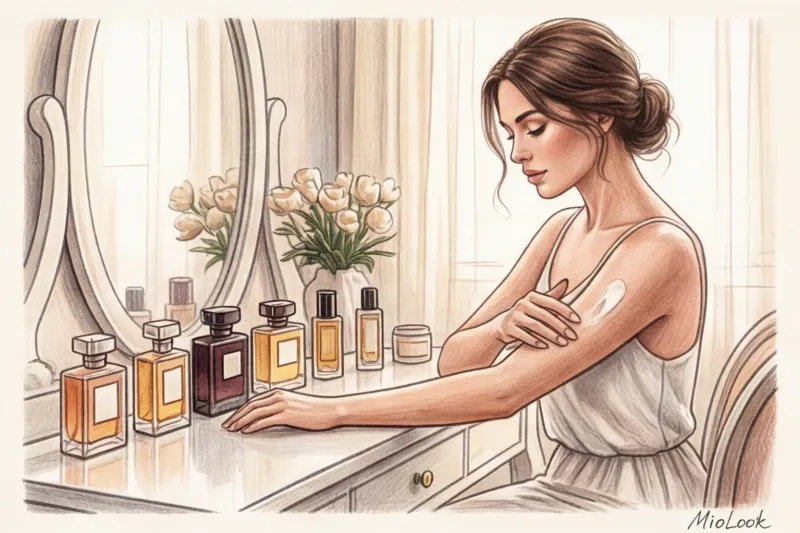
Base rule: Use a scented body lotion with simple woody notes (cedar, sandalwood) or molecular fragrances (based on Iso E Super or ambroxan). Let the lotion soak in for 10 minutes, then apply your main fragrance. The woody base will act as a primer, capturing the volatile notes and deepening them.
Insider's Secret Trick: Apply one, lighter scent to your pulse points, and a second, heavier scent to the lining of your outerwear. As you move, they will blend in the air, creating a 3D effect.
When it does NOT work: Never mix two complex, self-contained compositions (for example, a heavy oriental oud and a dense floral bouquet). You'll create an unbearable olfactory cacophony. Layer only simple fragrances (mono-notes) on top of complex ones, or two light colognes on top of each other.
Perfume Etiquette: How to Wear Heavy Autumn Fragrances for Women in the Office
Autumn brings with it a unique challenge: we move from 5°C outdoors into offices heated to 25°C. And that wonderful, warming amber perfume that smelled so beautiful in the chilly wind turns into a weapon of mass destruction in a closed, open space.
According to HR portal survey statistics, "perfume terrorism" from colleagues consistently ranks among the top 5 most annoying factors in the workplace.

How to wear your favorite autumn compositions without becoming an outcast in your group?
- Follow the arm's length rule. Your sillage shouldn't be detectable further than an arm's length away. If someone can smell your perfume three meters away, you've overdone it.
- Change application areas. Forget about your neck and décolleté. Warm air rises, and the scent will hit you and your companions. Spray perfume under your knees, on the hem of your skirt, or on the back of your neck, under your hair.
- Taboo for the office. Even in the middle of November, the following are inappropriate for a business dress code: heavy animalic oud (it can produce physiological notes in warm weather), overt gourmand (the smell of food in the workplace is distracting), and piercing tuberose compositions.
Ready to get started?
Take stock of your wardrobe before the cold weather hits. The smart MioLook app will help you create a capsule wardrobe where everything pairs perfectly.
Get access — €0.99 onceChecklist: Auditing Your Perfume Wardrobe for Cold Weather
Just like you put away your linen pants and bring out your cashmere sweaters, your fragrance cabinet requires seasonal rotation. I recommend integrating your fragrance selection into your overall style management system—for example, by creating looks through smart wardrobe feature in MioLook , immediately note which perfume will complement a specific capsule.
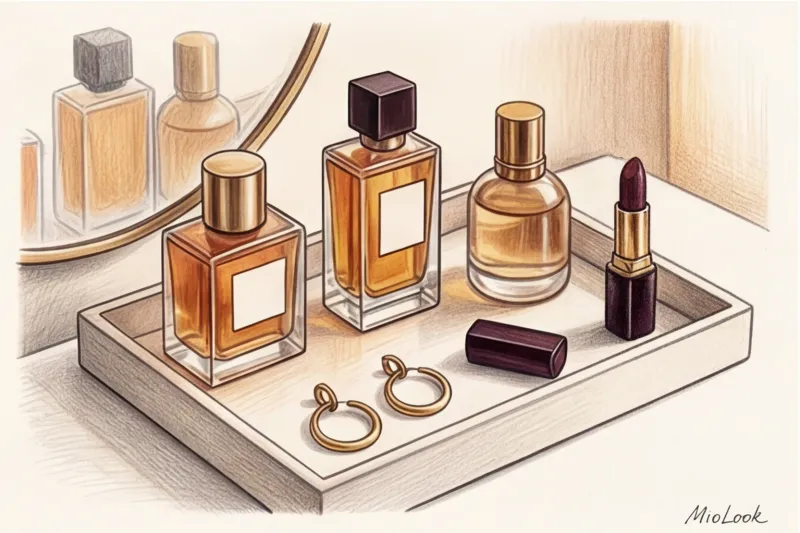
Take 15 minutes this weekend and audit:
- Put in a dark closet: seawater, mono-citrus (leave them until spring, now they will smell like air freshener), light fruit "compotes" in Eau de Toilette concentration.
- Get to the front line: Eau de parfum (EDP) and extracts. Fragrances with leading notes of sandalwood, cedar, labdanum, leather, tobacco, plum, and spices.
- Check the status: If your bottles have been sitting on a light-colored vanity in direct sunlight all summer, the top notes may have been damaged. Spray the fragrance on paper: if you smell alcohol or rancid oil in the first few seconds, the perfume is ruined.
Perfume is the only accessory that physically enters other people's bodies through their breath, leaving a mark on their subconscious even before they've even assessed the cut of your coat. Choose it as carefully as you choose the words you use to introduce yourself.