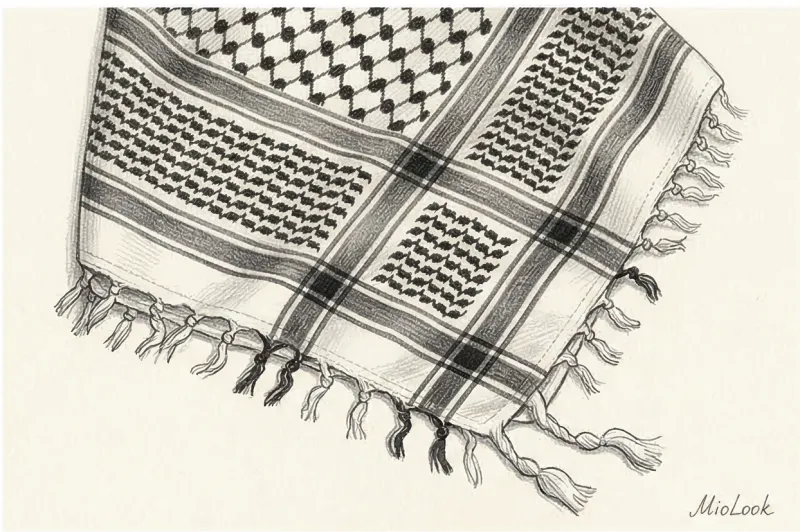
An arafatka is a traditional Middle Eastern square headscarf characterized by a distinctive woven geometric pattern. Authentic pieces are crafted from lightweight, breathable cotton measuring around forty-seven inches per side. Modern style enthusiasts wear it as a versatile neckerchief.
What Is An Arafat Scarf And Where Does The Name Come From?
The term arafatka is a colloquial name that originated in Eastern Europe and Russia during the late twentieth century. It directly references Palestinian leader Yasser Arafat, who rarely appeared in public without his signature black-and-white headscarf. Through extensive media coverage, his personal style made the accessory globally recognizable, leading many people outside the Middle East to associate the garment entirely with him.
Historically, this scarf was engineered for survival rather than style. Nomadic tribes and desert dwellers relied on the dense cotton fabric to protect their heads, faces, and necks from scorching sunlight, blowing sand, and sudden temperature drops that occur after dusk in arid environments. The tight weave acts as a physical barrier against dust storms while allowing air to circulate, preventing overheating during the day.
Arafatka In English: Understanding The Terminology
If you are searching for an arafatka in English, you will quickly find that the term is almost exclusively used in Slavic languages. In English-speaking regions, this accessory is known by two primary names: the keffiyeh and the shemagh.
The word keffiyeh is the most widely recognized term globally. It translates roughly to "from the city of Kufa" in Iraq, pointing to the garment's deep historical roots in the region. You will see this term used in fashion magazines, historical texts, and cultural discussions.
The term shemagh is also common, particularly in the United Kingdom and within military circles. British soldiers adopted the scarf during desert campaigns in the mid-twentieth century, valuing its practical benefits. Today, outdoor enthusiasts and tactical gear manufacturers primarily use the word shemagh when marketing these scarves. Another related garment is the ghutra, which is similar in shape but typically made of plain white, lighter fabric without the heavy woven patterns.
Distinctive Features And Authentic Materials
A genuine arafatka is easily identifiable by its complex, woven geometric pattern. Unlike cheap printed imitations, an authentic scarf features patterns created by thick threads woven directly into the base fabric. This technique creates a raised texture that resembles an oversized houndstooth or gingham check. The dense border around the edges adds structural integrity, preventing the fabric from fraying under harsh conditions.
Traditionally, these scarves are made entirely of lightweight, breathable cotton. The natural fibers ensure excellent temperature regulation, wicking sweat away in the summer and trapping body heat in the winter. Some modern variations designed specifically for cold climates blend cotton with wool, though pure cotton remains the gold standard. The edges of the scarf are traditionally finished with knotted fringe or small tassels, which originally served to weigh the fabric down and keep it in place during strong winds.
Color plays a significant role in the identity of the scarf. The black-and-white pattern is universally recognized as the Palestinian style, while the red-and-white variation is closely associated with Jordanian heritage. However, contemporary fashion brands have expanded the palette significantly. You can now find these scarves in olive green, navy blue, charcoal gray, and even vibrant shades like pink or mustard.
Key Characteristics Of The Arafatka
Understanding the physical specifications of the scarf helps in identifying authentic pieces and styling them correctly.
| Characteristic | Details |
|---|---|
| Shape | Perfect square |
| Standard Dimensions | 42 x 42 inches to 47 x 47 inches (110x110 cm to 120x120 cm) |
| Traditional Material | 100% woven cotton |
| Winter Variations | Cotton and wool blends |
| Classic Colors | Black/white, Red/white |
| Seasonality | All-season (sun protection in summer, insulation in winter) |
How To Wear An Arafatka In Modern Outfits
The accessory made a massive leap into Western fashion during the 2000s, becoming a staple of street style, indie sleaze, and festival wardrobes. Its generous size allows for multiple tying methods, making it highly adaptable to different aesthetics.
The Classic Triangle Neck Wrap
This is the most popular way to wear the scarf in an urban setting. Fold the square diagonally to create a large triangle. Place the wide, pointed corner flat against your chest. Take the two long ends, wrap them behind your neck, cross them over, and bring them back to the front. You can leave the ends hanging loose over the main triangle, tie them in a relaxed knot, or tuck them underneath the fabric for a cleaner, more voluminous look. This method adds immediate texture and visual complexity to layered outfits.
The Tactical Head Wrap
For outdoor activities, festivals, or intense summer heat, the scarf can be worn traditionally around the head. Fold it into a triangle and drape it over your head so the straight edge sits just above your eyebrows. Take the right end, pull it under your chin, and wrap it up toward the left side of your head. Take the left end, pull it across your face to cover your nose and mouth, and wrap it toward the right. Tie the two ends securely at the back of your head. This provides maximum protection from the elements.
Integrating The Scarf Into Your Wardrobe
The arafatka fits seamlessly into grunge and military-inspired styles. It pairs exceptionally well with rugged outerwear like black leather biker jackets, distressed denim, oversized bomber jackets, and chunky lace-up combat boots. An olive and black scarf worn over a khaki parka creates a cohesive, utilitarian autumn look.
In everyday casual wardrobes, the accessory serves as a bold contrasting accent against minimalist basics. Throw a black-and-white keffiyeh over a solid-color crewneck T-shirt, a simple long-sleeved top, or a plain gray sweatshirt. Because the pattern is so striking, it is best to keep the rest of the outfit relatively subdued, allowing the scarf to act as the focal point of your ensemble.