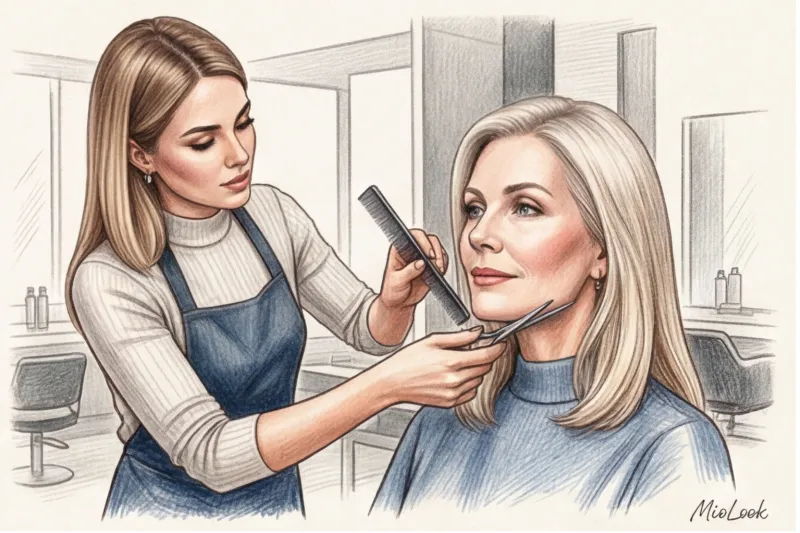
Every time a new client sits down with me and we discuss age-related changes, I hear the same phrase: "My hair has become so thin, let's just cut it shorter and cover the gray." Over 14 years of practicing as a stylist, I've learned that this instinctive impulse is the biggest mistake that visually adds years and highlights all the problems of thinning hair.
Instead of masking the problem with tons of styling products, I suggest using an architectural approach. The right ones Anti-aging haircuts for thin hair after 40 are based on the laws of geometry, not on the amount of varnish poured. We've covered the fundamental principles of working with different textures in more detail in our complete guide: Smart Haircuts for Your Hair Texture: The Secret to Shape Without Styling Today, we'll address a specific pain point: how to turn thinning and stubborn gray hair from a problem into your main stylistic asset.
The Anatomy of Change: Why Old Haircuts Stop Working After 40
To understand how to cut, you need to understand what exactly you're cutting. Have you ever noticed that your signature layered haircut, which looked gorgeous when you were 30, is now hanging in lifeless strands? It's not that your hairdresser has gone bad; it's that the physics of your hair has changed.
According to the International Society of Aesthetic Medicine (2023), after age 40, women's hair density decreases by an average of 10-15%. Declining estrogen levels lead to thinning of the hair shaft itself. But here arises a paradox: the hair on the scalp physically thins, but styling it becomes significantly more difficult. Why?
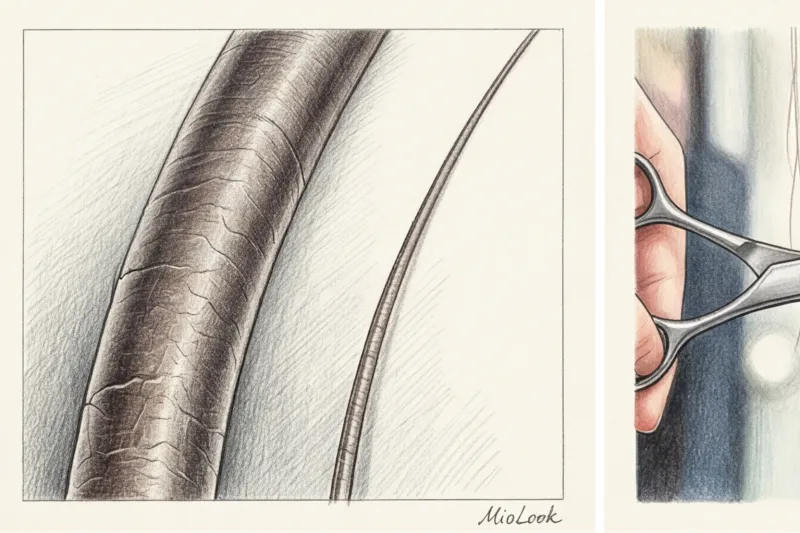
- Loss of melanin. A gray hair is an empty tube. Deprived of pigment, its structure changes, and its keratin layer becomes more rigid and porous.
- Change texture. Because of this stiffness, gray strands are 30% more difficult to heat style and constantly stand out from the crowd.
- The dandelion effect. Thinning pigmented hair loses volume, and coarse gray hairs stick out in all directions.
Trying to tame this new reality with old methods—thinning and aggressive brushing—is a surefire way to break off ends. We need a fundamentally different strategy.
Geometry vs. Styling: How Anti-Aging Haircuts Work for Thin Hair After 40
Back in the 1960s, the legendary Vidal Sassoon revolutionized the concept of Wash & Go (Wash and go). He proved that if a haircut is done with respect to the natural flow of the strands and the direction of hair growth, it will hold its shape without styling. For fine, mature hair, this isn't just a matter of convenience—it's a matter of survival.
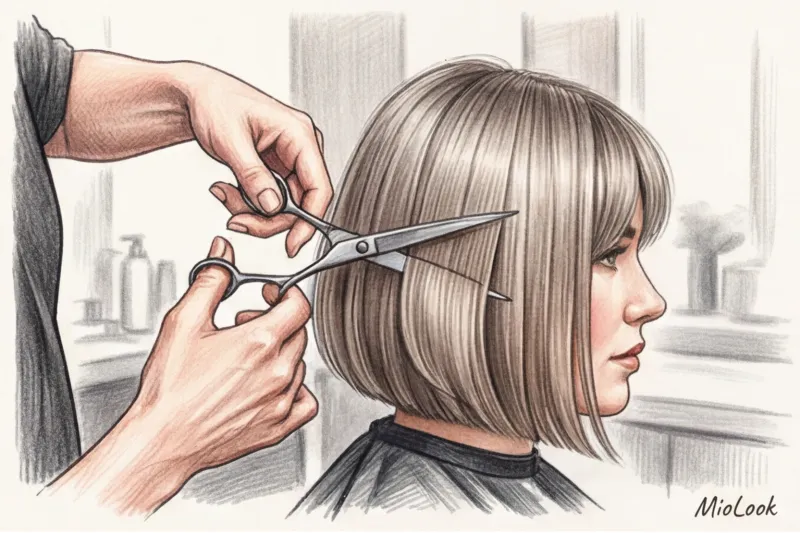
One of my regular clients, Marina, had been trying to maintain volume for years with daily backcombing and crimping at the roots. When she first came to me, the bottom third of her hair was practically translucent from constant heat damage. We removed 7 centimeters of length, created a tight bottom edge, and adjusted the angle of the curl. The result? Her morning styling time was cut from 40 minutes to 5, and her hair looked twice as thick simply by blow-drying in the direction of her hair growth.
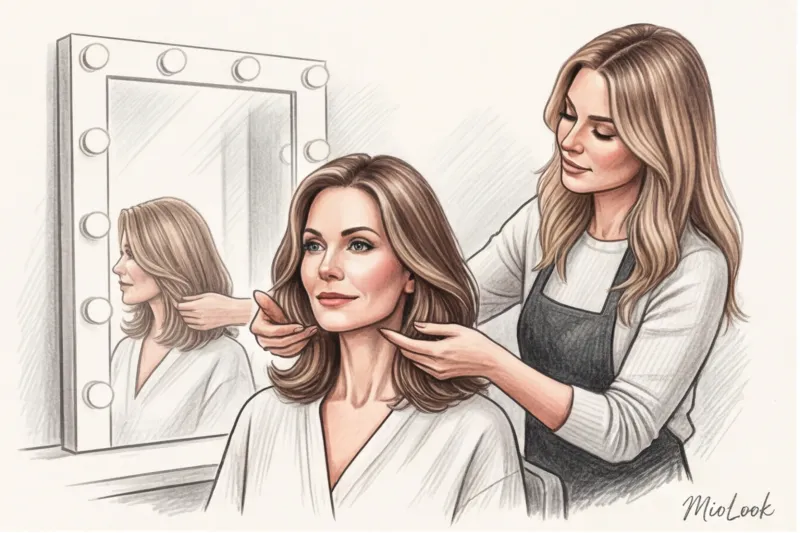
The secret to a "smart haircut" is that the ends of the hair curl inward or fall in the desired direction on their own—due to the angle at which the hairdresser cuts them, and not because you spent half an hour tugging at them with a round brush.
Access to MioLook for €0.99 — one-time payment
A smart AI stylist will select the perfect look based on your individual facial features and hair structure.
Get access — €0.99 onceThe Biggest Age Myth: "The Older You Get, the Shorter You Get" (and Why It's a Fatal Mistake)
This is perhaps the most damaging stereotype I have to combat in the salon. It's believed that if your hair is thinning, it needs a boyish cut. In reality, a classic short haircut with thinning at the crown (the aforementioned "feather tops") mercilessly exposes the scalp. On light or graying roots, this creates the effect of a receding hairline.
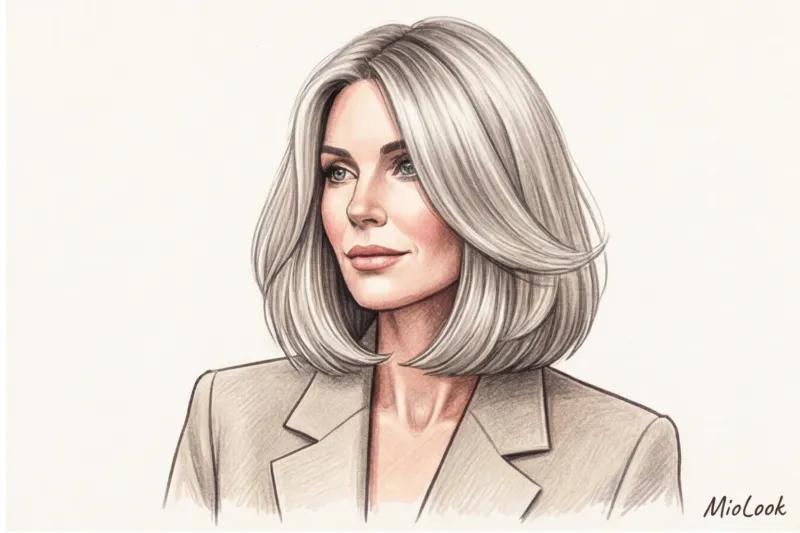
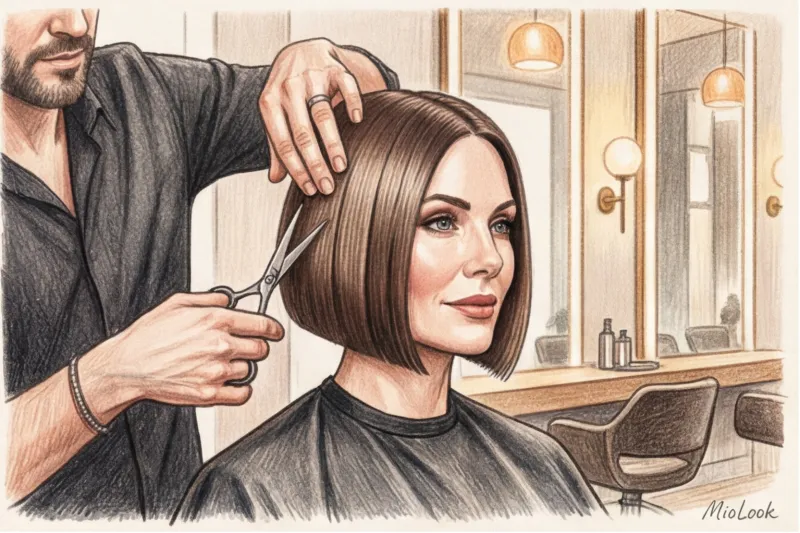
The optimal choice for camouflaging thinning hair is the length from the earlobe to the collarbone, combined with solid perimeter It's an optical illusion used by all Hollywood stylists. A blunt, even cut at the ends acts like the foundation of a building: it creates a visual sense of density and heaviness. Even if you have naturally fine hair, a solid bottom edge will make people believe it's thicker.
Top 3 architectural forms that masterfully conceal thinning
If you're looking for specific ideas for your next salon visit, here are three shapes I personally consider ideal for working with thinning texture. They require little styling and grow out gracefully.
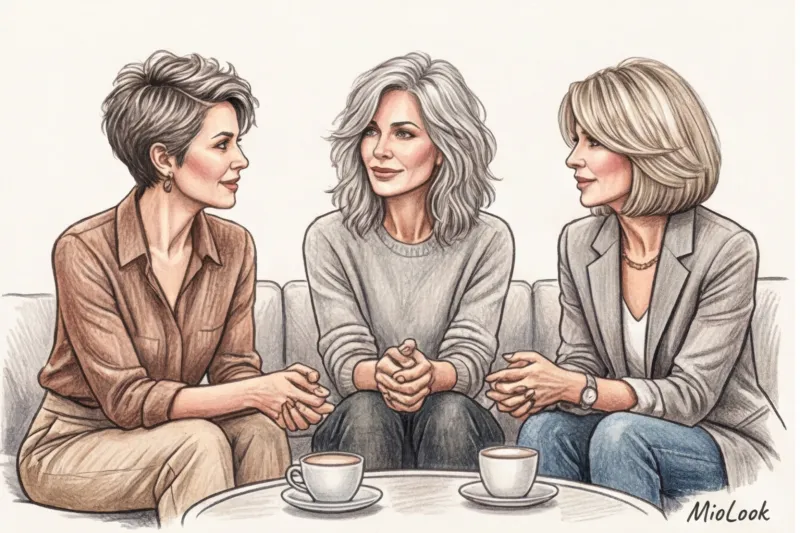
Textured bob with inner layers
A classic bob can look flat on fine hair. Our solution is a textured bob. We keep the bottom cut completely tight and defined for volume, but within the hair, the stylist creates subtle graduations (invisible layers). This lifts the roots and adds movement. The shape is ideal for straight and slightly wavy hair.
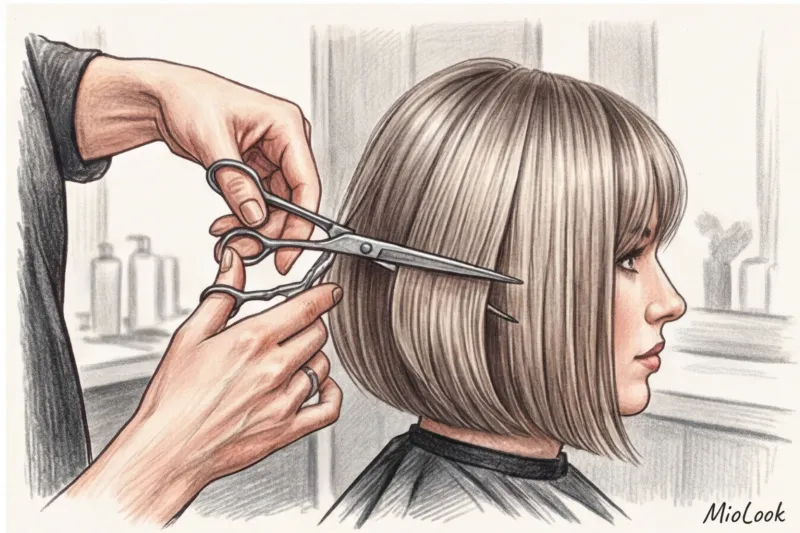
Bixie: a long pixie without the cap effect
The bixie is a brilliant hybrid of a bob and a short pixie. Unlike the classic pixie, the bixie leaves length at the temples, back, and bangs. This softness camouflages problem areas along the hairline and doesn't expose the scalp at the crown. It's a great option for those who want a shorter length but are wary of looking too severe.
Modern Shaggy with a correct edge line
Shaggy hair is built on chaotic layers that create a trendy "creative chaos." It's a godsend for uneven hair thickness, as the jagged texture conceals any gaps. Shaggy hair is also great for taming porous gray hair. But there is an important limitation here: This haircut absolutely does NOT work on completely straight, glassy hair - it will look sloppy, not stylish.
Gray Hair as an Ally: How a Haircut Can Help Conceal Growing Roots
Many women hate the coarseness of gray hair, but as a stylist, I suggest using this physical characteristic to your advantage. Coarse gray hair is the perfect natural "framework" for root volume. You no longer need gallons of styling mousse; your gray hair holds its shape naturally!
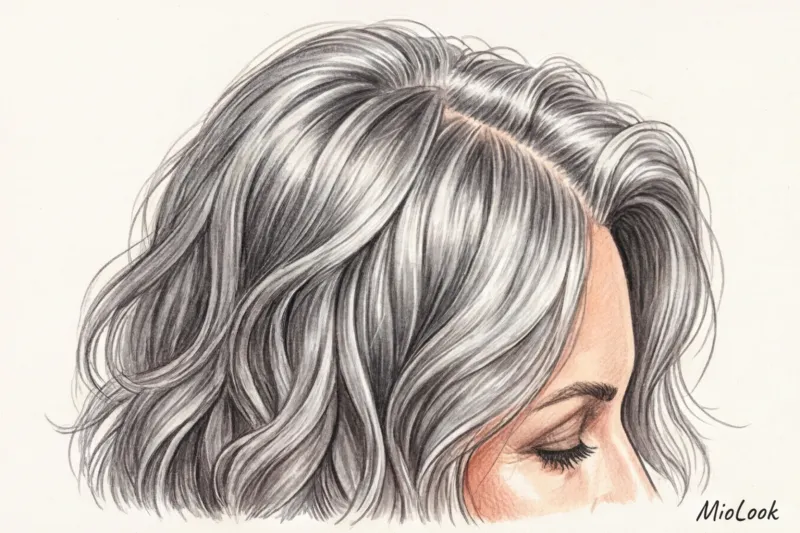
How to properly use haircut architecture to conceal regrown roots:
- Avoid the straight parting. A side parting is a landing strip that screams, "Look, I've grown gray hair!" Use zigzag or deep side partings.
- Add curtain bangs. It breaks the distinct hairline at the face, where gray hair usually shows up most quickly and brightly.
- Texture the strands around your face. A slight carelessness blurs the line between the dyed length and the light roots, making the color transition optically smooth.
If you want to see how different types of bangs will change your face, upload your photo to MioLook The app lets you try on dozens of styles without risking your real hair.
Checklist: How to Explain to Your Hairdresser That You Need a Smart Cut
Choosing the right shape is half the battle. The other half is communicating your needs to the stylist correctly. Here's a cheat sheet I give my clients if they're going to a different salon:
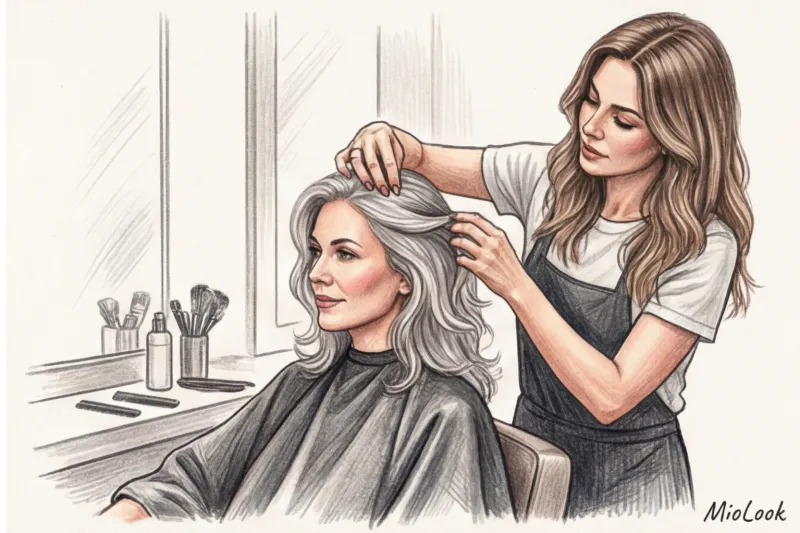
- Say a resounding "no" to thinning scissors. Request that texturing be done only with straight scissors (point-cut technique) or a razor blade. Thinning on fine hair after 40 is guaranteed to leave frizz within a week.
- Ask to take into account the curls. Tell your stylist: "Please pay attention to my natural hairline and crown. I want the haircut to lie naturally."
- Ask a test question before you start: "Will I be able to wear this style by simply blow-drying my hair with my hands, without having to straighten it with a brush every day?" If the stylist looks away uncertainly, it might be worth choosing a different style or a different stylist.
Your perfect look starts here
Join thousands of users who look flawless every day with MioLook's smart recommendations.
Get access — €0.99 onceA New Age for Your Hair: Less Effort, More Style
Age-related changes in skin texture aren't a diagnosis or a reason to endlessly fight your reflection. They're simply a signal that old algorithms are no longer working and it's time to change your strategy.
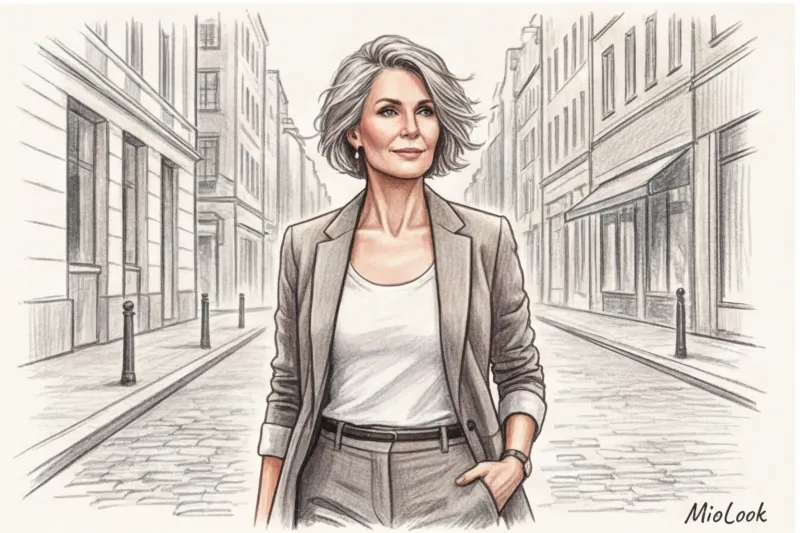
A quality architectural haircut from a reputable hairdresser can cost between €50 and €150, but the investment pays for itself instantly. You're not just buying a style; you're buying hundreds of hours of saved time in the morning, healthy hair free from heat styling, and a boost in self-confidence.
Embrace your new texture. Let the close cut create thickness and the gray hair provide volume. A smart haircut proves that after 40, you can look gorgeous with minimal effort.