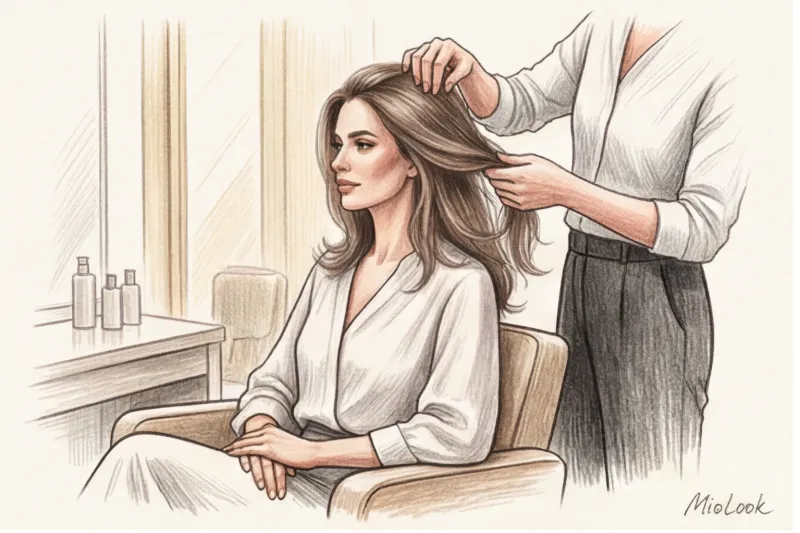
What is a smart haircut and why is it a game changer?
Have you ever timed how many minutes you spend each morning taming your locks in front of the mirror? Straightening with a flat iron, complex brushing, layered styling... Now imagine: you simply wash your hair, blow-dry it for five minutes, and it's perfectly styled. In professional slang, this is called a "smart haircut." It's the right haircut for your hair texture that forever separates your beauty routine into "before" and "after."
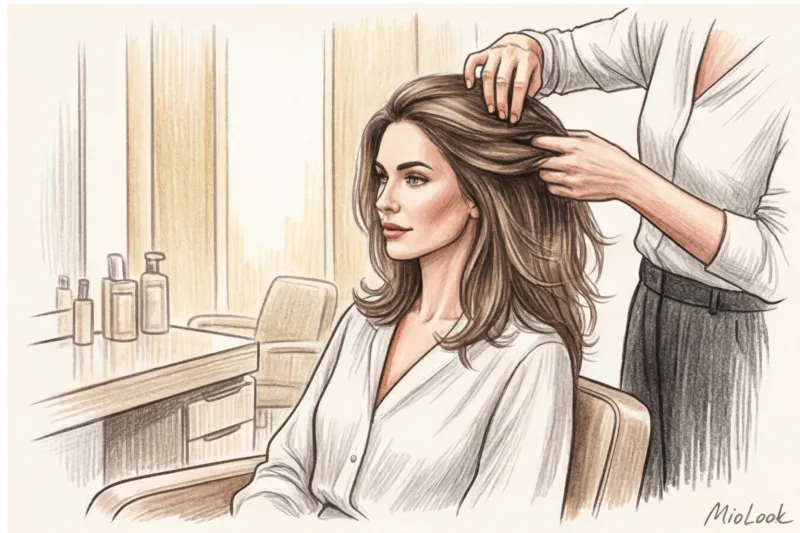
The philosophy of this haircut is based on one ironclad rule: the shape must be maintained solely by means of a precise geometric cut , not styling products. This revolution in hairdressing was brought about by the legendary Vidal Sassoon back in the 1960s.
His concept Wash and Go ("wash and go") freed women from hours of sitting under hair dryers. Sassoon proved that if a hairdresser correctly sets the angles of the haircut, the haircut will automatically return to its intended shape with the slightest movement of the head.
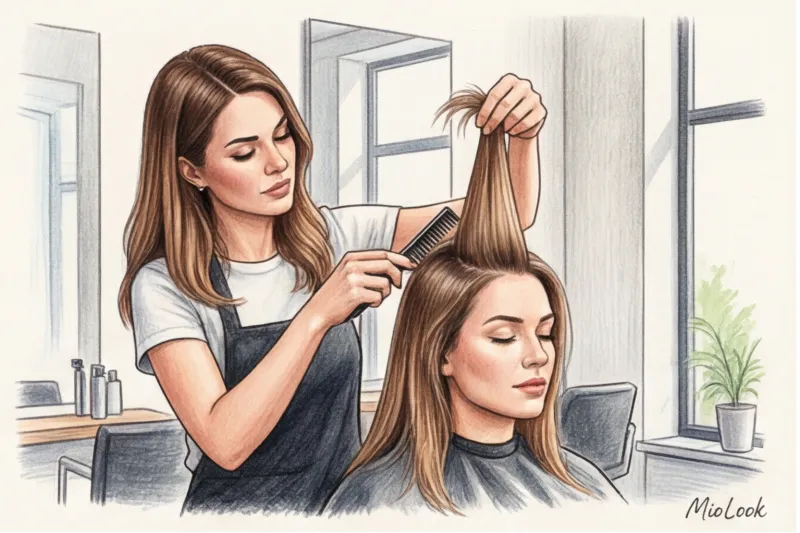
The secret lies in the hair's architecture. A good hairstylist must cut strictly in the direction of the natural growth and fall of the strands. Each of us has individual characteristics: cowlicks on the crown, an asymmetrical hairline, and varying density at the temples and back. Trying to alter this naturalness is like sewing a strict architectural jacket from a pattern made for flowing silk: the shape will inevitably "flow" at the first hint of dampness.
Over the years as a stylist, I've seen hundreds of women trapped in their daily styling routine. One of my clients, brand manager Anna, spent 40 minutes every morning trying to pull her thick, slightly porous, wavy locks into a perfectly sleek bob. We radically changed tactics: we created a textured, long bob with layers inside that allowed her natural waves to flow naturally. The math was astounding: Anna saved 35 minutes a day, which translates to about 200 hours of free time per year! Two hundred hours that could be spent on a good night's sleep or a leisurely breakfast. If you're still looking for some situational variety, I recommend my article about quick styling for short hair for every day — there I share techniques that require minimal effort.
Never forget the direct connection between your hairstyle and your personal brand. Hair is your most important and treasured accessory, worn every single day. You can change your signature bag, take off your statement earrings, but your haircut is always with you. A geometrically precise, smart shape conveys confidence without being overdone. This is the very effect of "quiet luxury" when others think you just woke up with impeccable style.
Before heading to the salon for a makeover, I always recommend gathering visual references. In the app MioLook It's very convenient to save mood boards with haircut options specifically for your texture, so you can discuss them with your stylist and be guaranteed to get that "smart" result that doesn't require a morning of tinkering.
Diagnosis: How to accurately determine your hair structure and needs
According to the International Institute of Trichology (2023), over 70% of women buy hair care products and choose haircuts for a completely different hair type. We often come to salons asking, "Give me volume, I have three hairs," without realizing the true structure of our hair. Let's once and for all separate two basic concepts that even beauty store consultants confuse: density and thickness.
Density — is the number of active hair follicles per square centimeter of your head. The average person has between 90,000 and 150,000 hairs. Thickness — This is the diameter of the hair shaft itself. Hair can resemble a fine web or a stiff fishing line.
The most common mistake I correct almost every day: women confuse thin but thick hair with sparse hair. A thin hair shaft doesn't hold its shape on its own; it's soft and easily falls out. But if you have 150,000 of these shafts, a classic layered cut will turn your head into a shapeless, impossible-to-style "dandelion." In this case, a tight, even cut is needed.
Practical test from a stylist: How can you determine the thickness of your hair right now? Pluck a single clean hair (or remove it from your comb) and place it on a white sheet of paper next to a piece of regular cotton sewing thread. If the hair is visibly thinner than the thread, it's thin. If it's about the same, it's medium. If it's noticeably thicker and feels coarser, you have thick hair.
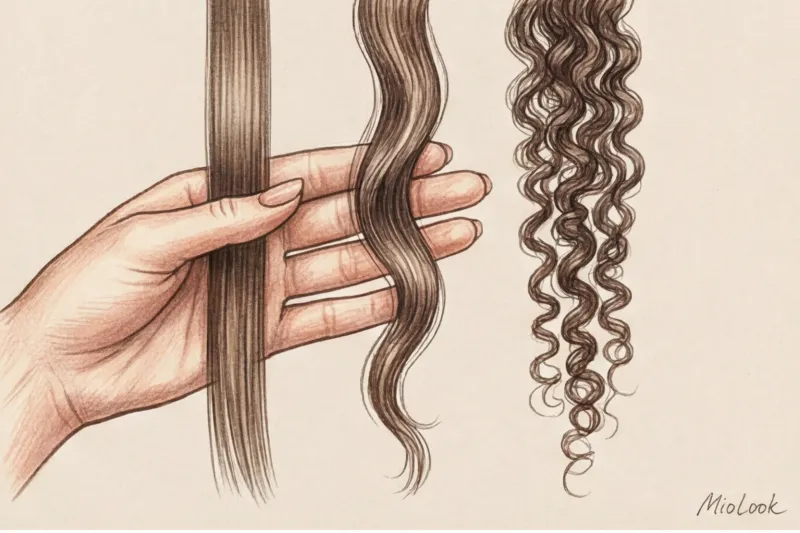
In addition to thickness, we need texture for a proper diagnosis. Professionally, we rely on the Andre Walker Hair Typing System. It's the best cheat sheet for understanding how strands will behave without styling:
- Type 1 (Straight): Smooth, often "glassy", they reflect maximum light, but are almost impossible to curl with a curling iron.
- Type 2 (Wavy): They form a soft S-curl. This is the most versatile texture, but unfortunately, it tends to frizz.
- Type 3 (Curly): Clear, elastic springs of different diameters, requiring a special multi-layer cut.
- Type 4 (Spiral): Afro-textured hair has a very tight curl. This type of hair appears thick, but is actually the most fragile and vulnerable to damage.
The Porosity Test and Why It's More Important Than Face Type
You can spend hours in the colorist's chair choosing the perfect bob to suit your face shape, but the first time you take a walk in humid weather, that perfect shape will be ruined. Why does a perfect salon haircut "break" with the first rain? It's all about porosity—your hair's ability to absorb and retain moisture.
Porosity is determined by the condition of the cuticle (the outer scaly layer). If the scales are tightly adjacent to each other ( low porosity ), hair repels water and takes a long time to dry, but often suffers from a lack of volume at the roots. high porosity The scales are slightly open—the hair instantly absorbs moisture from the air and begins to frizz chaotically, increasing the width of the hairstyle by two to three times. Medium porosity - this is a balanced norm.
To ensure your stylist gets the shape right, do a one-minute test at home with a glass of water. Take a clean, dry hair (no conditioner or styling product left) and drop it into a glass of room-temperature water. Let it sit for 3-4 minutes. If the hair floats on the surface, you have low porosity. If it sinks to the middle, you have medium porosity. If it sinks to the bottom, you have high porosity.
A stylist who understands these mechanisms will never perform a choppy, razor-thinning shave on highly porous hair—this is guaranteed to result in a "dried-out washcloth" effect and split ends within two weeks.
Access to MioLook for €0.99 — one-time payment
A smart AI stylist will select the perfect look based on your appearance and hair structure.
Get access — €0.99 onceHaircuts for fine and straight hair: creating the illusion of thickness
I'm adamant on this point: if you have fine, straight hair and a salon stylist cheerfully suggests a "volumizing layer," get up and walk away. This is the most damaging misconception in the hairdressing world, and it's one I've been fighting my entire career. Layering (or grading) mercilessly eats away at the little volume you naturally possess.
Imagine an architectural column: if you start carving it for "dynamics," it won't visually widen—it'll simply thin out at the base. Hair is exactly the same. When layering straight strands, the bottom edge turns into a transparent web. Such hair looks lifeless, tangles with the slightest breeze, and requires tedious daily brushing.
A professional insight that will forever change the way you approach salons: smart haircuts for this type of hair texture should be created exclusively with clippers or straight scissors. No thinning scissors. Thinning thin hair is a crime against its quality. It tears the cuticle and destroys the density of the ends. We only want a dense, heavy, and confident cut.
This leads to my absolute favorite for fine hair—the foolproof Isabella Formula:
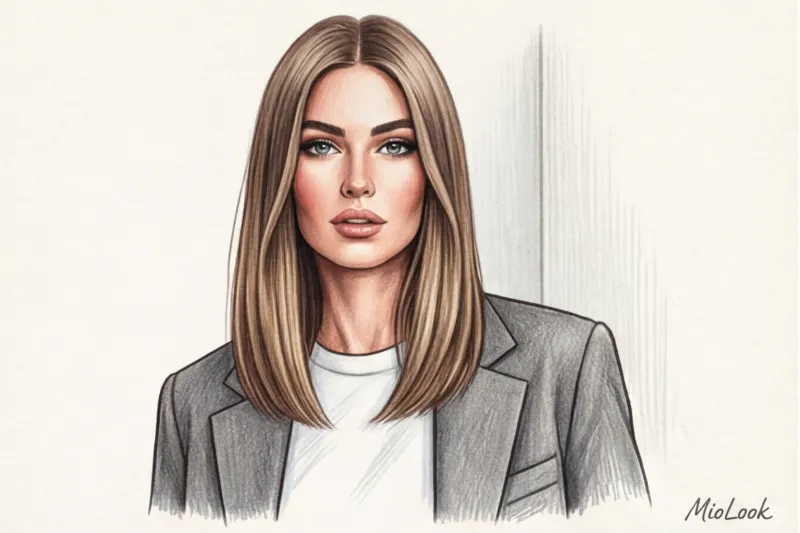
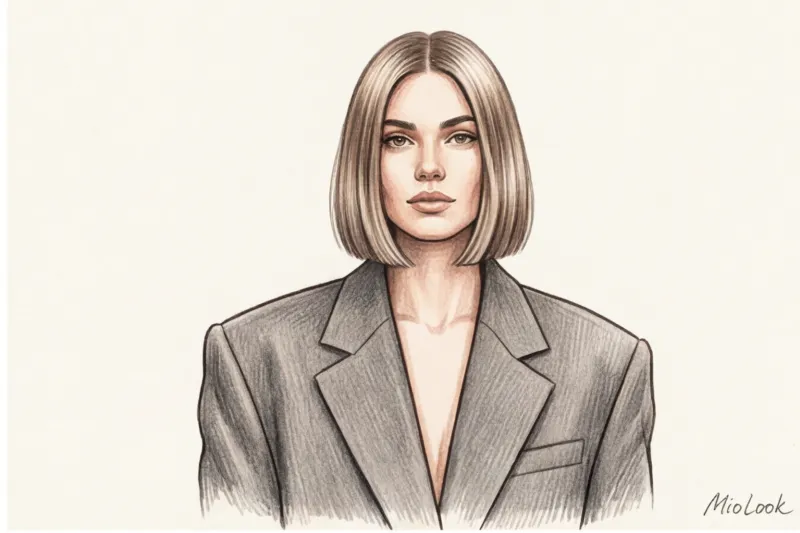
Blunt bob + straight cut = visual doubling of volume.
When every strand ends on a single, precise geometric line (the ideal length is at jawline or collarbone level), the optical illusion of a monolithic, dense wall of hair is created. Light reflects evenly off the smooth surface, giving the hairstyle an expensive, well-groomed look. Maintaining such a perfect cut at a good European salon will cost an average of €40–€80 every six weeks to two months, but the hours saved on morning styling will more than pay for the investment.
If you're ready for bold decisions, a pixie with long bangs is the perfect choice. The secret to this shape lies in cleverly redirecting the focus. We remove length at the back and temples (where hair often grows thinnest), but maintain maximum volume at the crown. The long, asymmetrical bangs become the main visual accent. In this case, the geometric shape compensates for the lack of natural thickness. A sleek pixie on fine hair can look sparse, but add a dry texturizing spray and direct the strands toward the face—and it will appear as if there's three times as much hair.
What if a straight bob cut seems too severe, but you don't want to lose the overall length? The solution: micro-bangs or delicate curtain bangs. They save straight hair, adding movement without losing volume. The main architectural rule: such bangs should never start too deep from the crown. The stylist should take only the thinnest edge layer near the face. This beautifully frames the cheekbones and creates the illusion of movement, while the main perimeter of the hair remains intact and thick.
Before you decide on a drastic change in shape—especially if you've been preserving every centimeter for years—I strongly recommend testing the new proportions virtually. Upload your photo to MioLook The app's smart algorithms will help you try out a tight blunt bob or a bold pixie with bangs to suit your individual facial features. This instantly removes any fear of scissors and gives you confidence that the new shape will work to your advantage.
Haircuts for Thick and Heavy Hair: Managing Volume
Considering haircuts by hair texture We often focus on adding volume, completely forgetting about those who need to tame it. Those with fine locks sincerely envy thick manes, but let's face it: heavy, dense hair is a daily test of neck strength and patience. The main architectural enemy here is the notorious "triangle" or "tent" effect. Without a well-structured shape, dense mass, under its own weight, hopelessly collapses at the roots and catastrophically widens at the ends. The result is a monolithic, immobile trapezoid, which visually weighs down the lower jaw and completely deprives your silhouette of lightness and dynamism.
To break this monolith, advanced masters use the technique of internal graduation ( hidden layers ). This is truly a delicate work of texture: the hairdresser works exclusively on the inner sections, literally cutting out invisible "pockets" within the volume. This method allows for the delicate removal of up to 30% of excess weight from within, leaving the top layer completely smooth, seamless, and shiny. A 2022 study by the London-based Sassoon Academy confirms that it is these hidden layers that allow the hair to flow rather than stand upright, while maintaining the illusion of a perfectly even, premium cut.
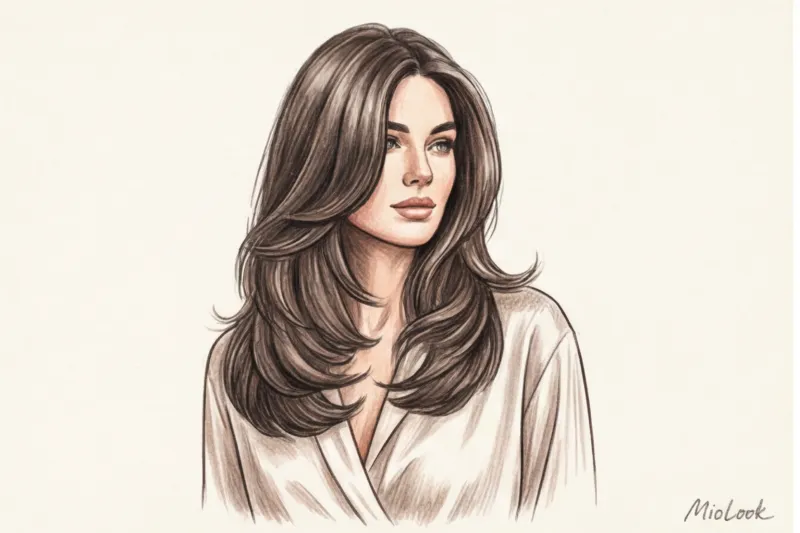
If you're looking for the perfect balance between length and manageability, my personal favorite is the long, layered cut inspired by the '90s supermodel aesthetic. Think Cindy Crawford's luxurious, bouncy styles. For heavy, glassy Asian or very thick Slavic hair, this is a real lifesaver. Layers near the face ( face-framing layers ) begins just below the collarbones and flows smoothly downwards. Achieving this shape requires masterful use of slicing scissors (incidentally, a professional tool of this caliber will cost a stylist upwards of €400, which largely explains the high price for such a high-quality service). However, the result exceeds all expectations: the strands begin to move independently, framing the face in soft lines, rather than lying in a single, heavy sheet.
Access to MioLook for €0.99 — one-time payment
Start creating the perfect looks with the help of artificial intelligence and choose a wardrobe to match your new perfect haircut.
Get access — €0.99 onceWhile a luxurious, flowing head of hair is a great choice for a relaxed dinner, it can look too casual in a strict corporate environment. How to adapt such an unruly texture for work? The main rule: control the perimeter and focal points. Even with hidden graduations, the hair should be flawlessly gathered into a sleek shape. I recommend following the principles described in the article " Hairstyles for the office: 10 strict styles »: To tame thick hair in a business environment, low architectural buns are ideal ( sleek low bun ) or a classic French twist. Your new smart haircut should be designed so you can secure your hair with literally three pins without creating a bulky ball at the back of your head that's ready to snap the elastic right in the middle of an important presentation.
Haircuts for Wavy Hair (Type 2): Mediterranean Chic
Every morning, thousands of women commit the same beauty crime: heating their flat iron to 200 degrees and methodically destroying the most coveted texture in the world. Type II waves (from light 2A to pronounced 2C) are an absolute jackpot. According to the British Vidal Sassoon Academy (2022), this structure has the highest "shape memory." You don't need to straighten your waves to look neat; you simply need an architecture that will make them work for your personal brand.
From the French Riviera to Milan: Bob as Art
If you want to project effortless luxury, forget about complicated hairstyles. Two styles are ideal for wavy hair: French bob (French bob up to the cheekbones or lips) and Italian bob (Italian bob that falls to the base of the neck).
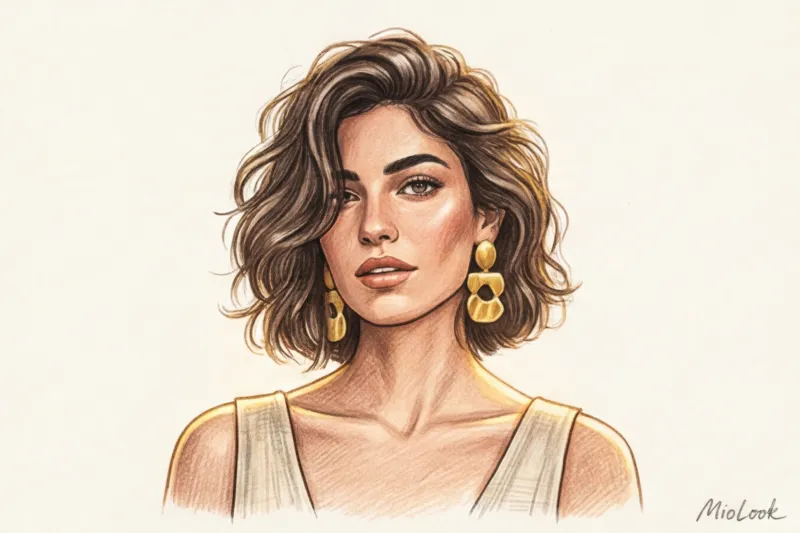
And now, my personal secret that I share with my clients. Want to create an instant, old-money look without breaking the bank? Here's my signature Mediterranean chic formula: a voluminous Italian bob with natural waves, an open neckline, and chunky vintage gold earrings. This combination makes you look like you just stepped off a yacht in Capri, even if you're wearing a simple white cotton T-shirt for €30.
The right cut allows the wave to form a beautiful, bouncy curl at the ends, rather than hanging like lifeless icicles. If you're unsure what length will flatter your facial contours, you can create a personalized mood board from references in the app. MioLook before booking a visit with a specialist.
Status Grunge: Shaggy and Wolf Cut for the Creative Class
What if your style is far from classic? For those in creative industries (IT, media, design) where individuality is valued, I offer modern haircuts. shag (shaggy) And wolf cut.
Many are afraid of these styles, recalling the disheveled looks of teenagers from the 2000s. But today's smart shag is a classy grunge. The stylist creates face-framing layers that blend seamlessly into the main length. This texture reveals itself beautifully on wavy hair: the strands naturally fall in the desired direction, creating a bold yet luxurious silhouette. In my practice, the main rule here is a strict no-thinning-scissors policy. All layers are worked with a straight cut only, to avoid uncontrollable frizz.
The Danger Zone: How to Avoid the "Neither One Nor the Other" Phase
There's one critical mistake when working with wavy hair that I call the "awkward length" trap. This is the moment when your strands reach shoulder level. Due to physical contact with your collarbones and clothing, the lower edge of the wave begins to curl outward uncontrollably.
- Solution 1: Keep the length strictly above the shoulders (the same bob or elongated bob).
- Solution 2: Grow the length below your collarbone, where the weight of the hair itself will slightly pull the curl, making it smoother and more predictable.
Smart haircuts based on your hair texture are always a matter of math. Once you eliminate the "uncomfortable length" and let your waves dictate the shape, you'll save dozens of hours getting ready in the morning, and your look will acquire that relaxed European elegance.
Curly Hair (Types 3 and 4): The Magic of Dry Cutting
Imagine a typical salon scene: the hairdresser meticulously combs your damp locks, pulls a strand with perfect tension, cuts it evenly, and when your hair is completely dry, you suddenly look like a dandelion or a triangular lamp. A familiar and very painful scene for those with Type 3 and 4 textures.
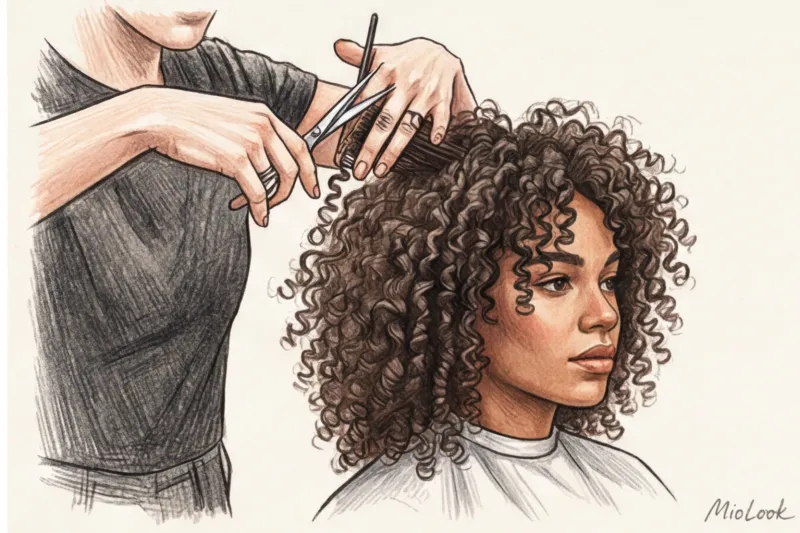
The reason for this disaster lies in basic physics. Remember the main rule that I never tire of repeating: curly hair It is ABSOLUTELY forbidden to cut wet hair. It's all about the powerful "acceleration" factor ( shrinkage ). Under the weight of water, wet hair stretches and appears 10-15 centimeters longer than its dry, curled state. If you cut off 5 centimeters of a wet strand, it will "jump" 15 centimeters longer after drying. It was precisely to solve this problem that the expert technique was developed. DevaCut , which forever changed texture handling protocols.
The secret to perfect curly hair lies in the architecture of the dry cut. The hairdresser must be able to see how each curl springs in its natural environment, not how it's taut and stretched under a stream of water.
This technique has become an integral part of philosophy Curly Girl Method , is based on the approach curl-by-curl (curl-based haircut). The hairstylist works on dry hair without pre-stretching or aggressive brushing. The curl is precisely cut at its natural curve (at the peak of the "C-loop") to ensure the curl doesn't unravel and retains its natural bounce. In premium European salons, the cost of such a personalized haircut ranges from €90 to €150, but the investment pays off handsomely: the perfect shape lasts for up to six months.
Once we stop fighting volume and start consciously building it, space opens up for stunning geometric silhouettes. For bouncy curls, I recommend three basic shapes:
- Round shape (Halo): Even, balanced volume from all sides. Ideal for tight, shallow curls (Type 4), creating a bold, statement-making halo that draws attention.
- Diamond: Volume is concentrated at the cheekbones and gently tapers toward the tips and crown. A stunning tool for contouring an elongated face shape.
- Waterfall: Carefully constructed layers, where the top strands flow smoothly into the lower ones without harsh steps, are the best choice for heavier, looser curls (Type 3A-3B).
Your perfect look starts here
Join thousands of users who look flawless every day and easily manage their style with MioLook.
Get access — €0.99 onceCurly hair has another underrated visual superpower: it acts as a natural "softener" for faces with sharp, angular features. If you have prominent cheekbones, a strong jawline, or a large nose, soft, dynamic curls around the face will act as a visual buffer. They break up the rigid geometry of the face, adding femininity and warmth. If you want to check in advance what length of curls will balance your proportions, I recommend experimenting with a virtual try-on. MioLook - this will eliminate the effect of surprise after visiting the salon.
Corporate clients often ask me the same question: "How can I integrate this mane of hair into a formal business attire so that I'm taken seriously?" My professional verdict: authority isn't measured by the straightness of your hair. Integrating curls into a business wardrobe is based on the absolute perfection of the curl itself, not on suppressing it. A deep side part, roots tamed with moisturizer (no wet-hair look!), and clearly defined, shiny ends—this is your new formula for status. You can secure the temples with minimalist metal clips, leaving the back of your head free. This conveys a powerful message: this is a confident woman who knows how to master her natural nature, and therefore, can handle any business challenge.
Style Formula: How Hair Texture Affects Wardrobe Choices
Have you ever noticed how the same silk top looks completely different on a woman with a graphic bob and on someone with voluminous Afro curls? Hair isn't just a frame for your face; it's a complete texture that interacts with your clothes first. At the Marangoni Institute, we were taught the golden rule of styling, which I call the "law of architectural balance." In short, your haircut dictates the rules of the game for your entire wardrobe.
This is where my personal secret, which I've been developing for my clients for years, comes into play. Write down this formula: "Sleek Hair + Intricate Cut = Status" vs. "Textured Hair + Minimalism = Elegance" It's the harmony of contrasts that makes a look so luxurious. Women with a perfect, glassy, sleek bob look phenomenal with draped details, asymmetry, and soft, flowing silk. The strict, rigid geometry of a smart haircut on straight hair serves as a rigid framework, preventing flowing fabrics from turning you into a shapeless cloud.
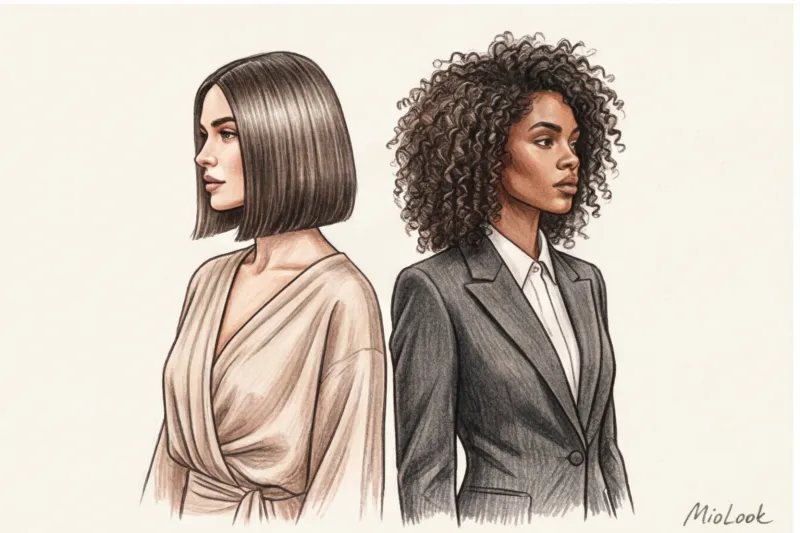
The opposite situation occurs when working with natural volume. If you have unruly curls or a voluminous shaggy style, strict geometric patterns are your best friend. Jackets with stiff, exaggerated shoulders in the spirit of Saint Laurent, thick cotton, and architectural shirts all work as the perfect balance. Clean lines calm the visual noise created by curls, creating a collected look. Adding ruffles and flounces to voluminous curls risks overt theatricality and overcrowding the portrait area.
What to do with complex textures? Tweed, bouclé, and chunky knits paired with vibrant, wavy hair are a stylistic minefield. To avoid turning into a tangle of textures and adding 10 years to your appearance, stick to the rule of single focus. If you've chosen a classic bouclé jacket (even a basic one in the €100-€150 range), gather your wavy hair into a sleek low bun or tuck it behind your ears. If you want to show off a luxurious cascade of waves, choose smooth fabrics for the portrait section—fine wool, satin, or thick knits.
By the way, it is most convenient to test such combinations of “texture plus silhouette” through the "smart wardrobe" feature in MioLook You can visualize in advance how the neckline of your favorite sweater will either compete with or complement your new hairstyle.
Choosing a neckline is the final touch, which mathematically depends on the length of your haircut. Here's my cheat sheet:
- Stand-up collar and turtlenecks: Ideal for short pixies or upswept hair. If you have a long bob (lob), the strands will curl unattractively at the collar, creating a sloppy effect.
- Boat neckline (bateau): It looks luxurious with a classic bob that reaches just below the chin or mid-neck. This cut broadens the shoulder line, and the vertical hairline gracefully offsets it.
- Deep V-neck: The best choice for long, layered haircuts. It creates an extra, tapered vertical line that visually elongates the neck, even if you have very thick and heavy hair.
Stylist's advice: If you drastically change the length or texture of your hair (for example, getting a perm or getting a bob after having long locks), be prepared for 30% of your top layers to stop working. This is normal. Clothes require a new geometry.
Checklist: How to Explain to Your Hairstylist That You Need a Smart Haircut
You know what phrase is most often heard in closed hairdresser break rooms? "She brought me a photo of Zendaya, but her hair is completely straight and glassy. How am I going to do that?" According to a 2024 WGSN analytical report, 68% of customer dissatisfaction in beauty salons is due to poor communication, not poor technique.
You can read hundreds of articles about haircuts based on your hair texture, but if you can't translate your desires into professional language in the chair, miracles won't happen. Over the course of my career, I've developed a strict safety protocol. This is a four-step checklist that you should save on your phone before your next appointment with a hairstylist.
Step 1: The Zero Stacking Rule
Don't come with styling: show the stylist how your hair looks in its natural state. It sounds counterintuitive—we're used to getting dressed up and prepping before going to the salon. But when you sit in the chair with your hair perfectly straightened for a brush, you're literally blinding the stylist. They can't see your cowlicks, the way your part falls apart, or your true porosity level.
Architecture is built on a foundation. Come with a clean, naturally dried head of hair, without styling products. Yes, you might look disheveled, but this "truth" will allow the hairdresser to create a shape that will stand alone without the use of hot tools.
Step 2: Filter References
I once had a client spend around €250 at a premium salon trying to achieve a sassy Charlize Theron-style pixie cut with her tight afro curls. The results were predictably disastrous. Show photos of girls ONLY with your hair structure. If you have heavy, thick hair, look for references on Asian or thick Slavic hair. If you have thin hair, look at Scandinavian hair.
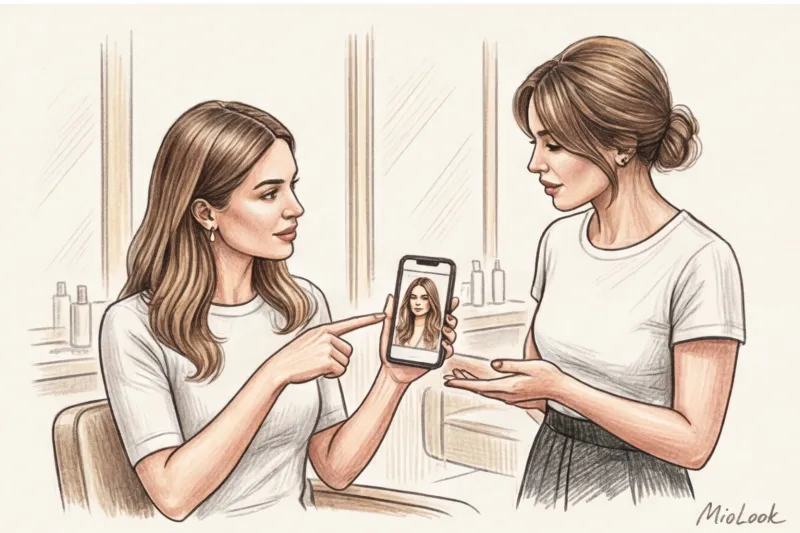
To avoid getting lost in hundreds of screenshots, I recommend my clients to compile mood boards of hairstyles through MioLook It's a convenient way to visualize how the chosen shape will pair with your basic wardrobe and familiar clothing cuts.
Step 3: Test for “your” master (marker words)
A professional with precise techniques (in the spirit of the British school of Vidal Sassoon) thinks geometrically. Listen carefully to what your stylist says during your pre-wash consultation. A good specialist will definitely say the following: marker words:
- Natural Decay - He looks at where your strands fall on their own, rather than trying to break them against your will.
- Inner Layers — the stylist understands how to manage volume (add or remove it) without thinning scissors, which only fluff up the ends.
- Skull shape and bone structure — the haircut should be designed taking into account your anatomical features, for example, a flat back of the head or prominent cheekbones.
If you're immediately offered "just a trim to make your ends look lighter," politely say goodbye and leave.
Step 4: Crash test the result
The most important step that many are embarrassed to complete. To check the result: ask your stylist to simply blow-dry your hair without brushing at the end of the procedure. A directed air flow and the hands of a master are everything.
If a professional needs three round brushes of different diameters, a flat iron, and a liter of texturizing spray to make your hair look presentable, you've been lied to. A smart haircut should fall into place with a simple blow-dry. Sure, you can fine-tune it at home for special occasions, but the base should be flawless on its own.
Let's be honest: this checklist doesn't guarantee you'll find your perfect stylist on the first try—sometimes the search can take years. But it's guaranteed to save you from making some truly bad decisions and a lot of stress. Remember, your hair is the only accessory you wear day and night. Invest in the right styling, and you'll never have to wrestle with your reflection in the morning again.
Guide Chapters
How to choose anti-aging haircuts for thin hair after 40
Is your hair thinning and your gray hair coarse? Find out how an architectural haircut addresses age-related issues better than any styling product.
Haircuts for coarse hair: secrets to the perfect shape
Coarse hair isn't a punishment, it's your greatest styling asset. Find out how the right shape can free you from daily styling hassles.
Perfect Haircuts for Wavy Hair: A No-Styling Guide
Most women don't even realize their natural waves exist, mistakenly fighting frizz. Learn how the right shape can solve the problem without a flat iron.
Haircuts for thick, heavy hair: removing excess weight
Styling heavy hair isn't a matter of how much styling you use, but pure physics. Find out how the right haircut can help you remove excess weight and add lightness to your hair.
Haircuts for curly hair: a frizz-free shape
Forget about flat irons and frizz. We reveal the secrets of the perfect haircut for curly hair, ensuring perfect shape without the hassle of styling.
Haircuts for porous, frizzy hair: the best ideas
Stop fighting nature and frying your locks with a flat iron. Learn how the right haircut can transform unruly dandelion locks into a stylish style.
How to Try on a Haircut Online from a Photo: Stylist Tips
Trying on a virtual hairstyle can lead to disappointment in the hairdresser's chair. We explore why AI doesn't take hair physics into account and how to avoid mistakes.
The best haircuts for fine and thin hair for volume
Tired of your hair looking like a spiderweb after washing? Learn how to restore visual thickness with the right haircut.
A Smart Haircut That Requires No Styling: How to Choose the Shape
The perfect hairstyle without a blow dryer or flat iron isn't a myth, but rather the right hair shape. We'll explain how to choose a style that will keep your locks healthy.