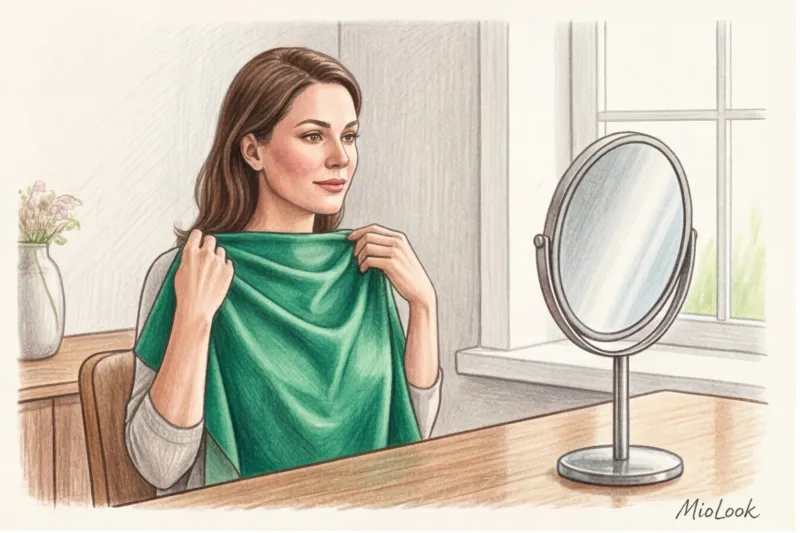
You know what comment I hear most often when I start working with a new client? "They told me to wear powder pink and beige to brighten my complexion, but they make me feel pale." And they're absolutely right. Ask glossy magazines about the colors in clothing that make you look younger, and they'll give you the standard list: pastels, light tones, and a total rejection of dark colors. But as a certified colorist, I can tell you straight: this approach is about twenty years out of date.
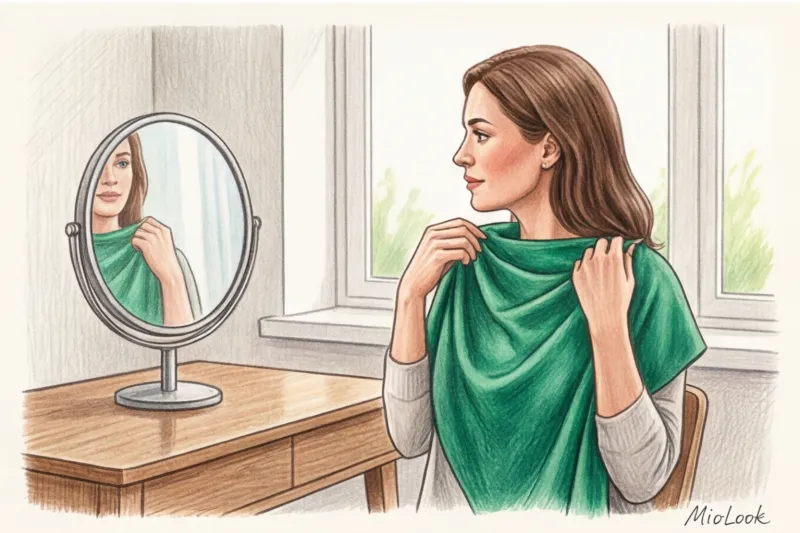
We won't be looking for non-existent "magic" shades. We've already discussed this in more detail in our complete guide to clothing style for women over 40 , where we discussed how age is a reason for luxury, not camouflage. Today, we'll rely on optical physics, the laws of light reflection, and color theory. Because the right shade works not as age-defying armor, but as a studio-quality light reflector.
Color Physics and Optics: How Clothing Works as Concealer
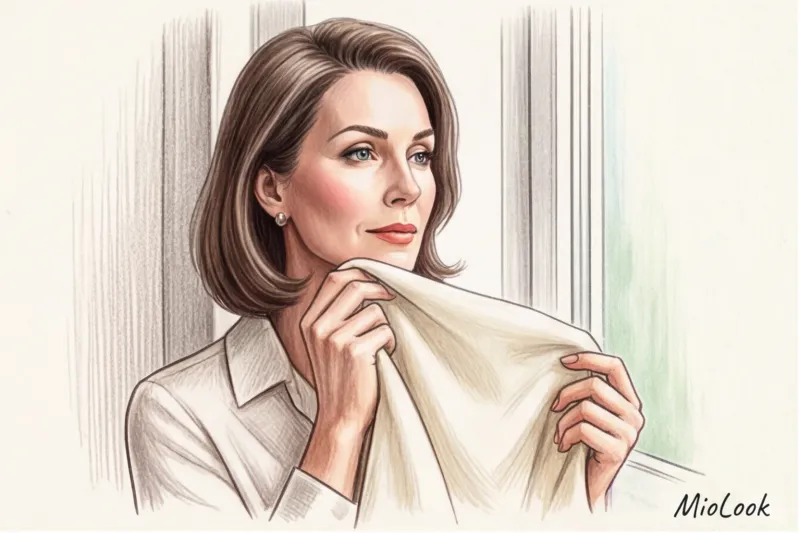
Let's talk physics. Clothing in the so-called "portrait zone" (the top 30 cm from the face) isn't just fabric. It's a physical reflector. Light hits your blouse and bounces off it, right onto your chin, neck, and cheeks. According to research by the Pantone Color Institute (2023), skin tone affects the visual perception of skin tone more than foundation.
At the beginning of the 20th century, the Swiss artist and theorist Johannes Itten formulated the law of simultaneous contrast: any color changes its characteristics depending on its surroundings. If you place a greenish-tinted cloth against your face, your skin will optically reveal a red pigment (often in the form of unwanted redness or rosacea). Place a cool gray cloth against your face, and your skin will respond with a yellowish pallor.
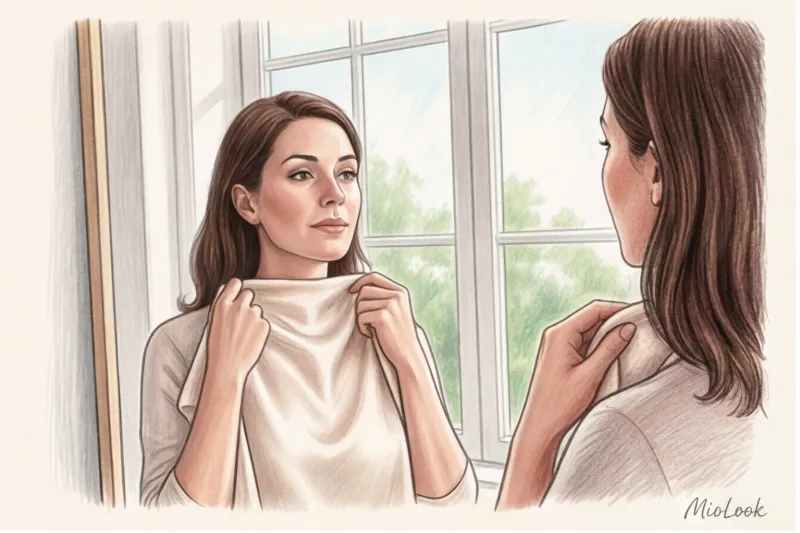
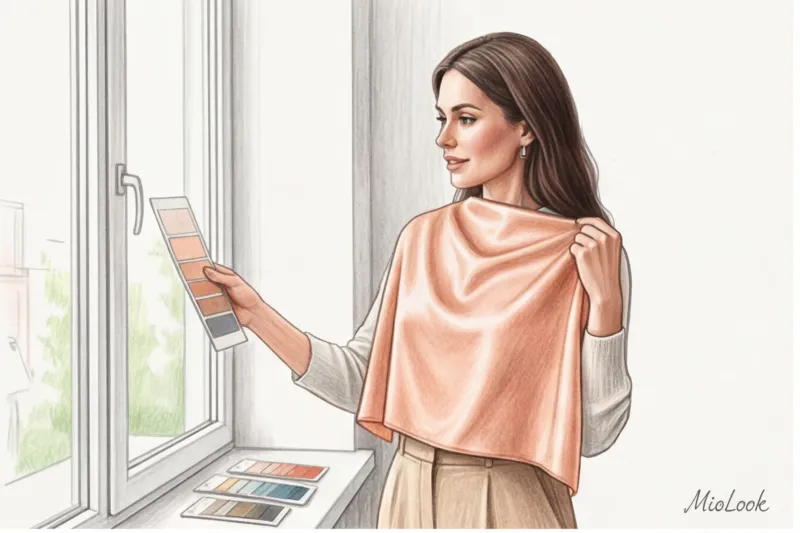
"During my color analysis consultations, when I change the drapes around a client's face, we literally see how, in a split second, the nasolabial fold visually smooths out or, conversely, a deep shadow under the eyes appears. It's not magic, it's optics."
As we age, our skin undergoes biological changes: the epidermis thins, hemoglobin levels decrease (which deprives us of our natural glow), and melanin production changes. Natural skin contrast decreases by an average of 20-30%. This is why the colors your skin could tolerate in your 20s can now appear dull and tired.
Your perfect look starts here
Join thousands of users who look flawless every day with the smart MioLook algorithm.
Get access — €0.99 onceThe biggest myth of style: why pastel colors can make you look older
Let's break the biggest stereotype: "light always makes you look younger." This is a dangerous generalization. Light colors only work when they have sufficient purity The problem is that most women choose so-called "dusty" and "dirty" shades—dusty rose, taupe, muted mint.
I had a client, a senior executive, let's call her Elena. Having crossed 45, she read a ton of advice online and completely switched her wardrobe to a powdery beige palette "appropriate for her age." At our first meeting, she admitted that colleagues were often asking her if she was feeling well. And no wonder! Dusty shades contain gray pigment. Due to the loss of natural contrast, Elena's face blended into her clothes, turning into a featureless blur. The gray undertone of her blouse projected a gray shadow onto her face.
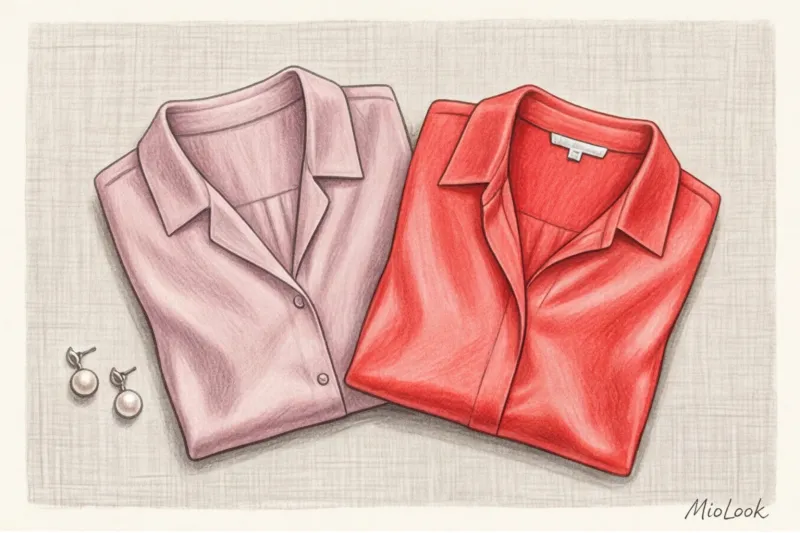
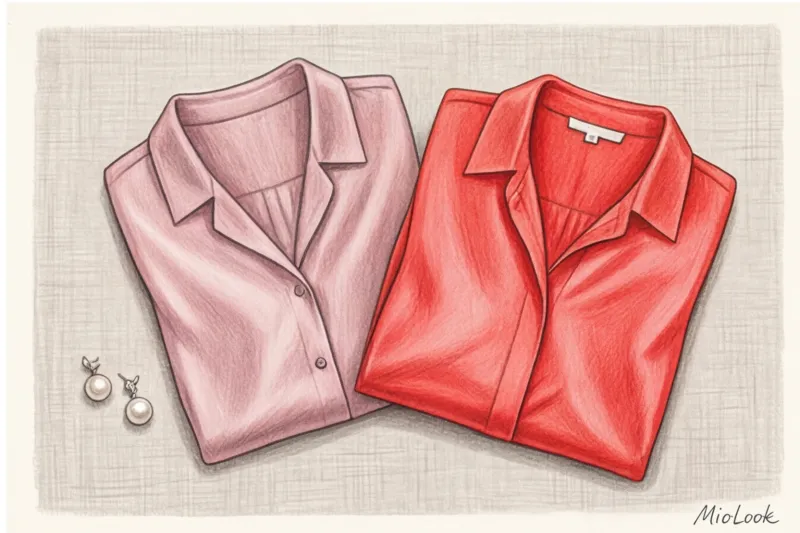
Once we swapped the dusty rose for a pure, deep ruby, Elena's eyes "lit up" and her facial contours became more defined. Remember: there's a huge difference between a clean, icy pastel (which can be truly refreshing) and a dirty, earthy one (which can be aging).
Colors in clothes that really make you look younger and fresher
Enough abstract rules. Let's move on to specific color groups that have been proven to provide an optical lifting effect for most European skin tones.
Red and coral palette: a natural blush effect
As we age, we lose our youthful glow. Coral, salmon, and warm red colors act as a boost to your look. They complement the sallow and grayish undertones of tired skin, instantly neutralizing them.
- If you have golden or red hair (warm undertones): Choose tomato, terracotta, or watermelon flesh color.
- If you have ash, light brown or cool gray hair: Your choice is raspberry, lingonberry, cold red.
Not ready for a red jacket? Start with a silk scarf over your face (in the €50–€120 range, you can find great options at Massimo Dutti or local silk brands).
Shades of blue: visually whitening your smile and the whites of your eyes
This is my favorite trick. The human eye perceives colors through contrast. Pure shades of blue—lapis lazuli, cobalt, cornflower blue—create an optical illusion: against their backdrop, the whites of your eyes and tooth enamel appear noticeably whiter. And a clear gaze is the main marker of youth.
Navy is the perfect, much softer alternative to black in a business wardrobe. It elongates the silhouette just as effectively, but doesn't cast harsh shadows on the chin. By the way, if you're planning a capsule collection, I recommend loading your pieces into the "smart wardrobe" feature in MioLook — the algorithm perfectly suggests how to combine navy shades with bright accents without the risk of making a mistake.
Precious stones: emerald, sapphire and amethyst
Jewel tones are an absolute must-have for women over 40. Why? They're rich in saturation, yet dark enough to frame the silhouette and add sculpting to the face.
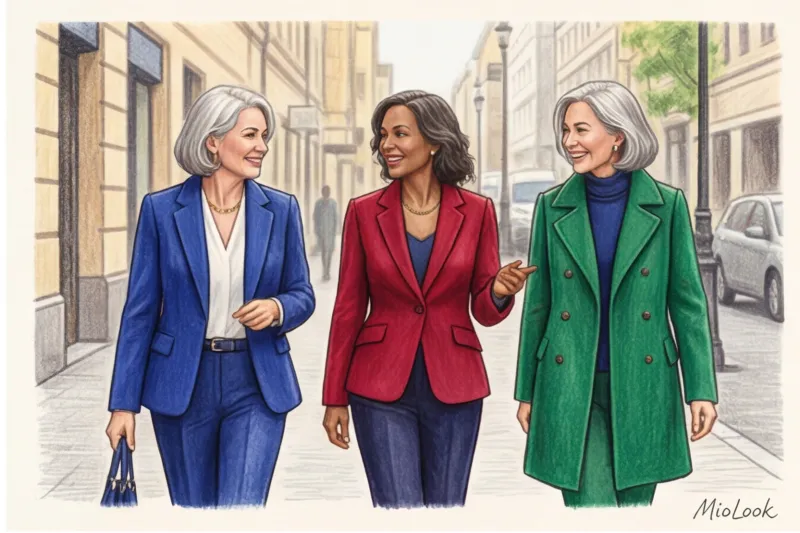
An emerald silk top or an amethyst cashmere sweater convey confidence and status. Unlike frivolous pastels, these colors say, "I know my worth and I don't have anything to prove."
Ready to get started?
Try the free MioLook plan—our smart AI stylist will find the perfect palette for your look, no strings attached.
Get access — €0.99 onceBlack color after 40: ban, can't leave
Stylists love to demonize the color black. And there's some truth to this: according to the laws of physics, black absorbs light. Wearing a solid black turtleneck deprives your face of the light from below, causing all the natural shadows (nasolabial folds, under-eye circles, wrinkles) to appear deeper.
But I'll be honest with you (and here we come to an important limitation): the rule is "black always makes you look older." It doesn't work If you naturally have a very contrasting "winter" appearance—snow-white skin and naturally black hair with no gray. In this case, black will continue to serve you faithfully.
For everyone else there is Buffer rule If you love black, just move it away from your face. Here's how:
- Deep V-neck (showing skin, which is itself a reflector).
- A light shirt collar peeking out from under a black jumper.
- Use chunky jewelry. A pearl necklace or a chunky gold chain over a black collar will act as that perfect light reflector.
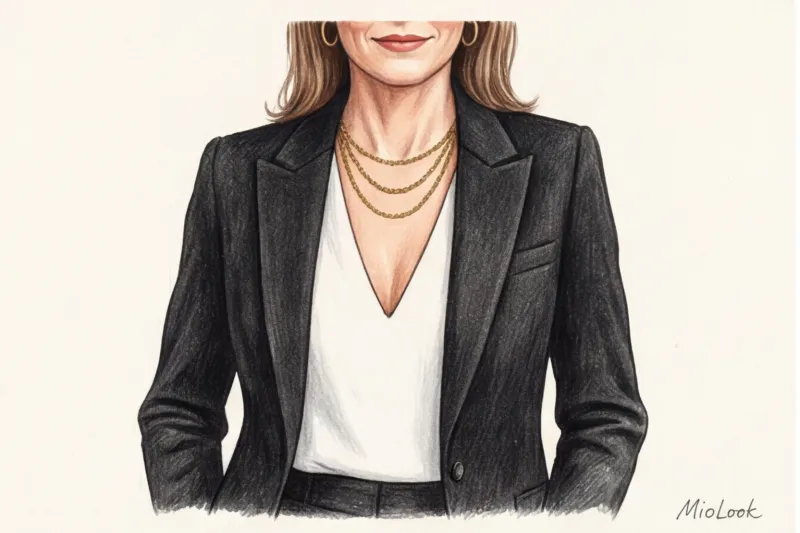
Texture is also critically important. Matte black (heavy cotton, drape) ages relentlessly. But black with a satin or glossy sheen (silk, smooth leather, satin) reflects light naturally and looks luxurious.
The Dynamics of Color: How to Adapt Your Palette Over Time
Over 12 years of practice, I've noticed a pattern: women stubbornly cling to the colors that brought them compliments in their 20s and 25s. But coloring isn't a constant. It's a dynamic system based on the concept of 12 color types, which can shift with age.
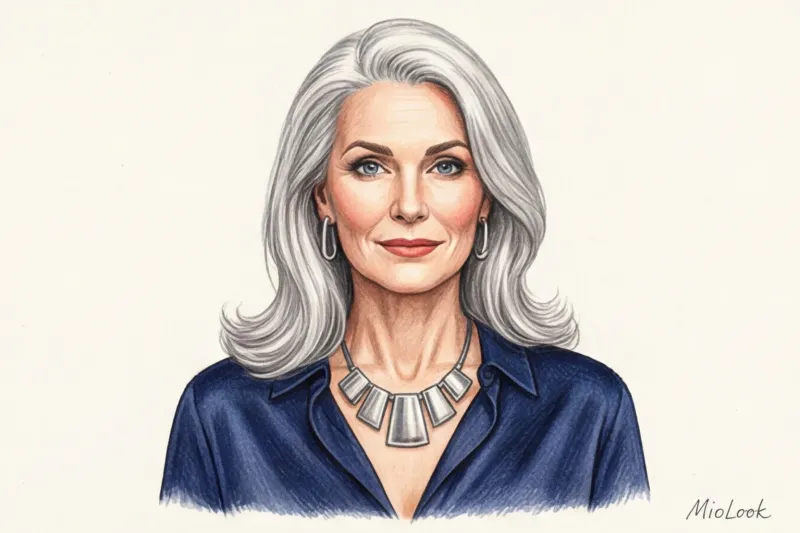
The main trigger for these changes is gray hair. When silver appears in your hair, the overall "temperature" of your appearance inexorably shifts toward cooler, and your natural contrast drops from high to medium or low. That warm mustard sweater that made you look like a star in your 30s will give your face an unhealthy yellow tint if you have silvery gray hair. There's no need to "make yourself look younger"—you just need to find harmony with your new, stunning natural features.
A stylist's checklist: how to incorporate refreshing colors into your wardrobe
To make sure this theory doesn't just remain a text, here's a concrete algorithm I use with clients when sorting through their wardrobes. You can do it yourself today:
- Conduct an audit of the portrait zone. Set aside all tops, blouses, and scarves that hang close to your face. Separate them into solid colors and dusty ones.
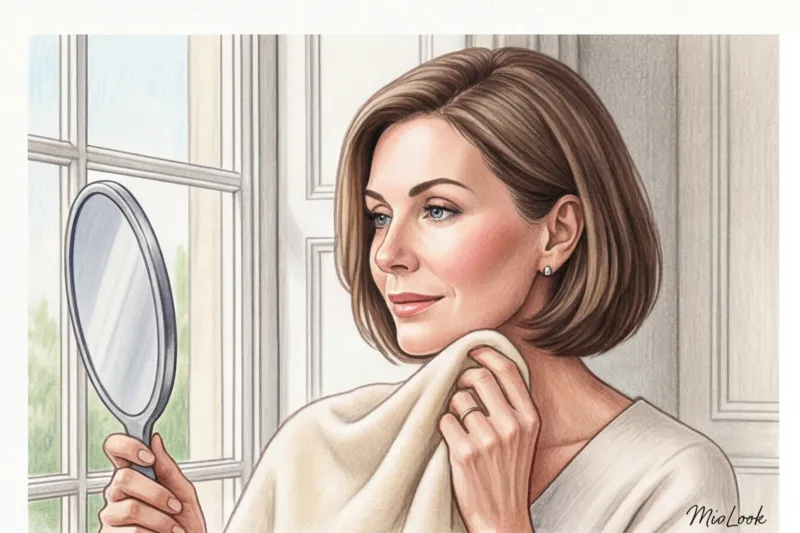
- Do the "window test". Remove your makeup, stand near a window in natural daylight, and apply each fabric to your neck one by one. You'll immediately see which fabrics brighten your eyes and which ones accentuate dark circles under your eyes.
- Invest in the right base. Even a basic T-shirt made of thick cotton (in the range of €30–50 at COS or Uniqlo) in the right, refreshing shade will do more for your appearance than an expensive but dull cashmere.
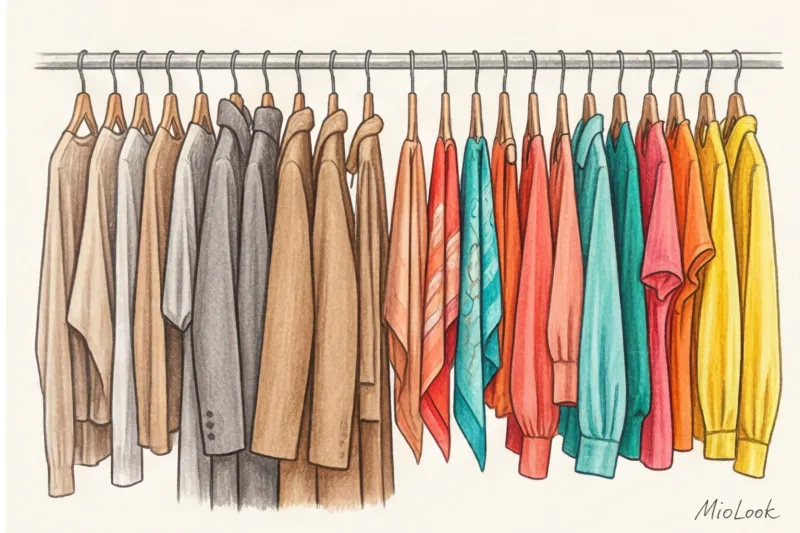
- The 80/20 rule. Keep 80% of your wardrobe in calm, basic tones (deep blue, dark chocolate, graphite), and spend 20% of your budget on bright, rich accents near the face (scarves, collars, jewelry).
Access to MioLook for €0.99 — one-time payment
A smart AI stylist will analyze your appearance and select the perfect color look for every day.
Get access — €0.99 onceInstead of a conclusion: your color is your energy
There's an immutable rule in the psychology of style: color influences not only how others see you, but also your inner state. When you wear something that visually makes you look tired, your brain reads this reflection in the mirror and literally tells your body: "We're tired, we have no energy."
Abandon artificial "age" restrictions. Clothing after forty is a manifestation of a mature, self-aware woman. Use color as a tool, like your own portable spotlight. And remember: the most rejuvenating color in your wardrobe is the one that makes your back straight.