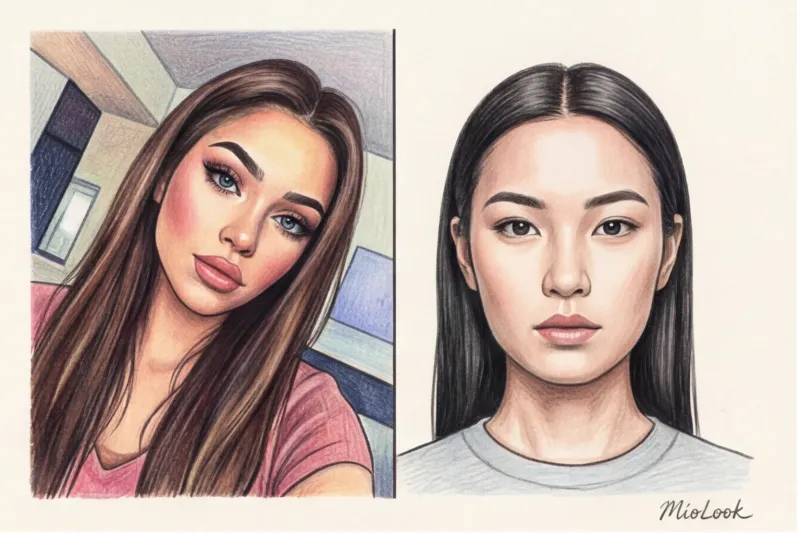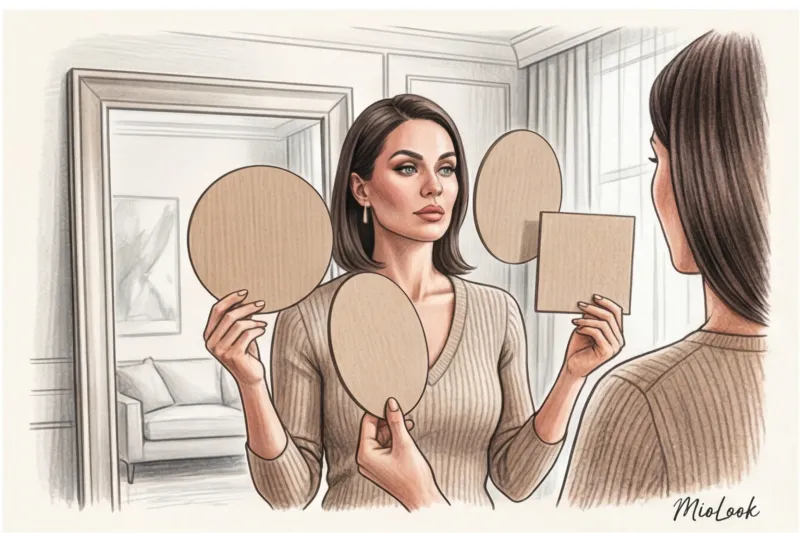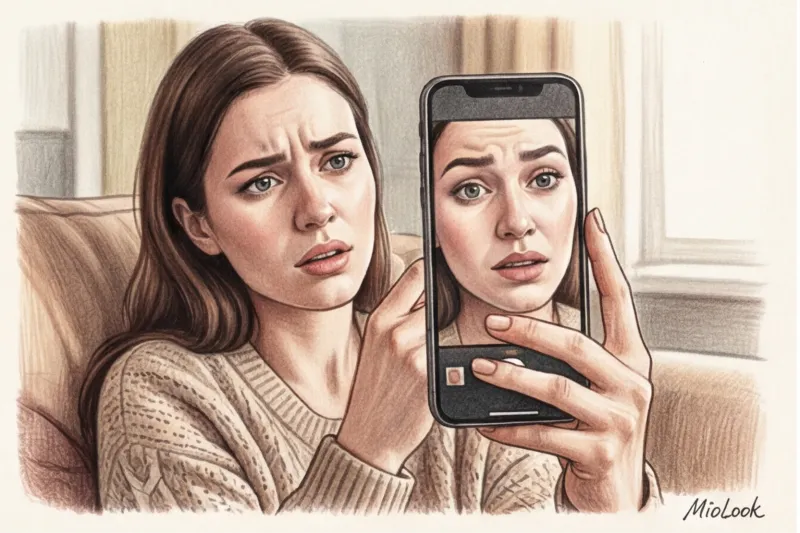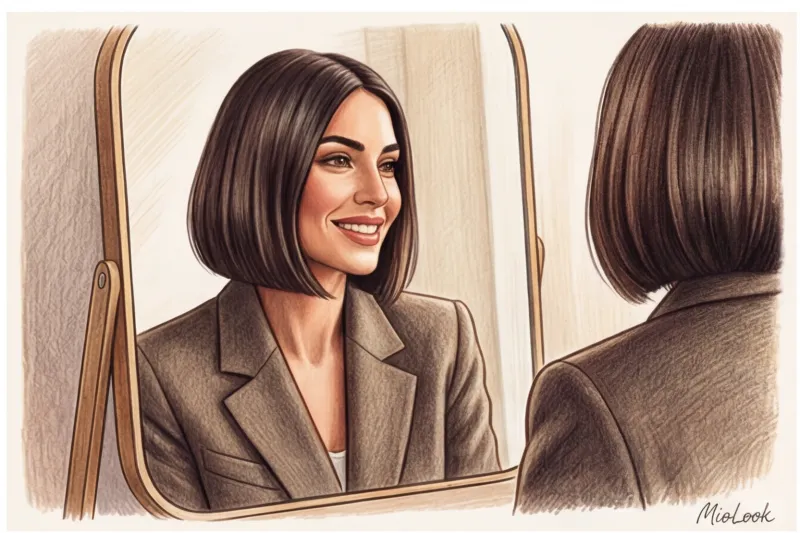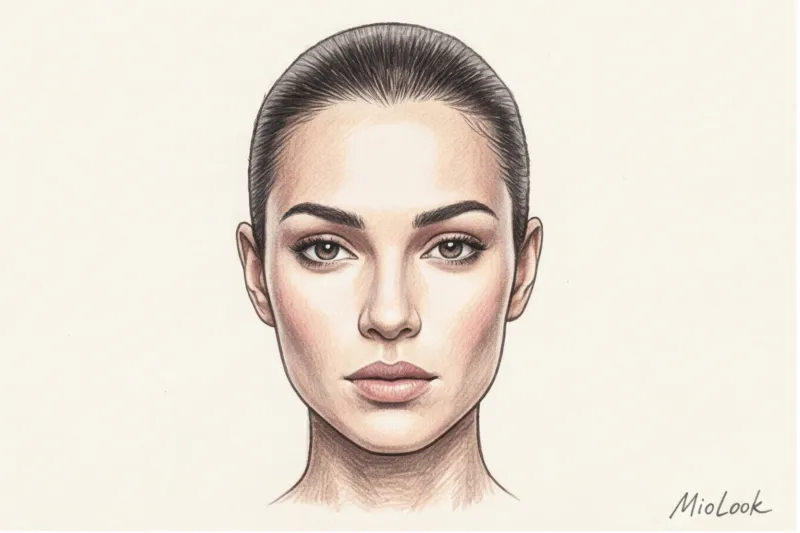
Did you know that your usual outstretched-arm selfie visually enlarges the center of your face by almost 30%? Optical distortion makes your nose appear larger, your temples appear narrower, and your jaw appears heavier. Now imagine feeding this distorted frame to an algorithm. When we run Finding a hairstyle based on your face shape using a photo We expect a flawless forecast. In reality, however, we often get results that, in real life, lead to disaster in the barber's chair.
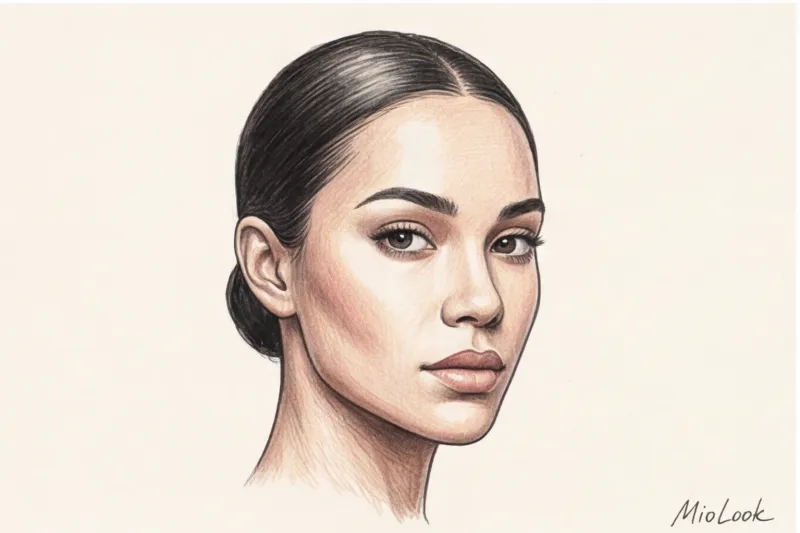
We have covered in detail where technology still “glitches” and embellishes reality in our The Complete Guide to Trying on Hairstyles Online: Why AI Lies to You In this article, we'll go further and uncover the technical underbelly: how exactly the digital brain evaluates your appearance, what it's sorely unable to see, and how you can "hack" the system to get a truly useful haircut reference.
The Anatomy of Digital Vision: How Neural Networks Scan Your Photo
To understand why the app sometimes suggests a haircut that makes your face appear wider (even though you asked for the opposite), you need to understand how AI "sees" you in the first place. A neural network doesn't look at you like an artist. It looks at you like a mathematician.
According to research into computer vision algorithms at the Massachusetts Institute of Technology (MIT, 2023), modern biometric systems place between 68 and 106 key reference points on your face. These form an invisible grid.
- Jaw line: from the lobe of one ear through the chin to the other ear (determines the width of the lower third).
- Zygomatic arch: the widest part of the face.
- Hairline: determines the height and width of the forehead.
- Proportions of thirds: the ratio of the distances from the hairline to the eyebrows, from the eyebrows to the tip of the nose, and from the nose to the chin.
Why has virtual haircuts become so popular? The answer is simple: fear. Fixing a bad haircut at a good European salon will cost you between €80 and €150, and that's not counting the months spent painfully growing it out. AI gives us the illusion of control.
However, there is a huge difference between basic entertainment apps and intelligent neural networks. The former simply overlay a flat "helmet" of artificial hair, cut from a template, onto a photo. The latter (such as MioLook ) analyze depth of field, head tilt, and try to adapt the volume of the image to your individual cranial anatomy. But even the most advanced systems stumble over one thing: the quality of the source material.
Access to MioLook for €0.99 — one-time payment
A smart AI stylist will select the perfect look based on your proportions.
Get access — €0.99 onceThe Main Enemy of Accurate Analysis: Why Selfies Break the Algorithm
The most common mistake I see in my practice is trying to choose a haircut based on a photo taken in an elevator, a car, or simply at arm's length.
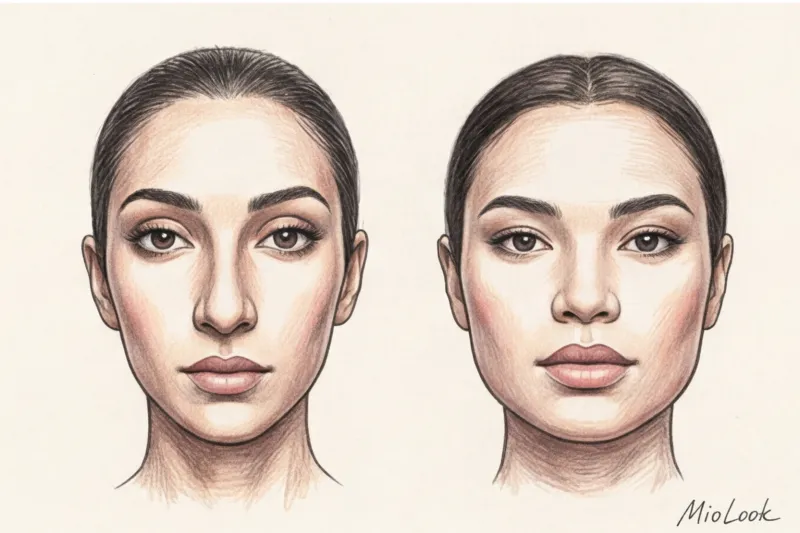
Most modern smartphone front-facing cameras are equipped with wide-angle lenses with a focal length of 24–28 mm. Due to the laws of optics, such a lens inevitably creates distortion. Areas closer to the center of the lens (your nose and forehead) are artificially magnified, while the periphery (cheekbones, temples, ears) are pushed back.
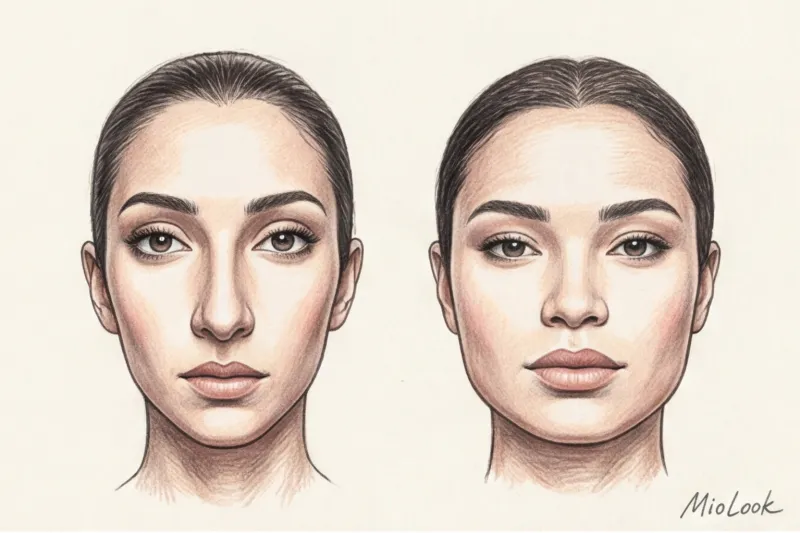
Angle is everything. If you take a selfie from slightly above (the most popular angle on social media, as it makes your eyes look bigger), the algorithm instantly reads your forehead as disproportionately wide and your chin as narrow. AI diagnoses: inverted triangle ("heart") face. If you shoot from below, you are guaranteed to have a heavy jaw and a false “square” appearance.
"One of my clients was convinced she had a round face because an app said so. We took measurements in a chair in front of a mirror, and it turned out she had a perfect, classic oval shape. She simply took the photo for analysis while lying on a pillow, where gravity had shifted the facial tissues, and her chin was pressed against her neck."
Playing with Light and Shadow: How Lighting Changes the Architecture of Cheekbones
Algorithms analyze a 2D plane. The only way for AI to understand where you have volume and where you have depressions is by calculating shadows.
Harsh sidelight (for example, if you're standing sideways to a window) creates a deep shadow under your cheekbone. The program interprets this as pronounced cheekbones and may suggest an ultra-short pixie cut to accentuate them. Poor overhead lighting in the bathroom, on the other hand, blurs the contours of your jawline, making your chin blend into your neck. The program will assume you don't have a defined oval face and suggest a tight, long bob to "hide" this nonexistent problem.
Your perfect look starts here
Join thousands of users who look flawless every day with MioLook.
Get access — €0.99 onceAI Blind Spots: What the Program Will Never See in a Photo
And now it's time to debunk the biggest hairdressing myth. Face shape is not the only or even the main criterion to choose the perfect haircut.
Yes, glossy magazines have been writing for decades: "A square face needs soft waves, and an elongated face needs bangs." But as a practicing stylist, I can tell you honestly: your hair texture, density, and hairline matter a hundred times more than the proverbial oval or square shape. And this is where artificial intelligence is completely blind.
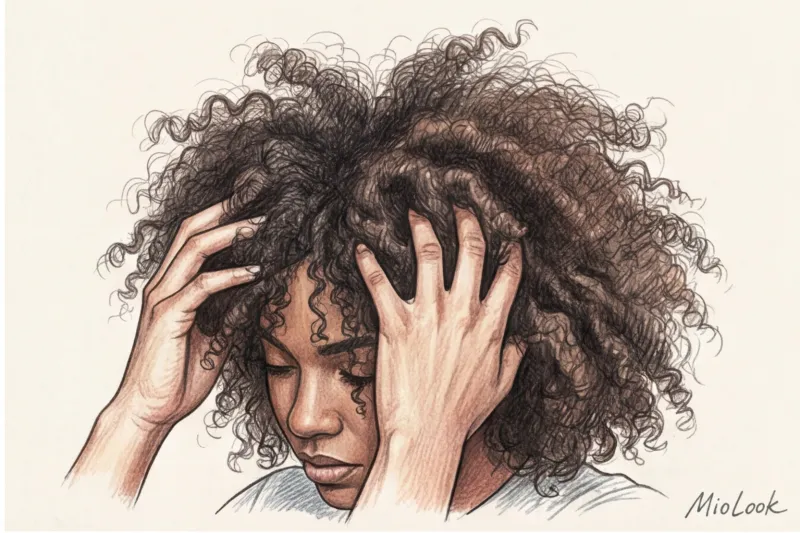
What AI ignores when choosing a hairstyle based on your face shape from a photo:
- Texture and porosity. An app can easily give you a perfectly sleek, glassy bob. But if you have porous, slightly curly, and thick hair, in real life, at that length, it will turn into an unruly "house" or triangle. Without daily straightening, the cut will never look like the one in the picture.
- Hair density (mass). An algorithm can't touch your hair. It might suggest thick, even bangs to a girl with thin, sparse hair. In real life, to achieve such bangs, you'd have to cut half the hair from the very top, leaving a measly three strands at the temples.
- Whirls and direction of strand breakdown. Everyone has their own natural parting and hairline. Many have a stiff cowlick on their forehead. While AI creates bangs that fall straight across, your cowlick will physically prevent them from falling that way—they'll stick out to the side or fall apart.
Let me tell you right away: virtual fitting It doesn't work As a direct guide to action if you have afro curls or extremely coarse, glassy hair that's unmanageable. In these cases, the haircut's geometry is created by hand by the stylist, strand by strand.
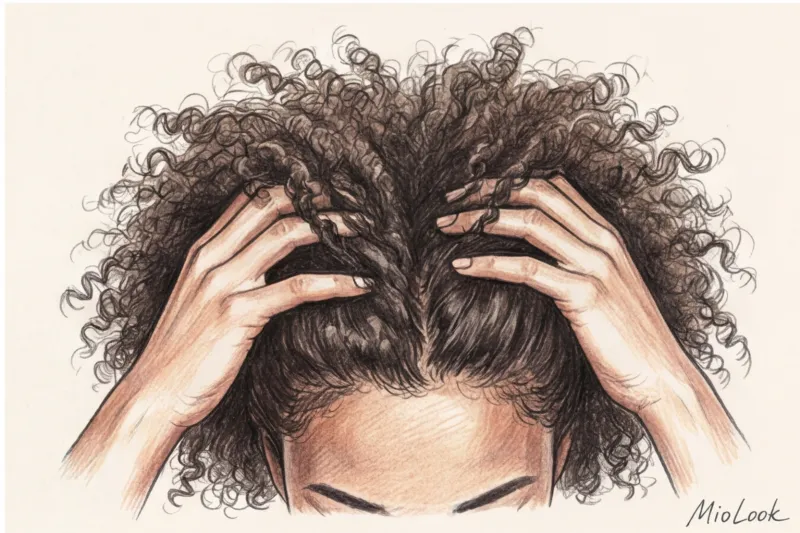
Stylist's Guide: How to Take the Perfect Photo for Smart Hairstyles
To ensure the algorithm doesn't give you a random image, but a useful tool for working with your stylist, the original photo must be technical. Not just a pretty one for Instagram, but technically sound.
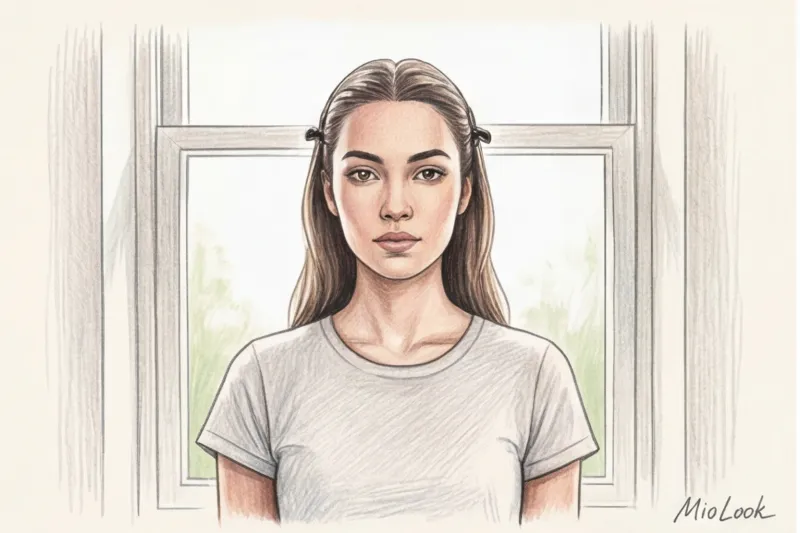
Here's my step-by-step guide to getting the right result:
- Step 1: The Right Distance. No selfies! Ask someone to take your photo (or use a tripod with a timer). The camera should be at eye level, strictly parallel to the floor, and 1.5–2 meters away. This is the only way to avoid lens distortion. If necessary, simply crop out any excess background in the finished photo.
- Step 2: Perfect Light. Stand facing a large window during the day. The light should fall directly on you, softly illuminating your entire face without harsh shadows under your nose or on your cheekbones. Avoid artificial yellow light from a chandelier.
- Step 3: Honest preparation. Hair should be slicked back and pulled back into a tight ponytail. Your ears, neck, and forehead should be completely exposed. If you wear glasses, remove them (glare on the lenses can interfere with your eyesight).
- Step 4: Facial expression. Neutral. No wide smiles—they stretch the mouth, lift the cheeks, and change the proportions of the chin. Just a calm, relaxed gaze into the lens.
Only by uploading such a photo to the app will you give the neural network a chance to correctly measure your proportions.
Ready to get started?
Try the free plan—no commitments. Upload the perfect photo and find your style.
Get access — €0.99 onceFrom virtual fitting to a real haircut: how to filter results
So, you've got several variants of generated images. How can you avoid being fooled and use them correctly?
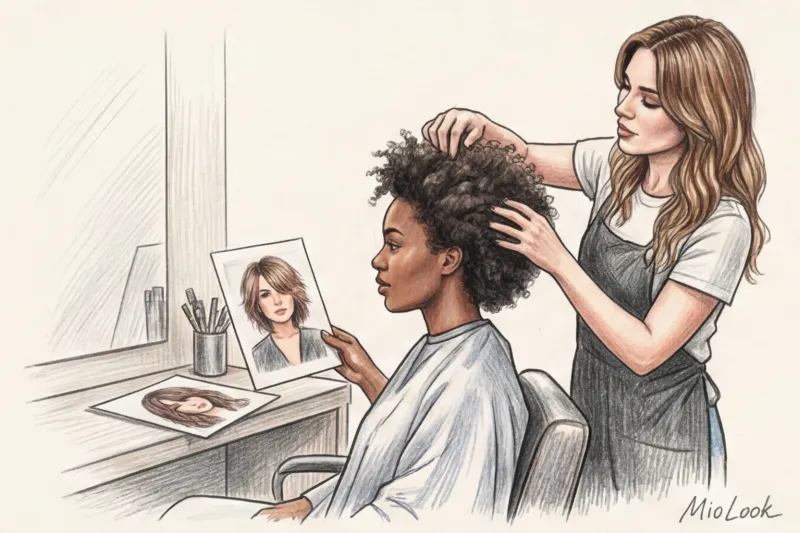
According to the WGSN Beauty Technology Report (2024), 65% of women are disappointed with a real haircut created using an AI reference, precisely because they are trying to copy the texture of artificial hair rather than its shape.
When you look at the result, turn off your emotions and turn on geometry. Analyze only three parameters:
- Where is the maximum volume? Did the algorithm suggest volume at the crown or cheekbones? How did this visually change your face?
- Where does the length end? Does the cut line follow the jawline, expose the neck, or lie on the collarbones?
- Is the forehead open or closed? If the app is persistently drawing bangs on you, it may be trying to balance out the elongated upper third of your face.
Don't judge the beautiful shine of these virtual curls. Just appreciate the shape's architecture. Save two or three of your best options and show them to your hairdresser, saying: "I like the way the volume and length are distributed around my face. Can we achieve a similar shape given my hair thickness and growth pattern?".
Results: Making AI your assistant, not your illusionist
Online hairstyle selection is a fantastic, safe way to step out of your comfort zone. It allows you to try on a look in just 5 minutes that would take you months to decide on in real life. It's a great safeguard against impulsive decisions (how many times have we cut our bangs at 1 a.m. under stress, only to regret it later?).
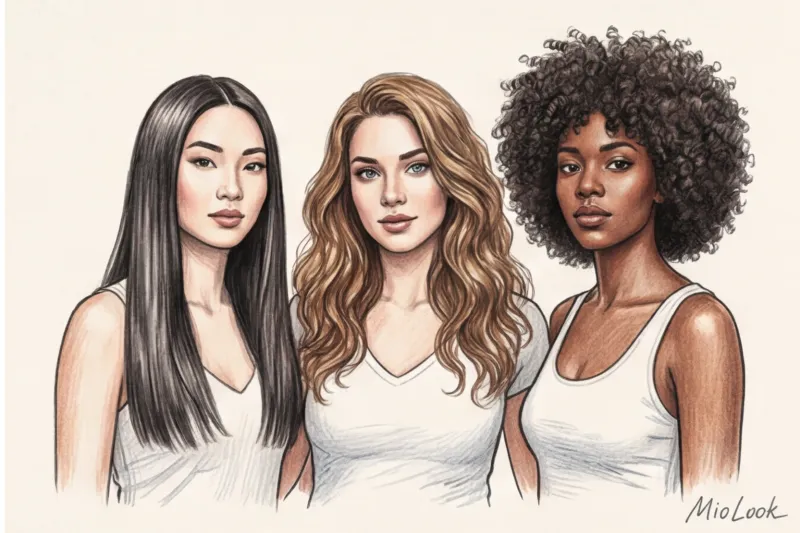
The main rule to remember is that artificial intelligence gives idea and concept , and a professional stylist will adapt it to the laws of physics of your real hair. Don't expect magic from programs if you're uploading distorted selfies. Prepare a proper technical photo, upload it to a smart service, and analyze shapes, not textures.
If you want to test how different lengths and volumes change your appearance, try MioLook The program uses advanced proportion analysis algorithms, allowing you to come to the designer with a ready-made, well-thought-out mood board, saving both money and stress.