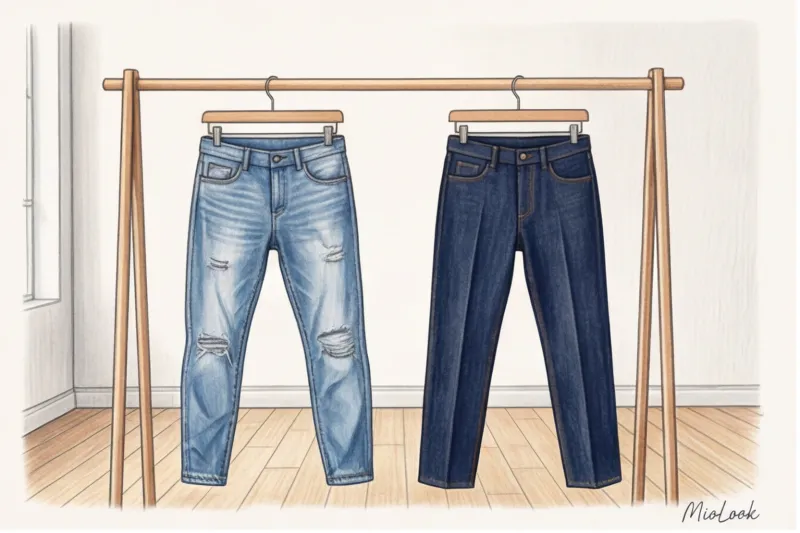
Have you ever noticed how your posture changes depending on the fabric of your pants? It's one thing to stand before a boardroom in a thick wool suit that literally holds your body together, and quite another to do so in soft, stretchy trousers. According to a 2024 WGSN report, 80% of international companies officially allow denim in their business dress code. But here's the paradox: 60% of HR managers admit in anonymous surveys that employees have absolutely no idea how to style it.
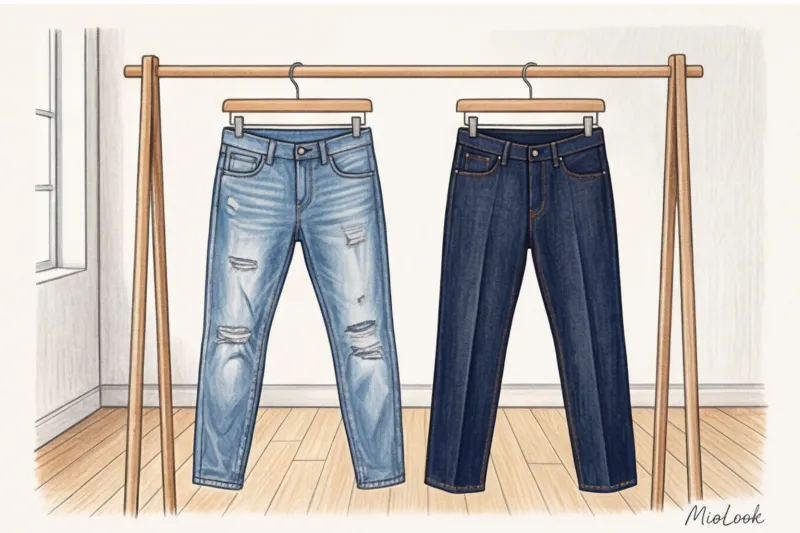
My name is Darina Marchenko, and I'm a colorist and image consultant. Over 12 years of practice, I've learned one thing: the right denim can look more classy than a classic suit, while the wrong one can make you look like a student who accidentally stumbled into a serious negotiation. Today, we'll explore how to incorporate women's jeans into the office so they complement your professional image. Spoiler alert: the advice to "just buy black jeans without holes" is no longer effective.
By the way, if you are just starting to form a smart base, we talked about wardrobe architecture in more detail in our The Complete Guide to a Basic Denim Wardrobe: Building the Perfect Capsule.
Why 90% of Women Wear Jeans to the Office Wrong (and How to Fix It)
Last year, Anna, the CFO of a large logistics company, came to me for a consultation. Her request was: "We have casual on Fridays, and when I wear jeans, I feel like my subordinates are no longer taking me seriously." We opened her closet. Inside were five pairs of form-fitting skinny jeans with 5% elastane.
The main pitfall of office denim is the pursuit of "pajama-like" comfort. Adding elastane (especially more than 2%) dramatically cheapens the garment's appearance. The fabric begins to cling to every detail of the body, bunching up under the knees and stretching out over the buttocks by mid-workday. In business etiquette, as experts at the Institute of Image Training and Testing note, excessive tightness is subconsciously interpreted as vulnerability and a lack of distance.
We swapped Anna's five pairs of "comfortable" skinny jeans for two pairs of stiff, straight-leg, 100% cotton jeans (priced around €120). Just a week later, she texted me: "Darina, I feel like I'm wearing armor in these."
Try MioLook for free
A smart AI stylist will find the perfect look for your office dress code.
Start for freeDenim Architecture: Choosing the Perfect Pair for Work
In business attire, jeans should act as a sculptural frame, not a second skin. In clothing design, there's a concept called "visual weight of fabric." The denser the fabric, the more authoritative, composed, and "expensive" the silhouette appears. Thin denim is visually lightweight, conjuring up images of relaxation, the beach, or the countryside.
Density and composition: the secret to a "trouser" fit
The gold standard for office denim is a weight of 12 to 14 ounces (oz). This information is often included on the inside tags of brands like COS, Arket, or premium Levi's lines. Fabric of this density physically cannot hug the leg like leggings. It falls in a smooth, even sheet, concealing any figure nuances—from the hips to the shape of the knees.
Look for 100% cotton on the label. Yes, you'll have to literally "learn how to sit" in these jeans for the first three days until the fabric molds to your body. But the results are worth it. However, there is an important exception here: If you have a pronounced difference between your waist and hips (a pear-shaped figure), a very stiff cotton fabric can create an unsightly bulge at the waist. In this case, a maximum of 1% elastane is recommended.
Styles that work for your status
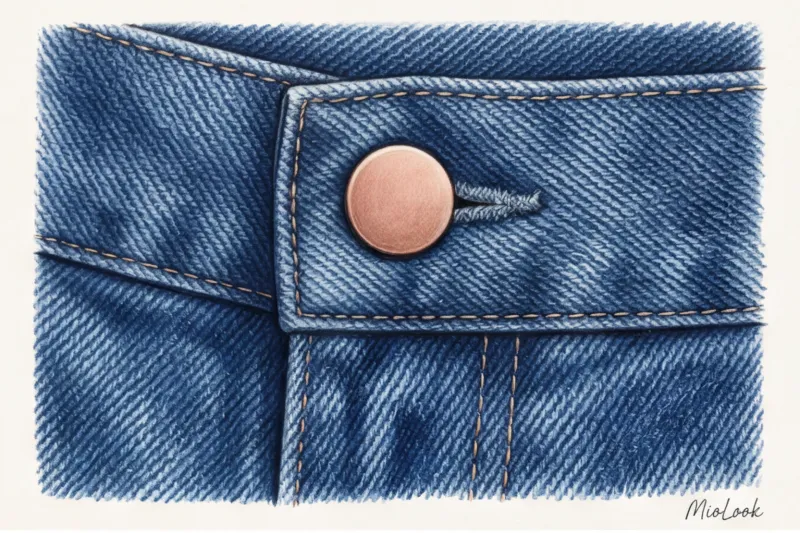
The new office classics are the straight and wide-leg styles. They create that vertical line that's typical of a men's business suit. To increase the formality, use an old tailoring trick: iron the creases on straight-leg jeans. This micro-detail instantly elevates a piece from casual to smart-casual.
But what should be strictly avoided within the dress code are mom and slouchy styles. The relaxed, slightly baggy crotch combined with a tapered hem disrupts the business-like geometric lines. They're a great choice for a weekend brunch, but at a meeting, these jeans look like you borrowed a pair from a teenager.
Business Denim Colors: Forget About Faded Black
"If you don't know what to wear to the office, wear black jeans." I hear this rule every week, and as a colorist, I'm obliged to disprove it. Black denim is one of the most tricky wardrobe items. Unlike the smoothness of a suit's wool, the fuzzy texture of cotton diffuses light.
The cold fluorescent lighting in open-plan spaces literally "eats away" the depth of black. After three washes, black jeans acquire a dusty gray, tired undertone, reminiscent of technicians' uniforms rather than expert attitudes.
Deep indigo (Raw Denim) as an alternative to a navy suit
To find the perfect women's office jeans, I personally tested over 20 high- and mid-market brands. My verdict: the best choice for work is raw denim in a deep indigo shade. Its density gives it a subtle satin sheen, which the brain subconsciously perceives as the expensive fabric of a men's navy suit.
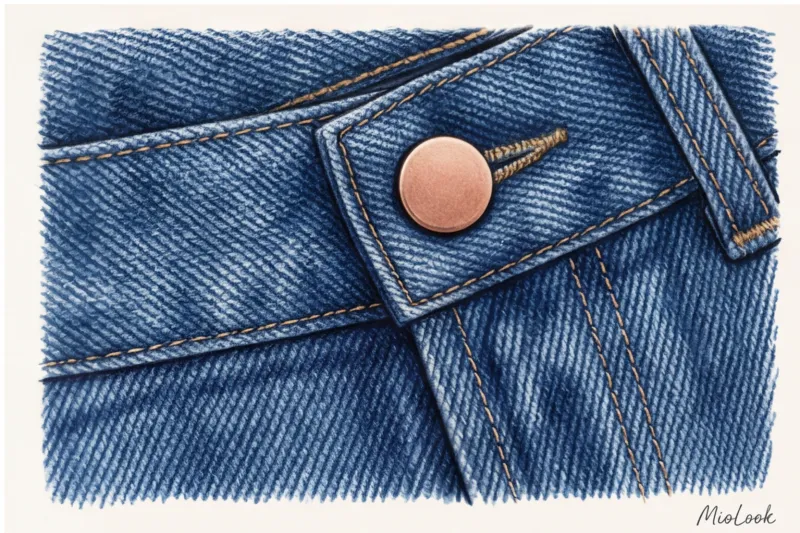
In color psychology, according to research by the Pantone Institute, dark blue conveys logic, reliability, and expertise. The main criterion for "expensive" indigo is the complete absence of artificial fraying (whiskering/fading) on the hips. The color should be uniform from the waist to the hem.
Colored jeans in the office: ecru, chocolate, and marsala
If you're tired of the blue dress code, consider more refined shades. Pure white denim looks out of place in the office, as it conjures up images of yachting and resorts. Swap it for ecru or ivory—the natural, undyed color of cotton.
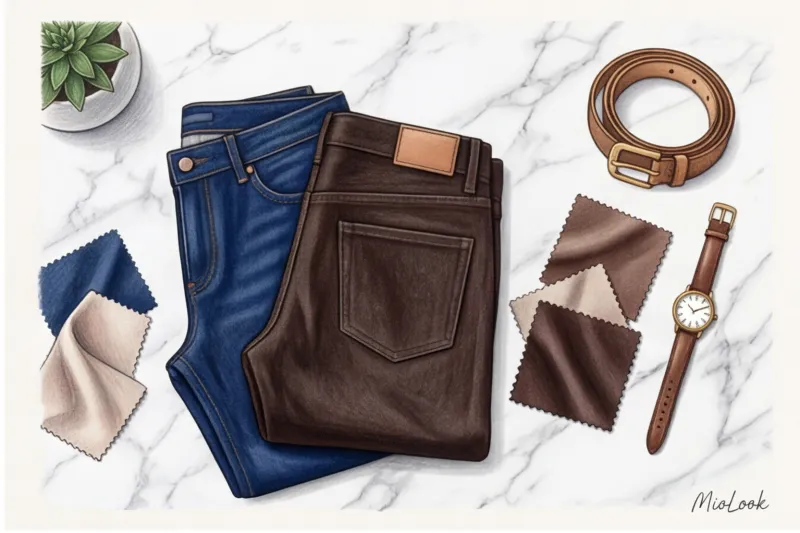
Dark chocolate or deep marsala jeans are a brilliant investment for the fall/winter season. A quality brand (such as Massimo Dutti or good local labels in the €80–€150 range) will give them the look of full-fledged trousers but retain the utilitarian durability of denim.
Your perfect wardrobe starts here.
Digitize your items in MioLook and find new combinations in seconds.
Start for freeLook formulas: what to wear with women's jeans in the office to look expensive
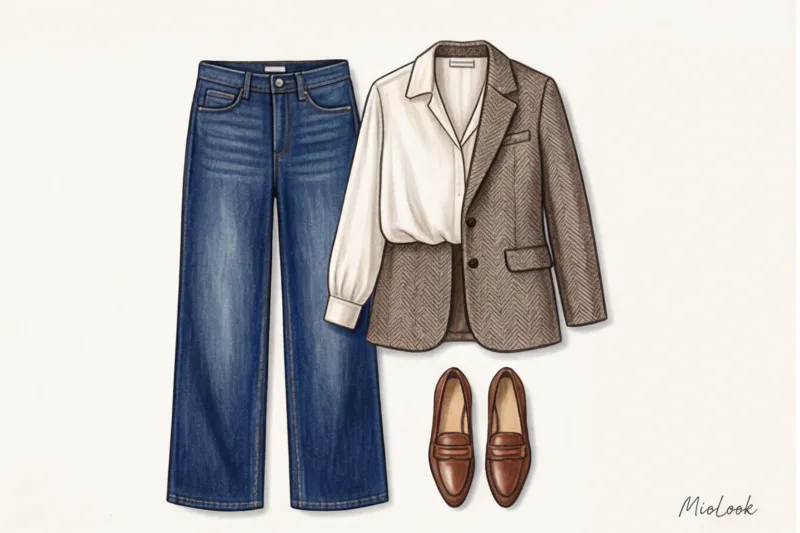
Integrating jeans into a formal wardrobe relies on one fundamental rule of style: contrasting textures. Denim is, by nature, a rough, workwear fabric. Wearing jeans with a cotton T-shirt or a thin viscose jumper will create a look that's too relaxed.
The Rule of Texture Contrast: Denim + Silk + Tweed
The roughness of jeans should be counteracted with decidedly refined, "status" materials. The smooth silk of a blouse will reflect the light, creating a beautiful contrast with the matte indigo. A structured tweed jacket or a thick wool blazer will add the necessary formality to the look.
Never pair jeans with thin, see-through knitwear in the office. If you want to wear a sweater, choose a thick cashmere or chunky merino wool—playing with the contrasting tactile sensations (rough denim versus soft cashmere) always looks luxurious.
Monochromatic Verticals: How to Elongate Your Silhouette
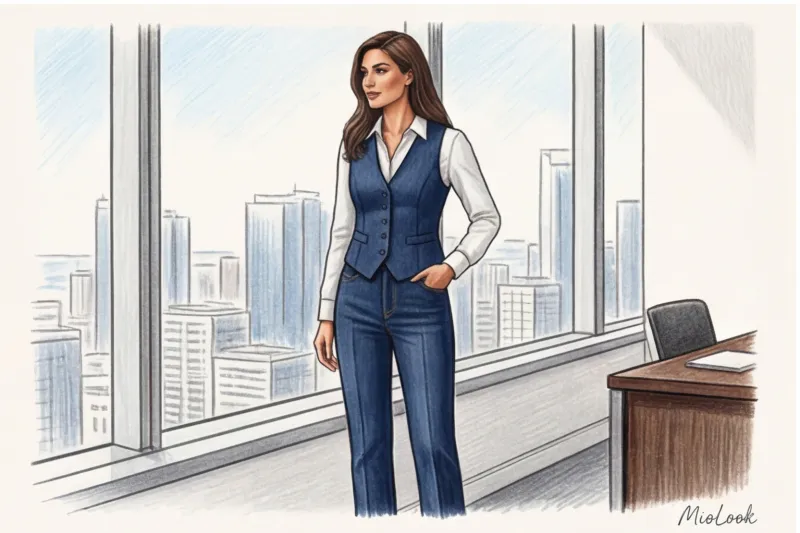
One of my favorite styling tricks is tone-on-tone monochrome. Pair dark blue straight-leg jeans with a dark blue silk blouse or a tone-on-tone cashmere turtleneck. This creates a continuous vertical line that elongates, slims, and looks incredibly elegant.
A third layer is a must. A classic jacket or a tailored suit vest (a hit of the last two seasons) acts as a "discipline" element. It ties relaxed denim into the strict geometry of a business style.
Shoes and Accessories: Markers That Save a Denim Look
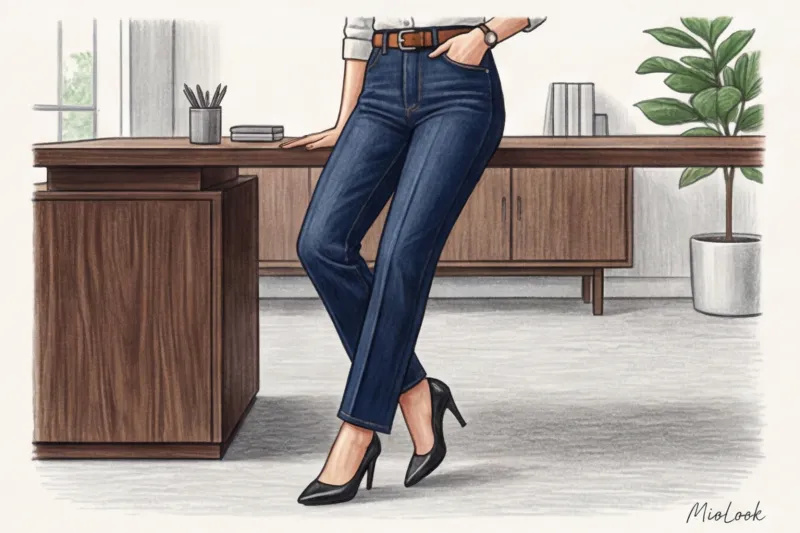
Even the perfect €200 jeans can be ruined by the wrong shoes. Save your favorite white sneakers for the weekend. At the office, jeans require a more robust pair of shoes.
- Shoes: Loafers with thick soles, slingbacks with a closed pointed toe, or classic pumps. The pointed toe peeking out from under straight-leg jeans visually lengthens the leg and adds dynamism to the look.
- Belt: Women's jeans should always be worn with a belt for the office. This is the key to a complete look. A belt should be 3-4 cm wide, smooth leather, and a minimalist buckle without logos. The color of the belt should complement either the shoes or the bag.
- Bags: Soft shopper bags will complement a denim look. Opt for structured bags with a rigid bottom and a clean, geometric shape, such as totes or trapezoids.
Checklist: Are Your Jeans Ready for Monday?
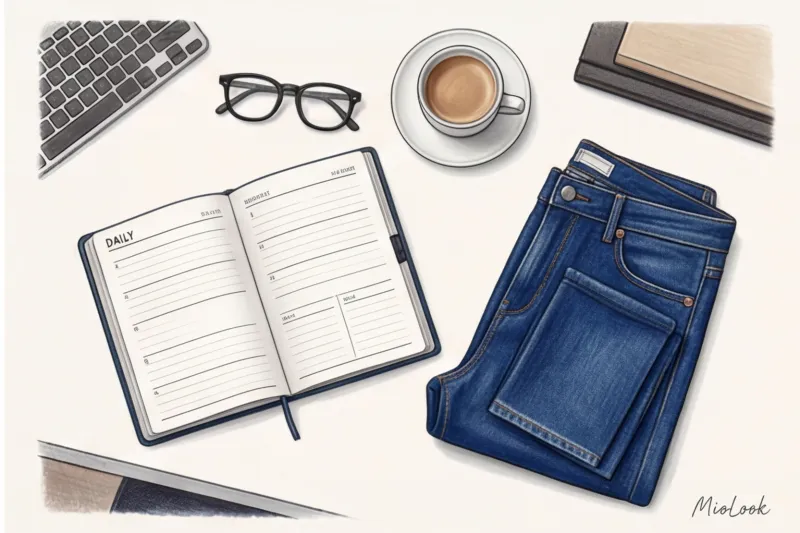
Before you wear jeans to work tomorrow morning, run a quick checklist. If an item doesn't meet even one requirement, save it for Friday's movie night.
- Fittings. Minimize shiny rivets. Ideally, the stitching should match the fabric (blue on blue), not a contrasting orange.
- Length. Straight-leg jeans should end 1-2 cm below the ankle (covering the ankle bone), but should never bunch up at the instep. Wide-leg jeans should cover the shoe almost to the floor, leaving only the toe visible.
- Color. Absolutely even, without lightened areas on the hips or knees.
- Edges. No fringe, raw edges, and especially no factory tears.
Instead of a conclusion: jeans as a canvas for your professionalism
Denim in the modern business wardrobe isn't a dress code relaxation imposed by loyal management. It's a natural evolution. The right jeans demonstrate that you're up-to-date, value quality, and understand the difference between casualness and smart casual.
Start small: invest in one perfect pair of crisp, straight-leg dark blue jeans (you can find great options from European brands for €100-€150). Pair them with smooth silk, accentuate your waist with a leather belt, and wear structured shoes. You'll notice a difference not only in your appearance but also in how attentive you are to your surroundings at meetings.