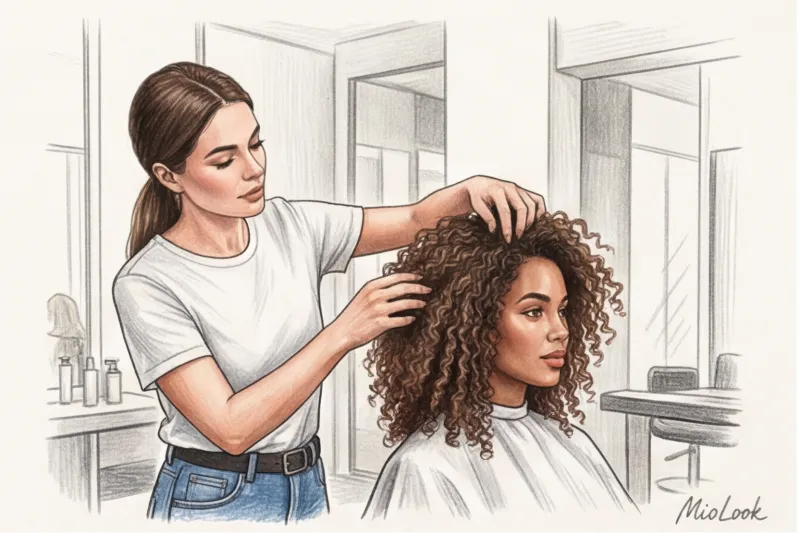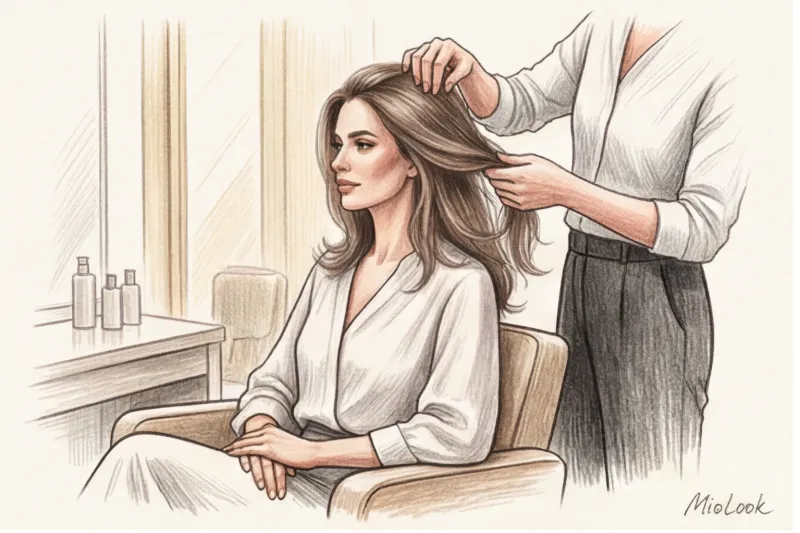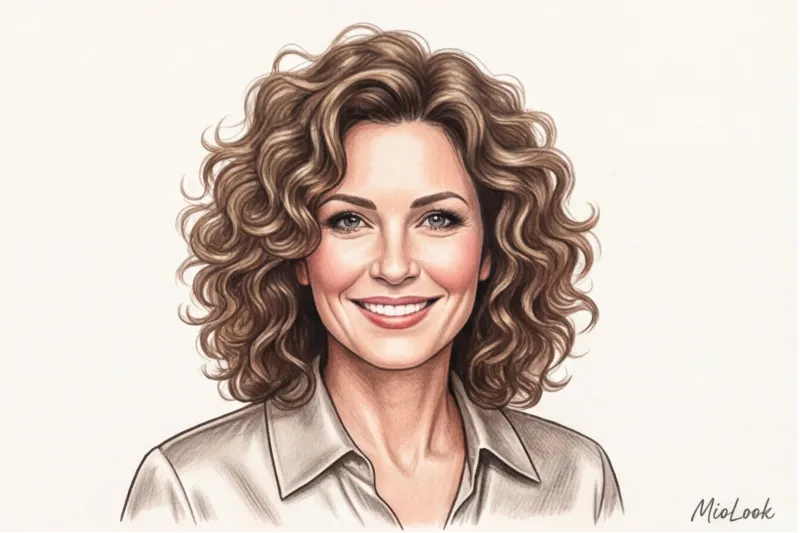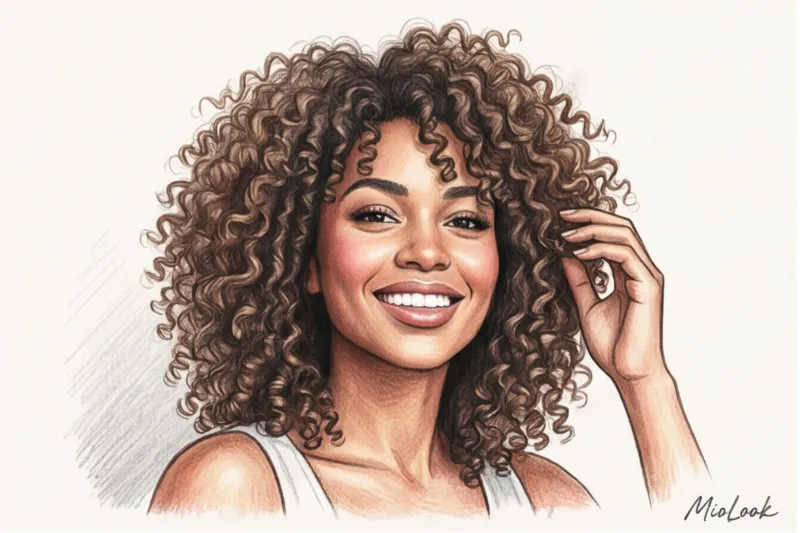
Imagine a typical morning: you spend 40 minutes trying to straighten unruly strands with a flat iron heated to 200°C. Then you step outside into the humid air—and within five minutes, you're transformed into a fluffy dandelion. Sound familiar? In 12 years of working as a stylist, I've heard this story hundreds of times. Many girls wage war on their natural texture for years, considering it a curse. But the truth is, the right haircuts for curly hair — it's not magic or a lottery. It's pure physics and geometry.
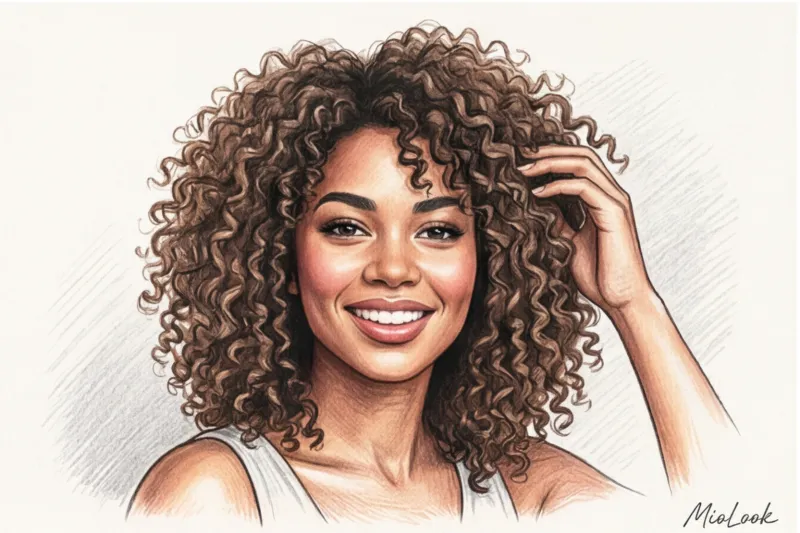
We've covered how geometry works on different hair types in more detail in our complete guide. Smart haircuts based on hair texture: the secret to achieving shape without styling Today, we'll focus exclusively on curl architecture. We'll explore why your hairdresser is likely cutting your hair incorrectly, and how a smart cut can permanently eliminate frizz without gallons of hairspray.
Why curls get frizzy: How haircut design overcomes chaos
One of my clients, brand manager Anna, came to me in utter despair. She regularly bought moisturizing masks in the €50–€80 range and got salon treatments, but her hair still resembled a shapeless cloud. The problem wasn't dry cuticles, but a completely improper weight distribution.
"Statistically, 80% of frizz in curly hair is caused by improperly cut geometry, not by a lack of moisture."
The legendary Vidal Sassoon revolutionized hair styling back in the 1960s with his "Wash and Go" concept. He designed haircuts so that they would fall naturally into the desired line through precise angle calculations. This same philosophy of architectural, "smart" cutting applies to texture. The only difference is that straight hair falls downward under the influence of gravity, while curly hair rises and flows outward, creating volume.
When Anna and I reshaped her hair, removing excess weight from the back of her head and freeing up the curl, her morning routine dropped from 40 minutes to 10. We calculated that the right haircut saved her almost five hours a week. Her moisturizers finally started working because they no longer had to glue together the geometric chaos.
Your perfect look starts here
Join thousands of users who look flawless every day with MioLook. The smart algorithm takes your hair texture into account.
Get access — €0.99 onceThe Main Enemy: The Triangle Effect and How to Avoid It
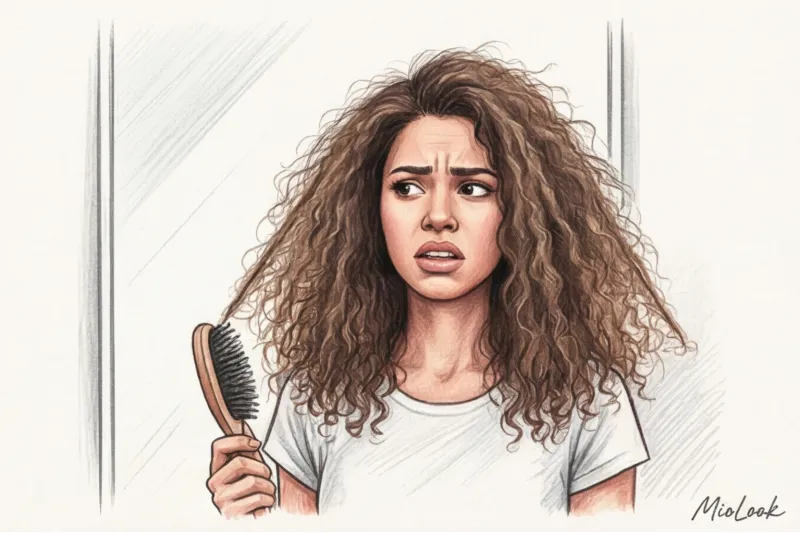
If you've ever cut your hair into a straight bob and ended up with a "house" on your head, you're familiar with the "triangle" effect. It's a classic mistake of traditional hairstyling: a flat, slicked-back crown and unnaturally flared, heavy volume at the ends.
Why is a straight cut, which looks so luxurious and classy on straight hair, so detrimental to curls? It's all about compression ratio (shrinkage). According to research by the WGSN Institute (2024) on textured hair, natural curl can "jump" 30-50% of its length when wet.
When a hairstylist pulls back a strand and makes a straight cut, they create a single line of weight. As it dries, each spring compresses differently. The top layers, which have a longer distance to travel, fall on top of the lower layers, creating excess weight right at shoulder or chin level. The roots don't have the strength to lift all this weight, so the crown remains flat.
Correct graduation: the secret to the perfect shape
To break up the "triangle," we need layers. But here lies the main pitfall—the difference between thinning and proper geometric graduation. Thinning scissors literally rip out chunks of hair, thinning the ends. For curls, this is a death sentence: the thinned curl loses its structural integrity, disintegrates into individual hairs, and turns into that dreaded frizz.
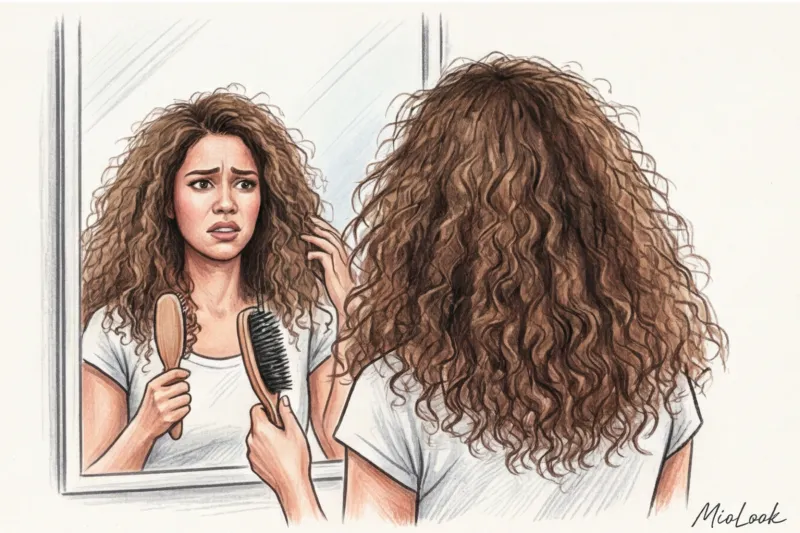
Proper graduation involves creating invisible steps within the shape with a straight cut. The top layers are made shorter than the bottom ones, which removes excess weight. As a result, each spiral has room to freely shape itself without compressing adjacent strands.
Ready to get started?
Try the MioLook plan for free—no commitments required. Find the perfect curl shape for your hair in advance.
Get access — €0.99 onceThe Wet Cut Myth: Why Curls Should Be Cut Dry
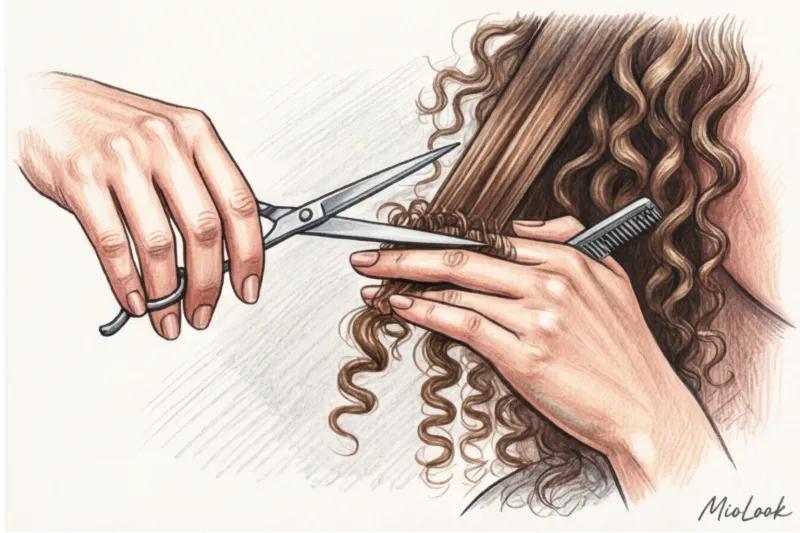
Now here's a counterintuitive fact that might surprise you. If you sit down in the stylist's chair and the first thing they tell you to do is go to the sink to wet your curls, get up and walk away. Cutting curly hair while it's wet is a huge mistake.
Conventional wisdom teaches cutting wet hair because water stretches it, making it manageable. But Lorraine Massey, creator of the famous Curly Girl Method, proved back in 2001 that water alters the structure beyond recognition. Wet curls stretch, concealing cowlicks, varying degrees of curl in different areas of the head, and the natural parting.
Cutting wet curls is like sewing a dress onto a mannequin twice your height and weight, hoping it will fit. As it dries, the strand at the back of your head might jump 5 centimeters, while the strand at your temple might jump 10.
This is why advanced craftsmen use this technique Curl-by-Curl The cut is made on dry hair, in its natural state. The stylist takes each individual curl and cuts it at the bend of the spiral. This is the only way to control the actual length and volume of the future hairstyle.
Top 4 Smart Haircuts for Curly Hair of Different Lengths
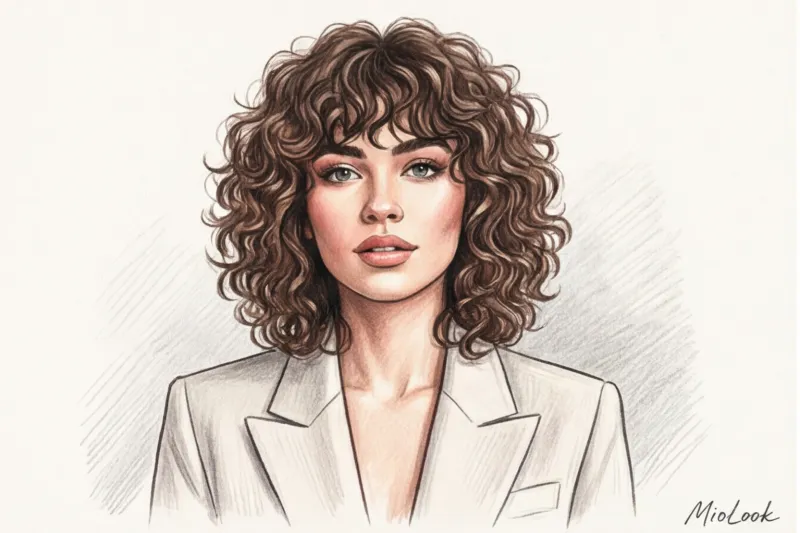
There's no one-size-fits-all haircut, but there are some styles that work like a Swiss watch: they require no styling and look classy. To visualize how these styles will suit your face shape, you can upload a photo of yourself to MioLook and try on different volume options before going to the salon.
Pixie Bob for a Defined Curl (Type 3B-4A)
An ultra-modern short cut with a significantly shorter back and sides, but a longer crown and fringe. It's a bob for those with coarse, dense curls (Afro-textured or finely coiled), which are difficult and expensive to tame at long lengths. The pixie bob draws attention to the cheekbones and neckline, creating a fragile yet daring look.
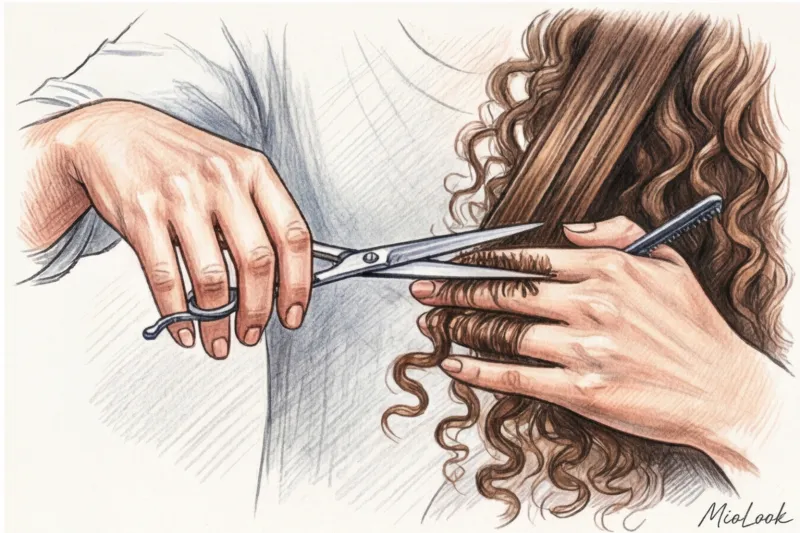
Shaggy and Mullet: Controlled Casualness
The hottest trend of recent seasons, it's perfect for textured hair. It features an abundance of choppy layers all over the head and a must-have bangs. The shaggy cut brilliantly camouflages frizz, as the very essence of the cut is a slight carelessness. It works best on wavy hair (Type 2B-3A). It's an excellent choice for creative professions or IT with a relaxed dress code.
Layered cascade for medium and long hair
If you're not ready to part with length, a layered cascade with a rounded or U-shaped fringe at the ends is your choice. A V-shaped fringe often creates a "rattail" look, while a U-shape maintains the density of the perimeter. Layers start at the collarbone, removing weight from the nape and allowing the top curls to curl into bouncy springs.
Access to MioLook for €0.99 — one-time payment
A smart AI stylist will select the perfect look: from haircut to wardrobe.
Get access — €0.99 onceChecklist: How to tell if your stylist knows how to work with curls
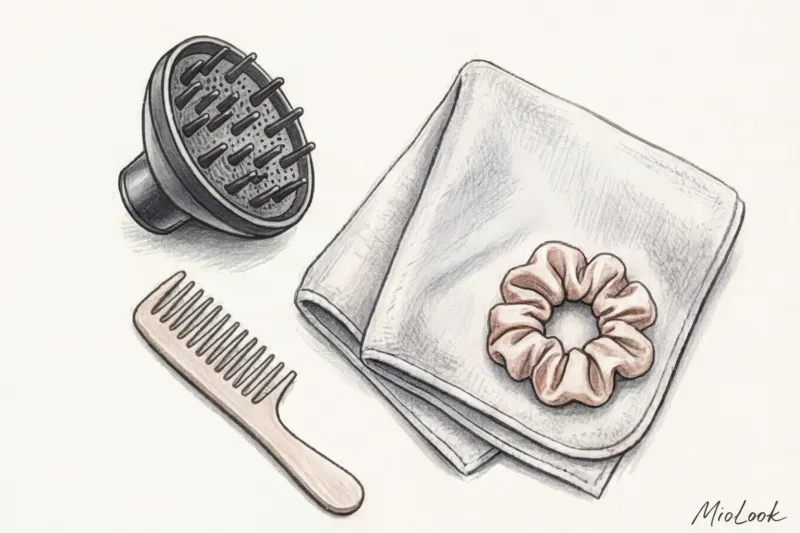
Finding the right texture specialist is more difficult than finding a good dentist. To avoid disappointment, ask your stylist a few questions before they even pick up the scissors. Here's a checklist based on international curly hair stylist qualification standards:
- Dry Rating: Does your stylist ask you to come in with dry, loose hair, without tight elastic bands? If they immediately call you to the wash, that's a red flag.
- Routine analysis: Does he ask how much time you're willing to spend styling your hair in the morning and how you usually wear it (in a ponytail, with a clip)?
- Tools: Does he use a razor or thinning shears? For curls, only a straight cut with sharp, straight scissors is acceptable.
- Styling: Does the stylist know the proper application techniques? They should apply gel or mousse to wet hair using the "praying hands" technique and then create the curl using a characteristic "scrunching" motion.
Important limitation: I have to be honest. Even the most brilliant dry haircut won't work if you comb dry hair at home with a thick plastic comb. A haircut only works when paired with proper, gentle care.
Curls and Personal Branding: How to Incorporate Volume into Business Style
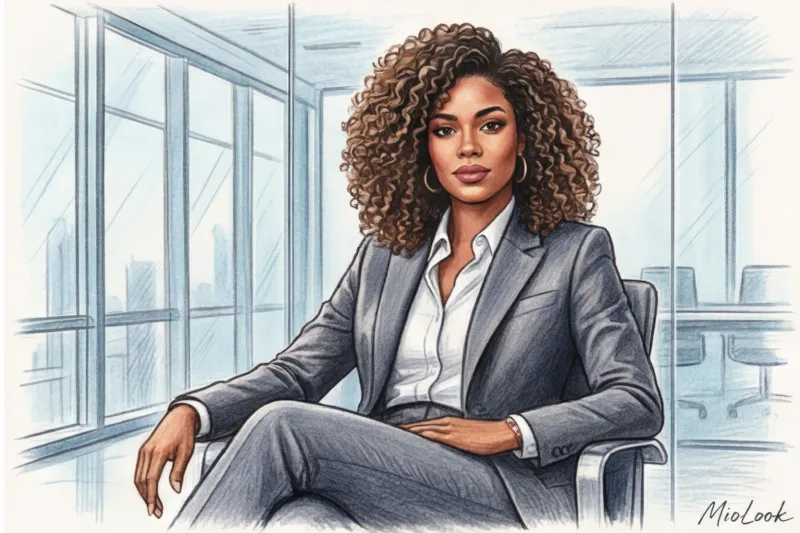
For a long time, there was an unspoken, deeply outdated stereotype in the corporate world: straight hair was "professional," while curls were "unkempt." Fortunately, today the rules have changed. According to McKinsey (2023) on workplace inclusivity, natural hair texture is no longer a barrier to career advancement. On the contrary, it's a powerful tool for personal branding.
As a stylist, I love playing with contrasts. The voluminous, vibrant texture of curls (like a layered bob) looks fantastic paired with a formal business suit. The architectural minimalism of a thick wool jacket balances the looseness of the curls. If you have an important presentation or a management interview coming up, there's no need to frantically pull your hair out. Simply gather the front strands away from your face with bobby pins or a stylish clip, leaving the volume at the nape of the neck.
Correctly selected haircuts for curly hair A hairstyle isn't just about aesthetics. It's an investment in your morning calm and self-confidence. When the shape is perfect, you no longer have to fight nature—you just have to let your hair be itself.