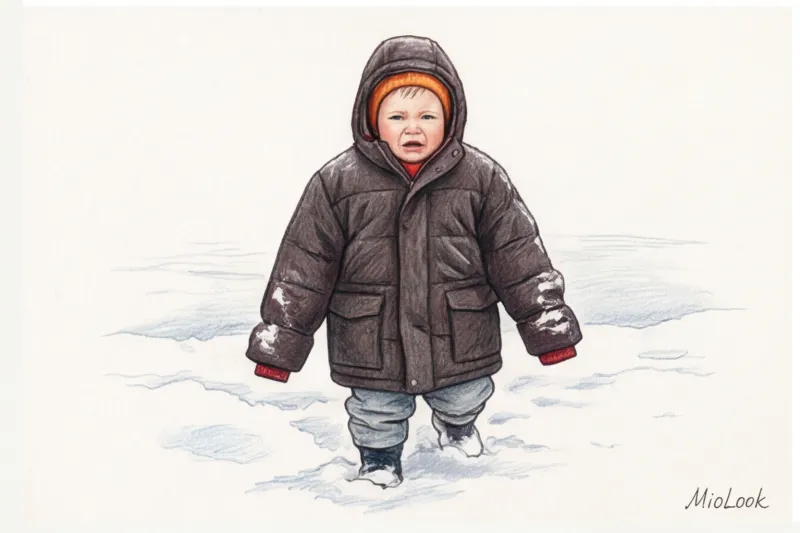
It's 7:30 a.m. on a winter morning. You're late for work, and your child is lying on the hallway floor, sobbing. The reason for the tragedy: "the sweater bites," "this hat is stupid," and in his jacket, he's "like a penguin and can't bend his arms." Sound familiar? As a stylist and colorist, I constantly hear complaints from clients about getting ready in the morning.
We adults are used to buying children's winter clothes for reasons of stern utility: we buy dark colors so they won't get dirty, and two sizes too big so they'll last for next year. The result is visual chaos that makes children feel overwhelmed, uncomfortable, and unattractive. But there is a solution: smartly assembled clothes. winter capsule for children This isn't just a set of warm clothes; it's a strict mathematics of layering, where every element works for comfort and aesthetics. We've already discussed this approach in more detail in our The complete guide to a child's capsule wardrobe , and today we will look at the winter specifics.
Why a winter capsule for children is more than just a set of warm clothes
The difference between "buying a warm jacket" and "assembling a capsule wardrobe" is enormous. In the former case, you're buying disparate items that may clash in color, texture, and volume. In the latter, you're creating a modular system.
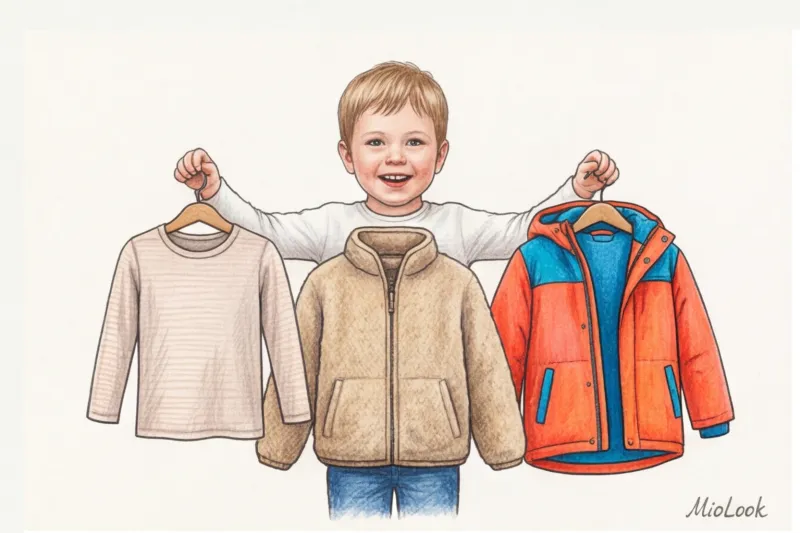
I had a revealing case in my practice. My client's five-year-old son, Mark, hated winter camp and threw tantrums every day. When we sorted through his closet, the reason became obvious. He had a great, expensive navy blue jacket, but his favorite warm pants were bright green, and his hat had red robots on it. The tactile and visual dissonance between his clothes caused him unconscious irritation. Children are much more sensitive to aesthetic disharmony than we think. As soon as we put together a capsule wardrobe for him where all the bottoms matched all the tops in a single palette, the morning protests ceased.
The main rule of a children's winter capsule wardrobe is mathematical balance. The ideal ratio is one "bottom" (pants/rompers) to three "tops" (sweaters/cardigans/fleeces). This allows for variety without overcrowding the closet.
The Three Layer Rule from a Stylist's Perspective
To combine functionality (warmth) and aesthetics, we use the three-layer principle. The capsule approach makes it simple: you simply select one item from each category, knowing they will complement each other in color and volume.
There is one honest limitation here. This multi-layered approach It doesn't work If your child is under eighteen months old and mostly sleeps in the stroller during outings, then trendy capsules are outweighed by a single, solid down wrap. But for active toddlers and preschoolers, three layers are the gold standard.
Your perfect wardrobe starts here.
Join thousands of users who look flawless every day and save time in the morning with MioLook.
Start for freeWardrobe math: How many items does a winter capsule for kids include?
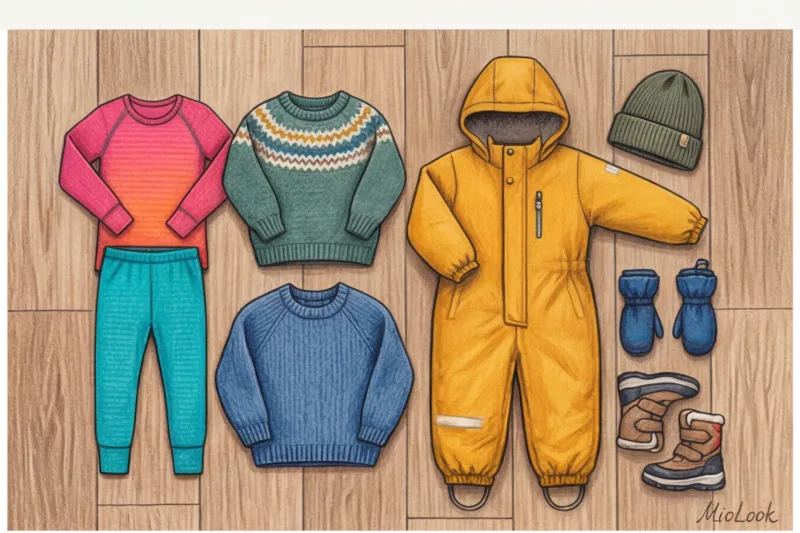
One of the biggest myths of motherhood is that a baby needs a lot of outerwear to change into. In fact, a well-designed capsule wardrobe is compact. A basic winter set looks like this:
- Outerwear: 1 membrane overall or set (jacket + semi-overalls).
- Insulating layer: 1 fleece jacket and 1-2 sweaters (merino or wool blend).
- Base layer: 2 sets of thermal underwear.
- Everyday Bottoms: 2 pairs of joggers or warm trousers (for indoors, garden, visiting).
- Accessories: 2 hats (or 1 balaclava), 2 pairs of waterproof mittens.
Let's calculate the cost-per-wear benefit. A high-quality membrane set (for example, Reima or Didriksons) costs around €150. In our climate, a child wears it approximately 120 days a year. €150 / €120 = €1.25 per wear.
The alternative? Buy three cheap jackets for €50 each in different colors, all of which get wet, tear on the slopes, and require constant washing. The final cost is the same, but the stress level for the mother and the discomfort for the child are disproportionately higher.
Base layer: thermal underwear that doesn't itch
The most dangerous mistake is dressing a child in 100% cotton in winter. According to pediatricians, cotton is absolutely not suitable as a first layer for active children in winter. It instantly absorbs sweat, doesn't wick away moisture, and feels cold on the skin. This creates a cold compress effect.
For a winter sleeping bag, choose either 100% merino wool (it's ultra-fine and completely non-itchy) or high-tech synthetics (polyester, polyamide) with microfleece lining. They wick away moisture, keeping your baby's back dry.
Insulating and outer layers: fleece, membrane and down
For an active child running around on the playground, 160–180 grams of insulation in a membrane jacket at temperatures down to -15°C (assuming three layers) is sufficient. If the child is sedentary, look for 250–330 grams.
Now, an insider secret. My personal winter clothing test: when I'm choosing a jacket for a client's child, I always stick my hand inside the sleeve and check the lining for slipperiness. If there's fleece sewn inside the sleeve, it's a disaster. The fleece will cling to the sweater, the sleeve will get stuck halfway through, and morning tears are guaranteed. Sleeve linings should only be made of smooth polyester!
Color Palette: Breaking the "Dark Means Easy to Mark" Stereotype
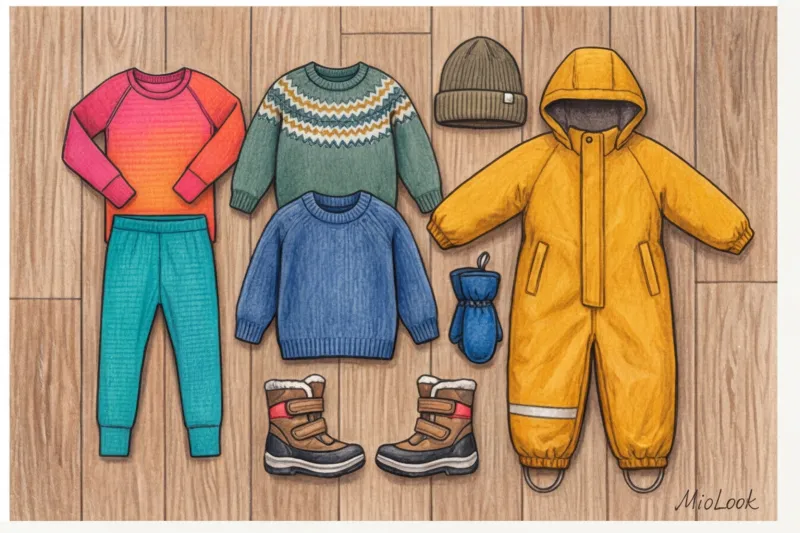
Buying a black, graphite, or dark blue jacket for a child "for practicality" is a huge, and sometimes fatal, mistake. Modern membrane fabrics are treated with a dirt-repellent coating (such as Teflon). Dirt can be easily wiped off with a damp cloth, regardless of whether the fabric is black or neon yellow.
But the price for this supposedly "practical" dark color is too high. According to Scandinavian road safety research (Trafikskyddet, 2023), in winter twilight, a driver notices a pedestrian in dark clothing from a distance of only 20-30 meters. A child in a bright jacket (yellow, orange, light green) with reflectors is visible from 130-150 meters. At 50 km/h, a car's braking distance in winter is about 30-40 meters. Bright colors in children's clothing are not just about style; they are about life.
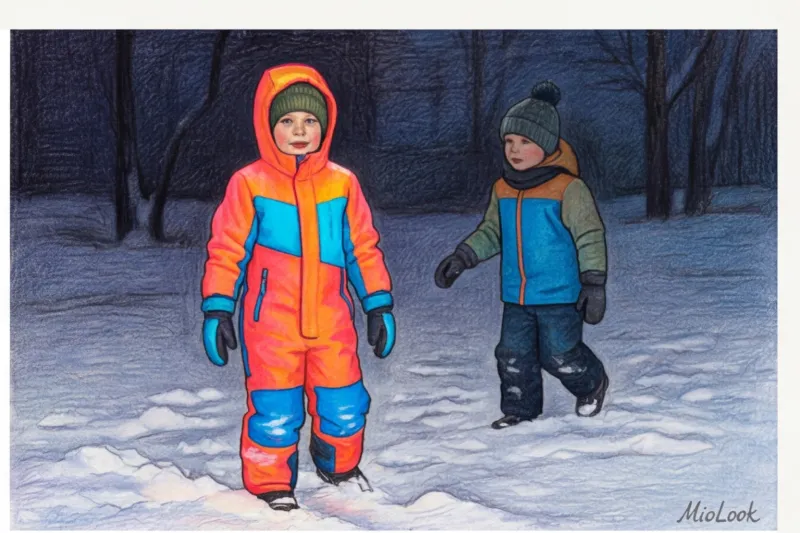
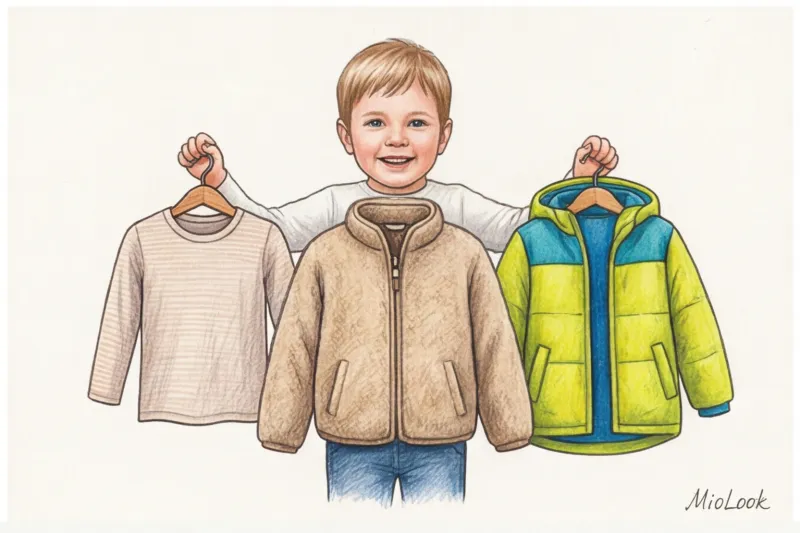
As a colorist, I suggest the following formula for a children's palette: 2 base colors + 2 accent colors.
Instead of dull black, choose a deep pine green, chocolate, or rich burgundy as a base. Add mustard, electric blue, or bright terracotta as accents. These shades look great against the snow and make your child stand out.
Try MioLook for free
A smart AI stylist will help you choose the perfect palette and create a capsule wardrobe in which all items coordinate with each other.
Start for freeHow to Bring Dinosaurs and Aesthetics Together: Prints in a Winter Capsule
No stylish capsule wardrobe can survive a child's desire to wear a sweater with a giant Batman, Peppa Pig, or a tractor on it. And there's no need to fight it. Suppressing a child's taste will only deepen their hatred of getting dressed.
I use it in my work "one screamer" rule This means the outfit can only include one item with a vibrant, wild print. If your son demands a hoodie with an acid-colored dinosaur, great. But then the jacket, pants, and hat should be simple and solid, echoing one of the print's colors. A green dinosaur with orange studs? Just a basic green jacket and an orange hat. The end result is a happy child, and the outfit looks like a designer's idea, not like an explosion in a toy factory.
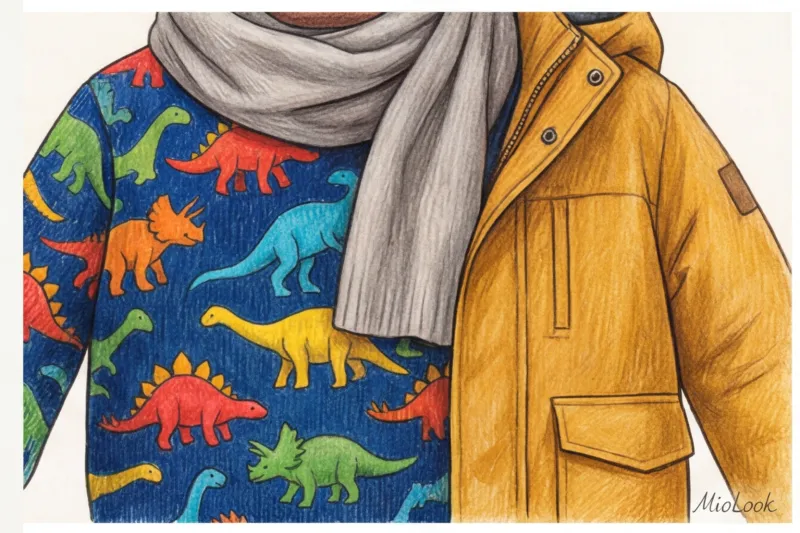
If you're choosing prints for your base layers yourself, go for classics that never cheapen a look: Scandinavian patterns on sweaters, large checks, minimalist geometrics, or stripes.
Shoes and accessories: putting together a cohesive ensemble
The footwear in your winter kit should cover two needs: walking through snowdrifts and driving/shopping. Ideally, this should include one high-quality pair of Gore-Tex membrane boots with Velcro closures or lightweight EVA snow boots with a warm liner.
Accessories are a particular pain point for parents. If your child goes to kindergarten, the teachers will thank you (and your child will be relieved) if you completely ditch the scarves and hats with ties. A thick, wool-lined balaclava with windproof earflaps is your best bet.
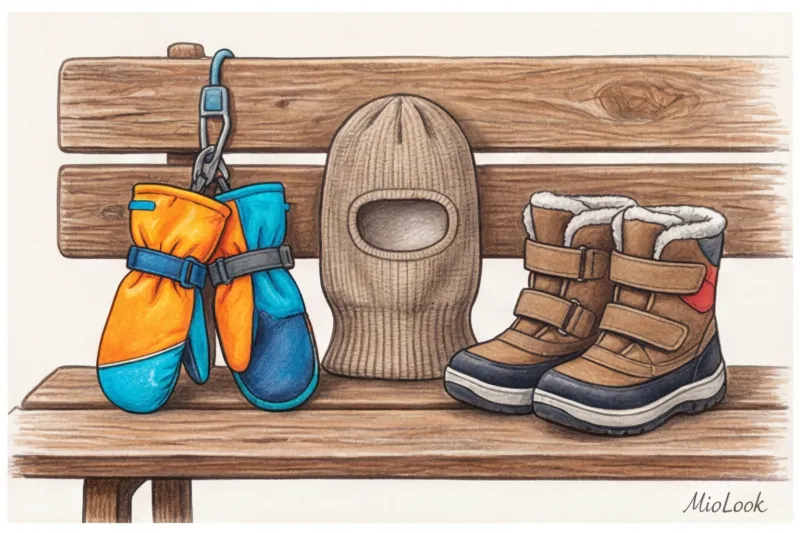
The same goes for mittens. Forget gloves—putting them on in the freezing cold for five years is akin to a feat. You need tall, waterproof mittens that fit over your jacket sleeve and are secured with a single drawstring.
Instructions: How to build a winter capsule for your child step by step
To put this theory into practice today, follow these 4 steps:
- Cabinet inspection. Ruthlessly remove anything that's too small, pinches your neck, has tight elastic bands, or broken zippers. Keep only the essentials that are actually worn.
- Selecting a reference object. In a winter capsule, it's always outerwear. Buy a high-quality jacket or overalls in an accent color (remember, safety). Prices for good brands range from €80 to €200.
- Selection of base layers. Choose thermal underwear, fleece, and a couple of sweaters so that their colors either match the jacket's color or create a harmonious contrast. Take photos of these items and upload them to MioLook so that the program can clearly show how the highs are mixed with the lows.
- Adding accessories. Buy a helmet and mittens. If the jacket is bright, keep the accessories subdued. If the jacket is basic (for example, mustard), the hat can be a piercing blue.
Top 3 Mistakes Moms Make When Buying Winter Clothes
Over the years of sorting through wardrobes, I've identified three main mistakes that turn a closet into a storage area and a child into a disgruntled teddy bear.
- Buying clothes “for growth” (+2 sizes). This is a disaster for heat exchange. Modern clothing warms by creating a layer of air between the body and the fabric. If the jacket is too big, cold air can easily escape, and the child gets cold. Furthermore, long sleeves and a loose inseam make it difficult to climb. Choose a maximum of 4-6 cm extra room above the child's current height.
- Ignoring the weight of clothing. Many grandmothers still insist on sheepskin coats and heavy wool overcoats. But modern membrane overalls weigh about 500-700 grams and are much warmer than sheepskin thanks to high-tech insulation (Isosoft, Thinsulate). Heavy clothing tires out a child within 15 minutes.
- Spontaneous purchases during sales. Seeing red trousers on sale for 70% off for €15 and buying them, even though your child has a purple jacket, is a recipe for visual chaos. Only buy an item if you can name at least two items in your closet that go with it, eyes closed.
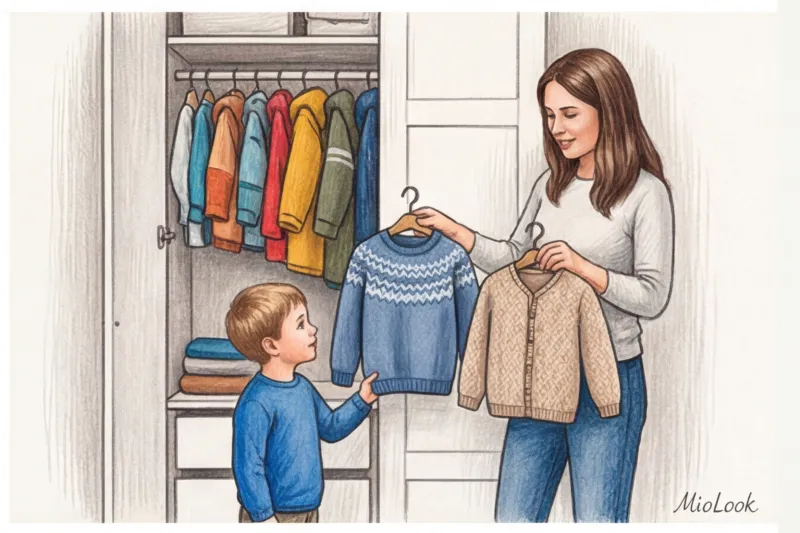
Assembling a child's winter capsule wardrobe is an investment not so much in fashion as in your personal peace of mind. When your closet is stocked with a limited number of items that coordinate perfectly, are scratch-free, and easy to put on, morning dressing can be reduced to five minutes. Let your child choose from a pre-prepared capsule, and you'll be surprised how quickly the tears in the hallway turn into the anticipation of a wonderful winter walk.