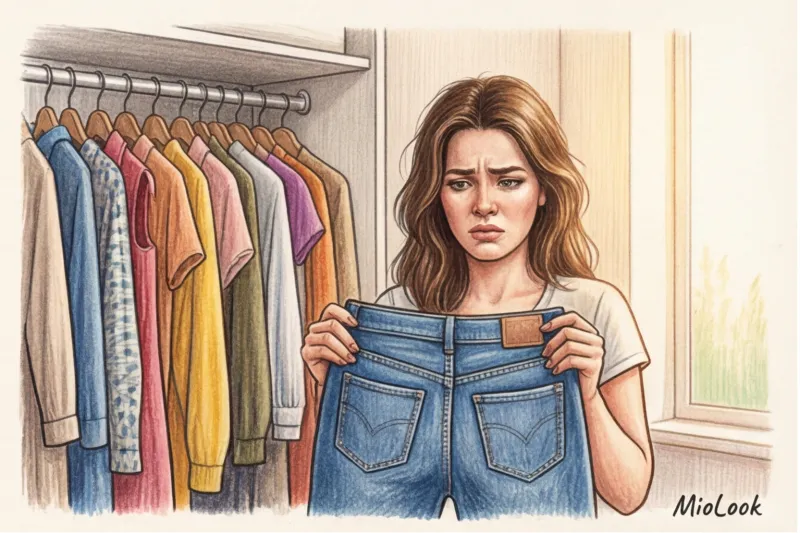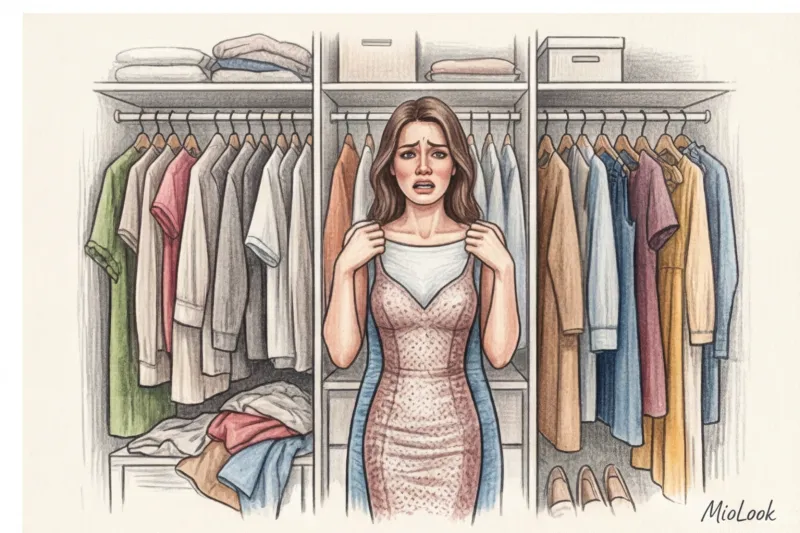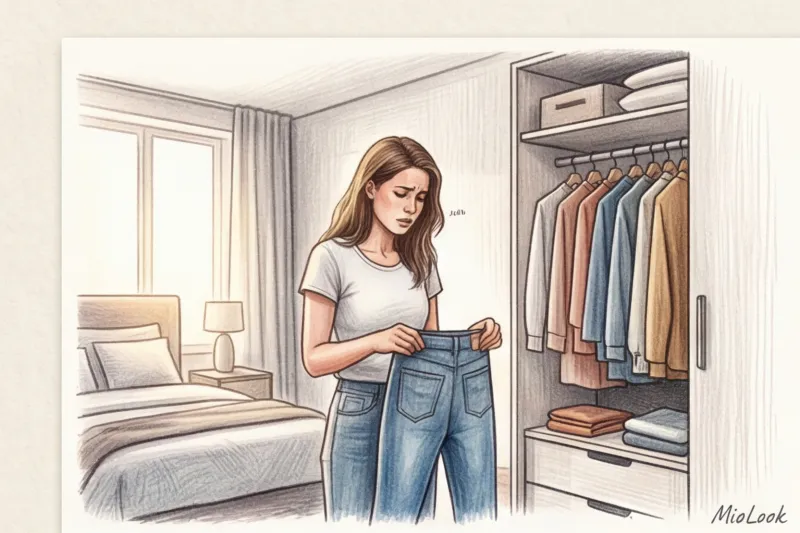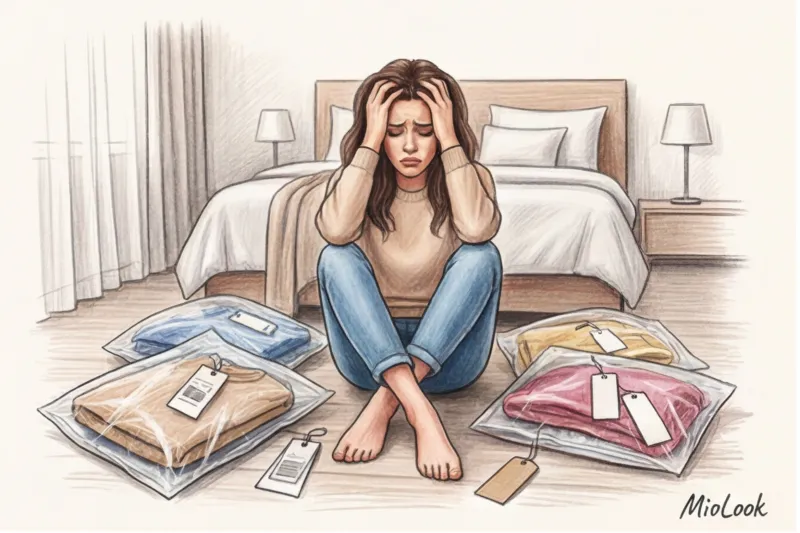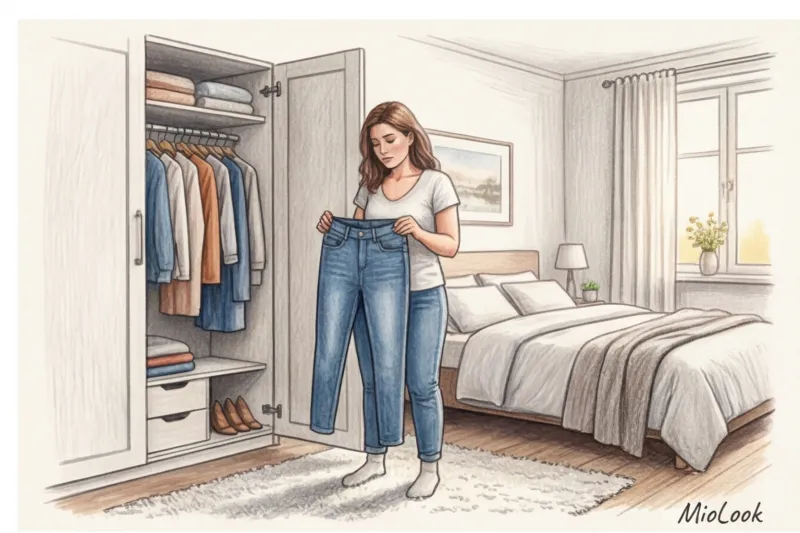
What percentage of your closet is dedicated to the woman you are right now? If you're like most of my clients, your active wardrobe takes up barely two-thirds of the space. The rest is a museum of unfulfilled hopes, where pride of place is reserved for "the jeans I'll fit into by summer." In my 14 years as a stylist, I've seen this hundreds of times: the solution store things for weight loss It seems like a harmless source of motivation, but in practice it works like a time bomb.
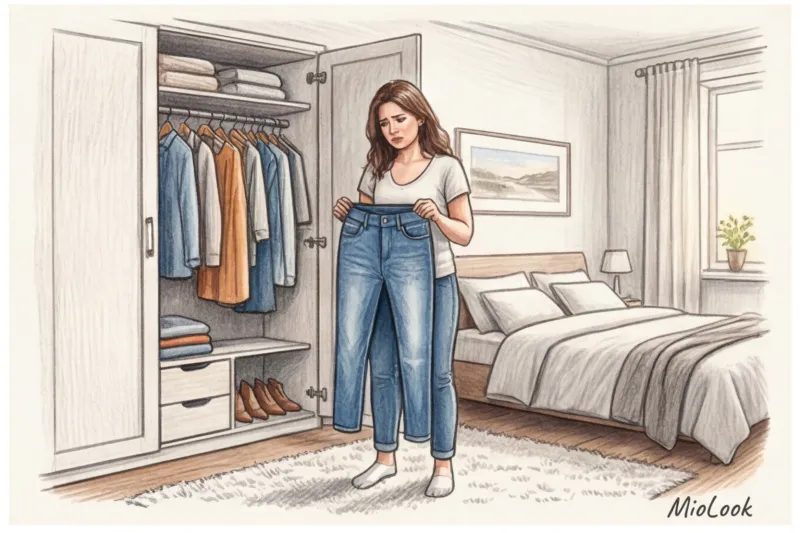
This habit not only complicates your daily clothing choices, but, paradoxically, physiologically hinders your weight loss. We discussed the mechanisms of attachment to things in more detail in our the complete guide to wardrobe psychology Today, we'll explore the specific phenomenon of "motivational" clothing. Why does that perfect dress that's a size too small drain your energy, and how does neurobiology explain our failure to achieve a slim figure in front of an open closet?
The Psychology of Self-Deception: Why We're So Enticed to Save Weight-Loss Items
Buying clothes in a smaller size or carefully storing away a pair of jeans from your college days is a classic example of what psychologists call the "Fantasy Self" phenomenon. We dress a version of ourselves that doesn't yet exist, trying to create the illusion of control over our bodies.
When you buy a dress one size smaller (for example, a perfect silk slip from COS or a Massimo Dutti jacket), you tick off a box in your mind: "I've already started losing weight." The action is complete, the dopamine rush is delivered. But the reality is, the dress goes into the closet, and you continue with your old habits.
"Too many options, many of which are unavailable to you right now, leads to cognitive paralysis. You waste energy not on choosing an outfit, but on regret," Barry Schwartz described this principle in his book, The Paradox of Choice (2004), and it applies 100% to your wardrobe.
Every time I review my wardrobe, I find this "hope shelf." The problem is that instead of motivating, it creates the effect of a constant reminder of your "imperfections."
Your perfect look starts here
Join thousands of users who look flawless every day with MioLook. Digitize your closet and eliminate visual clutter.
Get access — €0.99 onceThe Cortisol Effect: How "Motivational" Clothing Physiologically Hinders Weight Loss
The biggest myth in fitness culture is: "If I hang a dress two sizes too small in a visible place, it will make me go to the gym." It's counterintuitive, but research in the neurobiology of stress proves otherwise. Guilt is the worst trainer.
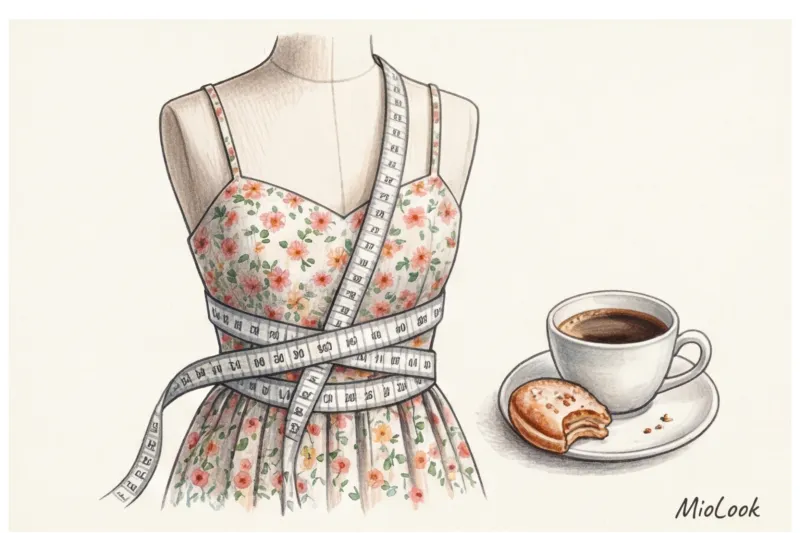
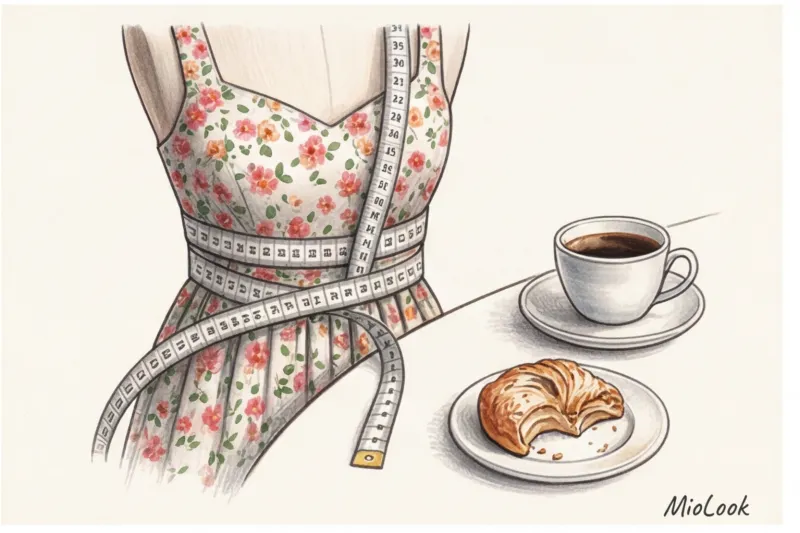
Imagine your morning. You open your closet. Your gaze falls on a pair of tight jeans. In a split second, your brain registers the failure: "I'm still not in shape." This morning visual microstress triggers an immediate release of cortisol. And what does cortisol do? It signals the body to be in danger, literally ordering it to retain fluid, block fat breakdown, and crave fast carbohydrates for energy. You're frustrated with your jeans, and your hand instinctively reaches for a croissant instead of oatmeal.
One of my clients, Maria, a top manager at an IT company, complained that she had been struggling to lose "those last 3 kilos" for years. When we packed all her size 42 clothes into opaque boxes and left only her comfortable size 44 in the active zone, she lost those same 3 kilos in a month and a half. Why? The daily morning stress disappeared. She stopped punishing herself with her clothes.
Dead Weight: An Audit of Your Closet in Facts and Figures
Let's look at the situation from an analytical perspective. See the appendix. MioLook Where users digitize their wardrobes, we see clear statistics: tightly fitted items have a 0% wear rate, but they take up 100% of the morning's decision-making energy.
According to a large-scale McKinsey study (2023) on mindful consumption, up to 40% of the contents of the average woman's closet goes unworn for years. Half of this is ill-fitting clothing.
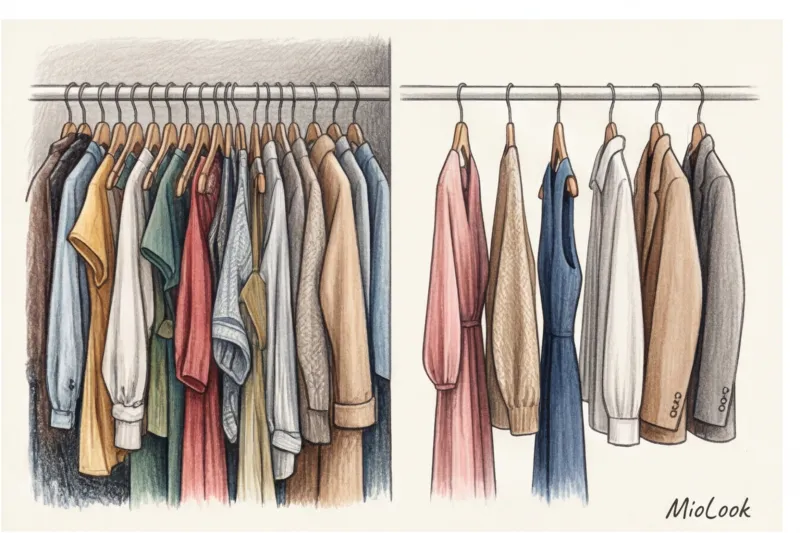
- Zero Cost per Wear. You bought a silk skirt for €120 but never wore it because it's too small in the waist. Its real value to you is now zero.
- Theft of space. These items take up up to 30% of the usable space. They wrinkle themselves and wrinkle other clothes.
- Parkinson's Law in the Wardrobe. Weight loss items tend to multiply, filling up all available space and creating the effect of “the wardrobe is full, but there’s nothing to wear.”
Access to MioLook for €0.99 — one-time payment
A smart AI stylist will select the perfect look from the items that fit you perfectly right now. No more stress in the mornings.
Get access — €0.99 onceToxic Wardrobe vs. Acceptance Capsule
The concept I promote is "Wardrobe for the Now." Your body deserves beautiful, high-quality, and perfectly fitting clothes today. Not when the scale hits that sweet spot, but this very Tuesday.
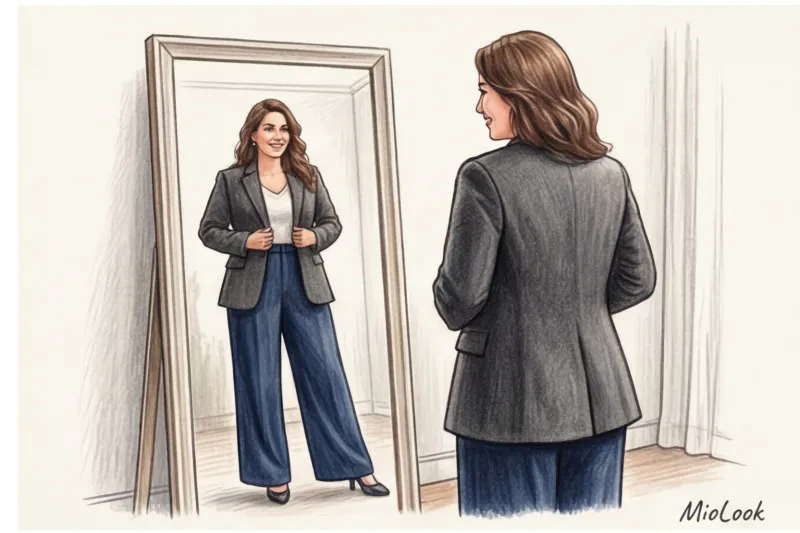
Buying clothes in your current size (even if it's a size or two larger than your desired size) has a magical effect: it instantly makes you look slimmer. The confidence that comes from wearing comfortable clothes without digging belts or loose buttons generates energy. You'll happily spend this energy on a walk or a workout, while self-flagellation in front of the mirror will drain your energy before you even leave the house.
Stylist Secrets: How Your Current Size Hides Your Figure's Nuances
Why do smaller sizes always make you look bigger? It's a law of physics and cut geometry. Clothing that's too small clings to the body, creating folds and rolls where there aren't any.
A proper fit requires air between the body and the fabric. This air is your main tool for visual correction. A slightly loose, straight-cut jacket conceals curves better than the most expensive shapewear. When fabric falls loosely, the minds of others (and your own) imagine a more fragile silhouette beneath.
What to do with "skinny" things: a step-by-step decluttering algorithm
Getting rid of good things is psychologically difficult. So I offer a sustainable and gradual process that works without fail.
- One year rule. If a piece hasn't been worn in 12 months (and it's not a Black Tie evening dress), it doesn't belong on the clothes rail with your current wardrobe.
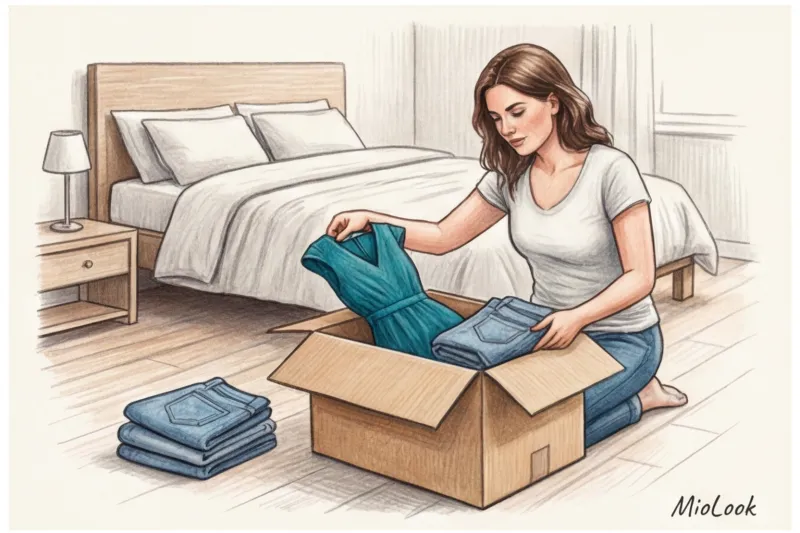
- Quarantine method. Pack all your "weight loss" clothing in a sturdy box. Important restrictions: This method does NOT work if the box is transparent or in a visible place. Put it on the farthest mezzanine or under the bed.
- Monetization of illusions. Designer items with tags are best sold. A new Zara dress for €50 or a trench coat for €150 can bring you cash today. Resale platforms and local swap parties are great for this.
- Needs analysis. Load up your remaining essentials into your digital closet and see what you're really missing to create everyday looks.
Ready to get started?
Try the MioLook plan for free—no commitments required. Organize your closet and your mind with our smart wardrobe manager.
Get access — €0.99 onceSmart Wardrobe: How to Invest in Weight-Adaptive Wardrobe
Weight fluctuations of 3–5 kilograms are completely normal for the female body (depending on the phase of your cycle, stress, and travel). To avoid changing your wardrobe every season, invest in adaptive smart casual.
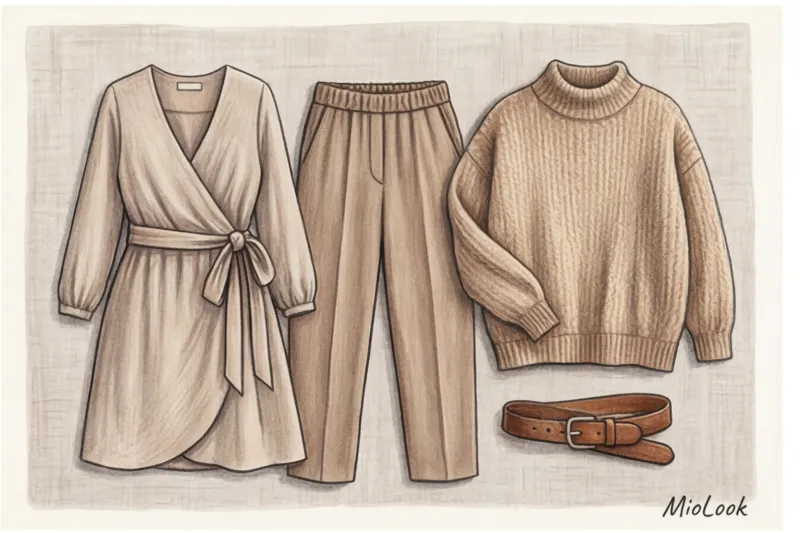
Choose the right textures. Avoid stiff 100% linen in favor of dense cotton (180 g/m² and above) or viscose with 3-5% elastane. The fabric should hold its shape but adapt to your movements.
Smart tailoring is your savior. A classic wrap dress (in the style of iconic model Diane von Furstenberg), flowy palazzo pants with an elasticated waistband at the back, and A-line skirts are all examples. These pieces easily accommodate size fluctuations from 11 to 12.
And don't forget the power of accessories. A structured bag, quality shoes, statement belts, and jewelry are sizeless. They can elevate any outfit, even the simplest, basic one, in the €30–€80 price range, adding a touch of class and poise.
Bottom line: Your closet should be a comfort zone, not a battlefield.
Your wardrobe is a tool that should serve you, not the other way around. Clothes are designed to protect your body, adorn it, and provide comfort today, not to chastise you for the dessert you ate last night.
Getting rid of clothes that don't fit is a powerful act of self-love. This weekend, set aside exactly one hour. Open your closet, take out everything that "motivates" you through guilt, put it in a box, and put it out of sight. Keep only the clothes that make you feel relaxed and beautiful right now. I promise, Monday morning will be the beginning of a new, cortisol-free life.