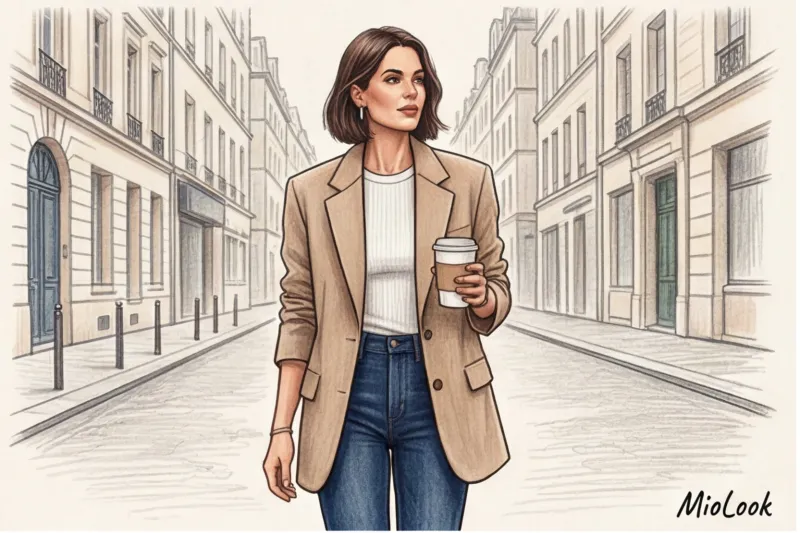
What is smart casual style for women? Saying goodbye to "clean" styles.
Over 12 years of working as a personal stylist, I've uncovered a frightening statistic: 4 out of 5 women with a bulging closet regularly experience "wardrobe burnout." This happens for one simple reason: they're trying to maintain a single, "pure" style. In the morning, they pull on a strict three-piece office suit that's impossible to casually enjoy coffee with a friend in, and on the weekends, they go to extremes, wearing shapeless tracksuits.
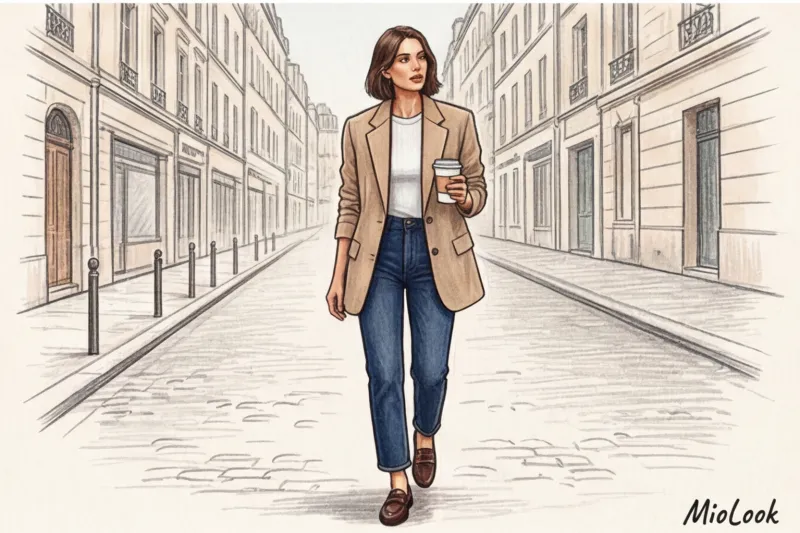
We discussed in more detail why trying to force yourself into the rigid framework of one direction always leads to a closet full of things that you have nothing to wear with in our a complete guide to women's clothing styles Today we'll talk about the lifeline of the modern wardrobe.
Smart casual style for women It's not a strict dress code. It's a mathematically calibrated spectrum, a hybrid between the comfort of a couch and the formality of a boardroom. According to a McKinsey & Company report (2022) on the post-pandemic transformation of the fashion market, we no longer want to choose between comfort and status. The study found that sales of formal business suits have fallen, while demand for "hybrid" wardrobe items (such as knit jackets and trousers with elastic waistbands and creases) has increased by 45%.
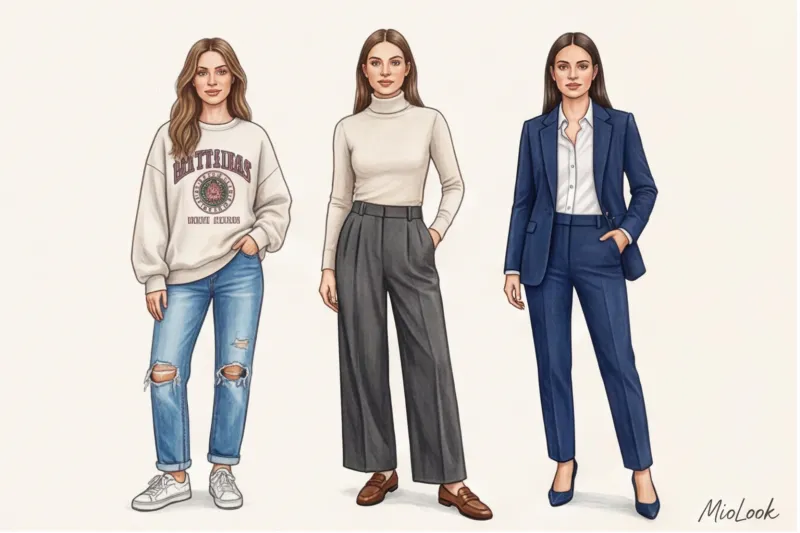
When creating mood boards, 80% of my new clients confuse smart casual with business casual. But the difference is crucial: business casual is when you take a business suit and remove the tie (or unbutton the top button of your shirt). Smart casual is when you take everyday basics and "pull them together" through structure.
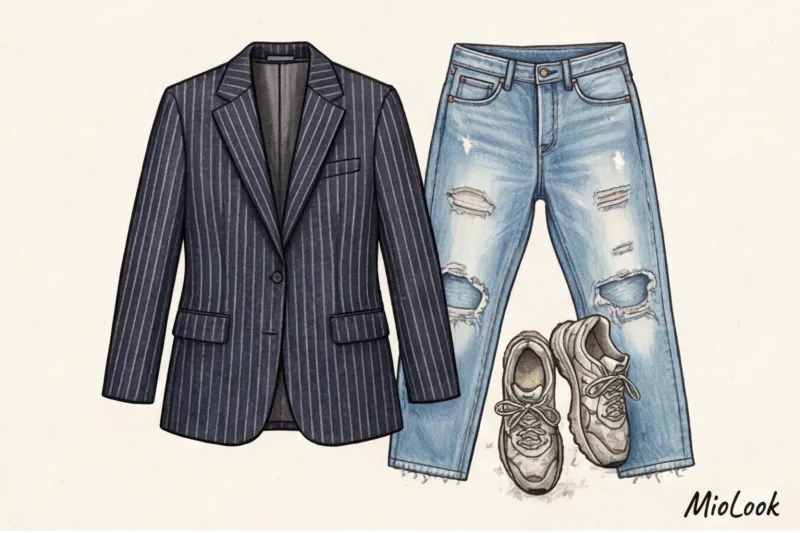
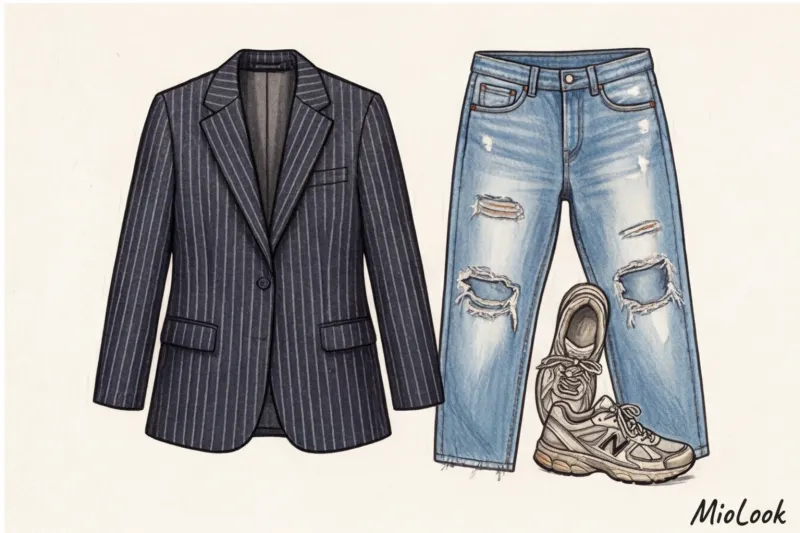
The biggest mistake newbies make: why "jacket + ripped jeans" no longer works
Let's debunk the biggest stylistic myth of the decade: Smart casual isn't just about throwing a jacket on any casual outfit..
I regularly see this mistake on the streets of European capitals: a girl wears a revealing, washed-out T-shirt, heavily ripped jeans, and then a formal office jacket made of stiff wool. It doesn't look stylish. It looks like you're cold and borrowed a jacket from a passing clerk.
Items in an outfit should complement each other, not clash. There's a rule about "temperature": you can't mix elements from extreme opposites. A clash of textures ruins an outfit.
- Badly: Fine flowing viscose with a floral print + a crisp tweed jacket with massive shoulders.
- Fine: Thick cotton T-shirt (from 180 g/m²) + semi-fitted jacket made of wool blend.
Joggers with classic pumps and a blazer aren't smart casual either; they're a stylistic flourish that's great for street style at Fashion Week, but looks awkward and sloppy in real life.
Your perfect look starts here
Join thousands of users who look flawless every day with the help of the smart MioLook algorithm.
Get access — €0.99 onceWardrobe Math: The 60/40 Rule for Perfect Balance
Smart casual relies not on intuition but on clear proportions. I teach my clients to use the "60/40 Formula." Your look should consist of either 60% formal, structured pieces and 40% relaxed ones, or vice versa. The ratio depends on your destination.
The whole secret lies in the game Structures (things that hold their shape regardless of your body) and Drapery (things that softly hug the figure). Let's look at two working formulas.
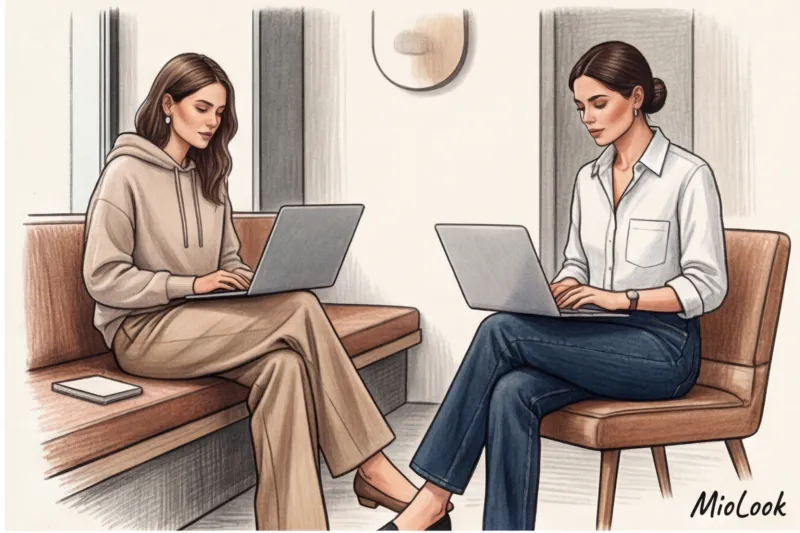
Formula 1: Relaxed Bottom + Structured Top
This formula is perfect for days when you need to look put together on the top half (like for work video calls) but still want to stay comfortable.
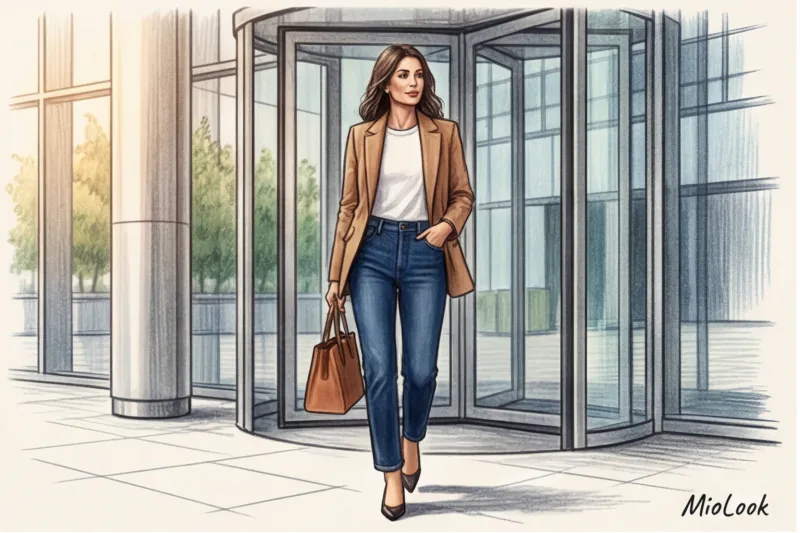
- Example 1: Thick straight jeans without any fading (relaxed) + basic shirt + structured jacket with a clear shoulder line (structure).
- Example 2: Wide-leg trousers in a soft, flowing fabric (relaxed) + a thin cashmere turtleneck + a rigid, geometric leather bag (structured).
Formula 2: Strict bottom + Soft top
A reverse proportion, perfect for offices with a relaxed dress code or for business meetings in an informal setting.
- Example 1: Palazzo trousers with creases (strictness) + high-quality thick knitwear, for example, a polo jumper (softness).
- Example 2: A pencil skirt or midi A-line skirt made of thick cotton (strictness) + a voluminous chunky knit sweater, slightly tucked in at the front (softness).
Smart Casual Capsule: 8 Investments That Will Make Every Penny Worth It
When you're putting together your basics, stop thinking in terms of "cheap/expensive." Start calculating Cost Per Wear (CPW)—the cost per wear. Which is more cost-effective: a €50 cocktail sheath dress that you'll wear twice a year (CPW = €25), or a pair of basic straight-leg jeans for €120 that you'll wear 100 days a year (CPW = €1.20)? The answer is obvious.
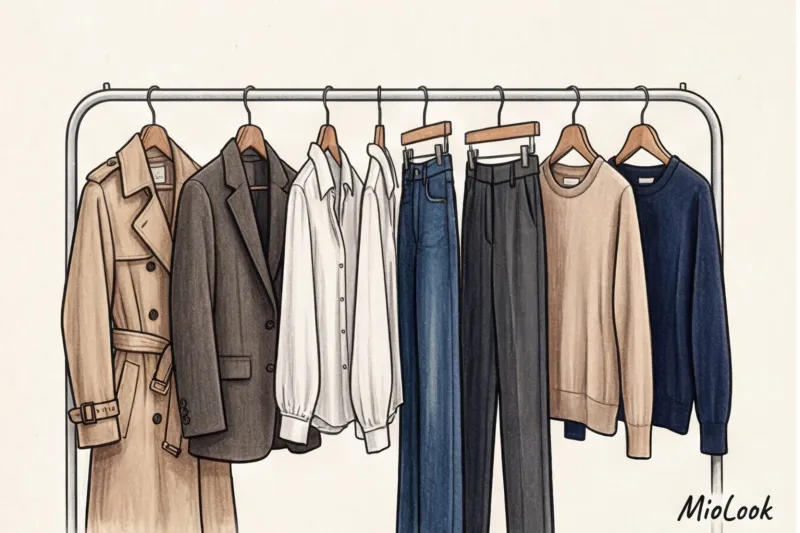
Here are 8 elements that make up a smart working capsule. I'll provide specific recommendations on brands and materials based on my daily practice:
- The jacket is straight or slightly oversized. Look for it not in the basic line of H&M or Zara (they often use cheap polyester that's shiny and doesn't breathe), but at Massimo Dutti or & Other Stories. The ideal composition: wool with 3-5% elastane.
- Jeans without fraying. The cut should be straight or slightly flared (wide leg). The color should be uniform: classic blue, dark gray, or black. No holes at the knees.
- Thick basic T-shirt. The weight of the cotton matters. Look for a density of 180–220 g/m². The neckline should have a closed seam (reinforced binding), otherwise it will ripple after the third wash. These excellent basic T-shirts are often found in the men's department at Uniqlo.
- Polo jumper or thin cardigan. I categorically forbid my clients from buying 100% acrylic—it immediately pills and looks cheap. The ideal option for smart casual is blends with merino wool or cotton from COS.
- White or blue poplin shirt. It should be loose, there should be a space of at least 3-4 centimeters between the body and the fabric.
- Trousers with arrows. Modern models have a hidden elastic waistband at the back—this is what creates that hybrid comfort.
- Silk or viscose top with wide straps. Salvation for evening image transformations.
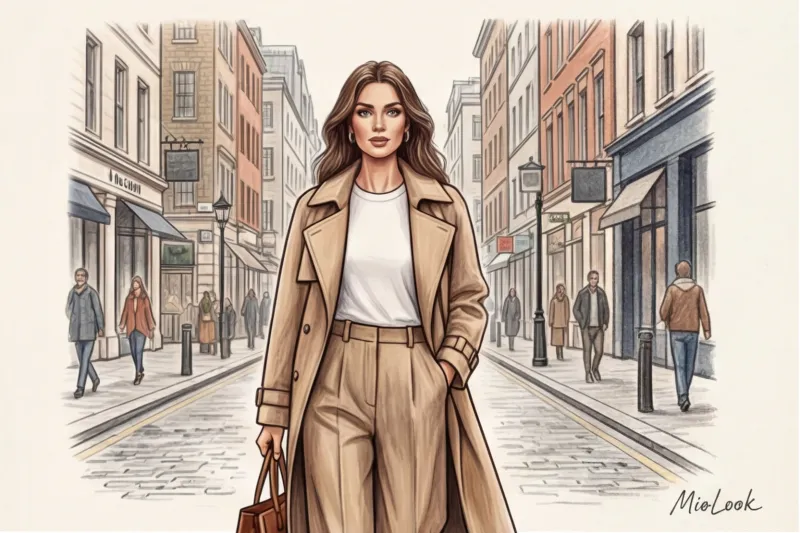
- Classic trench coat or straight cut coat. Your outerwear should be longer than your jacket to avoid creating a "cabbage" effect.
Ready to get started?
Try the MioLook free plan—no commitments required. Upload items from your capsule, and the AI stylist will create dozens of combinations.
Get access — €0.99 onceShoes and accessories: where your look's status is hidden
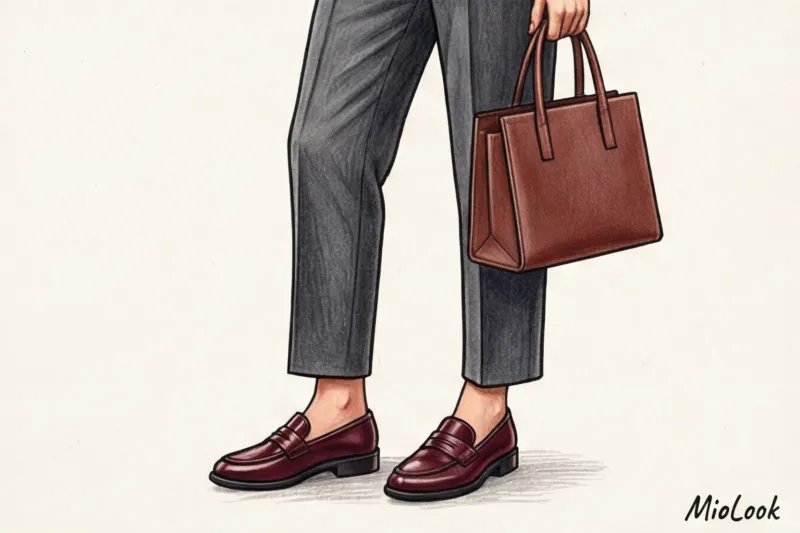
There's an old style rule: you can wear a €10 T-shirt, but your shoes and bag must be impeccable. Shoes are the key. Cheap, dull hardware on a bag or worn-out heels instantly ruin the whole smart-casual look, turning it into banal sloppiness.
What shoes to choose?
- Loafers. Opt for smooth leather styles with a midsole. They're an absolute must-have that elevates any pair of jeans to the smart side.
- Minimalist sneakers. The key word is minimalist. No massive logos, neon accents, or running soles. Clean white, beige, or black leather.
- Ankle boots or shoes with a square/pointed toe. A pointed toe always adds a graphic and collected touch to an outfit.
When it comes to bags, the same principle of structure applies. Soft hobo bags lend a boho or grunge feel. If you're wearing relaxed knitwear and jeans, a more structured tote or a sturdy crossbody bag will provide that 40% frame of formality in our mathematical formula.
Adapting to different scenarios: from coffee with a friend to a Zoom call
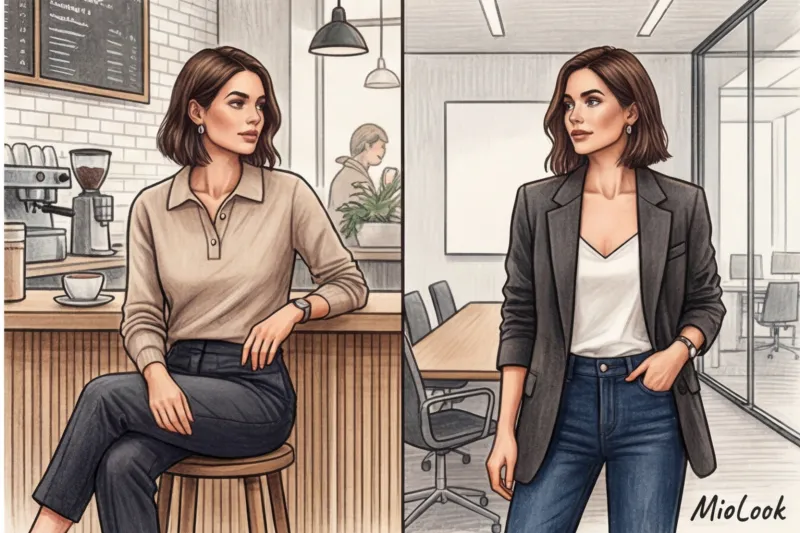
The beauty of this style is its incredible adaptability. Changing just one detail is enough to change the context. In the app MioLook My clients often create separate "smart transformer" folders for such cases. Here's how it works in practice:
Situation 1: Working in a coworking or hybrid office.
You should be comfortable sitting in front of your laptop for eight hours, but you shouldn't look like you just rolled out of bed. The basics: wide-leg viscose trousers and a thick T-shirt. Add a long, thick-knit cardigan and leather loafers. The result: comfortable as pajamas, looks like a million bucks.
Situation 2: Friday dinner with colleagues after work.
In the morning, you leave in jeans, a top, and a jacket, complete with sneakers. In the evening, you simply swap the sneakers for pointed ankle boots, remove the jacket, leaving only the top, and add red lipstick or statement earrings. The transition from daytime to evening smart casual takes exactly two minutes.
Situation 3: Business trip.
A plane demands comfort, and being greeted from the steps demands presentability. Wear stretchy trousers with a crease, a thin cashmere turtleneck, and comfortable slip-ons. Pack a wrinkle-resistant jacket in your carry-on. Just slip the jacket on before leaving the airport—the look is complete.
A stylist's checklist: how to check your look before going out
Despite its versatility, smart casual has clear limitations. This style is categorically It doesn't work , if your invitation states a black tie dress code, or you're interviewing at a traditional investment bank (where you'll still be expected in a formal suit). Otherwise, it's your best friend.
Before you leave the house, ask yourself three questions from my professional checklist:
- Is the "rule of three things" observed?
Jeans and a T-shirt aren't a look; they're modern underwear. It becomes a look when you add a third layer: a jacket, a sweater draped over your shoulders, an accent belt, or a structured cardigan. The third element shows you've made an effort. - Did the look pass the sloppiness test?
Smart casual doesn't tolerate sloppiness. Pilling on a €200 sweater will make it look cheaper than polyester. Sagging knees on trousers, dirty laces on sneakers, or a wrinkled shirt ruin the elegance. This style demands impeccable care. - The "expensive restaurant" test.
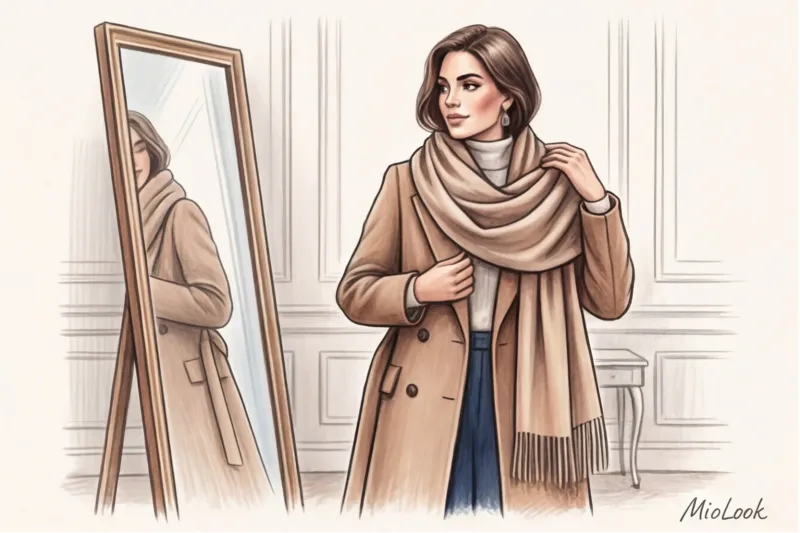
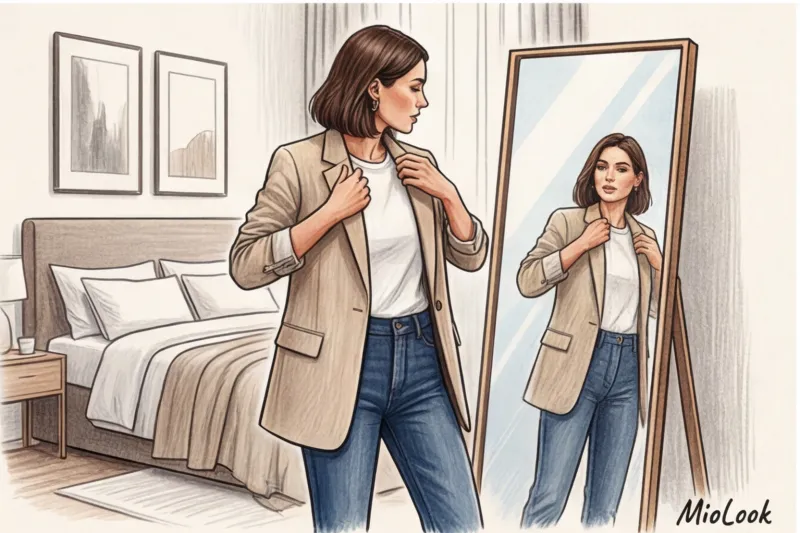
Look in the mirror and ask yourself: "If my boss called me right now and asked me to meet him at an expensive restaurant, would I be embarrassed to go there dressed like this?" If the answer is "yes, I'll want to change," then your look is leaning toward lazy casual. Add a structured detail.
"Elegance isn't about being noticed, it's about being remembered. Smart casual allows you to be memorable without sacrificing your comfort."
Stop hoarding items for "special occasions" and suffering in uncomfortable clothes on weekdays. Start investing in quality essentials, mixing textures wisely, and managing your style with balance. After all, the most important thing in smart casual isn't the brands, but your sense of confidence at any moment of the day.