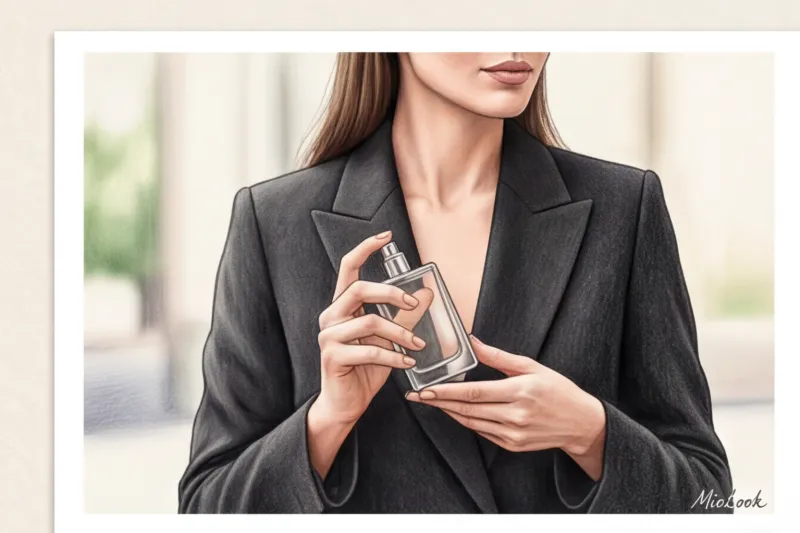
A couple of years ago, Anna, a brilliant corporate lawyer, approached me. She had an impeccable wardrobe: tailored fine wool suits, a perfect fit, and an expensive watch. But during difficult negotiations, she repeatedly felt that her counterparts were condescending to her. The answer was unexpected. Anna adored gourmand fragrances and generously applied perfume with notes of cotton candy and burnt caramel. Her visual image conveyed status and toughness, while her olfactory signature screamed childishness and relaxation. We switched her scent to a dry, austere cedar, and the dynamics of the meetings changed dramatically.
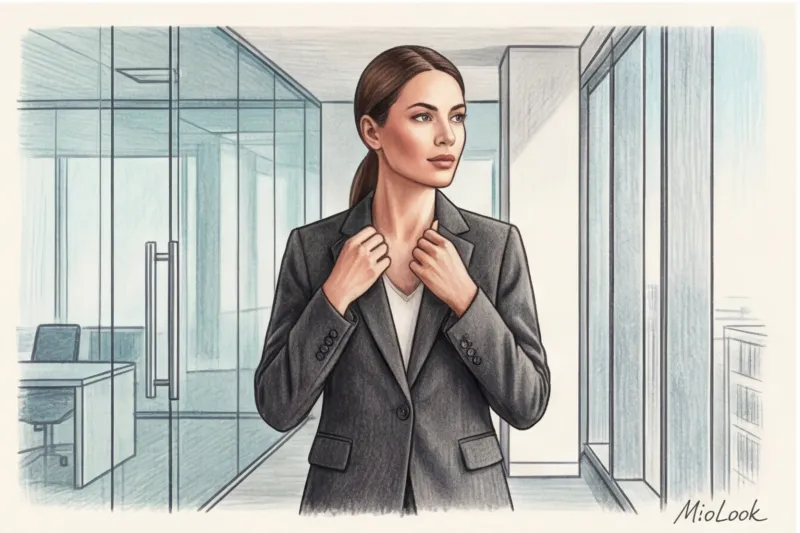
Correctly selected women's office perfume — it's more than just a pleasant scent. It's a functional tool for your personal brand. We've covered more about how to build a fragrance base in our the complete guide to your perfume wardrobe Today, we'll explore a strategy for choosing a fragrance specifically for a business environment, which has its own, very strict rules.
Olfactory Dress Code: Why Women's Office Perfume Is Part of a Personal Brand
Our brain processes smells differently than visual information. Olfactory receptors are directly connected to the limbic system, the area responsible for emotions and memory. A 2014 study by Rockefeller University revealed a staggering figure: people remember 35% of what they smell, compared to 5% of what they see. Your scent forms a subconscious impression of you a split second before someone else even notices the cut of your jacket.
In my work as a stylist, I always view fragrance as "invisible clothing." It should seamlessly integrate into your wardrobe. If you show up to an interview wearing a strict, minimalist look but smell like heavy oriental oud, it creates cognitive dissonance.
Moreover, this is a matter of professional ethics. According to HR industry reports, strong odors consistently rank among the top three causes of conflict in open-plan spaces. An offensive odor can become an unspoken reason for rejection during an interview simply because the interviewer feels physically uncomfortable being in the same conference room with you.
The main rule of business etiquette: control the trail and diffusion
In perfumery, there are two different concepts that are often confused: longevity and sillage. Longevity is how long a fragrance lasts on your skin. Sillage is the trail it leaves in the air as you pass by.
Ideal women's office perfume It should have high longevity but minimal sillage. In the business world, a strict "arm's length rule" applies: your fragrance should only be detectable in your intimate area (no more than 40-50 cm from your body). The "fill the room" concept, so beloved by luxury brand marketers, is considered bad manners and a violation of personal boundaries in the office.
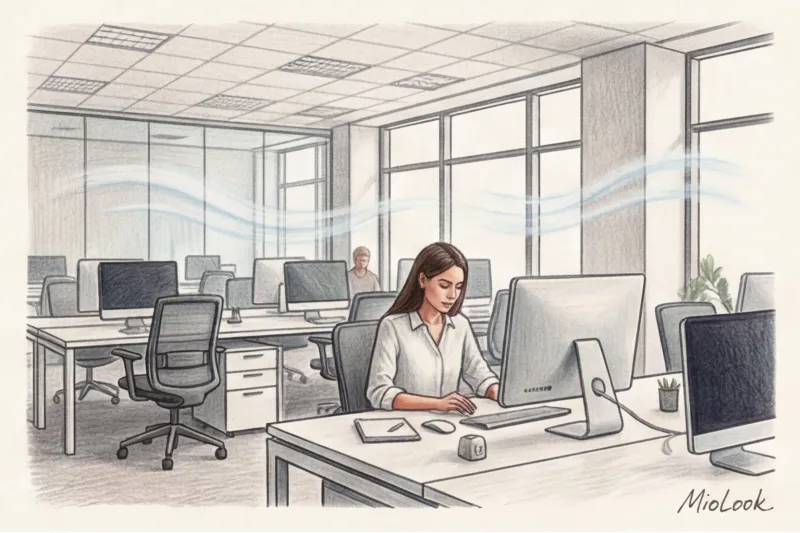
The International Fragrance Association (IFRA) regularly issues recommendations on safe concentrations of fragrances. In enclosed spaces, the principle applies. scent zoning (fragrance zoning) - your perfume should not intrude into the work area of your colleague at the next desk.

How air conditioners and open-plan spaces change the scent
I personally conducted an experiment: over the course of three months, I recorded the longevity of various compositions and collected feedback from colleagues in a dry, air-conditioned open space. The results were impressive. An artificial office climate alters the chemistry of fragrance development.
Dry, cold air accelerates the evaporation of volatile top notes by approximately 30%. What smelled like a fresh garden in the humid street air turns into a flat base note within an hour in the office. This leads to the biggest rookie mistake: "olfactory blindness." You lose the ability to smell your perfume and begin maniacally reapplying it every two hours. You think the scent has disappeared, while your colleagues quietly open their windows.
Your perfect look starts here
Join thousands of users who look flawless every day with the MioLook smart wardrobe.
Get access — €0.99 onceThe Citrus Myth: Which Notes Actually Work in the Office
Open any glossy article and you'll see the advice: "Choose fresh citrus scents for the office." As a practicing professional, I strongly disagree. It's counterintuitive, but citrus is one of the worst choices for a business environment.
Firstly, lemon, bergamot, and grapefruit molecules (limonene) are the most volatile. Under office air conditioning, they will evaporate within an hour. Secondly, the household chemicals industry has been using cheap citrus fragrances for decades. In a sterile office environment, your expensive niche bergamot might be subconsciously associated by your colleagues with restroom air freshener or window cleaner.
Gourmand notes (vanilla, praline, ethyl maltol) are also off-limits. These notes are evolutionarily associated with food, comfort, childhood, and relaxation. They diminish your sense of expertise and interfere with concentration.
Ideal components: molecular aromas, dry wood and tea notes
So what should you wear? Opt for fragrances that create a clean and collected effect:
- Molecular perfumery: Ingredients like Iso E Super or Ambroxan don't have a classic trail. They pulse, creating an aura of "clean skin after a shower." Fair warning: Molecular perfumes don't work on everyone. They may not open up well on cool skin, so a test before purchasing is essential.
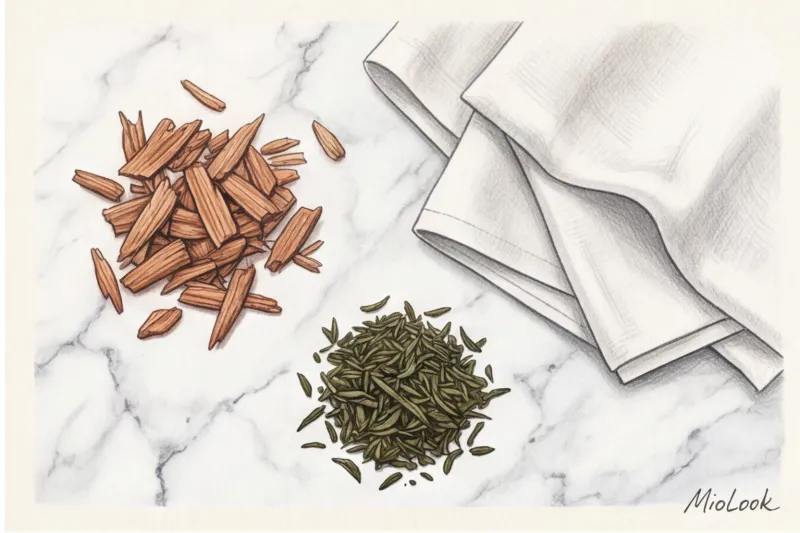
- Dry wood: Cedar, vetiver, sandalwood. Unlike resinous oriental woods, dry woods have a stern, austere quality, conveying reliability, stability, and focus.
- Tea and powdery notes: Green tea, white musk, and orris root add elegance without overpowering the look.
Perfume wardrobe for different types of dress code
Synchronizing fabric texture with olfactory profile is the pinnacle of styling. Thick tweed pairs beautifully with powdery iris, and the crisp cotton of a white shirt with white musk.
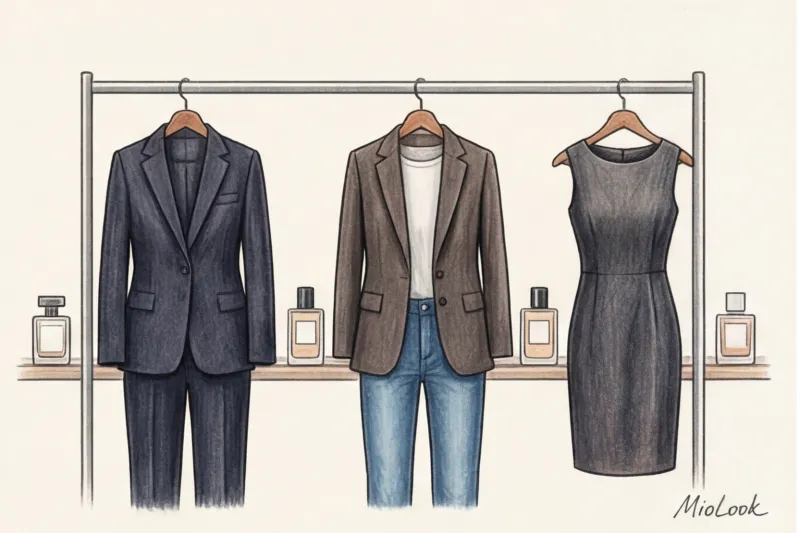
In the appendix MioLook We always recommend adding perfume to saved looks as a finishing touch. This helps you track which fragrances work best with specific outfits.
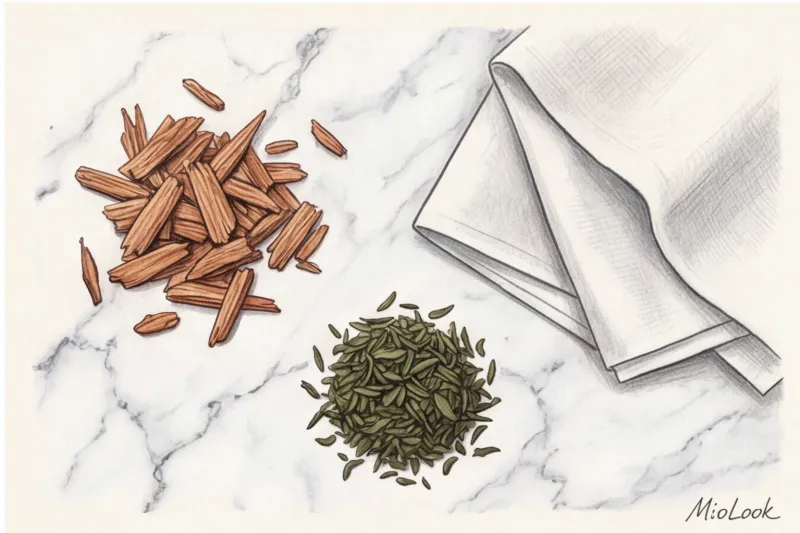
Business Formal: Fragrance as Invisible Armor
If you're facing difficult negotiations, a presentation to the board, or work in a conservative financial sector, you need a scent that provides protection. It should be emotionless.
Look for austere modern chypres, cool iris, or clean vetiver. These scents create an invisible distance. They say, "I'm here to solve problems, not to please you." Incidentally, this approach complements proper business makeup , where the emphasis is on well-groomed and architectural features of the face, rather than on bright colors.
Smart/Business Casual: Elegant Everyday Wear
For creative agencies, the IT sector, and casual Fridays where you can afford quality denim and a blazer, the scent might be more friendly.
Green florals (lily-of-the-valley, freesia without indolic notes), light sandalwood, and those aforementioned molecular scents work well here. They encourage conversation, create a comfortable atmosphere for brainstorming, while still maintaining a professional air.
Access to MioLook for €0.99 — one-time payment
A smart AI stylist will create the perfect look and help you integrate your perfume wardrobe into your daily capsule wardrobe.
Get access — €0.99 onceHow to Properly Apply Perfume Before Work (and Refresh It)
Forget about traditional spraying on pulse points (wrists and neck) if you're heading to the office. Due to active circulation, perfume evaporates too loudly and quickly from these areas.
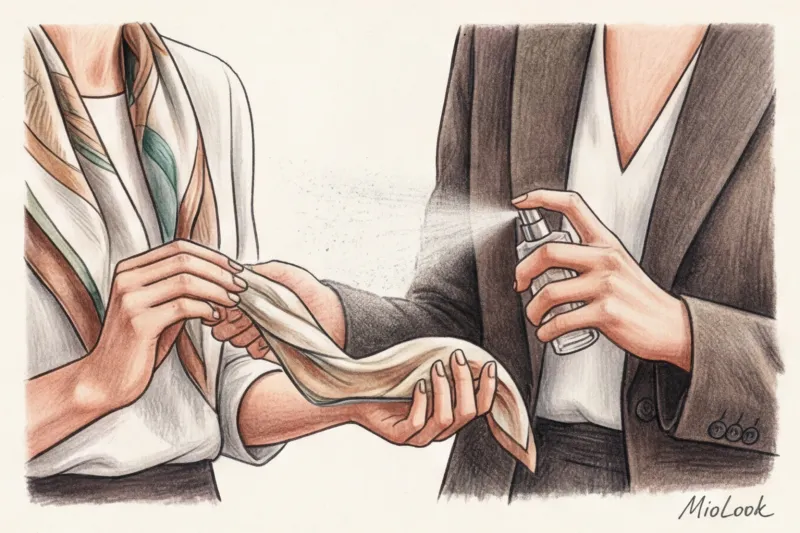
For a business environment, I recommend the "cloud" method or applying it to the back of your neck (under your hair). This way, the scent will be subtle, only releasing when you turn your head. Hair holds the scent well without distorting its chemistry.
Be careful with clothing. The natural wool of business suits holds base notes incredibly well (sometimes for weeks), so if you like to change your perfume daily, apply it only to your skin. However, expensive silk blouses can retain oily perfume stains permanently—spraying liquids on them is strictly prohibited.
"The golden rule of office etiquette: never spray perfume directly at your desk. Even the lightest fragrance contains a high concentration of alcohol when sprayed, which will instantly disperse throughout the open space."
Checklist: How to Choose Your Perfect Office Fragrance
Buying a work perfume isn't something you should rush. A blotter (paper strip) in the store won't give you any indication of how the composition will perform during a stressful Zoom call at 3:00 PM.
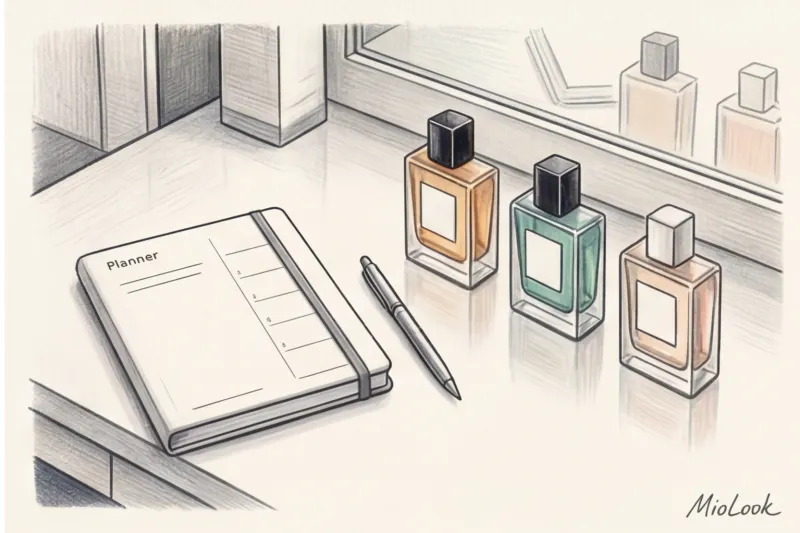
- Test in real conditions: Spray the fragrance on your skin and head to work. See if it gives you a headache by midday.
- Check the cable: Ask a trusted colleague to estimate the listening distance. Ask directly, "Is it too loud?"
- Rate the base: What you hear in the first 15 minutes is marketing. What remains on your skin after 6 hours is the reality your colleagues will live with in the afternoon.
- Digitize your selection: Upload your lucky finds to MioLook and tie them to your office capsule bag. This will save you from morning worries about "what to wear and how to complete your look."
Ultimately, the right office perfume is an indicator of your social intelligence. The ability to sound expensive and prestigious, yet still be eco-friendly, speaks volumes about your professionalism far more than the logo on your bag.